
Homework Answers
Add Answer to:
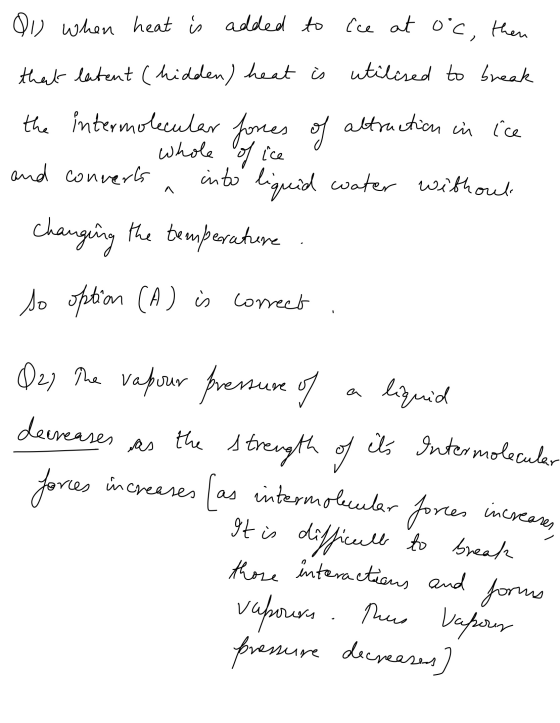
Question 1 & 2.
which of the following statements is true?
the vapor pressure of a...
Which of the following are TRUE statements regarding evaporation, boiling, and vapor pressure? Select as many...
 Which of the following are TRUE statements regarding evaporation, boiling, and vapor pressure? Select as many as are applicable however points will be deducted for incorrect answers. Select one or more: The standard boiling point occurs when the vapor pressure of a compound equals 1 bar The rate of evaporation at temperatures below the boiling point is dependent on surface area The vapor pressure at dynamic equilibrium in a closer container does not depend on the amount of liquid, as...
oter 7 Reading Question 4 Part A Which of the following statements about vapor pressure is...
 oter 7 Reading Question 4 Part A Which of the following statements about vapor pressure is true? View Available Hint(s) O Vapor pressure is caused by gas molecules returning to liquid form As temperature increases, vapor pressure decreases. Compounds with stronger attractive forces predict higher vapor pressures at a given temp e Compounds with higher boiling points have lower vapor pressures at a given temperature. Submit
figure 1 Figure 2 Liquid ethanol mm P increasing P = equilibrium vapor pressure P=0 Add...
 figure 1
Figure 2
Liquid ethanol mm P increasing P = equilibrium vapor pressure P=0 Add System comes to equilibrium ethanol Evacuated flask, pressure zero Molecules begin to vaporize, pressure increases Molecules leave and enter liquid at equal rates, pressure reaches steady-state value 34.6 °C 78.3°C 100 °C Normal boiling point Diethyl ether Vapor pressure (torr) Ethyl alcohol (ethanol) Water Ethylene glycol 100 20 40 60 80 Temperature (°C) Copyright 2009 Pearson Prentice Hall,Inc. Click on: (Figure 2) and study...
figure 1
Figure 2
Liquid ethanol mm P increasing P = equilibrium vapor pressure P=0 Add System comes to equilibrium ethanol Evacuated flask, pressure zero Molecules begin to vaporize, pressure increases Molecules leave and enter liquid at equal rates, pressure reaches steady-state value 34.6 °C 78.3°C 100 °C Normal boiling point Diethyl ether Vapor pressure (torr) Ethyl alcohol (ethanol) Water Ethylene glycol 100 20 40 60 80 Temperature (°C) Copyright 2009 Pearson Prentice Hall,Inc. Click on: (Figure 2) and study...
Which of the following changes would increase the vapor pressure of a liquid? i. An...
Which of the following changes would increase the vapor pressure of a liquid? i. An increase in temperature ii. An increase in the intermolecular forces in the liquid iii. An increase in the size of the open vessel containing the liquid a) i and ii only b) i and iii only c) i only d) ii only e) iii only If the rate of evaporation from the surface of a liquid exceeds...
Question 3 (4 points) The vapor pressure of a liquid is dependent on: the temperature of...
 Question 3 (4 points) The vapor pressure of a liquid is dependent on: the temperature of the liquid and intermolecular forces of attraction in the liquid the temperature of the liquid and the surface area of the liquid only on the surface area of the liquid only the temperature of the liquid O only the forces of intermolecular attraction in the liquid Question 4 (4 points) If the atmospheric pressure over a sample of liquid is increased, the boiling point...
The vapor pressure of a liquid is the pressure exerted by its vapor when the liquid...
The vapor pressure of a liquid is the pressure exerted by its vapor when the liquid and vapor states are in equilibrium. The relationship between vapor pressure P and temperature T is expressed by the Clausius-Clapeyron equation. lnP2P1=ΔHvapR(1T1−1T2) where P1 and P2 are the vapor pressures at the absolute temperatures T1 and T2, respectively, ΔHvap is the heat of vaporization of the substance in joules per mole, and R is the ideal gas constant, which is equal to 8.3145 J/(mol⋅K)....
Use the following vapor pressure data to answer the questions: Liquid Vapor Pressure, torr Temperature, °C...
Use the following vapor pressure data to answer the questions: Liquid Vapor Pressure, torr Temperature, °C A) C3H7OH 400torr, 82.0 C B) C2H5SH 400torr ,17.7 C (1) In which liquid are the intermolecular attractive forces the strongest ? (A or B?) (2) Which liquid would be expected to have the highest vapor pressure at 49.9 °C? (A or B?)
18. 0/3 points Previous Answers GVSUChem 115v2 10.a.P.004. Check all that are true about the relationship...
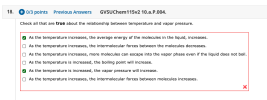 18. 0/3 points Previous Answers GVSUChem 115v2 10.a.P.004. Check all that are true about the relationship between temperature and vapor pressure. As the temperature increases, the average energy of the molecules in the liquid, increases. o As the temperature increases, the intermolecular forces between the molecules decreases. As the temperature increases, more molecules can escape into the vapor phase even if the liquid does not boil. As the temperature is increased, the boiling point will increase. As the temperature is...
"Vapor Pressure of Water" assignment: VAPOR PRESSURE OF WATER INTRODUCTION All liquids exist in equilibrium with...
 "Vapor Pressure of Water" assignment:
VAPOR PRESSURE OF WATER INTRODUCTION All liquids exist in equilibrium with the vapor state. As temperature increases, this equilibrium shifts more and more in favor of the vapor until one reaches the boiling point, at which all liquid is converted to gas. The pressure exerted by the vapor over the liquid is known as its vapor pressure and is a function of temperature. Boiling occurs at the temperature at which the vapor pressure is equal...
"Vapor Pressure of Water" assignment:
VAPOR PRESSURE OF WATER INTRODUCTION All liquids exist in equilibrium with the vapor state. As temperature increases, this equilibrium shifts more and more in favor of the vapor until one reaches the boiling point, at which all liquid is converted to gas. The pressure exerted by the vapor over the liquid is known as its vapor pressure and is a function of temperature. Boiling occurs at the temperature at which the vapor pressure is equal...
If heat is added to ice and liquid water in a closed container and, after the...
If heat is added to ice and liquid water in a closed container and, after the addition of the heat, ice and liquid water remain, a. the vapor pressure of the water will decrease. b. the temperature will increase somewhat. c. the temperature will decrease somewhat. d. the vapor pressure of the water will rise. e. the vapor pressure of the water will remain constant.
 Which of the following are TRUE statements regarding evaporation, boiling, and vapor pressure? Select as many as are applicable however points will be deducted for incorrect answers. Select one or more: The standard boiling point occurs when the vapor pressure of a compound equals 1 bar The rate of evaporation at temperatures below the boiling point is dependent on surface area The vapor pressure at dynamic equilibrium in a closer container does not depend on the amount of liquid, as...
 oter 7 Reading Question 4 Part A Which of the following statements about vapor pressure is true? View Available Hint(s) O Vapor pressure is caused by gas molecules returning to liquid form As temperature increases, vapor pressure decreases. Compounds with stronger attractive forces predict higher vapor pressures at a given temp e Compounds with higher boiling points have lower vapor pressures at a given temperature. Submit
 figure 1
Figure 2
Liquid ethanol mm P increasing P = equilibrium vapor pressure P=0 Add System comes to equilibrium ethanol Evacuated flask, pressure zero Molecules begin to vaporize, pressure increases Molecules leave and enter liquid at equal rates, pressure reaches steady-state value 34.6 °C 78.3°C 100 °C Normal boiling point Diethyl ether Vapor pressure (torr) Ethyl alcohol (ethanol) Water Ethylene glycol 100 20 40 60 80 Temperature (°C) Copyright 2009 Pearson Prentice Hall,Inc. Click on: (Figure 2) and study...
figure 1
Figure 2
Liquid ethanol mm P increasing P = equilibrium vapor pressure P=0 Add System comes to equilibrium ethanol Evacuated flask, pressure zero Molecules begin to vaporize, pressure increases Molecules leave and enter liquid at equal rates, pressure reaches steady-state value 34.6 °C 78.3°C 100 °C Normal boiling point Diethyl ether Vapor pressure (torr) Ethyl alcohol (ethanol) Water Ethylene glycol 100 20 40 60 80 Temperature (°C) Copyright 2009 Pearson Prentice Hall,Inc. Click on: (Figure 2) and study...
 Question 3 (4 points) The vapor pressure of a liquid is dependent on: the temperature of the liquid and intermolecular forces of attraction in the liquid the temperature of the liquid and the surface area of the liquid only on the surface area of the liquid only the temperature of the liquid O only the forces of intermolecular attraction in the liquid Question 4 (4 points) If the atmospheric pressure over a sample of liquid is increased, the boiling point...
 18. 0/3 points Previous Answers GVSUChem 115v2 10.a.P.004. Check all that are true about the relationship between temperature and vapor pressure. As the temperature increases, the average energy of the molecules in the liquid, increases. o As the temperature increases, the intermolecular forces between the molecules decreases. As the temperature increases, more molecules can escape into the vapor phase even if the liquid does not boil. As the temperature is increased, the boiling point will increase. As the temperature is...
 "Vapor Pressure of Water" assignment:
VAPOR PRESSURE OF WATER INTRODUCTION All liquids exist in equilibrium with the vapor state. As temperature increases, this equilibrium shifts more and more in favor of the vapor until one reaches the boiling point, at which all liquid is converted to gas. The pressure exerted by the vapor over the liquid is known as its vapor pressure and is a function of temperature. Boiling occurs at the temperature at which the vapor pressure is equal...
"Vapor Pressure of Water" assignment:
VAPOR PRESSURE OF WATER INTRODUCTION All liquids exist in equilibrium with the vapor state. As temperature increases, this equilibrium shifts more and more in favor of the vapor until one reaches the boiling point, at which all liquid is converted to gas. The pressure exerted by the vapor over the liquid is known as its vapor pressure and is a function of temperature. Boiling occurs at the temperature at which the vapor pressure is equal...
Most questions answered within 3 hours.
-
Where is the error in this code sequence?
String s1 = "Hello";
String s2 = "ello";...
asked 11 months ago -
Financial data for Joel de Paris, Inc., for last year
follow:
Joel de Paris, Inc.
Balance...
asked 11 months ago -
Consider this reaction:
Al2(SO4)3 (aq)+ BaCl3
(aq) Al2Cl6 (aq)- +
3BaSO4(s) . What is the...
asked 11 months ago -
Suppose that Savneet is considering increasing her
recent random sample from 20 car rentals to 40...
asked 11 months ago -
Trucks arrive at an unloading terminal at an average rate of 120
per hour.
Trucks arrive...
asked 11 months ago -
Why are methanol and ethanol completely soluble in water while
octanol is not very little soluble....
asked 11 months ago -
A facilities manager at a university reads in a research report
that the mean amount of...
asked 11 months ago -
When the CuSO4 is rehydrated by adding water to the anhydrous
compound, is this an endothermic...
asked 11 months ago -
A ray of sunlight is passing from diamond into crown glass; the
angle of incidence is...
asked 11 months ago -
A block of mass 0.249 kg is placed on top of a light, vertical
spring of...
asked 11 months ago -
how do the kidneys compensate in the presences of acidosis
a) trigger hyperventilate
b) reserve acid...
asked 11 months ago -
Question 501 pts
The rental rate of capital to the firm increases. Which of the
following...
asked 11 months ago