TCO 2) Explain the purpose of a conceptual database model and describe the most common method...
TCO 2) Explain the purpose of a conceptual database model and describe the most common method of creating one
Homework Answers
The Conceptual Data Model
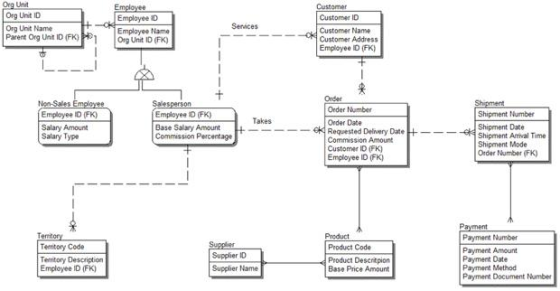
A conceptual data model is a high level or coarse data model which is preliminary in structure, possibly abstract in content and sparse in attributes, that is intended to represent a business area. It is preliminary in structure because it may contain many-to-many relationships. It is abstract in content because it may need to suppress some details so as to subsume different subtypes. It is sparsely attributed because it will usually contain only major business attributes. Because of these characteristics, you cannot implement a conceptual data model.
There are three main reasons:
For management
presentations. If you have to justify or explain a project to
management, you do not have forever. Management has a short
attention span. This is not a value judgment about management. If
you are presenting to senior, or any non-technical management, you
need to get to the point in (say) 15 minutes or so. You have to be
able to explain the issue to them clearly and quickly. A conceptual
data model is ideal for this purpose. For this reason, the
conceptual data model should fit on a single page.
For planning. A project that is in the planning
stages does not need detail yet. You need only know what overall
data, and sometimes only what types of data, are contained in the
business area. A mass of detail is not necessary for this. The
conceptual data model serves this purpose.
To start top-down modeling. There are two
circumstances for which a conceptual data model is necessary: new
development and major maintenance. New development is development
from scratch. Only about 20% of software projects are new
development. It is dangerous and cumbersome to do new development
only bottom-up. In major maintenance substantial new requirements
are added to an existing system. Such projects will start bottom-up
when reverse engineering the existing database. The conceptual data
model will be necessary to understand in what way to introduce the
new requirements.
Let us expand our thoughts on bottom-up in data modeling. Use-case modeling is very popular these days. Use-cases are a simplified form of process modeling and an enriched form of process definition. It is helpful to employ use-cases to expand a data model. BUT the data model should not rely exclusively on use-cases. All data modeling should always be a combination of top-down, bottom-up and middle-out. New development starts top-down. Maintenance starts bottom-up. Developing a data model exclusively from use-cases is essentially doing a data model bottom-up. It restricts the kind of creative thinking that should naturally go into a data model. The conceptual data model is used to start the top-down process. The use-cases provide the bottom-up perspective. Working with the data model in and of itself, exploring business needs, and then expanding the data model from within is the middle-out part of the process. It is where the real creativity occurs. The data modeler and use-case modeler should be simultaneously exposed to requirements from the business experts. Then, individually, each develops its own unique deliverable from these; the data model in one case, the use-case in the other. And then these two models should be concurrently interacted and balanced one against the other.
Add Answer to:
TCO 2) Explain the purpose of a conceptual database model and
describe the most common method...
Create a conceptual database design for the following scenario using an ER model The purpose of...
 Create a conceptual database design for the following
scenario using an ER model
The purpose of this form shown below is to record the
medication given to a particular patient at the Wellmeadows
Hospital. Examine the data shown on the form.
Create a conceptual database design for the following
scenario using an ER model
The purpose of this form shown below is to record the
medication given to a particular patient at the Wellmeadows
Hospital. Examine the data shown on the form.
question 1 (a) i. Explain the difference in the nature and purpose of conceptual class diagram...
question 1 (a) i. Explain the difference in the nature and purpose of conceptual class diagram and design class diagram? ii. Design classes are often classified as information (model), control (controller) and interface (or boundary or view) classes. Briefly describe the general role that each of these types of classes play in the generation of behaviour iii. Briefly explain the nature and purpose of UML in OOAD
Describe each questions: Explain why the object-oriented database model was developed. How does ...
Describe each questions: Explain why the object-oriented database model was developed. How does the OID in the OO model differ from the primary key in the relational model? Is it possible for a superkey not to be a candidate key? Why or why not? Briefly describe the four types of binary relationships possible between an entity set A and an entity set B based on relationship cardinality. Sales Database: Customer(custId, lastName, firstName, address, phone, creditLimit) Order(orderNumber, date, total, custID) LineItem(orderNumber,...
Describe each questions: Explain why the object-oriented database model was developed. How does the OID in...
Describe each questions: Explain why the object-oriented database model was developed. How does the OID in the OO model differ from the primary key in the relational model? Is it possible for a superkey not to be a candidate key? Why or why not? Briefly describe the four types of binary relationships possible between an entity set A and an entity set B based on relationship cardinality. Sales Database: Customer(custId, lastName, firstName, address, phone, creditLimit) Order(orderNumber, date, total, custID) LineItem(orderNumber, itemNumber,...
1. Discuss the "equity theory" Model by doing the following: describe the purpose/use of this model...
1. Discuss the "equity theory" Model by doing the following: describe the purpose/use of this model and then describe how equity sensitivity relates to the model and one challenge or problem managers face in using this model. 2. Describe the three needs in the learned needs theory 3. Describe the General Adaptation Syndrome and its three stages 4. Explain the difference between surface-level diversity and deep-level diversity and give specific examples of each of these types of diversity. 5. Define...
1-Explain what Repetitive Strain Injury (RSI) is and describe the most common causes. 2- Describe the...
1-Explain what Repetitive Strain Injury (RSI) is and describe the most common causes. 2- Describe the available options used to reduce or prevent RSI in the workplace
1- Explain what Repetitive Strain Injury (RSI) is and describe the most common causes. 2- Describe...
1- Explain what Repetitive Strain Injury (RSI) is and describe the most common causes. 2- Describe the available options used to reduce or prevent RSI in the workplace
(TCO 2) What types of states are most likely to become authoritarian? Why? Along the same...
(TCO 2) What types of states are most likely to become authoritarian? Why? Along the same lines, what authoritarian states have been most likely to democratize? Under what circumstances does this democratization occur and why? Based on previous findings, describe one country you think is likely to democratize in the near future.
Explain the purpose of a dataset and describe how to create a dataset called dsEmployee in...
Explain the purpose of a dataset and describe how to create a dataset called dsEmployee in Visual Studio 2012. Assume you have the following function in the clsDataLayer class. Write the SQL command to select all rows from the tblEmployee table, and write the code to fill the dataset. public static dsEmployee GetEmployee(string Database) { dsEmployee DS; OleDbConnection sqlConn; OleDbDataAdapter sqlDA; sqlConn = new OleDbConnection("PROVIDER=Microsoft.ACE.OLEDB.12.0;" + "Data Source=" + Database); // Write the code here to select all rows from...
Please do not delete the questions. 1. What is the purpose of a database? 2. What...
Please do not delete the questions. 1. What is the purpose of a database? 2. What is the reason to use a database over a spreadsheet? 3. Based on the previous answers (#1 & #2), there is a simple rule of thumb. A spread sheet is used when there is _________________________. A database is used when there are _________________________. 4. Please answer followings. a) A group of 8 bits is called a ____________ (from Chapter 4). b) The answers of...
 Create a conceptual database design for the following
scenario using an ER model
The purpose of this form shown below is to record the
medication given to a particular patient at the Wellmeadows
Hospital. Examine the data shown on the form.
Create a conceptual database design for the following
scenario using an ER model
The purpose of this form shown below is to record the
medication given to a particular patient at the Wellmeadows
Hospital. Examine the data shown on the form.
Most questions answered within 3 hours.
-
Where is the error in this code sequence?
String s1 = "Hello";
String s2 = "ello";...
asked 11 months ago -
Financial data for Joel de Paris, Inc., for last year
follow:
Joel de Paris, Inc.
Balance...
asked 11 months ago -
Consider this reaction:
Al2(SO4)3 (aq)+ BaCl3
(aq) Al2Cl6 (aq)- +
3BaSO4(s) . What is the...
asked 11 months ago -
Suppose that Savneet is considering increasing her
recent random sample from 20 car rentals to 40...
asked 11 months ago -
Trucks arrive at an unloading terminal at an average rate of 120
per hour.
Trucks arrive...
asked 11 months ago -
Why are methanol and ethanol completely soluble in water while
octanol is not very little soluble....
asked 11 months ago -
A facilities manager at a university reads in a research report
that the mean amount of...
asked 11 months ago -
When the CuSO4 is rehydrated by adding water to the anhydrous
compound, is this an endothermic...
asked 11 months ago -
A ray of sunlight is passing from diamond into crown glass; the
angle of incidence is...
asked 11 months ago -
A block of mass 0.249 kg is placed on top of a light, vertical
spring of...
asked 11 months ago -
how do the kidneys compensate in the presences of acidosis
a) trigger hyperventilate
b) reserve acid...
asked 11 months ago -
Question 501 pts
The rental rate of capital to the firm increases. Which of the
following...
asked 11 months ago