
Homework Answers

Add Answer to:
A 1500 kg car begins Wing down a 5.0 inclined road with a speed of 30...
Name Rec. Inst. Hand-in-HW # A 1500 kg car coasting on a horizontal road hits a...
 Name Rec. Inst. Hand-in-HW # A 1500 kg car coasting on a horizontal road hits a 500 kg moose. The moose is thrown through the windshield into the passenger compartment. What percent of the initial kinetic energy is lost (turned into non-mechanical forms of energy) in the collision? For thought: why does the initial speed of the car not matter but the fact that it is coasting does? I need the graph of the question and unit check Rep: ID:...
A car weighting 1500 kgf and with a 200 hp power travels up a slope inclined...
A car weighting 1500 kgf and with a 200 hp power travels up a slope inclined at 60° with constant speed for 20 s a) Calculate the change in kinetic energy b) Calculate the change in potential energy c) Is mechanical energy conserved? Justify your answer d) What is the work done by the gravitational force? e) Calculate the net work on the car
4. A car with a mass of 1500 kg moves along a level road with an...
 4. A car with a mass of 1500 kg moves along a level road with an initial speed of 20 m/s. If the puts on his brakes and slides to a stop with a friction force of 3000N, How far will it take him to stop? Sketch a diagram of the situation.
Show units, check the ones I did and show workj for all parts A 1.535-kg car...
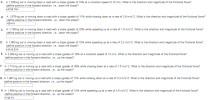 Show units, check the ones I did and show workj for all
parts
A 1.535-kg car is moving down a road with a slope (grade) of 10% at a constant speed of 13 nVs. What is the direction and magnitude of the frictional force? (define positive in the forward direction, i.e.. down the slope)? A 1.576-kg car is moving down a road with a slope (grade) of 11% while slowing down at a rate of 3.6 rrv'sA2. What is the...
Show units, check the ones I did and show workj for all
parts
A 1.535-kg car is moving down a road with a slope (grade) of 10% at a constant speed of 13 nVs. What is the direction and magnitude of the frictional force? (define positive in the forward direction, i.e.. down the slope)? A 1.576-kg car is moving down a road with a slope (grade) of 11% while slowing down at a rate of 3.6 rrv'sA2. What is the...
A 1300-kg car, initially at rest, is initially accelerated at 4.9m/s2. After the car moves 550m,...
A 1300-kg car, initially at rest, is initially accelerated at 4.9m/s2. After the car moves 550m, the engine is cut off. The car then moves a distance of 1230 before coming to a stop. Assume the road to be level and that g = 10 N/kg. a) What is in m/s, the magnitude of the velocity of the car at the end of the first 550m? b) What is in m/s2, the magnitude of the acceleration of the car while...
a 2.0 kg mass moves along a frictionless horizontal surface at a speed of 5.0 m/s....
a 2.0 kg mass moves along a frictionless horizontal surface at a speed of 5.0 m/s. The mass encounters a 30 degree inclined surface with a constant friction force of 1.5 N. At 1 m high (vertical) the surface levels off and is again frictionless. the mass then encounters a spring with k=10 N/m a) how far is the spring compressed after the mass comes to rest? b) how far down the inclined plane will the mass move after bouncing...
A car drives down a curving road at a constant speed. Which of the following statements are...
A car drives down a curving road at a constant speed. Which of the following statements are true? (Select all that apply.) A. There is no net force acting on the car as it drives down the road. B. The car is traveling at a constant velocity down the road. C. The car is experiencing no acceleration as it drives down the road. D. The car is experiencing a non-zero net force while driving down the road/ E. The car is experiencing...
A car of mass 1000 Kg descends a hill inclined with horizontal by 30°, the car...
 A car of mass 1000 Kg descends a hill inclined with horizontal by 30°, the car is traveling at 80 km/h is uniformly brought to rest over a distance of 40 m. Calculate using work-energy method the average braking force required. The resistance to the motion is 200 N. 40 0 = 30°
A 1500 kg car is traveling on a flat surface at 100 km/h. Find the kinetic...
A 1500 kg car is traveling on a flat surface at 100 km/h. Find the kinetic energy. Assuming no frictional losses so that kinetic energy is transformed to potential energy, if the car then coasts up a hill, how high will it go vertically before it comes to rest?
A 1030 kg car is pulling a 290 kg trailer. Together the car and trailer move...
A 1030 kg car is pulling a 290 kg trailer. Together the car and trailer move forward with an acceleration of 2.13 m/s2. Ignore any frictional force of air drag on the car and all frictional forces on the trailer. (a) Determine the net force on the car. Magnitude: Direction: Forward/Backward b.)Determine the net force on the trailer: Magnitude Direction: Forward/Backward c.) Determine the force exerted by the trailer on the car. Magnitude: Direction: Forward/Backward d.) Determine the resultant force...
 Name Rec. Inst. Hand-in-HW # A 1500 kg car coasting on a horizontal road hits a 500 kg moose. The moose is thrown through the windshield into the passenger compartment. What percent of the initial kinetic energy is lost (turned into non-mechanical forms of energy) in the collision? For thought: why does the initial speed of the car not matter but the fact that it is coasting does? I need the graph of the question and unit check Rep: ID:...
 4. A car with a mass of 1500 kg moves along a level road with an initial speed of 20 m/s. If the puts on his brakes and slides to a stop with a friction force of 3000N, How far will it take him to stop? Sketch a diagram of the situation.
 Show units, check the ones I did and show workj for all
parts
A 1.535-kg car is moving down a road with a slope (grade) of 10% at a constant speed of 13 nVs. What is the direction and magnitude of the frictional force? (define positive in the forward direction, i.e.. down the slope)? A 1.576-kg car is moving down a road with a slope (grade) of 11% while slowing down at a rate of 3.6 rrv'sA2. What is the...
Show units, check the ones I did and show workj for all
parts
A 1.535-kg car is moving down a road with a slope (grade) of 10% at a constant speed of 13 nVs. What is the direction and magnitude of the frictional force? (define positive in the forward direction, i.e.. down the slope)? A 1.576-kg car is moving down a road with a slope (grade) of 11% while slowing down at a rate of 3.6 rrv'sA2. What is the...
 A car of mass 1000 Kg descends a hill inclined with horizontal by 30°, the car is traveling at 80 km/h is uniformly brought to rest over a distance of 40 m. Calculate using work-energy method the average braking force required. The resistance to the motion is 200 N. 40 0 = 30°
Most questions answered within 3 hours.
-
Where is the error in this code sequence?
String s1 = "Hello";
String s2 = "ello";...
asked 11 months ago -
Financial data for Joel de Paris, Inc., for last year
follow:
Joel de Paris, Inc.
Balance...
asked 11 months ago -
Consider this reaction:
Al2(SO4)3 (aq)+ BaCl3
(aq) Al2Cl6 (aq)- +
3BaSO4(s) . What is the...
asked 11 months ago -
Suppose that Savneet is considering increasing her
recent random sample from 20 car rentals to 40...
asked 11 months ago -
Trucks arrive at an unloading terminal at an average rate of 120
per hour.
Trucks arrive...
asked 11 months ago -
Why are methanol and ethanol completely soluble in water while
octanol is not very little soluble....
asked 11 months ago -
A facilities manager at a university reads in a research report
that the mean amount of...
asked 11 months ago -
When the CuSO4 is rehydrated by adding water to the anhydrous
compound, is this an endothermic...
asked 11 months ago -
A ray of sunlight is passing from diamond into crown glass; the
angle of incidence is...
asked 11 months ago -
A block of mass 0.249 kg is placed on top of a light, vertical
spring of...
asked 11 months ago -
how do the kidneys compensate in the presences of acidosis
a) trigger hyperventilate
b) reserve acid...
asked 11 months ago -
Question 501 pts
The rental rate of capital to the firm increases. Which of the
following...
asked 11 months ago