Explain the effect of (i) zeta potential (ii) Hamaker constant and (iii) molar salt concentration on...
Explain the effect of (i) zeta potential (ii) Hamaker constant and (iii) molar salt concentration on the colloid stability.
Homework Answers
Colloidal solution is contains with microsolid substace disperse in the other liquid substance. It also called colloidal suspension.
Due to two other phases it need some stability testing such as-
I- Zeta potential- the potential difference existing between the surface of a solid particle which is immersed in a conducting liquid (e.g. polar solvent or water) and the bulk of the liquid. It must be in limit to found a good stability of colloidal solution.
Zeta potential [mV] Stability behavior of the colloid
from 0 to ±5, Rapid coagulation or flocculation
from ±10 to ±30 Incipient instability
from ±30 to ±40 Moderate stability
from ±40 to ±60 Good stability
more than ±61 Excellent stability
ii Hamaker constant-The Hamaker constant A can be defined for a Van der Waals (VdW) body–body interaction. The force between the particles or bonds make the solution stable.
III molar salt concentration - it is also a most important parameter for colloidal solution. Equilibrium must be maintain in molar concentration. More molar concentration may lead to Aggregragation and very low may lead to DEFFLUCULATIion.
Add Answer to:
Explain the effect of (i) zeta potential (ii) Hamaker constant
and (iii) molar salt concentration on...
Explain the effect of (i) zeta pontential, (ii) Hamaker constant and (iii) molar salt concentration on...
Explain the effect of (i) zeta pontential, (ii) Hamaker constant and (iii) molar salt concentration on the colloid stability.
Q2 (a) Explain the effect of each of the following changes on the molar mass of a polymer formed by radical polymerisati...
Q2 (a) Explain the effect of each of the following changes on the molar mass of a polymer formed by radical polymerisation, assuming everything else is kept constant as much as possible: (i) Doubling the initiator concentration (ii) Reducing the monomer concentration by a factor of five (iii) Adding a chain transfer agent
I. An equipotential surface is a surface of constant potential. II. The electrostatic force does no...
 I. An equipotential surface is a surface of constant potential. II. The electrostatic force does no work on a charge that moves along an equipotential surface. III. The equipotential surfaces surrounding a point charge consist of an infinite number of concentric spherical shells IV. Electric field lines are everywhere perpendicular to equipotential surfaces. O I only OI and II only III and IV only O All of the above The electric potential is constant throughout a certain region of space....
Which salt(s) listed below form(s) an acidic aqueous solution when dissolved in water? I. II. III....
 Which salt(s) listed below form(s) an acidic aqueous solution when dissolved in water? I. II. III. KNO2 NaF NH4C104 O a. III only All of these م O c. II only O d. I only Oe. I and II
a) The antidepressant Abilify®, (I), is made blood soluble by conversion to its monohydrochloride salt (II)....
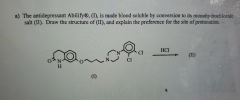 a) The antidepressant Abilify®, (I), is made blood soluble by conversion to its monohydrochloride salt (II). Draw the structure of (II), and explain the preference for the site of protonation. НСІ СІ lona CI ZI (1) b) Succinic acid (I) reacts with excess thionyl chloride to produce (II) in high yield. None of (III) is formed. Draw the structure of (II) and explain its formation. SOC12 SOCI (II) OH * HO СІ o (1) (III)
A saturated solution of lead(II) iodide, PbI2 has an iodide concentration of 3.0 x 10^-3 mol/L. a) What is the molar...
A saturated solution of lead(II) iodide, PbI2 has an iodide concentration of 3.0 x 10^-3 mol/L. a) What is the molar solubility of PbI2? b) Determine the solubility constant, Ksp, for lead(II) iodide. c) Does the molar solubility of lead (II) iodide increase, decrease, or remain unchanged with the addition of potassium iodide to the solution? EXPLAIN.
I) ion solution of unknown concentration shows an absorbance of 0.55. What a. A metal(II) ion sol...
 I) ion solution of unknown concentration shows an absorbance of 0.55. What a. A metal(II) ion solution of unk of the metal(II) ion in the sample? nce is the molar concentration b. Assu ming a molar mass of the metal(II) ion is 58.93 g/mol, what is the concent mg/L (ppm)? what is the concentration of metal(lI) ion in units eFor a metal(II) ion solution having a 0.0080 M concentration, what would be its predicted absorbance 5. Experimental Procedure, Part D....
The reaction of (R)-2-iodopentane with one-molar equivalent of ammonia in ethanol to give 1 was found...
 The reaction of (R)-2-iodopentane with one-molar
equivalent of ammonia in ethanol to give 1 was
found to be first order.
Consider the following statements and choose the correct
one(s).
I. Both enantiomers of 1 form.
II. Increasing the concentration of (R)-2-iodopentane has
no effect on the rate of the reaction.
III. The rate of the reaction depends on the concentration of
ammonia.
Group of answer choices
I and II only
I and III only
II and III only
I only...
The reaction of (R)-2-iodopentane with one-molar
equivalent of ammonia in ethanol to give 1 was
found to be first order.
Consider the following statements and choose the correct
one(s).
I. Both enantiomers of 1 form.
II. Increasing the concentration of (R)-2-iodopentane has
no effect on the rate of the reaction.
III. The rate of the reaction depends on the concentration of
ammonia.
Group of answer choices
I and II only
I and III only
II and III only
I only...
1- A saturated solution of lead(II) iodide, PbI2 has an iodide concentration of 3.0*10^-3 mol/L. a- What is the molar...
1- A saturated solution of lead(II) iodide, PbI2 has an iodide concentration of 3.0*10^-3 mol/L. a- What is the molar solubility of PbI2? b- Determine the solubility constant, Ksp for lead (II) iodide. c- Does the molar solubility of lead(II) iodide increase, decrease or remain unchanged with the addition of potassium iodide to the solution? Explain? 2- The Ksp of Ca(OH)2 was 5.2*10^-6 and 4.8*10^-6 respectively. a- What is the average Ksp of Ca(OH)2?
1) The molar solubility of PbI2 is 1.5X10⁻³ mol/L. PbI2(s) ? Pb2+(aq) + 2I-(aq) What is the molar concentration of iodi...
1) The molar solubility of PbI2 is 1.5X10⁻³ mol/L. PbI2(s) ? Pb2+(aq) + 2I-(aq) What is the molar concentration of iodide ion in a saturated PbI2 solution in mol/L? Hint: Consider mol ratios. Don't use scientific notation. Use 2 significant figures. ________ 2) The molar solubility of PbI2 is 1.5X10⁻³ mol/L. PbI2(s) ?Pb2+(aq) + 2I-(aq) Determine the solubility constant, ksp, for lead(II) iodide: ksp = [Pb2+][I-]2 Don't use scientific notation. Use 2 significant figures. ________ 3) How is the molar...
 I. An equipotential surface is a surface of constant potential. II. The electrostatic force does no work on a charge that moves along an equipotential surface. III. The equipotential surfaces surrounding a point charge consist of an infinite number of concentric spherical shells IV. Electric field lines are everywhere perpendicular to equipotential surfaces. O I only OI and II only III and IV only O All of the above The electric potential is constant throughout a certain region of space....
 Which salt(s) listed below form(s) an acidic aqueous solution when dissolved in water? I. II. III. KNO2 NaF NH4C104 O a. III only All of these م O c. II only O d. I only Oe. I and II
 a) The antidepressant Abilify®, (I), is made blood soluble by conversion to its monohydrochloride salt (II). Draw the structure of (II), and explain the preference for the site of protonation. НСІ СІ lona CI ZI (1) b) Succinic acid (I) reacts with excess thionyl chloride to produce (II) in high yield. None of (III) is formed. Draw the structure of (II) and explain its formation. SOC12 SOCI (II) OH * HO СІ o (1) (III)
 I) ion solution of unknown concentration shows an absorbance of 0.55. What a. A metal(II) ion solution of unk of the metal(II) ion in the sample? nce is the molar concentration b. Assu ming a molar mass of the metal(II) ion is 58.93 g/mol, what is the concent mg/L (ppm)? what is the concentration of metal(lI) ion in units eFor a metal(II) ion solution having a 0.0080 M concentration, what would be its predicted absorbance 5. Experimental Procedure, Part D....
 The reaction of (R)-2-iodopentane with one-molar
equivalent of ammonia in ethanol to give 1 was
found to be first order.
Consider the following statements and choose the correct
one(s).
I. Both enantiomers of 1 form.
II. Increasing the concentration of (R)-2-iodopentane has
no effect on the rate of the reaction.
III. The rate of the reaction depends on the concentration of
ammonia.
Group of answer choices
I and II only
I and III only
II and III only
I only...
The reaction of (R)-2-iodopentane with one-molar
equivalent of ammonia in ethanol to give 1 was
found to be first order.
Consider the following statements and choose the correct
one(s).
I. Both enantiomers of 1 form.
II. Increasing the concentration of (R)-2-iodopentane has
no effect on the rate of the reaction.
III. The rate of the reaction depends on the concentration of
ammonia.
Group of answer choices
I and II only
I and III only
II and III only
I only...
Most questions answered within 3 hours.
-
Where is the error in this code sequence?
String s1 = "Hello";
String s2 = "ello";...
asked 11 months ago -
Financial data for Joel de Paris, Inc., for last year
follow:
Joel de Paris, Inc.
Balance...
asked 11 months ago -
Consider this reaction:
Al2(SO4)3 (aq)+ BaCl3
(aq) Al2Cl6 (aq)- +
3BaSO4(s) . What is the...
asked 11 months ago -
Suppose that Savneet is considering increasing her
recent random sample from 20 car rentals to 40...
asked 11 months ago -
Trucks arrive at an unloading terminal at an average rate of 120
per hour.
Trucks arrive...
asked 11 months ago -
Why are methanol and ethanol completely soluble in water while
octanol is not very little soluble....
asked 11 months ago -
A facilities manager at a university reads in a research report
that the mean amount of...
asked 11 months ago -
When the CuSO4 is rehydrated by adding water to the anhydrous
compound, is this an endothermic...
asked 11 months ago -
A ray of sunlight is passing from diamond into crown glass; the
angle of incidence is...
asked 11 months ago -
A block of mass 0.249 kg is placed on top of a light, vertical
spring of...
asked 11 months ago -
how do the kidneys compensate in the presences of acidosis
a) trigger hyperventilate
b) reserve acid...
asked 11 months ago -
Question 501 pts
The rental rate of capital to the firm increases. Which of the
following...
asked 11 months ago