Let M = {0} and N = Ø and L = {ε, 1} be the languages...
Let M = {0} and N = Ø and L = {ε, 1} be the languages over {0,1}. Which of the following represents the language NN*M ?
{0}
{0}*
{ε}
None of the above
Homework Answers
The language NN*M is represented by {0} because we have M={0} and N=Ø so when we create strings through a regular grammer or we represent the string by a language it becomes Ø Ø *0 so Ø Ø* makes nothing in the string as Ø is not a transition from one state to another or transition from the same state it does nothing so Ø Ø * does not mean anything so only is left in the language so the language is represnted by {0} .
2. Give the first five strings in L-ordering for each of the following languages over 2...
 2. Give the first five strings in L-ordering for each of the following languages over 2 - {0,1}. If there are fewer than five strings, give the entire language instead: Let L1= {0, 11, 101) Let L2 = {€, 0,10 a) LUL b) L2-L2 c) L L2 d) L22
Let L = {0^n 1^n | n ≥ 0}. Draw the state diagram of a Turing...
 Let L = {0^n 1^n | n ≥ 0}. Draw the state diagram of a Turing
machine deciding L= Σ∗\L(basically the complement of L), where Σ =
{0,1}, and Γ = {0,1,#,U}, and “\” is set subtraction.
I understand that the complement of L will be {0^n 1^m | n=!m} U
{(0 U 1)* 1 0 {0 U 1)*}.
How should I draw the state diagram with this?
Let L = {0"1" | n > 0}. Draw the state diagram...
Let L = {0^n 1^n | n ≥ 0}. Draw the state diagram of a Turing
machine deciding L= Σ∗\L(basically the complement of L), where Σ =
{0,1}, and Γ = {0,1,#,U}, and “\” is set subtraction.
I understand that the complement of L will be {0^n 1^m | n=!m} U
{(0 U 1)* 1 0 {0 U 1)*}.
How should I draw the state diagram with this?
Let L = {0"1" | n > 0}. Draw the state diagram...
Give the size of each of the following languages over S = {0, 1} below. If...
Give the size of each of the following languages over S = {0, 1} below. If the language has no enough strings, then list all its strings. Let L1 = {ε, 1, 10}, L2 = {0, 01}, and LÆ = {}. a) |L1 – L2| = ____________ b) |L2L1 | = ___________ c) |L12|= __________ d) |L2LÆ| = ____________ e) |LÆ*|= ___________
Automata question Categorize the languages as I. Type 0 or Recursively Enumerable Languages II. &n
Automata question Categorize the languages as I. Type 0 or Recursively Enumerable Languages II. Type 1 or CSL III. Type 2 or CFL IV. Type 3 or Regular in accordance to the Chomsky hierarchy (select only one of the answers designating the lowest level - Note that Type 3 is the lowest level and Type 0 is the highest level) over the alphabet {0,1} L = {0n10k |k, n is any integer} i think its type 0.. am i right ?...
10. Let D represent the demand, μ be the average demand, and be a random error, such that ε ~ N(0...
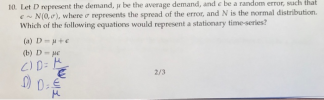 10. Let D represent the demand, μ be the average demand, and be a random error, such that ε ~ N(0, σ), where σ represents the spread of the error, and N is the normal distribution. Which of the following equations would represent a stationary time-series? 2/3
10. Let D represent the demand, μ be the average demand, and be a random error, such that ε ~ N(0, σ), where σ represents the spread of the error, and N is...
10. Let D represent the demand, μ be the average demand, and be a random error, such that ε ~ N(0, σ), where σ represents the spread of the error, and N is the normal distribution. Which of the following equations would represent a stationary time-series? 2/3
10. Let D represent the demand, μ be the average demand, and be a random error, such that ε ~ N(0, σ), where σ represents the spread of the error, and N is...
5. Let A={a,b,c} and let K, L C A be languages described as follows: K =...
 5. Let A={a,b,c} and let K, L C A be languages described as follows: K = {a"y":n in e Zo} and L = {a?,62,c2-free words over A}. Thus L is the language of all words over A that have no consecutive letters that are the same. (a) Give a recursive description of K. (b) Construct a finite state automaton (FSA) that accepts L.
Let Σ = {0,1}and define a language L over Σ as L = {0n10n10n : n...
Let Σ = {0,1}and define a language L over Σ as L = {0n10n10n : n ≥1} Show that L is not context-free. Remark: Compare this with language S1 onpage106,which is context free. Hint: Let p be the pumping constant and consider the string s = 0p10p10p. Write s as in the Pumping Lemma. Either vy has no zeros,or it has at leas tone zero;consider theses cases separately.
Let n be a positive integer. Classify the languages R = { (M) | M is a TM and L(M) contains exactly n strings} S = { (M)...
Let n be a positive integer. Classify the languages R = { (M) | M is a TM and L(M) contains exactly n strings} S = { (M) | M is a TM and L(M) contains more than n strings} as (a) decidable (b) Turing-recognizable but not co-Turing recognizable (c) co-Turing recognizable but not Turing-recognizable (d) neither Turing nor co-Turing recognizable
1. Let n be a positive integer. Classify the languages (i) R = {(M)IM is a...
 1. Let n be a positive integer. Classify the languages (i) R = {(M)IM is a TM and L(M) contains exactly n strings) (ii) S- (M)|M is a TM and L(M) contains more than n strings as (a) decidable, (b) Turing-recognizable but not co-Turing-recognizable, (c) co-Turing-recognizable but not Turing-recognizable, (d) neither Turing-recognizable nor co-Turing-recognizable. Justify your answers.
 2. Give the first five strings in L-ordering for each of the following languages over 2 - {0,1}. If there are fewer than five strings, give the entire language instead: Let L1= {0, 11, 101) Let L2 = {€, 0,10 a) LUL b) L2-L2 c) L L2 d) L22
 Let L = {0^n 1^n | n ≥ 0}. Draw the state diagram of a Turing
machine deciding L= Σ∗\L(basically the complement of L), where Σ =
{0,1}, and Γ = {0,1,#,U}, and “\” is set subtraction.
I understand that the complement of L will be {0^n 1^m | n=!m} U
{(0 U 1)* 1 0 {0 U 1)*}.
How should I draw the state diagram with this?
Let L = {0"1" | n > 0}. Draw the state diagram...
Let L = {0^n 1^n | n ≥ 0}. Draw the state diagram of a Turing
machine deciding L= Σ∗\L(basically the complement of L), where Σ =
{0,1}, and Γ = {0,1,#,U}, and “\” is set subtraction.
I understand that the complement of L will be {0^n 1^m | n=!m} U
{(0 U 1)* 1 0 {0 U 1)*}.
How should I draw the state diagram with this?
Let L = {0"1" | n > 0}. Draw the state diagram...
 10. Let D represent the demand, μ be the average demand, and be a random error, such that ε ~ N(0, σ), where σ represents the spread of the error, and N is the normal distribution. Which of the following equations would represent a stationary time-series? 2/3
10. Let D represent the demand, μ be the average demand, and be a random error, such that ε ~ N(0, σ), where σ represents the spread of the error, and N is...
10. Let D represent the demand, μ be the average demand, and be a random error, such that ε ~ N(0, σ), where σ represents the spread of the error, and N is the normal distribution. Which of the following equations would represent a stationary time-series? 2/3
10. Let D represent the demand, μ be the average demand, and be a random error, such that ε ~ N(0, σ), where σ represents the spread of the error, and N is...
 5. Let A={a,b,c} and let K, L C A be languages described as follows: K = {a"y":n in e Zo} and L = {a?,62,c2-free words over A}. Thus L is the language of all words over A that have no consecutive letters that are the same. (a) Give a recursive description of K. (b) Construct a finite state automaton (FSA) that accepts L.
 1. Let n be a positive integer. Classify the languages (i) R = {(M)IM is a TM and L(M) contains exactly n strings) (ii) S- (M)|M is a TM and L(M) contains more than n strings as (a) decidable, (b) Turing-recognizable but not co-Turing-recognizable, (c) co-Turing-recognizable but not Turing-recognizable, (d) neither Turing-recognizable nor co-Turing-recognizable. Justify your answers.
Most questions answered within 3 hours.
-
Where is the error in this code sequence?
String s1 = "Hello";
String s2 = "ello";...
asked 11 months ago -
Financial data for Joel de Paris, Inc., for last year
follow:
Joel de Paris, Inc.
Balance...
asked 11 months ago -
Consider this reaction:
Al2(SO4)3 (aq)+ BaCl3
(aq) Al2Cl6 (aq)- +
3BaSO4(s) . What is the...
asked 11 months ago -
Suppose that Savneet is considering increasing her
recent random sample from 20 car rentals to 40...
asked 11 months ago -
Trucks arrive at an unloading terminal at an average rate of 120
per hour.
Trucks arrive...
asked 11 months ago -
Why are methanol and ethanol completely soluble in water while
octanol is not very little soluble....
asked 11 months ago -
A facilities manager at a university reads in a research report
that the mean amount of...
asked 11 months ago -
When the CuSO4 is rehydrated by adding water to the anhydrous
compound, is this an endothermic...
asked 11 months ago -
A ray of sunlight is passing from diamond into crown glass; the
angle of incidence is...
asked 11 months ago -
A block of mass 0.249 kg is placed on top of a light, vertical
spring of...
asked 11 months ago -
how do the kidneys compensate in the presences of acidosis
a) trigger hyperventilate
b) reserve acid...
asked 11 months ago -
Question 501 pts
The rental rate of capital to the firm increases. Which of the
following...
asked 11 months ago