
Homework Answers

Add Answer to:
2. (15 pts) A uniform density flat solid square has a total mass M and side...
13. A bar of mass M on a frictionless, horizontal surface ex- periences a single horizontal...
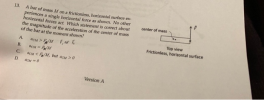 13. A bar of mass M on a frictionless, horizontal surface ex- periences a single horizontal force as shown. No other horizontal forces act. Which statement is correct about the magnitude of the acceleration of the center of mass of the bar at the moment shown? ACM > F/ M F, nt в. см FM ACM <F/M, but acm > 0 center of mass A Top view Frictionless, horizontal surface Co Version A
Calculate the fluid force (in Newtons) on one side of a square plate with a side...
Calculate the fluid force (in Newtons) on one side of a square plate with a side of 7 m that is submerged in water at a horizontal angle of 30°. Assume that the top edge of the plate lies at the surface of the water. (Use g = 9.8 m/s2 for the acceleration due to gravity and ρ = 1000 kg/m3 for the density of water.)
Consider a wide, nearly flat square with uniform charge density p. The square is centered at...
 Consider a wide, nearly flat square with uniform charge density p.
The square is centered at the origin and is lying parallel to the
xy plane. It has side length a and thickness h h<<a, so the
top surface of the square is at z=h/2 and the bottom is at z=-h/2.
Find a simple approximate (monomial) expression for the magnitude
of the electric field on the z-axis for
(1). 0 < z < h/2
(2). h/2 < z << a...
Consider a wide, nearly flat square with uniform charge density p.
The square is centered at the origin and is lying parallel to the
xy plane. It has side length a and thickness h h<<a, so the
top surface of the square is at z=h/2 and the bottom is at z=-h/2.
Find a simple approximate (monomial) expression for the magnitude
of the electric field on the z-axis for
(1). 0 < z < h/2
(2). h/2 < z << a...
11. A uniform thin rod of length L and mass M, pivoted at one end as...
 11. A uniform thin rod of length L and mass M, pivoted at one end as shown above, is held horizontal and then released from rest. Ignore all effects due to friction. (a) Find the angular speed of the rod as it sweeps through the vertical position. solution: 、13g / L (b) Find the force exerted on the rod by the pivot at this instant. solution Mg (c) Starting from the horizontal position, what initial angular speed would be needed...
Show Work For Credit 10.51 A uniform, 4.5-kg, square, solid wooden gate 1.5 m on each...
 Show Work For Credit
10.51 A uniform, 4.5-kg, square, solid wooden gate 1.5 m on each side hangs vertically from a frictionless pivot at the center of its upper edge. A 1.1-kg raven flying horizontally at 5.0 m/s flies into this door at its center and bounces back at 2.0 m/s in the oppo- site direction. (a) What is the angular speed of the gate just after it is struck by the unfortunate raven? (b)During the collision, why is the...
Show Work For Credit
10.51 A uniform, 4.5-kg, square, solid wooden gate 1.5 m on each side hangs vertically from a frictionless pivot at the center of its upper edge. A 1.1-kg raven flying horizontally at 5.0 m/s flies into this door at its center and bounces back at 2.0 m/s in the oppo- site direction. (a) What is the angular speed of the gate just after it is struck by the unfortunate raven? (b)During the collision, why is the...
4(12 points) A uniform rod of length L and mass M is attached at one end...
 4(12 points) A uniform rod of length L and mass M is attached at one end to a frictionless pivot and is free to rotate about the pivot in the vertical plane as in Figure. The rod is released from rest in the horizontal position. (a)What are the initial angular acceleration of the rod and the initial translational acceleration of its right end (as shown in Fig.a)? (b)What is its angular speed when the rod reaches its lowest position (as...
Consider a square plate of side a and mass m located with one corner on the...
Consider a square plate of side a and mass m located with one corner on the origin of the x, y plane. Assuming homogeneous surface density, calculate the inertia tensor (remember that it is still a 3 × 3 object). Then calculate the angular momentum around the origin and the rotational kinetic energy if the square is rotating with angular speed ω about (a) the x-axis and (b) the diagonal through the origin.
A solid uniform cylinder of mass M and radius R is at rest in the center...
 A solid uniform cylinder of mass M and radius R is at rest in
the center on a flat slab of mass m and thickness d, which in turn
rests on a horizontal, frictionless table, as shown in the figure at
right below. A horizontal force of magnitude F is applied to the
slab, acting through the center of the slab, causing it to
accelerate to the right. The cylinder rolls without slipping on the
slab. (The direction of F...
A solid uniform cylinder of mass M and radius R is at rest in
the center on a flat slab of mass m and thickness d, which in turn
rests on a horizontal, frictionless table, as shown in the figure at
right below. A horizontal force of magnitude F is applied to the
slab, acting through the center of the slab, causing it to
accelerate to the right. The cylinder rolls without slipping on the
slab. (The direction of F...
A pendulum consisting of a uniform rod and concentrated mass at its free end is pivoted...
 A pendulum consisting of a uniform rod and concentrated mass at its free end is pivoted to the inertial frame through a revolute joint. The rod has length L=1.2m and mass m=3 kg. The concentrated mass has magnitude M=5 kg. The system starts from rest with the rod making an angle 0=60° to the horizontal. A moment T-100 Nm acts on the rod. When the rod first makes an angle of p=300" to the horizontal, calculate: 1. Angular velocity of...
Two rods of uniform density, length l and mass m, are shown. Rod B is pivoted...
 Two rods of uniform density, length l and mass m, are shown. Rod B is pivoted about a point -l in from the left end and the other A is pivoted about its left end. They are held horizontally and then released. -l- l Which expression best describes the rela- tionship between the torque felt by rod A (pivoted about its end) and rod B, (pivoted 1 about a point = down from its end)? 1. TA = TB 2....
 13. A bar of mass M on a frictionless, horizontal surface ex- periences a single horizontal force as shown. No other horizontal forces act. Which statement is correct about the magnitude of the acceleration of the center of mass of the bar at the moment shown? ACM > F/ M F, nt в. см FM ACM <F/M, but acm > 0 center of mass A Top view Frictionless, horizontal surface Co Version A
 Consider a wide, nearly flat square with uniform charge density p.
The square is centered at the origin and is lying parallel to the
xy plane. It has side length a and thickness h h<<a, so the
top surface of the square is at z=h/2 and the bottom is at z=-h/2.
Find a simple approximate (monomial) expression for the magnitude
of the electric field on the z-axis for
(1). 0 < z < h/2
(2). h/2 < z << a...
Consider a wide, nearly flat square with uniform charge density p.
The square is centered at the origin and is lying parallel to the
xy plane. It has side length a and thickness h h<<a, so the
top surface of the square is at z=h/2 and the bottom is at z=-h/2.
Find a simple approximate (monomial) expression for the magnitude
of the electric field on the z-axis for
(1). 0 < z < h/2
(2). h/2 < z << a...
 11. A uniform thin rod of length L and mass M, pivoted at one end as shown above, is held horizontal and then released from rest. Ignore all effects due to friction. (a) Find the angular speed of the rod as it sweeps through the vertical position. solution: 、13g / L (b) Find the force exerted on the rod by the pivot at this instant. solution Mg (c) Starting from the horizontal position, what initial angular speed would be needed...
 Show Work For Credit
10.51 A uniform, 4.5-kg, square, solid wooden gate 1.5 m on each side hangs vertically from a frictionless pivot at the center of its upper edge. A 1.1-kg raven flying horizontally at 5.0 m/s flies into this door at its center and bounces back at 2.0 m/s in the oppo- site direction. (a) What is the angular speed of the gate just after it is struck by the unfortunate raven? (b)During the collision, why is the...
Show Work For Credit
10.51 A uniform, 4.5-kg, square, solid wooden gate 1.5 m on each side hangs vertically from a frictionless pivot at the center of its upper edge. A 1.1-kg raven flying horizontally at 5.0 m/s flies into this door at its center and bounces back at 2.0 m/s in the oppo- site direction. (a) What is the angular speed of the gate just after it is struck by the unfortunate raven? (b)During the collision, why is the...
 4(12 points) A uniform rod of length L and mass M is attached at one end to a frictionless pivot and is free to rotate about the pivot in the vertical plane as in Figure. The rod is released from rest in the horizontal position. (a)What are the initial angular acceleration of the rod and the initial translational acceleration of its right end (as shown in Fig.a)? (b)What is its angular speed when the rod reaches its lowest position (as...
 A solid uniform cylinder of mass M and radius R is at rest in
the center on a flat slab of mass m and thickness d, which in turn
rests on a horizontal, frictionless table, as shown in the figure at
right below. A horizontal force of magnitude F is applied to the
slab, acting through the center of the slab, causing it to
accelerate to the right. The cylinder rolls without slipping on the
slab. (The direction of F...
A solid uniform cylinder of mass M and radius R is at rest in
the center on a flat slab of mass m and thickness d, which in turn
rests on a horizontal, frictionless table, as shown in the figure at
right below. A horizontal force of magnitude F is applied to the
slab, acting through the center of the slab, causing it to
accelerate to the right. The cylinder rolls without slipping on the
slab. (The direction of F...
 A pendulum consisting of a uniform rod and concentrated mass at its free end is pivoted to the inertial frame through a revolute joint. The rod has length L=1.2m and mass m=3 kg. The concentrated mass has magnitude M=5 kg. The system starts from rest with the rod making an angle 0=60° to the horizontal. A moment T-100 Nm acts on the rod. When the rod first makes an angle of p=300" to the horizontal, calculate: 1. Angular velocity of...
 Two rods of uniform density, length l and mass m, are shown. Rod B is pivoted about a point -l in from the left end and the other A is pivoted about its left end. They are held horizontally and then released. -l- l Which expression best describes the rela- tionship between the torque felt by rod A (pivoted about its end) and rod B, (pivoted 1 about a point = down from its end)? 1. TA = TB 2....
Most questions answered within 3 hours.
-
Where is the error in this code sequence?
String s1 = "Hello";
String s2 = "ello";...
asked 11 months ago -
Financial data for Joel de Paris, Inc., for last year
follow:
Joel de Paris, Inc.
Balance...
asked 11 months ago -
Consider this reaction:
Al2(SO4)3 (aq)+ BaCl3
(aq) Al2Cl6 (aq)- +
3BaSO4(s) . What is the...
asked 11 months ago -
Suppose that Savneet is considering increasing her
recent random sample from 20 car rentals to 40...
asked 11 months ago -
Trucks arrive at an unloading terminal at an average rate of 120
per hour.
Trucks arrive...
asked 11 months ago -
Why are methanol and ethanol completely soluble in water while
octanol is not very little soluble....
asked 11 months ago -
A facilities manager at a university reads in a research report
that the mean amount of...
asked 11 months ago -
When the CuSO4 is rehydrated by adding water to the anhydrous
compound, is this an endothermic...
asked 11 months ago -
A ray of sunlight is passing from diamond into crown glass; the
angle of incidence is...
asked 11 months ago -
A block of mass 0.249 kg is placed on top of a light, vertical
spring of...
asked 11 months ago -
how do the kidneys compensate in the presences of acidosis
a) trigger hyperventilate
b) reserve acid...
asked 11 months ago -
Question 501 pts
The rental rate of capital to the firm increases. Which of the
following...
asked 11 months ago