MY QUESTION involves the problem below: Describe the motion of the mass m under the action of the force you derived and show whether it is simple harmonic.

Solution to 6:

QUESTION: Describe the motion of the mass m under the action of the force you derived and show whether it is simple harmonic in problem 6.
Homework Answers


Add Answer to:
MY QUESTION involves the problem below: Describe the motion of
the mass m under the action...
2. An object of mass m motion is described as damped simple harmonic motion. The object is now un...
 2. An object of mass m motion is described as damped simple harmonic motion. The object is now under the influence of two driving forcs, simultancously. The forces are given by: FiAst) Show that the steady state solution is simply a linear combination of the solution of each of the forces when acting by itself
2. An object of mass m motion is described as damped simple harmonic motion. The object is now under the influence of two driving forcs,...
2. An object of mass m motion is described as damped simple harmonic motion. The object is now under the influence of two driving forcs, simultancously. The forces are given by: FiAst) Show that the steady state solution is simply a linear combination of the solution of each of the forces when acting by itself
2. An object of mass m motion is described as damped simple harmonic motion. The object is now under the influence of two driving forcs,...
2. Consider a point particle of mass m undergoing a one-dimensional motion under the action of...
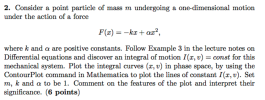 2. Consider a point particle of mass m undergoing a one-dimensional motion under the action of a force F(x) =-kx + az where k and ? are positive constants. Follow Example 3 in the lecture notes on Differential equations and discover an integral of motion I(x,v) - const for this mechanical system. Plot the integral curves (x, v) in phase space, by using the ContourPlot command in Mathematica to plot the lines of constant I(x,v). Set significance. (6 points)
Q2)) A particle of mass m is under the action of a force given by :...
 Q2)) A particle of mass m is under the action of a force given by : F = F + Cx; where F, and C are positive constants. If the particle starts motion from rest at x = 0; a) Is this force is conservative or not? and why? b) Find the change in its kinetic energy. c) Find the velocity of the particle as a function of distant x.
For my lab a 50g mass is on a spring. The spring is pulled down a...
 For my lab a 50g mass is on a spring. The spring is pulled down
a different length for each trial and then released. What would the
amplitude of motion be for this experiment and how can I test that
the frequency is independent from the amplitude.
In cases where the restoring force is proportional to the amount of displacement from the oquilibrium position, the object undergoes simple harmonic motion (SHM). An object on a spring is the simplest example...
For my lab a 50g mass is on a spring. The spring is pulled down
a different length for each trial and then released. What would the
amplitude of motion be for this experiment and how can I test that
the frequency is independent from the amplitude.
In cases where the restoring force is proportional to the amount of displacement from the oquilibrium position, the object undergoes simple harmonic motion (SHM). An object on a spring is the simplest example...
Lab 3: Mass on a Spring-Simple Harmonic Motion Prelab Exercise: l. Suppose a spring has a...
 Lab 3: Mass on a Spring-Simple Harmonic Motion Prelab Exercise: l. Suppose a spring has a spring constant of 95.0N/m. If the spring is stretched by 0.200m, what is the force exerted by the spring? Show your work. 2. Suppose a mass of 1.500kg is hung off the spring given in problem 1 (k-95.0N/m). How far from its equilibrium position will the spring be stretched? Show your work.
Question 1. (25 points) A point mass m is placed at the origin. A portion of a sphere is defined ...
 Could you include images and graphs to help understanding? Thank
you.
Question 1. (25 points) A point mass m is placed at the origin. A portion of a sphere is defined by density 6 and mass M. +y+2sR. ^szs R. This solid spherical cap has uniform Figure 1. A portion of a sphere (solid red region) with radius R and mass M generates an attractive force on a point mass m located at the origin. R/2 Out21- The gravitational force...
Could you include images and graphs to help understanding? Thank
you.
Question 1. (25 points) A point mass m is placed at the origin. A portion of a sphere is defined by density 6 and mass M. +y+2sR. ^szs R. This solid spherical cap has uniform Figure 1. A portion of a sphere (solid red region) with radius R and mass M generates an attractive force on a point mass m located at the origin. R/2 Out21- The gravitational force...
An object of mass m is connected to a light spring with a force constant of...
An object of mass m is connected to a light spring with a force constant of kH N/meter which oscillates on a frictionless horizontal surface with Simple Harmonic Motion. At t = 0 the spring was at rest but is compressed x = A meter maximum during oscillation. Write the equation of motion from Newton's 2nd law FH = m·a and Hook's Law FH = -kH·x. Because of the starting position assume a solution is x = A sin(ωt) a...
5. A 2 kg mass is attached to a spring whose constant is 30 N/m, and the entire system is submerg...
 5. A 2 kg mass is attached to a spring whose constant is 30 N/m, and the entire system is submerged in a liquid that imparts a damping force equal to 12 times the instaataneous velocity (a) Write the second-order linear differential equation to umodel the motion (b) Convert the second-order linear differential equation from part (a) to a first-order linear system (c) Classify the critical (equilibrium) point (0.0) (d) Sketch the phase portrait (e) Indicate the initial condition x(0)-(...
1. Newton’s Laws and damped simple harmonic motion A particle of mass m = 5 moves...
1. Newton’s Laws and damped simple harmonic motion A particle of mass m = 5 moves in a straight line on a horizontal surface. It is subject to the following forces: an attractive force in the direction of the fixed origin O with magnitude 40 times the instantaneous distance from O a damping force due to friction which is 20 times the instantaneous speed the force due to gravity the normal force. The particle starts from rest at a distance...
An object of mass m 5 kilograms falls vertically to the ground under the action of...
 An object of mass m 5 kilograms falls vertically to the ground under the action of the earth gravitational acceleration of magnitude g 10 meters per second squared. Denote by y vertical coordinate, positive upwards, and let y 0 be at the earth surface. Recall that the force on the object in this situation is f--mg, where the negative sign says the force points downwards. (a) Write the differential equation satisfied by this system. y"-10 Note: Write t for t,...
 2. An object of mass m motion is described as damped simple harmonic motion. The object is now under the influence of two driving forcs, simultancously. The forces are given by: FiAst) Show that the steady state solution is simply a linear combination of the solution of each of the forces when acting by itself
2. An object of mass m motion is described as damped simple harmonic motion. The object is now under the influence of two driving forcs,...
2. An object of mass m motion is described as damped simple harmonic motion. The object is now under the influence of two driving forcs, simultancously. The forces are given by: FiAst) Show that the steady state solution is simply a linear combination of the solution of each of the forces when acting by itself
2. An object of mass m motion is described as damped simple harmonic motion. The object is now under the influence of two driving forcs,...
 2. Consider a point particle of mass m undergoing a one-dimensional motion under the action of a force F(x) =-kx + az where k and ? are positive constants. Follow Example 3 in the lecture notes on Differential equations and discover an integral of motion I(x,v) - const for this mechanical system. Plot the integral curves (x, v) in phase space, by using the ContourPlot command in Mathematica to plot the lines of constant I(x,v). Set significance. (6 points)
 Q2)) A particle of mass m is under the action of a force given by : F = F + Cx; where F, and C are positive constants. If the particle starts motion from rest at x = 0; a) Is this force is conservative or not? and why? b) Find the change in its kinetic energy. c) Find the velocity of the particle as a function of distant x.
 For my lab a 50g mass is on a spring. The spring is pulled down
a different length for each trial and then released. What would the
amplitude of motion be for this experiment and how can I test that
the frequency is independent from the amplitude.
In cases where the restoring force is proportional to the amount of displacement from the oquilibrium position, the object undergoes simple harmonic motion (SHM). An object on a spring is the simplest example...
For my lab a 50g mass is on a spring. The spring is pulled down
a different length for each trial and then released. What would the
amplitude of motion be for this experiment and how can I test that
the frequency is independent from the amplitude.
In cases where the restoring force is proportional to the amount of displacement from the oquilibrium position, the object undergoes simple harmonic motion (SHM). An object on a spring is the simplest example...
 Lab 3: Mass on a Spring-Simple Harmonic Motion Prelab Exercise: l. Suppose a spring has a spring constant of 95.0N/m. If the spring is stretched by 0.200m, what is the force exerted by the spring? Show your work. 2. Suppose a mass of 1.500kg is hung off the spring given in problem 1 (k-95.0N/m). How far from its equilibrium position will the spring be stretched? Show your work.
 Could you include images and graphs to help understanding? Thank
you.
Question 1. (25 points) A point mass m is placed at the origin. A portion of a sphere is defined by density 6 and mass M. +y+2sR. ^szs R. This solid spherical cap has uniform Figure 1. A portion of a sphere (solid red region) with radius R and mass M generates an attractive force on a point mass m located at the origin. R/2 Out21- The gravitational force...
Could you include images and graphs to help understanding? Thank
you.
Question 1. (25 points) A point mass m is placed at the origin. A portion of a sphere is defined by density 6 and mass M. +y+2sR. ^szs R. This solid spherical cap has uniform Figure 1. A portion of a sphere (solid red region) with radius R and mass M generates an attractive force on a point mass m located at the origin. R/2 Out21- The gravitational force...
 5. A 2 kg mass is attached to a spring whose constant is 30 N/m, and the entire system is submerged in a liquid that imparts a damping force equal to 12 times the instaataneous velocity (a) Write the second-order linear differential equation to umodel the motion (b) Convert the second-order linear differential equation from part (a) to a first-order linear system (c) Classify the critical (equilibrium) point (0.0) (d) Sketch the phase portrait (e) Indicate the initial condition x(0)-(...
 An object of mass m 5 kilograms falls vertically to the ground under the action of the earth gravitational acceleration of magnitude g 10 meters per second squared. Denote by y vertical coordinate, positive upwards, and let y 0 be at the earth surface. Recall that the force on the object in this situation is f--mg, where the negative sign says the force points downwards. (a) Write the differential equation satisfied by this system. y"-10 Note: Write t for t,...
Most questions answered within 3 hours.
-
Where is the error in this code sequence?
String s1 = "Hello";
String s2 = "ello";...
asked 10 months ago -
Financial data for Joel de Paris, Inc., for last year
follow:
Joel de Paris, Inc.
Balance...
asked 10 months ago -
Consider this reaction:
Al2(SO4)3 (aq)+ BaCl3
(aq) Al2Cl6 (aq)- +
3BaSO4(s) . What is the...
asked 10 months ago -
Suppose that Savneet is considering increasing her
recent random sample from 20 car rentals to 40...
asked 10 months ago -
Trucks arrive at an unloading terminal at an average rate of 120
per hour.
Trucks arrive...
asked 10 months ago -
Why are methanol and ethanol completely soluble in water while
octanol is not very little soluble....
asked 10 months ago -
A facilities manager at a university reads in a research report
that the mean amount of...
asked 10 months ago -
When the CuSO4 is rehydrated by adding water to the anhydrous
compound, is this an endothermic...
asked 10 months ago -
A ray of sunlight is passing from diamond into crown glass; the
angle of incidence is...
asked 10 months ago -
A block of mass 0.249 kg is placed on top of a light, vertical
spring of...
asked 10 months ago -
how do the kidneys compensate in the presences of acidosis
a) trigger hyperventilate
b) reserve acid...
asked 10 months ago -
Question 501 pts
The rental rate of capital to the firm increases. Which of the
following...
asked 10 months ago