
Homework Answers
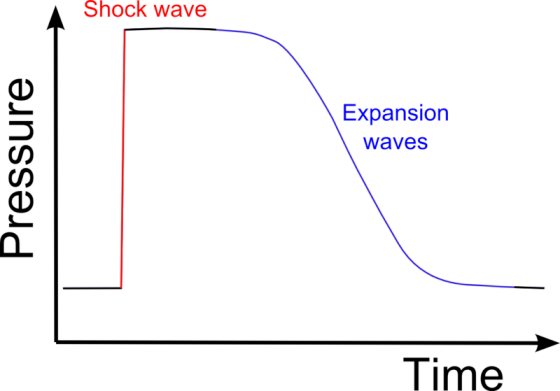
A shock wave is a type of propagating disturbance. Like an ordinary wave, it carries energy and can propagate through a medium (solid, liquid, or gas) or in some cases in the absence of a material medium, through a field such as the electromagnetic field. Shock waves are characterized by an abrupt, nearly discontinuous change in the characteristics of the medium. Across a shock, there is always an extremely rapid rise in pressure, temperature, and density of the flow. In supersonic flows, expansion is achieved through an expansion fan. A shock wave travels through most media at a higher speed than an ordinary wave.
When a shock wave passes through matter, the total energy is preserved but the energy that can be extracted as work decreases and entropy increases. This, for example, creates additional drag on aircraft with shocks.
Unlike solitons (another kind of nonlinear wave), the energy of a shock wave dissipates relatively quickly with distance. Also, the accompanying expansion wave approaches and eventually merges with the shock wave, partially canceling it out. Thus the sonic boom associated with the passage of a supersonic aircraft is the sound wave resulting from the degradation and merging of the shock wave and the expansion wave produced by the aircraft.
- Shock Front: An alternative name for the shock wave itself
- Contact Front: In a shock wave caused by a driver gas (for example the "impact" of a high explosive on the surrounding air), the boundary between the driver (explosive products) and the driven (air) gases. The Contact Front trails the Shock Front.
Examples
Moving shock
- It usually consists of a shockwave propagating into a stationary medium.
- In this case, the gas ahead of the shock is stationary, and the gas behind the shock is supersonic in the laboratory frame. The shock propagates with a wave front which is normal to the direction of flow. The speed of the shock is a function of the original pressure ratio between the two bodies of gas.
- Moving shocks are usually generated by the interaction of two bodies of gas at different pressure, with a shock wave propagating into the lower pressure gas, and an expansion wave propagating into the higher pressure gas.
- Examples include a balloon bursting, shock tube, and a shock wave from an explosion.
Detonation wave
- A detonation wave is essentially a shock supported by a trailing exothermic reaction. It involves a wave traveling through a highly combustible or chemically unstable medium, such as an oxygen-methane mixture or a high explosive. The chemical reaction of the medium occurs following the shock wave, and the chemical energy of the reaction drives the wave forward.
- A detonation wave follows slightly different rules from an ordinary shock since it is driven by the chemical reaction occurring behind the shock wave front. In the simplest theory for detonations, an unsupported, self-propagating detonation wave proceeds at the Chapman-Jouguet velocity. A detonation will also cause a shock of type 1, above to propagate into the surrounding air due to the overpressure induced by the explosion.
- When a shockwave is created by high explosives such as TNT (which has a detonation velocity of 6,900 m/s), it will always travel at high, supersonic velocity from its point of origin.
Detached shock
- Detached shocks are curved and form a small distance in front of the body. Directly in front of the body, they stand at 90 degrees to the oncoming flow and then curve around the body.
- Detached shocks allow the same type of analytic calculations as for the attached shock, for the flow near the shock. They are a topic of continuing interest, because the rules governing the shock's distance ahead of the blunt body are complicated, and are a function of the body's shape. Additionally, the shock standoff distance varies drastically with the temperature for a non-ideal gas, causing large differences in the heat transfer to the thermal protection system of the vehicle. These follow the "strong-shock" solutions of the analytic equations, meaning that for some oblique shocks very close to the deflection angle limit, the downstream Mach number is subsonic.
- A detached shock occurs when the maximum deflection angle is exceeded. A detached shock is commonly seen on blunt bodies, but it may also be seen on sharp bodies at low Mach numbers.
- Examples of detached shock include space return vehicles (Apollo, Space shuttle), bullets, the boundary (Bow shock) of a magnetosphere. The name "bow shock" comes from the example of a bow wave, the detached shock formed at the bow (front) of a ship or boat moving through water, whose slow surface wave speed is easily exceeded (see ocean surface wave).
Attached shock
- These shocks appear as "attached" to the tip of a sharp body moving at supersonic speeds.
- Examples: Supersonic wedges and cones with small apex angles.
- The attached shock wave is a classic structure in aerodynamics because, for a perfect gas and inviscid flow field, an analytic solution is available, such that the pressure ratio, temperature ratio, angle of the wedge and the downstream Mach number can all be calculated knowing the upstream Mach number and the shock angle. Smaller shock angles are associated with higher upstream Mach numbers, and the special case where the shock wave is at 90 degrees to the oncoming flow (Normal shock), is associated with a Mach number of one. These follow the "weak-shock" solutions of the analytic equations.
Recompression shock on a transonic flow airfoil, at and above critical Mach number.
Recompression shock
- These shocks appear when the flow over a transonic body is decelerated to subsonic speeds.
- Examples: Transonic wings, turbines
- Where the flow over the suction side of a transonic wing is accelerated to a supersonic speed, the resulting re-compression can be by either Prandtl-Meyer compression or by the formation of a normal shock. This shock is of particular interest to makers of transonic devices because it can cause separation of the boundary layer at the point where it touches the transonic profile. This can then lead to full separation and stall on the profile, higher drag, or shock-buffet, a condition where the separation and the shock interact in a resonance condition, causing resonating loads on the underlying structure.
Add Answer to:
Cara wants to know what could have caused this shockwave. Give an example of an event...
Give an example of a current event where context caused a problem. context within the subject...
Give an example of a current event where context caused a problem. context within the subject of TEAM BUILDING
Which event could have caused the following? Event #_ happens. As a result, the price of...
 Which event could have caused the following?
Event #_ happens. As a result, the price of coffee increases
with no change in the quantity of coffee sold.
Possible Events: 1 The price of coffee rises 2 The price of coffee falls 3 American Medical Association reports that drinking coffee causes cancer 4 American Medical Association reports that drinking coffee reduces cancer 5 Half of the coffee harvest turns out to be no good due to adverse weather conditions 16 Coffee...
Which event could have caused the following?
Event #_ happens. As a result, the price of coffee increases
with no change in the quantity of coffee sold.
Possible Events: 1 The price of coffee rises 2 The price of coffee falls 3 American Medical Association reports that drinking coffee causes cancer 4 American Medical Association reports that drinking coffee reduces cancer 5 Half of the coffee harvest turns out to be no good due to adverse weather conditions 16 Coffee...
Give an example of a cross-cultural negotiation event in which you have been involved or that...
Give an example of a cross-cultural negotiation event in which you have been involved or that you have read about in the news.
Which event could have caused the following? Event #_ happened. As a result, demand for coffee decreased. Possibl...
 Which event could have caused the following?
Event #_ happened. As a result, demand for coffee
decreased.
Possible Events:
1 The price of coffee rises
2 The price of coffee falls
3 American Medical Association reports that drinking coffee
causes cancer
4 American Medical Association reports that drinking coffee
reduces cancer
5 Half of the coffee harvest turns out to be no good due to
adverse weather conditions
6 Coffee harvests increase due to great weather
conditions
7 Half of...
Which event could have caused the following?
Event #_ happened. As a result, demand for coffee
decreased.
Possible Events:
1 The price of coffee rises
2 The price of coffee falls
3 American Medical Association reports that drinking coffee
causes cancer
4 American Medical Association reports that drinking coffee
reduces cancer
5 Half of the coffee harvest turns out to be no good due to
adverse weather conditions
6 Coffee harvests increase due to great weather
conditions
7 Half of...
a)Give an example of a data set that could have physical significance, but not statistical significance. b)What are thre...
a)Give an example of a data set that could have physical significance, but not statistical significance. b)What are three alternatives to null hypothesis testing?
1. Give a real-life example (either you or someone you know or an example you found...
1. Give a real-life example (either you or someone you know or an example you found online) of the alarm stage of GAS. 2. Give a real-life example of the resistance stage of GAS. 3. Define what the exhaustion stage of GAS could look like and use a real-life example.
Give an example of a negative or positive externality that you know about or have experienced....
Give an example of a negative or positive externality that you know about or have experienced. Once you have identified the externality, describe what is causing it and who it is effecting. Once you have done this, discuss the public policy or the private solution that is being applied to the negative or positive externality and discuss if it's working and how the externality is being internalized.
PLEASE GIVE ME AN EXAMPLE! HAVE to know: Dihybrid Crosses (2 genes), **KNOW the dihybrid F2...
PLEASE GIVE ME AN EXAMPLE! HAVE to know: Dihybrid Crosses (2 genes), **KNOW the dihybrid F2 phenotypic ratio is 9:3:3:1 (9/16dom/dom, 3/16 dom/rec, 3/16 rec/dom, 1/16 rec/rec) 1.- HAVE to know how to make a dihybrid Punnetts quare 2.- HAVE to know how to do 2 separate monohybrid Punnett squares and use the Product Law & Fork-Line Method to find phenotypic probabilities. Fork-Line Method to find phenotypic probabilities
Explain what synchronous rotation is. What is it caused by? Give an example. Answer: Synchronous rotation...
 Explain what synchronous rotation is. What is it caused by? Give an example. Answer: Synchronous rotation is when the rotational period of an object is the same as its orbital period around another object. As an object orbits another, it is stretched by the varying force of gravity across it. The resulting tidal bulges lag behind the rotational period becomes the same as the orbital period, at which point there is no longer any tidal friction and the rotational and...
Give an example of an event that might shift the supply of deposits to the banking...
Give an example of an event that might shift the supply of deposits to the banking industry and explain why this shift results.
 Which event could have caused the following?
Event #_ happens. As a result, the price of coffee increases
with no change in the quantity of coffee sold.
Possible Events: 1 The price of coffee rises 2 The price of coffee falls 3 American Medical Association reports that drinking coffee causes cancer 4 American Medical Association reports that drinking coffee reduces cancer 5 Half of the coffee harvest turns out to be no good due to adverse weather conditions 16 Coffee...
Which event could have caused the following?
Event #_ happens. As a result, the price of coffee increases
with no change in the quantity of coffee sold.
Possible Events: 1 The price of coffee rises 2 The price of coffee falls 3 American Medical Association reports that drinking coffee causes cancer 4 American Medical Association reports that drinking coffee reduces cancer 5 Half of the coffee harvest turns out to be no good due to adverse weather conditions 16 Coffee...
 Which event could have caused the following?
Event #_ happened. As a result, demand for coffee
decreased.
Possible Events:
1 The price of coffee rises
2 The price of coffee falls
3 American Medical Association reports that drinking coffee
causes cancer
4 American Medical Association reports that drinking coffee
reduces cancer
5 Half of the coffee harvest turns out to be no good due to
adverse weather conditions
6 Coffee harvests increase due to great weather
conditions
7 Half of...
Which event could have caused the following?
Event #_ happened. As a result, demand for coffee
decreased.
Possible Events:
1 The price of coffee rises
2 The price of coffee falls
3 American Medical Association reports that drinking coffee
causes cancer
4 American Medical Association reports that drinking coffee
reduces cancer
5 Half of the coffee harvest turns out to be no good due to
adverse weather conditions
6 Coffee harvests increase due to great weather
conditions
7 Half of...
 Explain what synchronous rotation is. What is it caused by? Give an example. Answer: Synchronous rotation is when the rotational period of an object is the same as its orbital period around another object. As an object orbits another, it is stretched by the varying force of gravity across it. The resulting tidal bulges lag behind the rotational period becomes the same as the orbital period, at which point there is no longer any tidal friction and the rotational and...
Most questions answered within 3 hours.
-
Where is the error in this code sequence?
String s1 = "Hello";
String s2 = "ello";...
asked 10 months ago -
Financial data for Joel de Paris, Inc., for last year
follow:
Joel de Paris, Inc.
Balance...
asked 10 months ago -
Consider this reaction:
Al2(SO4)3 (aq)+ BaCl3
(aq) Al2Cl6 (aq)- +
3BaSO4(s) . What is the...
asked 10 months ago -
Suppose that Savneet is considering increasing her
recent random sample from 20 car rentals to 40...
asked 10 months ago -
Trucks arrive at an unloading terminal at an average rate of 120
per hour.
Trucks arrive...
asked 10 months ago -
Why are methanol and ethanol completely soluble in water while
octanol is not very little soluble....
asked 10 months ago -
A facilities manager at a university reads in a research report
that the mean amount of...
asked 10 months ago -
When the CuSO4 is rehydrated by adding water to the anhydrous
compound, is this an endothermic...
asked 10 months ago -
A ray of sunlight is passing from diamond into crown glass; the
angle of incidence is...
asked 10 months ago -
A block of mass 0.249 kg is placed on top of a light, vertical
spring of...
asked 10 months ago -
how do the kidneys compensate in the presences of acidosis
a) trigger hyperventilate
b) reserve acid...
asked 10 months ago -
Question 501 pts
The rental rate of capital to the firm increases. Which of the
following...
asked 10 months ago