An Atwood's machine consists of masses m1 and m2, and a pulley of negligible mass and...
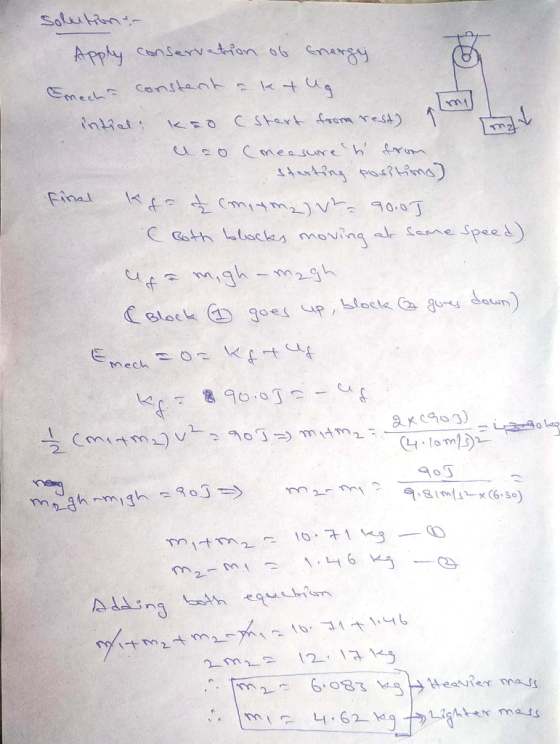
An Atwood's machine consists of masses m1 and m2, and a pulley of negligible mass and friction. Starting from rest, the speed of the two masses is 4.10 m/s at the end of 3.07 s. At that time, the kinetic energy of the system is 90.0 J and each mass has moved a distance of 6.30 m. Determine the lighter mass. Determine the heavier mass.
Homework Answers
Add Answer to:
An Atwood's machine consists of masses m1
and m2, and a pulley of negligible mass and...
A simple Atwood's machine uses two masses, m1 and m2. Starting from rest, the speed of...
A simple Atwood's machine uses two masses, m1 and m2. Starting from rest, the speed of the two masses is 8.0 m/s at the end of 4.0 s. At that instant, the kinetic energy of the system is 90 J and each mass has moved a distance of 16.0 m. Determine the values of m1 and m2. m1= m2=
A simple Atwood's machine uses two masses, m1 and m2. Starting from rest, the speed of...
 A simple Atwood's machine uses two masses, m1 and m2. Starting from rest, the speed of the two masses is 10.0 m/s at the end of 8.0 s. At that instant, the kinetic energy of the system is 90 J and each mass has moved a distance of 40.0 m. Determine the values of m1 and m2 kg m1 = kg
Conservative Forces and Potential Energy? A simple Atwood's machine uses two masses, m1 and m2. Starting...
Conservative Forces and Potential Energy? A simple Atwood's machine uses two masses, m1 and m2. Starting from rest, the speed of the two masses is 6 m/s at the end of 5 s. At that instant, the kinetic energy of the system is 67 J and each mass has moved a distance of 15 m. Determine the values of m1 and m2
Atwood's Machine An Atwood's machine consists of two masses, m1 and m2. connected by a string that passes over a pulley.
Atwood's Machine An Atwood's machine consists of two masses, m1 and m2. connected by a string that passes over a pulley. Part A If the pulley is a disk of radius R and mass M. find the acceleration of the masses.
An Atwood machine consists of two masses m1 and m2 (with m1 > m2 ) attached...
An Atwood machine consists of two masses m1 and m2 (with m1 > m2 ) attached to the ends of a light string that passes over a light, frictionless pulley. When the masses are released, the mass m1 is easily shown to accelerate down with an acceleration a = g*(m1+m2)/)m1−m2 Suppose that m and are measured as m1 = 100 +- 1 gram and m2 = 50 +- 1 gram. Derive a formula of uncertainty in the expected acceleration in...
In the Atwood machine shown below, m1 = 2.00 kg and m2 = 6.00 kg. The...
In the Atwood machine shown below, m1 = 2.00 kg and m2 = 6.00 kg. The masses of the pulley and string are negligible by comparison. The pulley turns without friction and the string does not stretch. The lighter object is released with a sharp push that sets it into motion at vi = 2.20 m/s downward. (a) How far will m1 descend below its initial level? 1 m In the Atwood machine shown below, m1 = 2.00 kg and...
4. A simple Atwood machine consists of two masses m1 and m2 that are connected by...
 4. A simple Atwood machine consists of two masses
m1 and m2 that are
connected by a string wound over a pulley, as seen in the figure
below. Assume m2 is larger than
m1. Motion in the upward direction is positive.
On a piece of paper, draw two free body diagrams; one for each of
the masses, showing all forces acting on each mass. Then answer the
following questions.
Suppose that m2 starts from rest at a height
of 7...
4. A simple Atwood machine consists of two masses
m1 and m2 that are
connected by a string wound over a pulley, as seen in the figure
below. Assume m2 is larger than
m1. Motion in the upward direction is positive.
On a piece of paper, draw two free body diagrams; one for each of
the masses, showing all forces acting on each mass. Then answer the
following questions.
Suppose that m2 starts from rest at a height
of 7...
An Atwood's machine consists of two masses, mi and m2, which are connected by a massless...
 An Atwood's machine consists of two masses, mi and m2, which are connected by a massless inelastic cord that passes over a pulley. If the pulley has radius R and moment of inertia I about its axle, determine the acceleration of the masses mi and m2, and compare to the situation in which the moment of inertia of the pulley is ignored. [Hint: The tensions FTI and FT2 are not necessarily equal.] T2
Two blocks m1 and m2 with masses 50 kg and 100 kg respectively are connected by...
Two blocks m1 and m2 with masses 50 kg and 100 kg respectively are connected by a string over a pulley that is frictionless with negligible mass. The 50 kg block slides on a 37 degree incline that has a coefficient of kinetic friction of 0.25. This block is also attached to a wall at the base of the incline by an ideal spring that has a spring coefficient of 100 N/m. The system is released from rest with a...
An Atwood's machine consists of two weights, m 3.4kg and m2 1.1 kg, connected by a by a string over a pulley of mas...
 An Atwood's machine consists of two weights, m 3.4kg and m2 1.1 kg, connected by a by a string over a pulley of mass mp-2.3 kg and radius r-0.28 m. Assume the pulley is a uniform solid cylinder (disk) 1m7 177 The system is released from rest when mj is 2.7 m above the floor, and m2 begins on the floor. Assume there is no friction in the pulley. Take the ground to be the location of zero GPE kg...
 A simple Atwood's machine uses two masses, m1 and m2. Starting from rest, the speed of the two masses is 10.0 m/s at the end of 8.0 s. At that instant, the kinetic energy of the system is 90 J and each mass has moved a distance of 40.0 m. Determine the values of m1 and m2 kg m1 = kg
 4. A simple Atwood machine consists of two masses
m1 and m2 that are
connected by a string wound over a pulley, as seen in the figure
below. Assume m2 is larger than
m1. Motion in the upward direction is positive.
On a piece of paper, draw two free body diagrams; one for each of
the masses, showing all forces acting on each mass. Then answer the
following questions.
Suppose that m2 starts from rest at a height
of 7...
4. A simple Atwood machine consists of two masses
m1 and m2 that are
connected by a string wound over a pulley, as seen in the figure
below. Assume m2 is larger than
m1. Motion in the upward direction is positive.
On a piece of paper, draw two free body diagrams; one for each of
the masses, showing all forces acting on each mass. Then answer the
following questions.
Suppose that m2 starts from rest at a height
of 7...
 An Atwood's machine consists of two masses, mi and m2, which are connected by a massless inelastic cord that passes over a pulley. If the pulley has radius R and moment of inertia I about its axle, determine the acceleration of the masses mi and m2, and compare to the situation in which the moment of inertia of the pulley is ignored. [Hint: The tensions FTI and FT2 are not necessarily equal.] T2
 An Atwood's machine consists of two weights, m 3.4kg and m2 1.1 kg, connected by a by a string over a pulley of mass mp-2.3 kg and radius r-0.28 m. Assume the pulley is a uniform solid cylinder (disk) 1m7 177 The system is released from rest when mj is 2.7 m above the floor, and m2 begins on the floor. Assume there is no friction in the pulley. Take the ground to be the location of zero GPE kg...
Most questions answered within 3 hours.
-
Where is the error in this code sequence?
String s1 = "Hello";
String s2 = "ello";...
asked 11 months ago -
Financial data for Joel de Paris, Inc., for last year
follow:
Joel de Paris, Inc.
Balance...
asked 11 months ago -
Consider this reaction:
Al2(SO4)3 (aq)+ BaCl3
(aq) Al2Cl6 (aq)- +
3BaSO4(s) . What is the...
asked 11 months ago -
Suppose that Savneet is considering increasing her
recent random sample from 20 car rentals to 40...
asked 11 months ago -
Trucks arrive at an unloading terminal at an average rate of 120
per hour.
Trucks arrive...
asked 11 months ago -
Why are methanol and ethanol completely soluble in water while
octanol is not very little soluble....
asked 11 months ago -
A facilities manager at a university reads in a research report
that the mean amount of...
asked 11 months ago -
When the CuSO4 is rehydrated by adding water to the anhydrous
compound, is this an endothermic...
asked 11 months ago -
A ray of sunlight is passing from diamond into crown glass; the
angle of incidence is...
asked 11 months ago -
A block of mass 0.249 kg is placed on top of a light, vertical
spring of...
asked 11 months ago -
how do the kidneys compensate in the presences of acidosis
a) trigger hyperventilate
b) reserve acid...
asked 11 months ago -
Question 501 pts
The rental rate of capital to the firm increases. Which of the
following...
asked 11 months ago