Consider a graph with distinct edge weights such that Prim and Kruskal select the edges of...
Consider a graph with distinct edge weights such that Prim and Kruskal select the edges of the spanning tree T in opposite order.
How must T look like?
Homework Answers
In kruskal's algorithm,we pick the edges in ascending order and
add them to the forest if no cycle is formed.The only reason for
emax to be present in the minimum spanning tree could be that it is
the only possible edge to cover a particular vertex in a tree since
all vertices have to cover a particular vertex in a tree since all
vertices have to be present in a spanning tree by the above
information.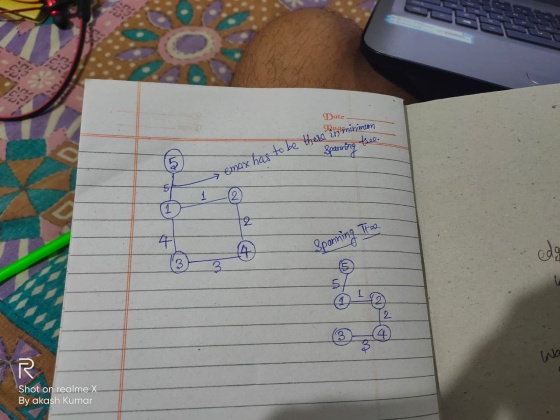
Add Answer to:
Consider a graph with distinct edge weights such that Prim and
Kruskal select the edges of...
Prove that in any graph with edge-weights that are distinct (no pair of edges exists with...
Prove that in any graph with edge-weights that are distinct (no pair of edges exists with the same weight), then both Prim and Kruskal must output the same MST, regardless of the starting node.
I need to write a small program in c++ that executes Kruskal or Prim algorithm whatever...
I need to write a small program in c++ that executes Kruskal or Prim algorithm whatever you want to do. It must ask for a graph and present at the end The minimum cost spanning tree that results from applying the algorithm. It can be presented as if it were a list of Vertices with ordered pairs that solve the edges. Kruskal or Prim will work with non-directed graphs.
Considering graph B above (to the right) which includes solid and dotted edges. the solid edges...
 Considering graph B above (to the right) which includes solid and dotted edges. the solid edges form a minimum spanning tree T of weight 26. Assign weights to the dotted edges such that: each edge weight is a positive integer tree T remains a minimum spanning tree and to other tree is also a minimum spanning tree of the graph each of the assigned dotted edge weights is minimal
Apply Prim and Kruskal algorithms to the following graph and find the minumum spanning tree. Strating...
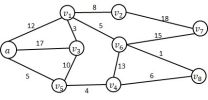 Apply Prim and Kruskal algorithms to the following
graph and find the minumum spanning tree.
Strating from vertex a and apply Dijkstra's algortihm
to find the shortest path from a to the other
vertexes.
00 a17
Apply Prim and Kruskal algorithms to the following
graph and find the minumum spanning tree.
Strating from vertex a and apply Dijkstra's algortihm
to find the shortest path from a to the other
vertexes.
00 a17
Run Prim (starting from vertex "f") and Kruskal algorithms on the graph below: 3 2 9...
 Run Prim (starting from vertex "f") and Kruskal algorithms on the graph below: 3 2 9 3 . (5 points) Prim's algorithm: draw a table that shows the vertices in the queue at each iteration, similar to example from the notes (2 points) Prim's algorithm: using the table from the first part, list the order in which edges are added to the tree (3 points) Kruskal's algorithm: list the order in which edges are added to the tree
1) Consider the graph to the left. (a) Assign the weights 1, 1,2,2,3,3,4,4 to the edges so that t...
 1) Consider the graph to the left. (a) Assign the weights 1, 1,2,2,3,3,4,4 to the edges so that the minimum weight spanning tree is unique b) Assign the weights 1, 1,2,2,3,3,4.4 to the edges so that the minimum weight spanning tree is not unique 2) Let x)S x-5 (a) Find the derivative f' of f. f (x) (-5)2 (b) Find an equation of the tangent Iine to the curve at the polnt (-1,- please answer both the questions..or else skip...
Consider the following weighted undirected graph.
 Consider the following weighted undirected graph. (a) Explain why edge (B, D) is safe. In other words, give a cut where the edge is the cheapest edge crossing the cut. (b) We would like to run the Kruskal's algorithm on this graph. List the edges appearing in the Minimum Spanning Tree (MST) in the order they are added to the MST. For simplicity, you can refer to each edge as its weight. (c) 1We would like to run the Prim's algorithm on this...
Please help me with this C++ I would like to create that uses a minimum spanning tree algorithm in C++. I would like the program to graph the edges with weights that are entered and will display the r...
Please help me with this C++ I would like to create that uses a minimum spanning tree algorithm in C++. I would like the program to graph the edges with weights that are entered and will display the results. The contribution of each line will speak to an undirected edge of an associated weighted chart. The edge will comprise of two unequal non-negative whole numbers in the range 0 to 99 speaking to diagram vertices that the edge interfaces. Each...
The weights of edges in a graph are shown in the table above. Find the minimum cost spanning tree on the graph above using Kruskal's algorithm.
 The weights of edges in a graph are shown in the table above. Find the minimum cost spanning tree on the graph above using Kruskal's algorithm. What is the total cost of the tree?
IN JAVA Given is a weighted undirected graph G = (V, E) with positive weights and...
IN JAVA Given is a weighted undirected graph G = (V, E) with positive weights and a subset of its edges F E. ⊆ E. An F-containing spanning tree of G is a spanning tree that contains all edges from F (there might be other edges as well). Give an algorithm that finds the cost of the minimum-cost F-containing spanning tree of G and runs in time O(m log n) or O(n2). Input: The first line of the text file...
 Considering graph B above (to the right) which includes solid and dotted edges. the solid edges form a minimum spanning tree T of weight 26. Assign weights to the dotted edges such that: each edge weight is a positive integer tree T remains a minimum spanning tree and to other tree is also a minimum spanning tree of the graph each of the assigned dotted edge weights is minimal
 Apply Prim and Kruskal algorithms to the following
graph and find the minumum spanning tree.
Strating from vertex a and apply Dijkstra's algortihm
to find the shortest path from a to the other
vertexes.
00 a17
Apply Prim and Kruskal algorithms to the following
graph and find the minumum spanning tree.
Strating from vertex a and apply Dijkstra's algortihm
to find the shortest path from a to the other
vertexes.
00 a17
 Run Prim (starting from vertex "f") and Kruskal algorithms on the graph below: 3 2 9 3 . (5 points) Prim's algorithm: draw a table that shows the vertices in the queue at each iteration, similar to example from the notes (2 points) Prim's algorithm: using the table from the first part, list the order in which edges are added to the tree (3 points) Kruskal's algorithm: list the order in which edges are added to the tree
 1) Consider the graph to the left. (a) Assign the weights 1, 1,2,2,3,3,4,4 to the edges so that the minimum weight spanning tree is unique b) Assign the weights 1, 1,2,2,3,3,4.4 to the edges so that the minimum weight spanning tree is not unique 2) Let x)S x-5 (a) Find the derivative f' of f. f (x) (-5)2 (b) Find an equation of the tangent Iine to the curve at the polnt (-1,- please answer both the questions..or else skip...
Most questions answered within 3 hours.
-
Where is the error in this code sequence?
String s1 = "Hello";
String s2 = "ello";...
asked 10 months ago -
Financial data for Joel de Paris, Inc., for last year
follow:
Joel de Paris, Inc.
Balance...
asked 10 months ago -
Consider this reaction:
Al2(SO4)3 (aq)+ BaCl3
(aq) Al2Cl6 (aq)- +
3BaSO4(s) . What is the...
asked 10 months ago -
Suppose that Savneet is considering increasing her
recent random sample from 20 car rentals to 40...
asked 10 months ago -
Trucks arrive at an unloading terminal at an average rate of 120
per hour.
Trucks arrive...
asked 10 months ago -
Why are methanol and ethanol completely soluble in water while
octanol is not very little soluble....
asked 10 months ago -
A facilities manager at a university reads in a research report
that the mean amount of...
asked 10 months ago -
When the CuSO4 is rehydrated by adding water to the anhydrous
compound, is this an endothermic...
asked 10 months ago -
A ray of sunlight is passing from diamond into crown glass; the
angle of incidence is...
asked 10 months ago -
A block of mass 0.249 kg is placed on top of a light, vertical
spring of...
asked 10 months ago -
how do the kidneys compensate in the presences of acidosis
a) trigger hyperventilate
b) reserve acid...
asked 10 months ago -
Question 501 pts
The rental rate of capital to the firm increases. Which of the
following...
asked 10 months ago