PROOFS: Use these theorems and others to prove these statements. Theorem 1: The sum of two...
PROOFS:
Use these theorems and others to prove these statements.
Theorem 1: The sum of two rational numbers is rational.
Theorem 2: The product of two rational numbers is rational.
Theorem 3: √ 2 is irrational.
Induction:
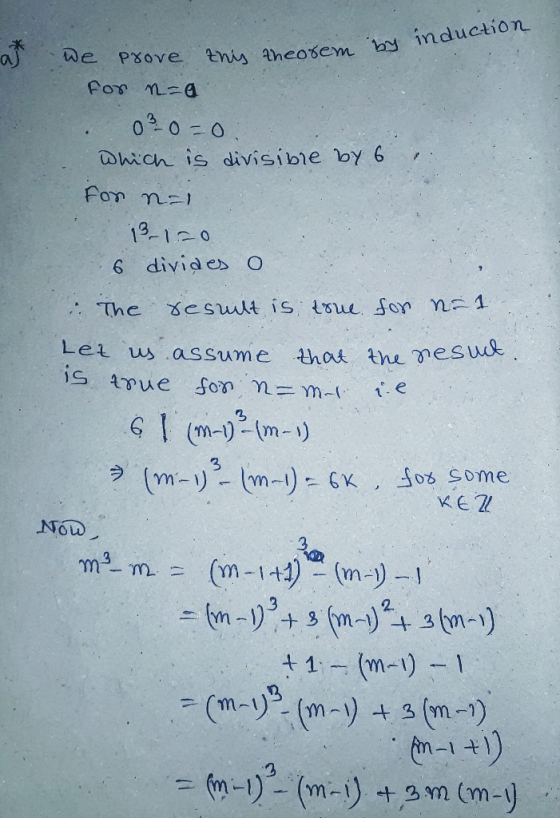
- Prove that 6 divides n 3 − n for any n ≥ 0
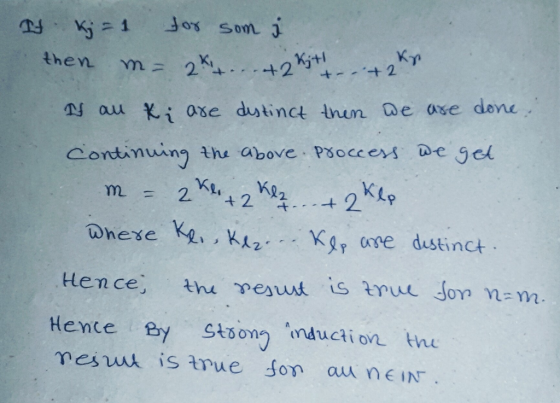
- Use strong induction to prove that every positive integer n can be written as the sum of distinct powers of 2. That is, prove that there exists a set of distinct integers, {k1, k2, . . . , km} where m ≥ 1, such that n = 2^(k1) + 2^(k2) + . . . + 2^(km).
Homework Answers

Add Answer to:
PROOFS:
Use these theorems and others to prove these statements.
Theorem 1: The sum of two...
For Exercises 1-15, prove or disprove the given statement. 1. The product of any three consecutive...
 For Exercises 1-15, prove or disprove the given
statement.
1. The product of any three consecutive integers is even.
2. The sum of any three consecutive integers is
even.
3. The product of an integer and its square is
even.
4. The sum of an integer and its cube is even.
5. Any positive integer can be written as the sum of
the squares of two integers.
6. For a positive integer
7. For every prime number n, n +...
For Exercises 1-15, prove or disprove the given
statement.
1. The product of any three consecutive integers is even.
2. The sum of any three consecutive integers is
even.
3. The product of an integer and its square is
even.
4. The sum of an integer and its cube is even.
5. Any positive integer can be written as the sum of
the squares of two integers.
6. For a positive integer
7. For every prime number n, n +...
Prove by strong induction that any nonzero natural number can be written as a sum of...
 Prove by strong induction that any nonzero natural number can be written as a sum of distinct powers of 2.
please prove 9.6 and 9.7 The next three theorems formalize what you may have discovered in...
 please prove 9.6 and 9.7
The next three theorems formalize what you may have discovered in the preceding group of questions. 9.6 Theorem. Let K be a positive integer Then, among any k real num- bers, there is a pair of them whose difference is within 1/K of being an integer When we take our collection of real numbers to be multiples of an ir- rational number, then we can find good rational approximations for the irrational number. Remember how...
please prove 9.6 and 9.7
The next three theorems formalize what you may have discovered in the preceding group of questions. 9.6 Theorem. Let K be a positive integer Then, among any k real num- bers, there is a pair of them whose difference is within 1/K of being an integer When we take our collection of real numbers to be multiples of an ir- rational number, then we can find good rational approximations for the irrational number. Remember how...
Proofs Use the following definitions and facts about integers in writing your proofs. . Suppose n...
 Proofs Use the following definitions and facts about integers in writing your proofs. . Suppose n є Z. We say n is odd if there exists k є Z such that n-2k + 1 . Suppose n є Z. We say n is even if there exists ke Z such that n-2k . Suppose m, n є Z and m -0. We say ma divides n (written mln) if there exists k Z such that n mk. is either ever...
(Assignment 4 - Strong Induction, Pigeon Hole Principle, Combinations and Permutations) Prove that if n +...
(Assignment 4 - Strong Induction, Pigeon Hole Principle, Combinations and Permutations) Prove that if n + 1 integers are selected from {1, 2, …, 2n}, then the selection includes integers a and b such that a divides b (that is there exists an integer k such that ak = b).
Induction proofs. a. Prove by induction: n sum i^3 = [n^2][(n+1)^2]/4 i=1 Note: sum is intended...
Induction proofs. a. Prove by induction: n sum i^3 = [n^2][(n+1)^2]/4 i=1 Note: sum is intended to be the summation symbol, and ^ means what follows is an exponent b. Prove by induction: n^2 - n is even for any n >= 1 10 points 6) Given: T(1) = 2 T(N) = T(N-1) + 3, N>1 What would the value of T(10) be? 7) For the problem above, is there a formula I could use that could directly calculate T(N)?...
please prove the theorems, thank you very much 8.21 Theorem. A natural numbern can be written...
 please prove the theorems,
thank you very much
8.21 Theorem. A natural numbern can be written as a sum of two squares of natural numbers if and only if every prime congruent to 3 modulo 4 in the unique prime factorization of n occurs to an even power Pythagorean triples revisited We are now in a position to describe the possible values for the hypotenuse in a primitive Pythagorean triple. 8.22 Theorem. If (a, h, e) is a primitive Pythagorean...
please prove the theorems,
thank you very much
8.21 Theorem. A natural numbern can be written as a sum of two squares of natural numbers if and only if every prime congruent to 3 modulo 4 in the unique prime factorization of n occurs to an even power Pythagorean triples revisited We are now in a position to describe the possible values for the hypotenuse in a primitive Pythagorean triple. 8.22 Theorem. If (a, h, e) is a primitive Pythagorean...
please prove lemma and theorems. 8.17 is not needed, thank you 8.15 Lemma. Let p be...
 please prove lemma and
theorems. 8.17 is not needed, thank you
8.15 Lemma. Let p be a prime and let a be a natural number not divisible by p. Then there exist integers x and y such that ax y (mod p) with 0xl.lyl 8.16 Theorem. Let p be a prime such that p (mod 4). Thenp is equal to the sum of two squares of natural numbers. (Hinl: Iry applying the previous lemma to a square root of- mohulo...
please prove lemma and
theorems. 8.17 is not needed, thank you
8.15 Lemma. Let p be a prime and let a be a natural number not divisible by p. Then there exist integers x and y such that ax y (mod p) with 0xl.lyl 8.16 Theorem. Let p be a prime such that p (mod 4). Thenp is equal to the sum of two squares of natural numbers. (Hinl: Iry applying the previous lemma to a square root of- mohulo...
Use strong induction to show that every positive integer can be written as a sum of...
Use strong induction to show that every positive integer can be written as a sum of distinct powers of two (i.e., 20 = 1; 21 = 2; 22 =4; 23 = 8; 24 = 16; :). For example: 19 = 16 + 2 + 1 = 2^4 + 2^1 + 2^0 Hint: For the inductive step, separately consider the case where k +1 is even and where it is odd. When it is even, note that (k + 1)=2 is...
answer question 5 please 3 and 4 are just included to refer to the theorems 3...
 answer question 5 please 3 and 4 are just included to
refer to the theorems
3 Prove the following theorem: Theorem 2.2. Let S be a ser. The following statements are equivalent: (1) S is a countable set, i. e. there exists an injective function :S (2) Either S is the empty ser 6 or there exists a surjective function g: N (3) Either S is a finite set or there exists a bijective function h: N S (4) Prove...
answer question 5 please 3 and 4 are just included to
refer to the theorems
3 Prove the following theorem: Theorem 2.2. Let S be a ser. The following statements are equivalent: (1) S is a countable set, i. e. there exists an injective function :S (2) Either S is the empty ser 6 or there exists a surjective function g: N (3) Either S is a finite set or there exists a bijective function h: N S (4) Prove...
 For Exercises 1-15, prove or disprove the given
statement.
1. The product of any three consecutive integers is even.
2. The sum of any three consecutive integers is
even.
3. The product of an integer and its square is
even.
4. The sum of an integer and its cube is even.
5. Any positive integer can be written as the sum of
the squares of two integers.
6. For a positive integer
7. For every prime number n, n +...
For Exercises 1-15, prove or disprove the given
statement.
1. The product of any three consecutive integers is even.
2. The sum of any three consecutive integers is
even.
3. The product of an integer and its square is
even.
4. The sum of an integer and its cube is even.
5. Any positive integer can be written as the sum of
the squares of two integers.
6. For a positive integer
7. For every prime number n, n +...
 Prove by strong induction that any nonzero natural number can be written as a sum of distinct powers of 2.
 please prove 9.6 and 9.7
The next three theorems formalize what you may have discovered in the preceding group of questions. 9.6 Theorem. Let K be a positive integer Then, among any k real num- bers, there is a pair of them whose difference is within 1/K of being an integer When we take our collection of real numbers to be multiples of an ir- rational number, then we can find good rational approximations for the irrational number. Remember how...
please prove 9.6 and 9.7
The next three theorems formalize what you may have discovered in the preceding group of questions. 9.6 Theorem. Let K be a positive integer Then, among any k real num- bers, there is a pair of them whose difference is within 1/K of being an integer When we take our collection of real numbers to be multiples of an ir- rational number, then we can find good rational approximations for the irrational number. Remember how...
 Proofs Use the following definitions and facts about integers in writing your proofs. . Suppose n є Z. We say n is odd if there exists k є Z such that n-2k + 1 . Suppose n є Z. We say n is even if there exists ke Z such that n-2k . Suppose m, n є Z and m -0. We say ma divides n (written mln) if there exists k Z such that n mk. is either ever...
 please prove the theorems,
thank you very much
8.21 Theorem. A natural numbern can be written as a sum of two squares of natural numbers if and only if every prime congruent to 3 modulo 4 in the unique prime factorization of n occurs to an even power Pythagorean triples revisited We are now in a position to describe the possible values for the hypotenuse in a primitive Pythagorean triple. 8.22 Theorem. If (a, h, e) is a primitive Pythagorean...
please prove the theorems,
thank you very much
8.21 Theorem. A natural numbern can be written as a sum of two squares of natural numbers if and only if every prime congruent to 3 modulo 4 in the unique prime factorization of n occurs to an even power Pythagorean triples revisited We are now in a position to describe the possible values for the hypotenuse in a primitive Pythagorean triple. 8.22 Theorem. If (a, h, e) is a primitive Pythagorean...
 please prove lemma and
theorems. 8.17 is not needed, thank you
8.15 Lemma. Let p be a prime and let a be a natural number not divisible by p. Then there exist integers x and y such that ax y (mod p) with 0xl.lyl 8.16 Theorem. Let p be a prime such that p (mod 4). Thenp is equal to the sum of two squares of natural numbers. (Hinl: Iry applying the previous lemma to a square root of- mohulo...
please prove lemma and
theorems. 8.17 is not needed, thank you
8.15 Lemma. Let p be a prime and let a be a natural number not divisible by p. Then there exist integers x and y such that ax y (mod p) with 0xl.lyl 8.16 Theorem. Let p be a prime such that p (mod 4). Thenp is equal to the sum of two squares of natural numbers. (Hinl: Iry applying the previous lemma to a square root of- mohulo...
 answer question 5 please 3 and 4 are just included to
refer to the theorems
3 Prove the following theorem: Theorem 2.2. Let S be a ser. The following statements are equivalent: (1) S is a countable set, i. e. there exists an injective function :S (2) Either S is the empty ser 6 or there exists a surjective function g: N (3) Either S is a finite set or there exists a bijective function h: N S (4) Prove...
answer question 5 please 3 and 4 are just included to
refer to the theorems
3 Prove the following theorem: Theorem 2.2. Let S be a ser. The following statements are equivalent: (1) S is a countable set, i. e. there exists an injective function :S (2) Either S is the empty ser 6 or there exists a surjective function g: N (3) Either S is a finite set or there exists a bijective function h: N S (4) Prove...
Most questions answered within 3 hours.
-
Where is the error in this code sequence?
String s1 = "Hello";
String s2 = "ello";...
asked 10 months ago -
Financial data for Joel de Paris, Inc., for last year
follow:
Joel de Paris, Inc.
Balance...
asked 10 months ago -
Consider this reaction:
Al2(SO4)3 (aq)+ BaCl3
(aq) Al2Cl6 (aq)- +
3BaSO4(s) . What is the...
asked 10 months ago -
Suppose that Savneet is considering increasing her
recent random sample from 20 car rentals to 40...
asked 10 months ago -
Trucks arrive at an unloading terminal at an average rate of 120
per hour.
Trucks arrive...
asked 10 months ago -
Why are methanol and ethanol completely soluble in water while
octanol is not very little soluble....
asked 10 months ago -
A facilities manager at a university reads in a research report
that the mean amount of...
asked 10 months ago -
When the CuSO4 is rehydrated by adding water to the anhydrous
compound, is this an endothermic...
asked 10 months ago -
A ray of sunlight is passing from diamond into crown glass; the
angle of incidence is...
asked 10 months ago -
A block of mass 0.249 kg is placed on top of a light, vertical
spring of...
asked 10 months ago -
how do the kidneys compensate in the presences of acidosis
a) trigger hyperventilate
b) reserve acid...
asked 10 months ago -
Question 501 pts
The rental rate of capital to the firm increases. Which of the
following...
asked 10 months ago