
Homework Answers
Add Answer to:
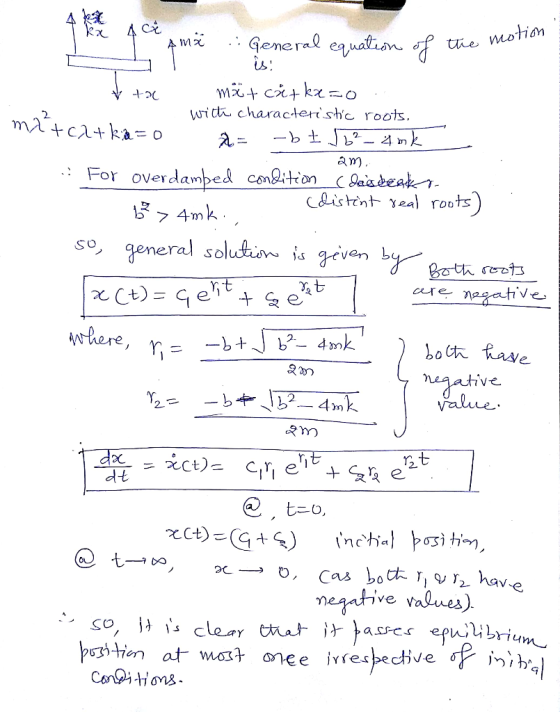
What is the general solution for overdamped motion equation? Show that the mass can pass through...
A spring-mass-dashpot system for the motion of a block of mass m kg is shown in...
 A spring-mass-dashpot system for the motion of a block of mass m kg is shown in Fig. II-2. The block is moved to the right of the equilibrium position and is released from rest (time t = 0) when its displacement, x = XO. Using the notations given in Fig. II-2,4 (1) Draw the free body diagram of the block - (2) Write the equation of motion of the block- If the initial displacement of the block to the right...
A spring-mass-dashpot system for the motion of a block of mass m kg is shown in...
 A spring-mass-dashpot system for the motion of a block of mass m kg is shown in Fig. II-2. The block is moved to the right of the equilibrium position and is released from rest (time t = 0) when its displacement, x = XO. Using the notations given in Fig. II-2,4 (1) Draw the free body diagram of the block - (2) Write the equation of motion of the block- If the initial displacement of the block to the right...
5. A 2 kg mass is attached to a spring whose constant is 30 N/m, and the entire system is submerg...
 5. A 2 kg mass is attached to a spring whose constant is 30 N/m, and the entire system is submerged in a liquid that imparts a damping force equal to 12 times the instaataneous velocity (a) Write the second-order linear differential equation to umodel the motion (b) Convert the second-order linear differential equation from part (a) to a first-order linear system (c) Classify the critical (equilibrium) point (0.0) (d) Sketch the phase portrait (e) Indicate the initial condition x(0)-(...
1. The change of position of the center of mass of a rigid body in a mechanical system is being monitored. At time t 0, when the initial conditions of the system were x = 0.1 m and x -0m/s, a ste...
 1. The change of position of the center of mass of a rigid body in a mechanical system is being monitored. At time t 0, when the initial conditions of the system were x = 0.1 m and x -0m/s, a step input of size 10 N began to apply to the system. The response of the system was represented by this differential equation: 2r + 110x + 500 x = 10 a) Write the order of the system, its...
64 The general procedure for the solution of motion-impending friction problems in this text invo...
 64 The general procedure for the solution of motion-impending friction problems in this text involves drawing the free-body diagram and deciding which way motion is impending. This is followed by the application of Equation (6.2) and the equa- tions of force equilibrium for concurrent force systems, or the equations of force equilibrium and moment equilibrium for noncurrent force systems. ccil ull the e Darts, the iCieht thread. The lead angle is calculated from lead, and mean radius of the θ...
How to answer all of this? Soalan Consider a particle attached to a spring executing a...
 How to answer all of this?
Soalan Consider a particle attached to a spring executing a motion x Asin(ot +0) with A 0.32 m,t 0, x= -0.07 m and a velocity -2 m/s. The total energy is 5.6 J.Determine, A-0324 Pertimbangkan partike! yang dipasangkan pada pegar melakranakan gerakan xAsin (at0 dengan A 0.32 m, 0 a berada pada x = 0.07 m dan halaju-2 m/ V=-L Jumlah tenaga adalah 5.6 J. Tentukan (i) phase, 0.22 a fasa e (5 Marks/Markah)...
How to answer all of this?
Soalan Consider a particle attached to a spring executing a motion x Asin(ot +0) with A 0.32 m,t 0, x= -0.07 m and a velocity -2 m/s. The total energy is 5.6 J.Determine, A-0324 Pertimbangkan partike! yang dipasangkan pada pegar melakranakan gerakan xAsin (at0 dengan A 0.32 m, 0 a berada pada x = 0.07 m dan halaju-2 m/ V=-L Jumlah tenaga adalah 5.6 J. Tentukan (i) phase, 0.22 a fasa e (5 Marks/Markah)...
Assume that a mass m satisfies m (d2x/dr) =-x2. 21.3. (c) Using a phase plane analysis, show that for most initial conditions the mass eventually tends towards -oo. Is that reasonable? However, show...
 Assume that a mass m satisfies m (d2x/dr) =-x2. 21.3. (c) Using a phase plane analysis, show that for most initial conditions the mass eventually tends towards -oo. Is that reasonable? However, show that for certain initial conditions the mass tends towards its equilibrium position. (d) How long does t take that solution to approach the equilibrium position? Would you say the equilibrium solution is stable or unstable? (e)
Assume that a mass m satisfies m (d2x/dr) =-x2. 21.3.
(c)...
Assume that a mass m satisfies m (d2x/dr) =-x2. 21.3. (c) Using a phase plane analysis, show that for most initial conditions the mass eventually tends towards -oo. Is that reasonable? However, show that for certain initial conditions the mass tends towards its equilibrium position. (d) How long does t take that solution to approach the equilibrium position? Would you say the equilibrium solution is stable or unstable? (e)
Assume that a mass m satisfies m (d2x/dr) =-x2. 21.3.
(c)...
6. A mass of 2 kilogram is attached to a spring whose constant is 4 N/m, and the entire system is...
 6. A mass of 2 kilogram is attached to a spring whose constant is 4 N/m, and the entire system is then submerged in a liquid that inparts a damping force equal to 4 tines the instantansous velocity. At t = 0 the mass is released from the equilibrium position with no initial velocity. An external force t)4t-3) is applied. (a) Write (t), the external force, as a piecewise function and sketch its graph b) Write the initial-value problem (c)Solve...
I will rate 5 stars for proper solution. A) Homework week 3-2 Q1. The center of...
 I will rate 5 stars for proper solution.
A) Homework week 3-2 Q1. The center of the disk in the figure is displaced a distance 8 5 cm from its equilibrium position and released. Determine x(t)-A cos(ant + ?) if the disk rolls without slip. The area moment of inertia of disk is 10-2 mr2. Given m = 10 kg, k = 60 N/m, r 50 cm. (HINT: Derive the equation of motion first. The initial velocity is zero.) Thin...
I will rate 5 stars for proper solution.
A) Homework week 3-2 Q1. The center of the disk in the figure is displaced a distance 8 5 cm from its equilibrium position and released. Determine x(t)-A cos(ant + ?) if the disk rolls without slip. The area moment of inertia of disk is 10-2 mr2. Given m = 10 kg, k = 60 N/m, r 50 cm. (HINT: Derive the equation of motion first. The initial velocity is zero.) Thin...
5. (20 points) A mass weighing 8 pounds stretches a spring 1.6 feet. The entire system...
 5. (20 points) A mass weighing 8 pounds stretches a spring 1.6 feet. The entire system is placed in a medium that offers a damping force numerically equivalent to twice the instantaneous velocity. The mass is initially released from a point 1/2 foot above the equilibrium point with a downward velocity of 5 ft/sec. (a) (6 points) Write the differential equation for the mass/spring system and identify the initial conditions. 7 5. (b) (12 points) Solve the IVP in part...
 A spring-mass-dashpot system for the motion of a block of mass m kg is shown in Fig. II-2. The block is moved to the right of the equilibrium position and is released from rest (time t = 0) when its displacement, x = XO. Using the notations given in Fig. II-2,4 (1) Draw the free body diagram of the block - (2) Write the equation of motion of the block- If the initial displacement of the block to the right...
 A spring-mass-dashpot system for the motion of a block of mass m kg is shown in Fig. II-2. The block is moved to the right of the equilibrium position and is released from rest (time t = 0) when its displacement, x = XO. Using the notations given in Fig. II-2,4 (1) Draw the free body diagram of the block - (2) Write the equation of motion of the block- If the initial displacement of the block to the right...
 5. A 2 kg mass is attached to a spring whose constant is 30 N/m, and the entire system is submerged in a liquid that imparts a damping force equal to 12 times the instaataneous velocity (a) Write the second-order linear differential equation to umodel the motion (b) Convert the second-order linear differential equation from part (a) to a first-order linear system (c) Classify the critical (equilibrium) point (0.0) (d) Sketch the phase portrait (e) Indicate the initial condition x(0)-(...
 1. The change of position of the center of mass of a rigid body in a mechanical system is being monitored. At time t 0, when the initial conditions of the system were x = 0.1 m and x -0m/s, a step input of size 10 N began to apply to the system. The response of the system was represented by this differential equation: 2r + 110x + 500 x = 10 a) Write the order of the system, its...
 64 The general procedure for the solution of motion-impending friction problems in this text involves drawing the free-body diagram and deciding which way motion is impending. This is followed by the application of Equation (6.2) and the equa- tions of force equilibrium for concurrent force systems, or the equations of force equilibrium and moment equilibrium for noncurrent force systems. ccil ull the e Darts, the iCieht thread. The lead angle is calculated from lead, and mean radius of the θ...
 How to answer all of this?
Soalan Consider a particle attached to a spring executing a motion x Asin(ot +0) with A 0.32 m,t 0, x= -0.07 m and a velocity -2 m/s. The total energy is 5.6 J.Determine, A-0324 Pertimbangkan partike! yang dipasangkan pada pegar melakranakan gerakan xAsin (at0 dengan A 0.32 m, 0 a berada pada x = 0.07 m dan halaju-2 m/ V=-L Jumlah tenaga adalah 5.6 J. Tentukan (i) phase, 0.22 a fasa e (5 Marks/Markah)...
How to answer all of this?
Soalan Consider a particle attached to a spring executing a motion x Asin(ot +0) with A 0.32 m,t 0, x= -0.07 m and a velocity -2 m/s. The total energy is 5.6 J.Determine, A-0324 Pertimbangkan partike! yang dipasangkan pada pegar melakranakan gerakan xAsin (at0 dengan A 0.32 m, 0 a berada pada x = 0.07 m dan halaju-2 m/ V=-L Jumlah tenaga adalah 5.6 J. Tentukan (i) phase, 0.22 a fasa e (5 Marks/Markah)...
 Assume that a mass m satisfies m (d2x/dr) =-x2. 21.3. (c) Using a phase plane analysis, show that for most initial conditions the mass eventually tends towards -oo. Is that reasonable? However, show that for certain initial conditions the mass tends towards its equilibrium position. (d) How long does t take that solution to approach the equilibrium position? Would you say the equilibrium solution is stable or unstable? (e)
Assume that a mass m satisfies m (d2x/dr) =-x2. 21.3.
(c)...
Assume that a mass m satisfies m (d2x/dr) =-x2. 21.3. (c) Using a phase plane analysis, show that for most initial conditions the mass eventually tends towards -oo. Is that reasonable? However, show that for certain initial conditions the mass tends towards its equilibrium position. (d) How long does t take that solution to approach the equilibrium position? Would you say the equilibrium solution is stable or unstable? (e)
Assume that a mass m satisfies m (d2x/dr) =-x2. 21.3.
(c)...
 6. A mass of 2 kilogram is attached to a spring whose constant is 4 N/m, and the entire system is then submerged in a liquid that inparts a damping force equal to 4 tines the instantansous velocity. At t = 0 the mass is released from the equilibrium position with no initial velocity. An external force t)4t-3) is applied. (a) Write (t), the external force, as a piecewise function and sketch its graph b) Write the initial-value problem (c)Solve...
 I will rate 5 stars for proper solution.
A) Homework week 3-2 Q1. The center of the disk in the figure is displaced a distance 8 5 cm from its equilibrium position and released. Determine x(t)-A cos(ant + ?) if the disk rolls without slip. The area moment of inertia of disk is 10-2 mr2. Given m = 10 kg, k = 60 N/m, r 50 cm. (HINT: Derive the equation of motion first. The initial velocity is zero.) Thin...
I will rate 5 stars for proper solution.
A) Homework week 3-2 Q1. The center of the disk in the figure is displaced a distance 8 5 cm from its equilibrium position and released. Determine x(t)-A cos(ant + ?) if the disk rolls without slip. The area moment of inertia of disk is 10-2 mr2. Given m = 10 kg, k = 60 N/m, r 50 cm. (HINT: Derive the equation of motion first. The initial velocity is zero.) Thin...
 5. (20 points) A mass weighing 8 pounds stretches a spring 1.6 feet. The entire system is placed in a medium that offers a damping force numerically equivalent to twice the instantaneous velocity. The mass is initially released from a point 1/2 foot above the equilibrium point with a downward velocity of 5 ft/sec. (a) (6 points) Write the differential equation for the mass/spring system and identify the initial conditions. 7 5. (b) (12 points) Solve the IVP in part...
Most questions answered within 3 hours.
-
Where is the error in this code sequence?
String s1 = "Hello";
String s2 = "ello";...
asked 10 months ago -
Financial data for Joel de Paris, Inc., for last year
follow:
Joel de Paris, Inc.
Balance...
asked 10 months ago -
Consider this reaction:
Al2(SO4)3 (aq)+ BaCl3
(aq) Al2Cl6 (aq)- +
3BaSO4(s) . What is the...
asked 10 months ago -
Suppose that Savneet is considering increasing her
recent random sample from 20 car rentals to 40...
asked 10 months ago -
Trucks arrive at an unloading terminal at an average rate of 120
per hour.
Trucks arrive...
asked 10 months ago -
Why are methanol and ethanol completely soluble in water while
octanol is not very little soluble....
asked 10 months ago -
A facilities manager at a university reads in a research report
that the mean amount of...
asked 10 months ago -
When the CuSO4 is rehydrated by adding water to the anhydrous
compound, is this an endothermic...
asked 10 months ago -
A ray of sunlight is passing from diamond into crown glass; the
angle of incidence is...
asked 10 months ago -
A block of mass 0.249 kg is placed on top of a light, vertical
spring of...
asked 10 months ago -
how do the kidneys compensate in the presences of acidosis
a) trigger hyperventilate
b) reserve acid...
asked 10 months ago -
Question 501 pts
The rental rate of capital to the firm increases. Which of the
following...
asked 10 months ago