
Homework Answers
Add Answer to:
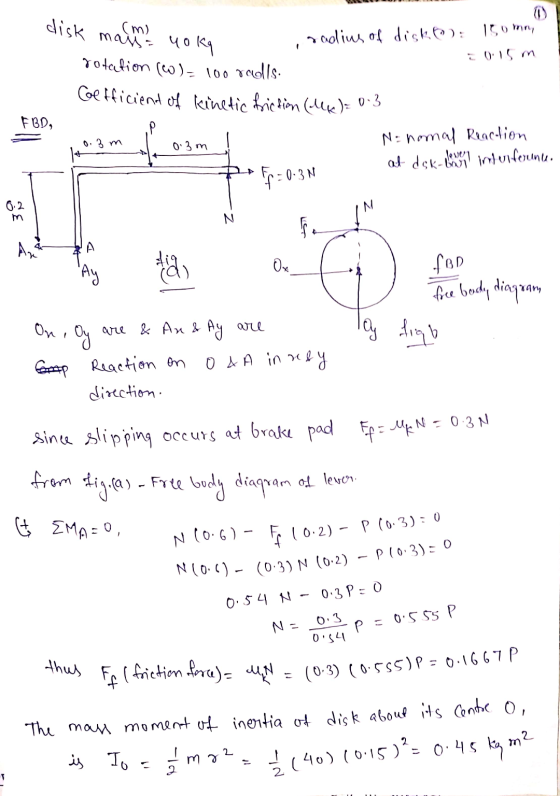
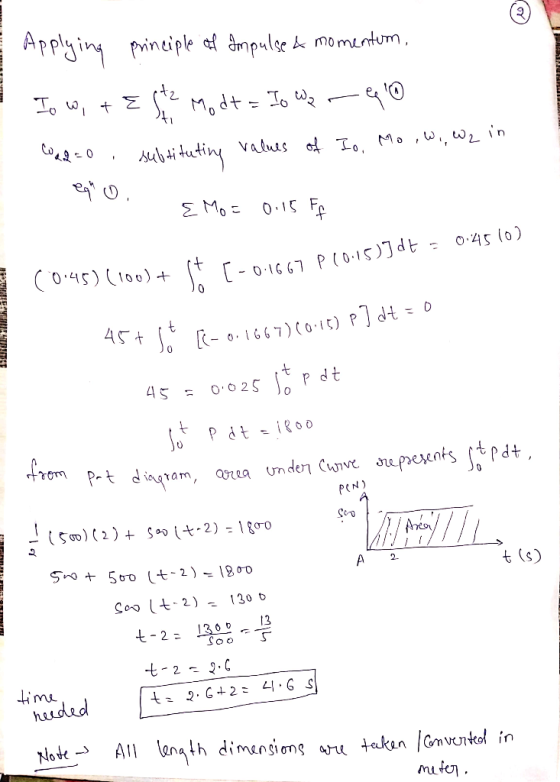
P (N) The 40-kg disk is rotating at o = 100 rad/s. When the force P...
The 42-kg disk is rotating at w = 110 rad/s. When the force P is applied...
 The 42-kg disk is rotating at w = 110 rad/s. When the force P is applied to the brake as indicated by the graph. The coefficient of kinetic friction at B is mu_k = 0.5. Neglect the thickness of the brake. (Figure 1) Determine the time t needed to stay the disk from rotating. Express your answer to three significant figures and include the appropriate units.
E MC422_TEST2_2020.pc x + V € → O o file:///C/Users/Muham/Downloads/MC422_TEST2_2020.pdf 2 of 5 10 - +...
 E MC422_TEST2_2020.pc x + V € → O o file:///C/Users/Muham/Downloads/MC422_TEST2_2020.pdf 2 of 5 10 - + Fit to page Page view A Reac aliud Add reites E Question #1. (10 marks) 160 mm 800 mm The speed of a rotating system is controlled with a brake as shown. 100 mm The drum A has a mass of 300 kg and a radius of gyration about the centre of rotation of ke-200 mm. The kinetic coefficient of friction between the brake...
6. Band Brake A differential band brake is used to control the speed of a drum...
 6. Band Brake A differential band brake is used to control the speed of a drum which rotates at a constant speed. Knowing that the coefficient of kinetic friction between the belt and the drum is 0.30 and that a couple of magnitude 150 N.m is applied to the drum, determine the corresponding magnitude of the force P that is exerted on end D of the lever when the drum is rotating (a) clockwise, (b) counterclockwise. r 140 mm 30...
Question 7 8 pts A disk is rotating at 21 rad/s counter-clockwise about its center and...
 Question 7 8 pts A disk is rotating at 21 rad/s counter-clockwise about its center and a constant angular acceleration of 4 rad/s? is applied to it clockwise. After 0.69 seconds, what is its rotational kinetic energy about its center if c 1/2, the mass of the disk is 4 kg, and its radius is 0.74 meters? Answer in Joules.
A stationary bicycle is raised off the ground, and its front wheel (m = 1.3 kg)...
A stationary bicycle is raised off the ground, and its front wheel (m = 1.3 kg) is rotating at an angular velocity of 14.2 rad/s (see the drawing). The front brake is then applied for 3.0 s, and the wheel slows down to 3.2 rad/s. Assume that all the mass of the wheel is concentrated in the rim, the radius of which is 0.34 m. The coefficient of kinetic friction between each brake pad and the rim is μk =...
A stationary bicycle is raised off the ground, and its front wheel (m = 1.44 kg)...
A stationary bicycle is raised off the ground, and its front wheel (m = 1.44 kg) is rotating at an angular velocity of 20.8 rad/s (see the figure). The front brake is then applied for 2.83 s, and the wheel slows down to 2.08 rad/s. Assume that all the mass of the wheel is concentrated in the rim, the radius of which is 0.330 m. The coefficient of kinetic friction between each brake pad and the rim is μk =...
Figure shows a disk with moment of inertia J=0.5 kg-m2 that is initially rotating at an...
 Figure shows a disk with moment of inertia J=0.5 kg-m2 that is initially rotating at an angular velocity 0 0 = 40 rad/s. A flexible shaft with torsional spring constant k = 65 N-m/rad connected to the disk. The disk is subjected to friction, which is modeled by linear viscous friction torque bò, with friction coefficient b = 1.0 N-m-s/rad. The input torque in the clockwise direction is a step function Tin(t) = 3.0U(t) N-m. Flexible shaft, k Disk Viscous...
As shown in Fig. 3, a homogenous disk of mass m = 3.5 kg rotates at...
 As shown in Fig. 3, a homogenous disk of mass m = 3.5 kg rotates
at the constant rate ?1 = 15 rad/s with respect to arm ABC, which
is welded to a shaft DCE rotating at the constant rate ?2 = 8.5
rad/s. Determine (a) the angular momentum of the disc about point C
(b) the couple of body representing the dynamic reactions at
supports D and E and (c) the kinetic energy of the system. Both
angular momentum...
As shown in Fig. 3, a homogenous disk of mass m = 3.5 kg rotates
at the constant rate ?1 = 15 rad/s with respect to arm ABC, which
is welded to a shaft DCE rotating at the constant rate ?2 = 8.5
rad/s. Determine (a) the angular momentum of the disc about point C
(b) the couple of body representing the dynamic reactions at
supports D and E and (c) the kinetic energy of the system. Both
angular momentum...
The 50-kg flywheel has a radius of gyration about its center of mass of ko= 250mm....
 The 50-kg flywheel has a radius of gyration about its center of
mass of ko= 250mm. It rotates with a constant angular velocity of
120rev/min before the brake is applied. If the coefficient of
kinetic friction between the brake pad B and the wheel’s rim is ?k=
0.5, and a force of P = 300 N is applied to the braking mechanism’s
handle, determine the time required to stop the wheel.
0.5 m 1 m 0.2 m 0.3 m
The 50-kg flywheel has a radius of gyration about its center of
mass of ko= 250mm. It rotates with a constant angular velocity of
120rev/min before the brake is applied. If the coefficient of
kinetic friction between the brake pad B and the wheel’s rim is ?k=
0.5, and a force of P = 300 N is applied to the braking mechanism’s
handle, determine the time required to stop the wheel.
0.5 m 1 m 0.2 m 0.3 m
A potter's wheel—a thick stone disk of radius 0.500 m and mass 125 kg—is freely rotating...
A potter's wheel—a thick stone disk of radius 0.500 m and mass 125 kg—is freely rotating at 50.0 rev/min. The potter can stop the wheel in 6.00 s by pressing a wet rag against the rim and exerting a radially inward force of 71.0 N. Find the effective coefficient of kinetic friction between the wheel and rag.
 The 42-kg disk is rotating at w = 110 rad/s. When the force P is applied to the brake as indicated by the graph. The coefficient of kinetic friction at B is mu_k = 0.5. Neglect the thickness of the brake. (Figure 1) Determine the time t needed to stay the disk from rotating. Express your answer to three significant figures and include the appropriate units.
 E MC422_TEST2_2020.pc x + V € → O o file:///C/Users/Muham/Downloads/MC422_TEST2_2020.pdf 2 of 5 10 - + Fit to page Page view A Reac aliud Add reites E Question #1. (10 marks) 160 mm 800 mm The speed of a rotating system is controlled with a brake as shown. 100 mm The drum A has a mass of 300 kg and a radius of gyration about the centre of rotation of ke-200 mm. The kinetic coefficient of friction between the brake...
 6. Band Brake A differential band brake is used to control the speed of a drum which rotates at a constant speed. Knowing that the coefficient of kinetic friction between the belt and the drum is 0.30 and that a couple of magnitude 150 N.m is applied to the drum, determine the corresponding magnitude of the force P that is exerted on end D of the lever when the drum is rotating (a) clockwise, (b) counterclockwise. r 140 mm 30...
 Question 7 8 pts A disk is rotating at 21 rad/s counter-clockwise about its center and a constant angular acceleration of 4 rad/s? is applied to it clockwise. After 0.69 seconds, what is its rotational kinetic energy about its center if c 1/2, the mass of the disk is 4 kg, and its radius is 0.74 meters? Answer in Joules.
 Figure shows a disk with moment of inertia J=0.5 kg-m2 that is initially rotating at an angular velocity 0 0 = 40 rad/s. A flexible shaft with torsional spring constant k = 65 N-m/rad connected to the disk. The disk is subjected to friction, which is modeled by linear viscous friction torque bò, with friction coefficient b = 1.0 N-m-s/rad. The input torque in the clockwise direction is a step function Tin(t) = 3.0U(t) N-m. Flexible shaft, k Disk Viscous...
 As shown in Fig. 3, a homogenous disk of mass m = 3.5 kg rotates
at the constant rate ?1 = 15 rad/s with respect to arm ABC, which
is welded to a shaft DCE rotating at the constant rate ?2 = 8.5
rad/s. Determine (a) the angular momentum of the disc about point C
(b) the couple of body representing the dynamic reactions at
supports D and E and (c) the kinetic energy of the system. Both
angular momentum...
As shown in Fig. 3, a homogenous disk of mass m = 3.5 kg rotates
at the constant rate ?1 = 15 rad/s with respect to arm ABC, which
is welded to a shaft DCE rotating at the constant rate ?2 = 8.5
rad/s. Determine (a) the angular momentum of the disc about point C
(b) the couple of body representing the dynamic reactions at
supports D and E and (c) the kinetic energy of the system. Both
angular momentum...
 The 50-kg flywheel has a radius of gyration about its center of
mass of ko= 250mm. It rotates with a constant angular velocity of
120rev/min before the brake is applied. If the coefficient of
kinetic friction between the brake pad B and the wheel’s rim is ?k=
0.5, and a force of P = 300 N is applied to the braking mechanism’s
handle, determine the time required to stop the wheel.
0.5 m 1 m 0.2 m 0.3 m
The 50-kg flywheel has a radius of gyration about its center of
mass of ko= 250mm. It rotates with a constant angular velocity of
120rev/min before the brake is applied. If the coefficient of
kinetic friction between the brake pad B and the wheel’s rim is ?k=
0.5, and a force of P = 300 N is applied to the braking mechanism’s
handle, determine the time required to stop the wheel.
0.5 m 1 m 0.2 m 0.3 m
Most questions answered within 3 hours.
-
Where is the error in this code sequence?
String s1 = "Hello";
String s2 = "ello";...
asked 11 months ago -
Financial data for Joel de Paris, Inc., for last year
follow:
Joel de Paris, Inc.
Balance...
asked 11 months ago -
Consider this reaction:
Al2(SO4)3 (aq)+ BaCl3
(aq) Al2Cl6 (aq)- +
3BaSO4(s) . What is the...
asked 11 months ago -
Suppose that Savneet is considering increasing her
recent random sample from 20 car rentals to 40...
asked 11 months ago -
Trucks arrive at an unloading terminal at an average rate of 120
per hour.
Trucks arrive...
asked 11 months ago -
Why are methanol and ethanol completely soluble in water while
octanol is not very little soluble....
asked 11 months ago -
A facilities manager at a university reads in a research report
that the mean amount of...
asked 11 months ago -
When the CuSO4 is rehydrated by adding water to the anhydrous
compound, is this an endothermic...
asked 11 months ago -
A ray of sunlight is passing from diamond into crown glass; the
angle of incidence is...
asked 11 months ago -
A block of mass 0.249 kg is placed on top of a light, vertical
spring of...
asked 11 months ago -
how do the kidneys compensate in the presences of acidosis
a) trigger hyperventilate
b) reserve acid...
asked 11 months ago -
Question 501 pts
The rental rate of capital to the firm increases. Which of the
following...
asked 11 months ago