
Homework Answers
This can be solve using the residue() function in MATLAB.
Here's how to use it
![b[3 1]; a - [1 3 2]; [r,p,k] - residue(b,a) 1 2 r2x1 2 P2x1 2 -1 1l](http://img.homeworklib.com/questions/bc958970-109c-11ec-9e0c-4bc4c66c6063.png?x-oss-process=image/resize,w_560)
In the above Image I've solved for Q(a)
You need to create two variables b and a and store the Coefficients of Numerator in b and Coefficients of Denominator in a. After this you just need to call the residue function passing b and a as parameters. This will return three variables r,p and k. Here r the size of r is 2x1 that means there are at least 2 terms in the expansion. Now the numerator of each term of expansion is given by r and denominator is given by p and the denominator is written as (s-p). So here in the first term is 5/(s-(-2)) = 5/(s+2). Now the second term is -2/(s+1). Now after this you have to see the value of k. Here k is empty so the expansion ends here. So the final Expansion is 5/(s+2) - 2/(s+1). Had there been some k value, say, 5. The final Expansion would have become 5/(s+2) - 2/(s+1) + 5.
The similar procedure can be done for Q(b) as well.
Here's the solution.
![a [1 17 79 63]; [r,p,k] - residue(b,a) 2 r3x1 1.8750 -1.0000 0.1250 P3x1 -9.0000 -7.0000 -1.0000 1l](http://img.homeworklib.com/questions/bceaffa0-109c-11ec-8bcf-b9f7fd510e76.png?x-oss-process=image/resize,w_560)
Here first you have to solve the Numerator which is (s+3)(s+4) which results in s2 + 7s + 12. Hence b is [1 7 12].
Similarly a is [1 17 79 63]. Call the residue and results are out.
Thank you. Any doubt please comment. Thank you.
Add Answer to:
Using MATLAB
Use MATLAB to find the partial fraction expansions of the following: Hs(s +3)(s +4)...
Find the time function corresponding to each of the following Laplace transforms using partial fraction expansions:...
 Find the time function corresponding to each of the following Laplace transforms using partial fraction expansions: (f) F(s)-2(s+ 2)
Finally, we now mention MATLAB commands that can be used to help in the partial fraction...
 Finally, we now mention MATLAB commands that can be used to help in the partial fraction decomposition of rational functions. This can be used when we need to express the Laplace transform as a partial fraction and then using a table and uniqueness property of the Laplace transform derive the time function. First, lookup how the commands collect and expand work. Now, read up on the documentation of command [x,p,k]=residue (b, a) to answer the following questions. Lab Exercise 1....
Q2d 400 Gen(s+4)(s2+4s+5)(s+4s+2-3s+2+3) Find the partial fraction expansion of F(s) and then use the Laplace transform...
 Q2d 400 Gen(s+4)(s2+4s+5)(s+4s+2-3s+2+3) Find the partial fraction expansion of F(s) and then use the Laplace transform tables to find f(t) ft)- cos( t+ oju(t) COS
Write matlab code to solve problem 10- Find the inverse Laplace transform using the Partial-Fraction Expansion...
 Write matlab code to solve problem
10- Find the inverse Laplace transform using the Partial-Fraction Expansion method. 38+4 s(s+1) it il 4-e? 4-e-21 4-2e-4
Write matlab code to solve problem
10- Find the inverse Laplace transform using the Partial-Fraction Expansion method. 38+4 s(s+1) it il 4-e? 4-e-21 4-2e-4
MATLAB c. Determine the Partial Fraction Expansion and the Laplace Inverse) of the following ace Inverse...
 MATLAB
c. Determine the Partial Fraction Expansion and the Laplace Inverse) of the following ace Inverse (fo)) of the following function F(s), using MATLAB: F( s) = (s+ 2) (s+ 4) (s + 6)2
MATLAB
c. Determine the Partial Fraction Expansion and the Laplace Inverse) of the following ace Inverse (fo)) of the following function F(s), using MATLAB: F( s) = (s+ 2) (s+ 4) (s + 6)2
find the unknown constants in the given partial fraction expansion: 3s+4/(s+2)^2 = a1/s+2 + a2/(s+2)^2
find the unknown constants in the given partial fraction expansion: 3s+4/(s+2)^2 = a1/s+2 + a2/(s+2)^2
3. Find and MATLAB-plot (-10 n 10) the inverse z-transforms of the following: (a) Xa(z)=TE 2(3-2)...
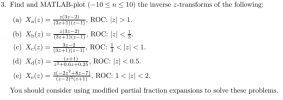 3. Find and MATLAB-plot (-10 n 10) the inverse z-transforms of the following: (a) Xa(z)=TE 2(3-2) , ROC: 비 > 1. 'ROC: 리 < 3z2 (e) Χ,(z) = 4부는구, ROC: 1 < 1리 You should consider using modified partial fraction expansions to solve these problems
3. Find and MATLAB-plot (-10 n 10) the inverse z-transforms of the following: (a) Xa(z)=TE 2(3-2) , ROC: 비 > 1. 'ROC: 리
3. Find and MATLAB-plot (-10 n 10) the inverse z-transforms of the following: (a) Xa(z)=TE 2(3-2) , ROC: 비 > 1. 'ROC: 리 < 3z2 (e) Χ,(z) = 4부는구, ROC: 1 < 1리 You should consider using modified partial fraction expansions to solve these problems
3. Find and MATLAB-plot (-10 n 10) the inverse z-transforms of the following: (a) Xa(z)=TE 2(3-2) , ROC: 비 > 1. 'ROC: 리
Use partial fraction expansion to obtain the laplace inverse of the following: G(s) = 1 /...
Use partial fraction expansion to obtain the laplace inverse of the following: G(s) = 1 / (s)((s+1)^3)(s+4)
Find the partial fraction decomposition for each of the following rational expressions. Then use the partial...
 Find the partial fraction decomposition for each of the
following rational expressions. Then use the partial fraction to
give an antiderivative for each function.
(2-6) (3 + 2)2
Find the partial fraction decomposition for each of the
following rational expressions. Then use the partial fraction to
give an antiderivative for each function.
(2-6) (3 + 2)2
(1 point) Consider the function 10s2 +3s 6 a. Find the partial fraction decomposition of F(s):...
 (1 point) Consider the function 10s2 +3s 6 a. Find the partial fraction decomposition of F(s): 10%,+ 3s + 6 b. Find the inverse Laplace transform of F(s). help (formulas)
 Find the time function corresponding to each of the following Laplace transforms using partial fraction expansions: (f) F(s)-2(s+ 2)
 Finally, we now mention MATLAB commands that can be used to help in the partial fraction decomposition of rational functions. This can be used when we need to express the Laplace transform as a partial fraction and then using a table and uniqueness property of the Laplace transform derive the time function. First, lookup how the commands collect and expand work. Now, read up on the documentation of command [x,p,k]=residue (b, a) to answer the following questions. Lab Exercise 1....
 Q2d 400 Gen(s+4)(s2+4s+5)(s+4s+2-3s+2+3) Find the partial fraction expansion of F(s) and then use the Laplace transform tables to find f(t) ft)- cos( t+ oju(t) COS
 Write matlab code to solve problem
10- Find the inverse Laplace transform using the Partial-Fraction Expansion method. 38+4 s(s+1) it il 4-e? 4-e-21 4-2e-4
Write matlab code to solve problem
10- Find the inverse Laplace transform using the Partial-Fraction Expansion method. 38+4 s(s+1) it il 4-e? 4-e-21 4-2e-4
 MATLAB
c. Determine the Partial Fraction Expansion and the Laplace Inverse) of the following ace Inverse (fo)) of the following function F(s), using MATLAB: F( s) = (s+ 2) (s+ 4) (s + 6)2
MATLAB
c. Determine the Partial Fraction Expansion and the Laplace Inverse) of the following ace Inverse (fo)) of the following function F(s), using MATLAB: F( s) = (s+ 2) (s+ 4) (s + 6)2
 3. Find and MATLAB-plot (-10 n 10) the inverse z-transforms of the following: (a) Xa(z)=TE 2(3-2) , ROC: 비 > 1. 'ROC: 리 < 3z2 (e) Χ,(z) = 4부는구, ROC: 1 < 1리 You should consider using modified partial fraction expansions to solve these problems
3. Find and MATLAB-plot (-10 n 10) the inverse z-transforms of the following: (a) Xa(z)=TE 2(3-2) , ROC: 비 > 1. 'ROC: 리
3. Find and MATLAB-plot (-10 n 10) the inverse z-transforms of the following: (a) Xa(z)=TE 2(3-2) , ROC: 비 > 1. 'ROC: 리 < 3z2 (e) Χ,(z) = 4부는구, ROC: 1 < 1리 You should consider using modified partial fraction expansions to solve these problems
3. Find and MATLAB-plot (-10 n 10) the inverse z-transforms of the following: (a) Xa(z)=TE 2(3-2) , ROC: 비 > 1. 'ROC: 리
 Find the partial fraction decomposition for each of the
following rational expressions. Then use the partial fraction to
give an antiderivative for each function.
(2-6) (3 + 2)2
Find the partial fraction decomposition for each of the
following rational expressions. Then use the partial fraction to
give an antiderivative for each function.
(2-6) (3 + 2)2
 (1 point) Consider the function 10s2 +3s 6 a. Find the partial fraction decomposition of F(s): 10%,+ 3s + 6 b. Find the inverse Laplace transform of F(s). help (formulas)
Most questions answered within 3 hours.
-
Where is the error in this code sequence?
String s1 = "Hello";
String s2 = "ello";...
asked 11 months ago -
Financial data for Joel de Paris, Inc., for last year
follow:
Joel de Paris, Inc.
Balance...
asked 11 months ago -
Consider this reaction:
Al2(SO4)3 (aq)+ BaCl3
(aq) Al2Cl6 (aq)- +
3BaSO4(s) . What is the...
asked 11 months ago -
Suppose that Savneet is considering increasing her
recent random sample from 20 car rentals to 40...
asked 11 months ago -
Trucks arrive at an unloading terminal at an average rate of 120
per hour.
Trucks arrive...
asked 11 months ago -
Why are methanol and ethanol completely soluble in water while
octanol is not very little soluble....
asked 11 months ago -
A facilities manager at a university reads in a research report
that the mean amount of...
asked 11 months ago -
When the CuSO4 is rehydrated by adding water to the anhydrous
compound, is this an endothermic...
asked 11 months ago -
A ray of sunlight is passing from diamond into crown glass; the
angle of incidence is...
asked 11 months ago -
A block of mass 0.249 kg is placed on top of a light, vertical
spring of...
asked 11 months ago -
how do the kidneys compensate in the presences of acidosis
a) trigger hyperventilate
b) reserve acid...
asked 11 months ago -
Question 501 pts
The rental rate of capital to the firm increases. Which of the
following...
asked 11 months ago