
Homework Answers
Effusion lab
The distribtion curve shown above can be labelled as,
The first box on the leftmost region of curved depicts = slower particles
The maxima on the curve depicts the = most probable speed
The second lower point to the right of most probable speed depicts = average speed
The last box on the right depicts = faster particles
Rate of Effusion Problems The average molecular speed in a sample of He gas at a...
 Rate of Effusion Problems
The average molecular speed in a sample of He gas at a certain temperature is 1.37x10 m/s. The average molecular speed in a sample of Kr gas is m/s at the same temperature. The rate of effusion of CH4 gas through a porous barrier is observed to be 3.73 x 10⁻⁴ mol/h. Under the same conditions, the rate of effusion of N2 gas would be mol/h.
Rate of Effusion Problems
The average molecular speed in a sample of He gas at a certain temperature is 1.37x10 m/s. The average molecular speed in a sample of Kr gas is m/s at the same temperature. The rate of effusion of CH4 gas through a porous barrier is observed to be 3.73 x 10⁻⁴ mol/h. Under the same conditions, the rate of effusion of N2 gas would be mol/h.
engage. Lab 7: Maxwell Distribution Exercise No Submissions | 1 Attempt Remaining Use the Maxwell Distribution...
 engage. Lab 7: Maxwell Distribution Exercise No Submissions | 1 Attempt Remaining Use the Maxwell Distribution Plotter to answer this question What is the most likely speed for Carbon gas (C) at a temperature of 168 K? What about 458 K? Vmax(168 K) = m/s Vmax(458 K) = m/s Submit Answer 1 question attempt remaining
A) Label the graph to show the effects of an increase in non-labor income Label all...
 A) Label the graph to show the effects of an increase in non-labor income Label all relevant parts of the graph. (You might or might not use every line/curve 0ท the graph.) B) Label the graph to show the effects of an increase in the wage rate. Label all relevant parts of the graph. (You might or might not use every line/curve on the graph)
The following graph shows the distribution of molecular. velocities for two different molecules (A and B) at the same temperature.
 The following graph shows the distribution of molecular. velocities for two different molecules (A and B) at the same temperature.Part AWhich molecule has the higher molar mass? Which molecule would have the higher rate of effusion?
B) Label the graph to show the effects of an increase in the wage rate. Label...
 B) Label the graph to show the effects of an increase in the wage rate. Label all relevant parts of the graph. (You might or might not use every line/curve on the graph.)
label correctly (studying for lab practical) UIRED TO KNOW - CUT OUT AND USE AS FLASHCARDS
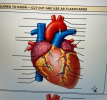 label correctly (studying for lab practical)
UIRED TO KNOW - CUT OUT AND USE AS FLASHCARDS
label correctly (studying for lab practical)
UIRED TO KNOW - CUT OUT AND USE AS FLASHCARDS
Use the References to access important values if needed for this question. The rate of effusion...
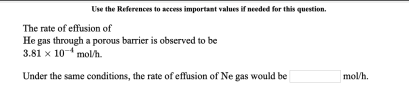 Use the References to access important values if needed for this question. The rate of effusion of He gas through a porous barrier is observed to be 3.81 x 10⁻⁴ mol/h. Under the same conditions, the rate of effusion of Ne gas would be mol/h.
Use the References to access important values if needed for this question. The rate of effusion...
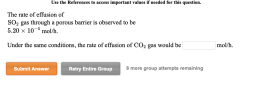 Use the References to access important values if needed for this question. The rate of effusion of SO2 gas through a porous barrier is observed to be 5.20 x 10⁴ mol/h mol/h Under the same conditions, the rate of effusion of CO2 gas would be 8 more group attempts remaining Submit Answer Retry Entire Group
The 4 curves in the graph below represent the distribution of molecular speed for 4 different...
 The 4 curves in the graph below represent the distribution of molecular speed for 4 different gases the same temperature. The four gases are argon (Ar), oxygen (O2), hydrogen (H2) and carbon dioxide (CO2). Identify which curve belongs to which gas. Number of molecules 1000 1500 molecular speed (m/s) red [Choose] blue [Choose] green [Choose] black [Choose]
label as described below on the graph From the graph with a single EKG trace, label...
 label as described below on the graph
From the graph with a single EKG trace, label and/or calculate
as described below:
- Heart rate in beats per minute - label the graph where you are
calculating this
- Label the P and T waves and calculate the amplitude of these
waves
- Label the PR and QT intervals and calculate the duration of
these intervals
- Label the PR and ST segments and note what is occurring both
electrically and...
label as described below on the graph
From the graph with a single EKG trace, label and/or calculate
as described below:
- Heart rate in beats per minute - label the graph where you are
calculating this
- Label the P and T waves and calculate the amplitude of these
waves
- Label the PR and QT intervals and calculate the duration of
these intervals
- Label the PR and ST segments and note what is occurring both
electrically and...
 Rate of Effusion Problems
The average molecular speed in a sample of He gas at a certain temperature is 1.37x10 m/s. The average molecular speed in a sample of Kr gas is m/s at the same temperature. The rate of effusion of CH4 gas through a porous barrier is observed to be 3.73 x 10⁻⁴ mol/h. Under the same conditions, the rate of effusion of N2 gas would be mol/h.
Rate of Effusion Problems
The average molecular speed in a sample of He gas at a certain temperature is 1.37x10 m/s. The average molecular speed in a sample of Kr gas is m/s at the same temperature. The rate of effusion of CH4 gas through a porous barrier is observed to be 3.73 x 10⁻⁴ mol/h. Under the same conditions, the rate of effusion of N2 gas would be mol/h.
 engage. Lab 7: Maxwell Distribution Exercise No Submissions | 1 Attempt Remaining Use the Maxwell Distribution Plotter to answer this question What is the most likely speed for Carbon gas (C) at a temperature of 168 K? What about 458 K? Vmax(168 K) = m/s Vmax(458 K) = m/s Submit Answer 1 question attempt remaining
 A) Label the graph to show the effects of an increase in non-labor income Label all relevant parts of the graph. (You might or might not use every line/curve 0ท the graph.) B) Label the graph to show the effects of an increase in the wage rate. Label all relevant parts of the graph. (You might or might not use every line/curve on the graph)
 B) Label the graph to show the effects of an increase in the wage rate. Label all relevant parts of the graph. (You might or might not use every line/curve on the graph.)
 label correctly (studying for lab practical)
UIRED TO KNOW - CUT OUT AND USE AS FLASHCARDS
label correctly (studying for lab practical)
UIRED TO KNOW - CUT OUT AND USE AS FLASHCARDS
 Use the References to access important values if needed for this question. The rate of effusion of He gas through a porous barrier is observed to be 3.81 x 10⁻⁴ mol/h. Under the same conditions, the rate of effusion of Ne gas would be mol/h.
 Use the References to access important values if needed for this question. The rate of effusion of SO2 gas through a porous barrier is observed to be 5.20 x 10⁴ mol/h mol/h Under the same conditions, the rate of effusion of CO2 gas would be 8 more group attempts remaining Submit Answer Retry Entire Group
 The 4 curves in the graph below represent the distribution of molecular speed for 4 different gases the same temperature. The four gases are argon (Ar), oxygen (O2), hydrogen (H2) and carbon dioxide (CO2). Identify which curve belongs to which gas. Number of molecules 1000 1500 molecular speed (m/s) red [Choose] blue [Choose] green [Choose] black [Choose]
 label as described below on the graph
From the graph with a single EKG trace, label and/or calculate
as described below:
- Heart rate in beats per minute - label the graph where you are
calculating this
- Label the P and T waves and calculate the amplitude of these
waves
- Label the PR and QT intervals and calculate the duration of
these intervals
- Label the PR and ST segments and note what is occurring both
electrically and...
label as described below on the graph
From the graph with a single EKG trace, label and/or calculate
as described below:
- Heart rate in beats per minute - label the graph where you are
calculating this
- Label the P and T waves and calculate the amplitude of these
waves
- Label the PR and QT intervals and calculate the duration of
these intervals
- Label the PR and ST segments and note what is occurring both
electrically and...
Most questions answered within 3 hours.
-
Where is the error in this code sequence?
String s1 = "Hello";
String s2 = "ello";...
asked 10 months ago -
Financial data for Joel de Paris, Inc., for last year
follow:
Joel de Paris, Inc.
Balance...
asked 10 months ago -
Consider this reaction:
Al2(SO4)3 (aq)+ BaCl3
(aq) Al2Cl6 (aq)- +
3BaSO4(s) . What is the...
asked 10 months ago -
Suppose that Savneet is considering increasing her
recent random sample from 20 car rentals to 40...
asked 10 months ago -
Trucks arrive at an unloading terminal at an average rate of 120
per hour.
Trucks arrive...
asked 10 months ago -
Why are methanol and ethanol completely soluble in water while
octanol is not very little soluble....
asked 10 months ago -
A facilities manager at a university reads in a research report
that the mean amount of...
asked 10 months ago -
When the CuSO4 is rehydrated by adding water to the anhydrous
compound, is this an endothermic...
asked 10 months ago -
A ray of sunlight is passing from diamond into crown glass; the
angle of incidence is...
asked 10 months ago -
A block of mass 0.249 kg is placed on top of a light, vertical
spring of...
asked 10 months ago -
how do the kidneys compensate in the presences of acidosis
a) trigger hyperventilate
b) reserve acid...
asked 10 months ago -
Question 501 pts
The rental rate of capital to the firm increases. Which of the
following...
asked 10 months ago