
Homework Answers
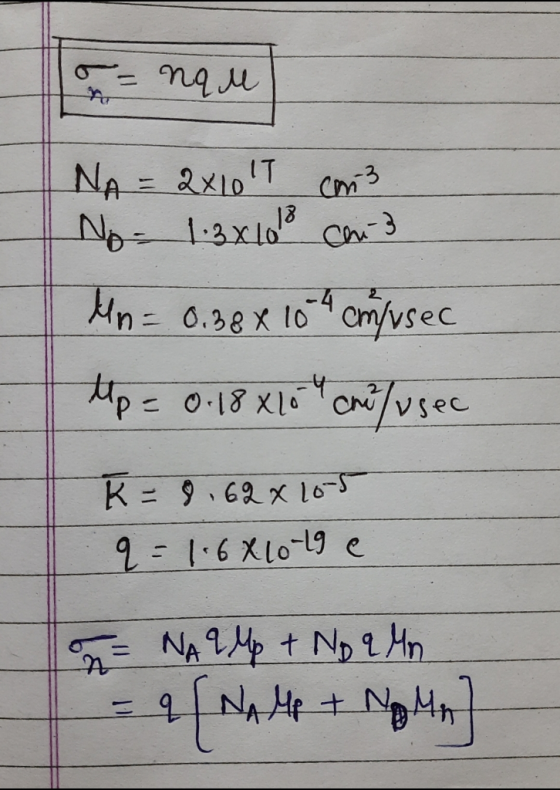
![= 9/ 2x 107 x 0.18x169 + 1.3x108x 0,38 0 =9 / 0,36X0 * T +4.94x10¹³] 9 x 53 x 10B so o=1:6810-19 x5:3x 10¹³ o o 8.48 x 10⁻⁶ s](http://img.homeworklib.com/questions/66f75e40-10c4-11ec-a175-8b097e652ce7.png?x-oss-process=image/resize,w_560)
Add Answer to:
By accident, a Ge wafer is doped with In (Group III) to a level of 2.0x10⁷m",...
A silicon semiconductor material is doped with 3x10¹⁵/cm of phosphorous atoms at room temperature (300°K). Given:...
A silicon semiconductor material is doped with 3x10¹⁵/cm of phosphorous atoms at room temperature (300°K). Given: Electron mobility is 1450 cm2/V-s, Hole mobility is 380 cm?/V-s, Intrinsic carrier concentration (n) of Si at room temperature (300°K) 1.5x 101%cm³. Calculate the conductivity of the material
If a block of Si is doped with 10^17 Boron atom/cm^3 and 5X10^16 Arsenic atoms/cm^3, (a)...
If a block of Si is doped with 10^17 Boron atom/cm^3 and 5X10^16 Arsenic atoms/cm^3, (a) Calculate the electron (n) and hole (p) concentration at 300°K. (b) Calculate the Fermi level (Ef- Ev) at 300°K. Sketch the band diagram and Fermi level. (c) Estimate the conductivity σ of the sample in part (a).
Taking pure silicon (Si) as an example, explain what is meant by the terms electron-hole generation...
 Taking pure silicon (Si) as an example, explain what is meant by the terms electron-hole generation and recombination, how they affect the electrical conductivity, and define what is meant by the "intrinsic carrier density", n. [5 marks] Q3. a) b) With the aid of both lattice and energy band diagrams, explain how n-type doping of Si is achieved and state two types of suitable dopant atoms. [7 marks] c) An n-type region on a Si wafer has a donor concentration...
In class Monday we established that the number density of free electrons in silicon was 1.09E+16 electrons per cubic meter. Now calculate the number of free electrons per silicon atom. The density of...
In class Monday we established that the number density of free electrons in silicon was 1.09E+16 electrons per cubic meter. Now calculate the number of free electrons per silicon atom. The density of silicon is 2.33 Mg/m3 ; the atomic mass of silicon is 28.085 g/mole. Consider silicon which has a band gap of 1.11 eV and a measured conductivity of 0.00034 /ohmm at 300K. Its electron mobility is 0.145 m^2/(V x sec) and its hole mobility is 0.050 m^2/(V...
Si sample doped with donors 101°cm-3 initially at room temperature 300 °K (n 31010 cm. Later it i...
 Si sample doped with donors 101°cm-3 initially at room temperature 300 °K (n 31010 cm. Later it is excited optically as such 1019 cm-3electron-hole pairs are produced in one second uniformly in the sample. Si band gap energy isEg-1.11 eV and the recombination for hole electron life-time10 μs. Hint may use results of question 1 above. Draw appropriate figures and mark related levels! a) Calculate the equilibrium Fermi level with respect to conduction band edge Ec b) Calculate the equilibrium...
Please help me out.. Need to pass this course as a removal for my other course.....
 Please help me out.. Need to pass this course as a removal for
my other course..
Si material parameters: Band gap energy at 300 K: Eg = 1.124 eV Relative permittivity: x = 11.7 Effective mass of electron: m =1.08m for density of states, Effective mass of hole: m = 0.81m for density of states, m = 0.26m for conductivity m =0.39m for conductivity Up = 470 cm/V.s Mobility: Un = 1400 cm /V-s, Diffusion coefficient: Do = 36 cm²/s,...
Please help me out.. Need to pass this course as a removal for
my other course..
Si material parameters: Band gap energy at 300 K: Eg = 1.124 eV Relative permittivity: x = 11.7 Effective mass of electron: m =1.08m for density of states, Effective mass of hole: m = 0.81m for density of states, m = 0.26m for conductivity m =0.39m for conductivity Up = 470 cm/V.s Mobility: Un = 1400 cm /V-s, Diffusion coefficient: Do = 36 cm²/s,...
This is a physics question, I selected physics but it shows chemistry here, somehow...... The group...
 This is a physics question, I selected physics but it shows
chemistry here, somehow......
The group I element potassium (K) forms the bcc crystal structure with the cubic-lattice parameter a=0.533 nm. Each atom contributes 1 electron to the conduction band. (a) Calculate the number of electrons per m-3 in the conduction band for potassium. (b) Calculate the Fermi energy for potassium in units of eV. The figure below shows the Brillouin Zone (the reciprocal cell) for the bcc crystal that...
This is a physics question, I selected physics but it shows
chemistry here, somehow......
The group I element potassium (K) forms the bcc crystal structure with the cubic-lattice parameter a=0.533 nm. Each atom contributes 1 electron to the conduction band. (a) Calculate the number of electrons per m-3 in the conduction band for potassium. (b) Calculate the Fermi energy for potassium in units of eV. The figure below shows the Brillouin Zone (the reciprocal cell) for the bcc crystal that...
**Please Show All The Steps** As I mentioned in the class assume that we have a...
 **Please Show All The Steps**
As I mentioned in the class assume that we have a GaAs (Gallium
Arsenide) sample which was doped with excessive As to produce a
resistivity of 0.05 Ωm. Owing to the presence of an unknown
acceptor impurity the actual resistivity was 0.06Ωm, the sample
remaining n-type. What were the concentrations of donors and
acceptors present?
(Please take μe=0.85 m2/Vs and assume that all impurity atoms
are ionized)
PHYSICAL CONSTANTS Avagadro's Number NA- 6.02 x 10*23...
**Please Show All The Steps**
As I mentioned in the class assume that we have a GaAs (Gallium
Arsenide) sample which was doped with excessive As to produce a
resistivity of 0.05 Ωm. Owing to the presence of an unknown
acceptor impurity the actual resistivity was 0.06Ωm, the sample
remaining n-type. What were the concentrations of donors and
acceptors present?
(Please take μe=0.85 m2/Vs and assume that all impurity atoms
are ionized)
PHYSICAL CONSTANTS Avagadro's Number NA- 6.02 x 10*23...
 Taking pure silicon (Si) as an example, explain what is meant by the terms electron-hole generation and recombination, how they affect the electrical conductivity, and define what is meant by the "intrinsic carrier density", n. [5 marks] Q3. a) b) With the aid of both lattice and energy band diagrams, explain how n-type doping of Si is achieved and state two types of suitable dopant atoms. [7 marks] c) An n-type region on a Si wafer has a donor concentration...
 Si sample doped with donors 101°cm-3 initially at room temperature 300 °K (n 31010 cm. Later it is excited optically as such 1019 cm-3electron-hole pairs are produced in one second uniformly in the sample. Si band gap energy isEg-1.11 eV and the recombination for hole electron life-time10 μs. Hint may use results of question 1 above. Draw appropriate figures and mark related levels! a) Calculate the equilibrium Fermi level with respect to conduction band edge Ec b) Calculate the equilibrium...
 Please help me out.. Need to pass this course as a removal for
my other course..
Si material parameters: Band gap energy at 300 K: Eg = 1.124 eV Relative permittivity: x = 11.7 Effective mass of electron: m =1.08m for density of states, Effective mass of hole: m = 0.81m for density of states, m = 0.26m for conductivity m =0.39m for conductivity Up = 470 cm/V.s Mobility: Un = 1400 cm /V-s, Diffusion coefficient: Do = 36 cm²/s,...
Please help me out.. Need to pass this course as a removal for
my other course..
Si material parameters: Band gap energy at 300 K: Eg = 1.124 eV Relative permittivity: x = 11.7 Effective mass of electron: m =1.08m for density of states, Effective mass of hole: m = 0.81m for density of states, m = 0.26m for conductivity m =0.39m for conductivity Up = 470 cm/V.s Mobility: Un = 1400 cm /V-s, Diffusion coefficient: Do = 36 cm²/s,...
 This is a physics question, I selected physics but it shows
chemistry here, somehow......
The group I element potassium (K) forms the bcc crystal structure with the cubic-lattice parameter a=0.533 nm. Each atom contributes 1 electron to the conduction band. (a) Calculate the number of electrons per m-3 in the conduction band for potassium. (b) Calculate the Fermi energy for potassium in units of eV. The figure below shows the Brillouin Zone (the reciprocal cell) for the bcc crystal that...
This is a physics question, I selected physics but it shows
chemistry here, somehow......
The group I element potassium (K) forms the bcc crystal structure with the cubic-lattice parameter a=0.533 nm. Each atom contributes 1 electron to the conduction band. (a) Calculate the number of electrons per m-3 in the conduction band for potassium. (b) Calculate the Fermi energy for potassium in units of eV. The figure below shows the Brillouin Zone (the reciprocal cell) for the bcc crystal that...
 **Please Show All The Steps**
As I mentioned in the class assume that we have a GaAs (Gallium
Arsenide) sample which was doped with excessive As to produce a
resistivity of 0.05 Ωm. Owing to the presence of an unknown
acceptor impurity the actual resistivity was 0.06Ωm, the sample
remaining n-type. What were the concentrations of donors and
acceptors present?
(Please take μe=0.85 m2/Vs and assume that all impurity atoms
are ionized)
PHYSICAL CONSTANTS Avagadro's Number NA- 6.02 x 10*23...
**Please Show All The Steps**
As I mentioned in the class assume that we have a GaAs (Gallium
Arsenide) sample which was doped with excessive As to produce a
resistivity of 0.05 Ωm. Owing to the presence of an unknown
acceptor impurity the actual resistivity was 0.06Ωm, the sample
remaining n-type. What were the concentrations of donors and
acceptors present?
(Please take μe=0.85 m2/Vs and assume that all impurity atoms
are ionized)
PHYSICAL CONSTANTS Avagadro's Number NA- 6.02 x 10*23...
Most questions answered within 3 hours.
-
Where is the error in this code sequence?
String s1 = "Hello";
String s2 = "ello";...
asked 11 months ago -
Financial data for Joel de Paris, Inc., for last year
follow:
Joel de Paris, Inc.
Balance...
asked 11 months ago -
Consider this reaction:
Al2(SO4)3 (aq)+ BaCl3
(aq) Al2Cl6 (aq)- +
3BaSO4(s) . What is the...
asked 11 months ago -
Suppose that Savneet is considering increasing her
recent random sample from 20 car rentals to 40...
asked 11 months ago -
Trucks arrive at an unloading terminal at an average rate of 120
per hour.
Trucks arrive...
asked 11 months ago -
Why are methanol and ethanol completely soluble in water while
octanol is not very little soluble....
asked 11 months ago -
A facilities manager at a university reads in a research report
that the mean amount of...
asked 11 months ago -
When the CuSO4 is rehydrated by adding water to the anhydrous
compound, is this an endothermic...
asked 11 months ago -
A ray of sunlight is passing from diamond into crown glass; the
angle of incidence is...
asked 11 months ago -
A block of mass 0.249 kg is placed on top of a light, vertical
spring of...
asked 11 months ago -
how do the kidneys compensate in the presences of acidosis
a) trigger hyperventilate
b) reserve acid...
asked 11 months ago -
Question 501 pts
The rental rate of capital to the firm increases. Which of the
following...
asked 11 months ago