
Homework Answers
Feel free to comment and ask clarifications. Thank you.
Add Answer to:
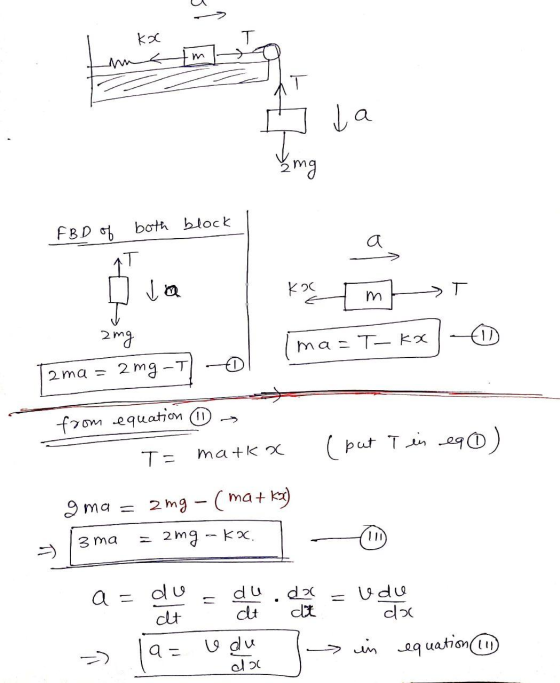
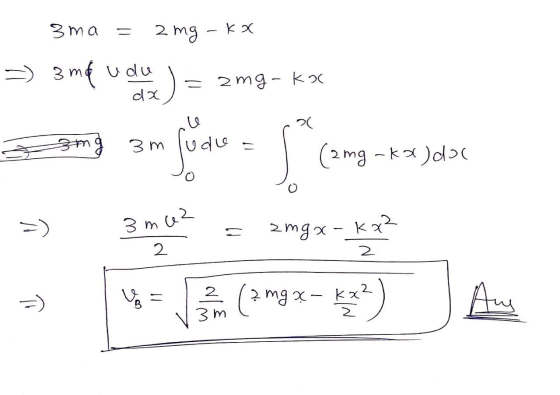
ENERGY The spring-mass system shown in the figure is released with the string taut, from the...
A 4kg mass sits on a surface with a coefficient of friction of 0.47. The spring...
 A 4kg mass sits on a surface with a coefficient of
friction of 0.47. The spring (spring constant = 140 N/m) is
compressed a distance of 0.62m from its unstretched position and
released. What is the velocity of the mass when the spring reaches
its unstretched position?
4 kg k
A 4kg mass sits on a surface with a coefficient of
friction of 0.47. The spring (spring constant = 140 N/m) is
compressed a distance of 0.62m from its unstretched position and
released. What is the velocity of the mass when the spring reaches
its unstretched position?
4 kg k
Question 2 A particle of mass m, is attached to a spring of natural length 2le...
 Question 2 A particle of mass m, is attached to a spring of natural length 2le and stiffness 2k, and a second spring of stiffness k and natural length lo. It lies on a smooth horizontal table. and the two spring ends are a fixed distance 4lo apart, as shown in Figure Q2. The particle is released from rest at a distance 2lo from each end. Let x be the distance of the particle from A wwwwwwwwww Figure 02 (a)...
The toy gun in the figure below consists of a spring with spring constant k
 The toy gun in the figure below consists of a spring with spring constant k. It is loaded with a projectile of mass m and the spring is compressed a distance d. The toy gun is fired horizontally and the bullet travels a total distance L within the toy gun before it is released. A) Neglecting all resistive forces, determine the speed of the projectile vo once it exits the toy gun (i.e., express Vo in terms of the known quantities...
8. A mass on the end of a string of length is displaced an angle from...
 8. A mass on the end of a string of length is displaced an angle from vertical and released (shown in the figure below). At the bottom of the swing the mass is released from the string and allowed to slide with friction coefficient uk) over a distance, d, before compressing a spring a distance, x (you may assume the friction only acts over the distance, d). CHEMISTRO IS BACK Use conservation of energy to find an equation for the...
Please write legibly Consider an ideal mass-spring-damper system similar to Figure 3.2. Find the damping coefficient of the system if a mass of 380 g is used in combination with a spring with stif...
 Please write legibly
Consider an ideal mass-spring-damper system similar to Figure 3.2. Find the damping coefficient of the system if a mass of 380 g is used in combination with a spring with stiffness k = 17 N/m and a period of 0.945 s. If the system is released from rest 5 cm from it's equilibrium point at to = 0 s, find the trajectory of the position of the mass-spring-damper from it's release until t 3s Figure 3.2: Mass-spring-damper...
Please write legibly
Consider an ideal mass-spring-damper system similar to Figure 3.2. Find the damping coefficient of the system if a mass of 380 g is used in combination with a spring with stiffness k = 17 N/m and a period of 0.945 s. If the system is released from rest 5 cm from it's equilibrium point at to = 0 s, find the trajectory of the position of the mass-spring-damper from it's release until t 3s Figure 3.2: Mass-spring-damper...
Part A Block A has a mass mA and is attached to a spring having a...
 Part A Block A has a mass mA and is attached to a spring having a stiffness k and unstretched length lo- Another block B, having a mass mB, is pressed against A so that the spring deforms a distance d. The coefficient of kinetic friction between the blocks and the ground is μk. (Figure 1) Assuming separation does occur what is the distance the blocks slide on the surface before they separate? Express your answer in terms of some...
Block A, having a mass m, is released from rest falls a distance h and strikes...
Block A, having a mass m, is released from rest falls a distance h and strikes the plate B having a mass 2m. If the coefficient of restitution between A and B is e, determine the velocity of the plate just after collision. The spring has a stiffness k.
k Problem 2 (30 pts) Blocks A and B are released from rest when the spring...
 k Problem 2 (30 pts) Blocks A and B are released from rest when the spring is unstretched. Block A has a mass my=3kg, and the linear spring has stiffness k=8N/m. If all sources of friction are negligible, determine the mass of block B such that it has a speed vp=1.5m/s after moving 1.2m downward, assuming that A never leaves the horizontal surface shown and the cord connecting A and B is inextensible. Use the work-energy principle. A B
A block of mass 50 kg is sitting on a platform as shown in the figure...
 A block of mass 50 kg is sitting on a platform as shown in the figure below. The platform sits on a spring with k = 2,200 N/m. The mass is initially at rest. (a) Add a coordinate system to this sketch. Choose File No file chosen This answer has not been graded yet. Where is a convenient place to choose the origin of the vertical (y) axis? This answer has not been graded yet. 0 be at the position...
6) A mass-spring system consists of a 250-g mass hanging from a spring with a spring...
 6) A mass-spring system consists of a 250-g mass hanging from a spring with a spring constant of k 0.18 J/m2. The mass is pulled down 7.1 cm from its equilibrium position and released from re a) How much work did the person do when she pulled the spring down from its equilibrium position? Assume that the mass was at rest before she pulled it down, and before it was released. (Use the energy-interaction model, not the expression W FavgAx,...
 A 4kg mass sits on a surface with a coefficient of
friction of 0.47. The spring (spring constant = 140 N/m) is
compressed a distance of 0.62m from its unstretched position and
released. What is the velocity of the mass when the spring reaches
its unstretched position?
4 kg k
A 4kg mass sits on a surface with a coefficient of
friction of 0.47. The spring (spring constant = 140 N/m) is
compressed a distance of 0.62m from its unstretched position and
released. What is the velocity of the mass when the spring reaches
its unstretched position?
4 kg k
 Question 2 A particle of mass m, is attached to a spring of natural length 2le and stiffness 2k, and a second spring of stiffness k and natural length lo. It lies on a smooth horizontal table. and the two spring ends are a fixed distance 4lo apart, as shown in Figure Q2. The particle is released from rest at a distance 2lo from each end. Let x be the distance of the particle from A wwwwwwwwww Figure 02 (a)...
 8. A mass on the end of a string of length is displaced an angle from vertical and released (shown in the figure below). At the bottom of the swing the mass is released from the string and allowed to slide with friction coefficient uk) over a distance, d, before compressing a spring a distance, x (you may assume the friction only acts over the distance, d). CHEMISTRO IS BACK Use conservation of energy to find an equation for the...
 Please write legibly
Consider an ideal mass-spring-damper system similar to Figure 3.2. Find the damping coefficient of the system if a mass of 380 g is used in combination with a spring with stiffness k = 17 N/m and a period of 0.945 s. If the system is released from rest 5 cm from it's equilibrium point at to = 0 s, find the trajectory of the position of the mass-spring-damper from it's release until t 3s Figure 3.2: Mass-spring-damper...
Please write legibly
Consider an ideal mass-spring-damper system similar to Figure 3.2. Find the damping coefficient of the system if a mass of 380 g is used in combination with a spring with stiffness k = 17 N/m and a period of 0.945 s. If the system is released from rest 5 cm from it's equilibrium point at to = 0 s, find the trajectory of the position of the mass-spring-damper from it's release until t 3s Figure 3.2: Mass-spring-damper...
 Part A Block A has a mass mA and is attached to a spring having a stiffness k and unstretched length lo- Another block B, having a mass mB, is pressed against A so that the spring deforms a distance d. The coefficient of kinetic friction between the blocks and the ground is μk. (Figure 1) Assuming separation does occur what is the distance the blocks slide on the surface before they separate? Express your answer in terms of some...
 k Problem 2 (30 pts) Blocks A and B are released from rest when the spring is unstretched. Block A has a mass my=3kg, and the linear spring has stiffness k=8N/m. If all sources of friction are negligible, determine the mass of block B such that it has a speed vp=1.5m/s after moving 1.2m downward, assuming that A never leaves the horizontal surface shown and the cord connecting A and B is inextensible. Use the work-energy principle. A B
 A block of mass 50 kg is sitting on a platform as shown in the figure below. The platform sits on a spring with k = 2,200 N/m. The mass is initially at rest. (a) Add a coordinate system to this sketch. Choose File No file chosen This answer has not been graded yet. Where is a convenient place to choose the origin of the vertical (y) axis? This answer has not been graded yet. 0 be at the position...
 6) A mass-spring system consists of a 250-g mass hanging from a spring with a spring constant of k 0.18 J/m2. The mass is pulled down 7.1 cm from its equilibrium position and released from re a) How much work did the person do when she pulled the spring down from its equilibrium position? Assume that the mass was at rest before she pulled it down, and before it was released. (Use the energy-interaction model, not the expression W FavgAx,...
Most questions answered within 3 hours.
-
Where is the error in this code sequence?
String s1 = "Hello";
String s2 = "ello";...
asked 10 months ago -
Financial data for Joel de Paris, Inc., for last year
follow:
Joel de Paris, Inc.
Balance...
asked 10 months ago -
Consider this reaction:
Al2(SO4)3 (aq)+ BaCl3
(aq) Al2Cl6 (aq)- +
3BaSO4(s) . What is the...
asked 10 months ago -
Suppose that Savneet is considering increasing her
recent random sample from 20 car rentals to 40...
asked 10 months ago -
Trucks arrive at an unloading terminal at an average rate of 120
per hour.
Trucks arrive...
asked 10 months ago -
Why are methanol and ethanol completely soluble in water while
octanol is not very little soluble....
asked 10 months ago -
A facilities manager at a university reads in a research report
that the mean amount of...
asked 10 months ago -
When the CuSO4 is rehydrated by adding water to the anhydrous
compound, is this an endothermic...
asked 10 months ago -
A ray of sunlight is passing from diamond into crown glass; the
angle of incidence is...
asked 10 months ago -
A block of mass 0.249 kg is placed on top of a light, vertical
spring of...
asked 10 months ago -
how do the kidneys compensate in the presences of acidosis
a) trigger hyperventilate
b) reserve acid...
asked 10 months ago -
Question 501 pts
The rental rate of capital to the firm increases. Which of the
following...
asked 10 months ago