Determine the settling velocity (m/s) of a sand particle with a density of 2.6 g/cm3 and...
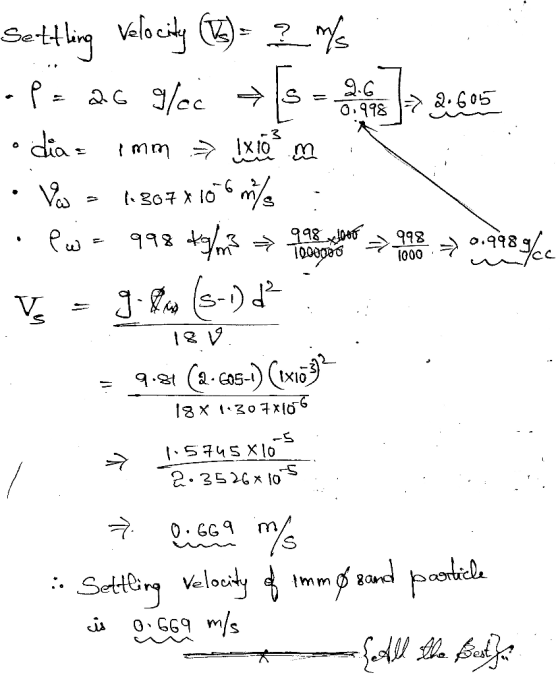
- Determine the settling velocity (m/s) of a sand particle with a density of 2.6 g/cm3 and 1 mm diameter. νw = 1.307x10⁻⁶ m2/s and ρw = 998 kg/m3.
Homework Answers
Add Answer to:
Determine the settling velocity (m/s) of a sand particle with a
density of 2.6 g/cm3 and...
Particle A has a density of 1.2 g/cm3 and a terminal settling velocity of 0.50 cm/s....
Particle A has a density of 1.2 g/cm3 and a terminal settling velocity of 0.50 cm/s. Particle B is the same size and shape as particle A but has a density of 2.4 g/cm3. What is the terminal settling velocity of particle B? A.) 0.25 cm/s B.) 0.50 cm/s C.) 0.71 cm/s D.) 1.0 cm/s
Find the settling velocity of an 8 μm diameter particle with density 1500 kg/m3. If this...
Find the settling velocity of an 8 μm diameter particle with density 1500 kg/m3. If this particle had been hurled to a height of 7000 m during a volcanic eruption, estimate the time required to reach the ground (at sea level). You may assume that the viscosity of air does not change enough with altitude to be important. If winds average 8.0 m/s, how far away (horizontally) would it travel on its way down?
(10 pts) For quiescent (still water) conditions determine the settling velocity of spheres of four particle...
 (10 pts) For quiescent (still water) conditions determine the settling velocity of spheres of four particle diameters: 0.01,0.1, 1.0, and 10.0 mm. Assume the particle density if 1,050 kg/m3. Plot vs versus dpon a log-log axis.
If a particle with 4-µm diameter and unknown density has a settling velocity of 0.1 cm/s...
If a particle with 4-µm diameter and unknown density has a settling velocity of 0.1 cm/s in the air, then according to Stokes Law, another particle with the same diameter but half of the density will have a setting velocity of _____ cm/s (Assuming the density of air is negligible).
2. Comparing sedimentation and flotation um spherical floc particles with a density of 1.15 g/cm3 pm...
 2. Comparing sedimentation and flotation um spherical floc particles with a density of 1.15 g/cm3 pm spherical floc particles with a density of 1.15 g/cm Calculate the settling velocity of 12 in summer (T-20°C) and in winter (T 4°C). Calculate the rise velocity of the same floc particle after the attachment of a single air bubble of 40 um diameter for the same two temperatures. The density of air is 1.27 kg/m3 at 4°C and 1.19 kg/m3 at 20°C Comment...
1) Consider particles characterized with a density of 1.5 g/cm3. At 250C and 1 atm determine...
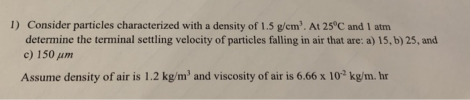 1) Consider particles characterized with a density of 1.5 g/cm3. At 250C and 1 atm determine the terminal settling velocity of particles falling in air that are: a) 15, b) 25, and c) 150 μm Assume density of air is 1.2 kg/m' and viscosity of air is 6.66 x 10² kg/m. hr
ENVIRONMENTAL ENGINEERING, please show all work and clearly circle your answer. A settling tank is being...
 ENVIRONMENTAL ENGINEERING, please show all work and clearly circle
your answer.
A settling tank is being designed to remove suspended particles through Type 1 settling. The density of the particle is 1045 kg/m23 and the density of the water is 1020 kg/m2. The diameter of the particles is 0.2 mm and the temperature is 25* C. Assuming laminar conditions, find the settling velocity, vi, for the particles. If the overflow rate is 65 m2/d m2, what is the percentage of...
ENVIRONMENTAL ENGINEERING, please show all work and clearly circle
your answer.
A settling tank is being designed to remove suspended particles through Type 1 settling. The density of the particle is 1045 kg/m23 and the density of the water is 1020 kg/m2. The diameter of the particles is 0.2 mm and the temperature is 25* C. Assuming laminar conditions, find the settling velocity, vi, for the particles. If the overflow rate is 65 m2/d m2, what is the percentage of...
Compute the terminal settling velocity in air of a sphere with density of 1,000 kg/m3. The...
Compute the terminal settling velocity in air of a sphere with density of 1,000 kg/m3. The sphere with a diameter of 10 μm falls through standard air (25 °C and 1 Atm).
Part B mework 7 blem 11.79-Enhanced-with Hints and Feedback Determine the velocity of the particle at which Stokes' law becomes invalid, at about Re Express your answer to three significant f...
 Part B
mework 7 blem 11.79-Enhanced-with Hints and Feedback Determine the velocity of the particle at which Stokes' law becomes invalid, at about Re Express your answer to three significant figures and include the appropriate units Review A 2.3-mm-diameter sand particle having a density of 2.40 Mg/m3 is released from rest at the surface of oi that is contained in the tube. As the particle fails downward, "creeping flow' will be established around it. The oil has a density of...
Part B
mework 7 blem 11.79-Enhanced-with Hints and Feedback Determine the velocity of the particle at which Stokes' law becomes invalid, at about Re Express your answer to three significant figures and include the appropriate units Review A 2.3-mm-diameter sand particle having a density of 2.40 Mg/m3 is released from rest at the surface of oi that is contained in the tube. As the particle fails downward, "creeping flow' will be established around it. The oil has a density of...
Problem 15.125 Water is discharged from a nozzle with a velocity of 8 m/s and strikes...
 Problem 15.125
Water is discharged from a nozzle with a velocity of 8 m/s and
strikes the blade mounted on the 18-kg cart. The nozzle has a
diameter of 50 mm and the density of water is ρw = 1000 kg/mg3.
A: Determine the tension developed in the cord, needed to hold
the cart stationary.
B: Determine the normal reaction of the wheels on the cart.
Problem 15.125
Water is discharged from a nozzle with a velocity of 8 m/s and
strikes the blade mounted on the 18-kg cart. The nozzle has a
diameter of 50 mm and the density of water is ρw = 1000 kg/mg3.
A: Determine the tension developed in the cord, needed to hold
the cart stationary.
B: Determine the normal reaction of the wheels on the cart.
 (10 pts) For quiescent (still water) conditions determine the settling velocity of spheres of four particle diameters: 0.01,0.1, 1.0, and 10.0 mm. Assume the particle density if 1,050 kg/m3. Plot vs versus dpon a log-log axis.
 2. Comparing sedimentation and flotation um spherical floc particles with a density of 1.15 g/cm3 pm spherical floc particles with a density of 1.15 g/cm Calculate the settling velocity of 12 in summer (T-20°C) and in winter (T 4°C). Calculate the rise velocity of the same floc particle after the attachment of a single air bubble of 40 um diameter for the same two temperatures. The density of air is 1.27 kg/m3 at 4°C and 1.19 kg/m3 at 20°C Comment...
 1) Consider particles characterized with a density of 1.5 g/cm3. At 250C and 1 atm determine the terminal settling velocity of particles falling in air that are: a) 15, b) 25, and c) 150 μm Assume density of air is 1.2 kg/m' and viscosity of air is 6.66 x 10² kg/m. hr
 ENVIRONMENTAL ENGINEERING, please show all work and clearly circle
your answer.
A settling tank is being designed to remove suspended particles through Type 1 settling. The density of the particle is 1045 kg/m23 and the density of the water is 1020 kg/m2. The diameter of the particles is 0.2 mm and the temperature is 25* C. Assuming laminar conditions, find the settling velocity, vi, for the particles. If the overflow rate is 65 m2/d m2, what is the percentage of...
ENVIRONMENTAL ENGINEERING, please show all work and clearly circle
your answer.
A settling tank is being designed to remove suspended particles through Type 1 settling. The density of the particle is 1045 kg/m23 and the density of the water is 1020 kg/m2. The diameter of the particles is 0.2 mm and the temperature is 25* C. Assuming laminar conditions, find the settling velocity, vi, for the particles. If the overflow rate is 65 m2/d m2, what is the percentage of...
 Part B
mework 7 blem 11.79-Enhanced-with Hints and Feedback Determine the velocity of the particle at which Stokes' law becomes invalid, at about Re Express your answer to three significant figures and include the appropriate units Review A 2.3-mm-diameter sand particle having a density of 2.40 Mg/m3 is released from rest at the surface of oi that is contained in the tube. As the particle fails downward, "creeping flow' will be established around it. The oil has a density of...
Part B
mework 7 blem 11.79-Enhanced-with Hints and Feedback Determine the velocity of the particle at which Stokes' law becomes invalid, at about Re Express your answer to three significant figures and include the appropriate units Review A 2.3-mm-diameter sand particle having a density of 2.40 Mg/m3 is released from rest at the surface of oi that is contained in the tube. As the particle fails downward, "creeping flow' will be established around it. The oil has a density of...
 Problem 15.125
Water is discharged from a nozzle with a velocity of 8 m/s and
strikes the blade mounted on the 18-kg cart. The nozzle has a
diameter of 50 mm and the density of water is ρw = 1000 kg/mg3.
A: Determine the tension developed in the cord, needed to hold
the cart stationary.
B: Determine the normal reaction of the wheels on the cart.
Problem 15.125
Water is discharged from a nozzle with a velocity of 8 m/s and
strikes the blade mounted on the 18-kg cart. The nozzle has a
diameter of 50 mm and the density of water is ρw = 1000 kg/mg3.
A: Determine the tension developed in the cord, needed to hold
the cart stationary.
B: Determine the normal reaction of the wheels on the cart.
Most questions answered within 3 hours.
-
Where is the error in this code sequence?
String s1 = "Hello";
String s2 = "ello";...
asked 11 months ago -
Financial data for Joel de Paris, Inc., for last year
follow:
Joel de Paris, Inc.
Balance...
asked 11 months ago -
Consider this reaction:
Al2(SO4)3 (aq)+ BaCl3
(aq) Al2Cl6 (aq)- +
3BaSO4(s) . What is the...
asked 11 months ago -
Suppose that Savneet is considering increasing her
recent random sample from 20 car rentals to 40...
asked 11 months ago -
Trucks arrive at an unloading terminal at an average rate of 120
per hour.
Trucks arrive...
asked 11 months ago -
Why are methanol and ethanol completely soluble in water while
octanol is not very little soluble....
asked 11 months ago -
A facilities manager at a university reads in a research report
that the mean amount of...
asked 11 months ago -
When the CuSO4 is rehydrated by adding water to the anhydrous
compound, is this an endothermic...
asked 11 months ago -
A ray of sunlight is passing from diamond into crown glass; the
angle of incidence is...
asked 11 months ago -
A block of mass 0.249 kg is placed on top of a light, vertical
spring of...
asked 11 months ago -
how do the kidneys compensate in the presences of acidosis
a) trigger hyperventilate
b) reserve acid...
asked 11 months ago -
Question 501 pts
The rental rate of capital to the firm increases. Which of the
following...
asked 11 months ago