Using the three-panel diagram, illustrate what happens in the US
economy if consumers save more money than they otherwise would
have. This will shift curve (b)—the supply curve in the market for
loanable funds. What happens to the interest rate? The amount of
funds loaned? Net Capital Outflow? Net Exports? The real exchange
rate?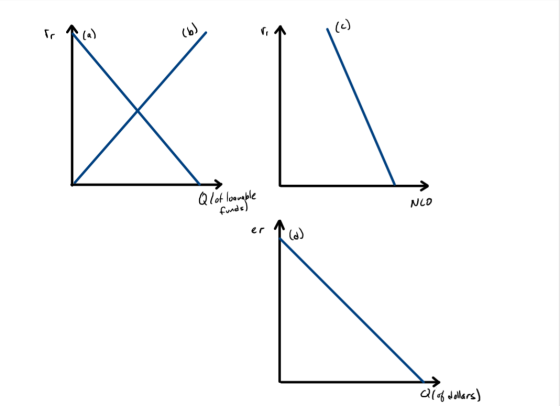
Homework Answers
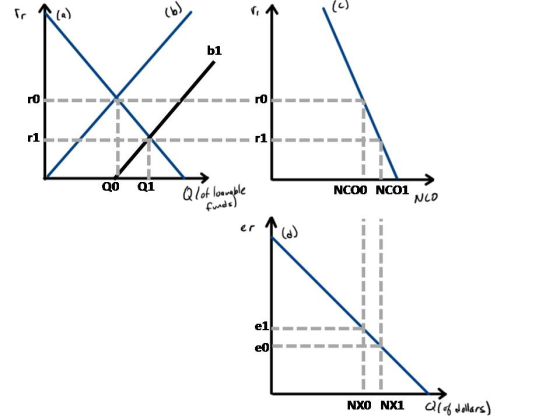
Higher domestic private saving will shift supply curve rightward to b1. As a result, interest rate will decrease from r0 to r1. At lower interest rate, Net capital outflow will increase from NCO0 to NCO1. Since net exports equal net capital outflow, higher net capital outflow will increase net exports from NX0 to NX1, causing exchange rate to decrease from e0 to e1.
Add Answer to:
Using the three-panel diagram, illustrate what happens in the US
economy if consumers save more money...
Let assume an economy in this year with the following loanable funds (LF) market demand equation....
 Let assume an economy in this year with the following loanable funds (LF) market demand equation. Demand: r = 8 – 0.005 * Qp Where, r is the real interest rate (ifr=12 then the interest rate is 12%), Q, in the quantity demanded of loanable funds (total investment). The government expenditures (G) is $300 billion, collected taxes (T) equal to $700 billion, and private saving is $800 billion. 1. Calculate the value of government savings in this economy. Is the...
Chapter 12: What is money? What are the three functions of money? What is the difference...
Chapter 12: What is money? What are the three functions of money? What is the difference between fiat money and commodity money? How can banks affect the money supply? What is the reserve ratio? What is the money multiplier? How did banking develop? How are required reserves different from excess reserves? Know the differences between bond markets, stock markets, banks, and mutual funds, and know the characteristics of bonds, stocks, banks, and mutual funds. How do banks help solve problems...
7. Suppose that Canada imposes an import quota on automobiles. In the open-economy macroeconomic model, which of...
7. Suppose that Canada imposes an import quota on automobiles. In the open-economy macroeconomic model, which of the following curves would this quota shift? a. supply of loanable funds left b. demand for loanable funds left c. demand for Canadian dollars right d. supply of Canadian dollars left 8. Suppose the Canadian government imposed import quotas on agricultural products. According to the foreign-currency exchange market diagram, which of the following outcomes would most likely result? a. Both the demand and supply curves...
3. E ffects of a government budget deficit Consider a hypothetical open economy. The following table presents data on the relationship between various real interest rates and national saving, domesti...
 3. Effects of a government budget deficit Consider a hypothetical open economy. The following table presents data on the relationship between various real interest rates and national saving, domestic investment, and net capital outflow in this economy, where the currency is the U.S. dollar. Assume that the economy is currently experiencing a balanced government budget. Given the information in the preceding table, use the blue points (circle symbol) to plot the demand for loanable funds. Next, use the orange points (square symbol)...
6.For an economy that engages in international trade, GDP is divided into four components. Which of...
 6.For an economy that engages in international trade, GDP is divided into four components. Which of the following items is not one of those components? a. Consumption. b. Taxes. c. Government purchases. d. Net exports. 7. The slope of the demand for loanable funds curve represents the a. positive relation between the real interest rate and investment. b. negative relation between the real interest rate and investment c. positive relation between the real interest rate and saving d. negative relation...
Suppose the US economy is at Potential GDP. Then, consumers and firms become pessimistic about future...
 Suppose the US economy is at Potential GDP. Then, consumers and firms become pessimistic about future economic conditions, and consumption and investment decrease. In response to the decline in consumption and investment, the FED increases the money supply. Congress responds as well approving an increase in government spending and tax cuts. Illustrate this sequence of events using an Aggregate Demand/Aggregate Supply graph. State what happens with Real GDP, Prices, and the Unemployment rate after monetary and fiscal policies are implemented.
Consider a reduction in (domestic) taxes (T). a. Consider the event in the long-run closed economy...
 Consider a reduction in (domestic) taxes (T). a. Consider the event in the long-run closed economy model. How will private and public savings be affected? Explain. Illustrate graphically using the domestic loanable funds market how such an event will affect the equilibrium domestic national savings, domestic investment spending and domestic real interest rate. Explain. b. Consider the same event, but now in the long-run small open economy model(Assume the economy is originally running a trade deficit.) I llustrate graphically using...
• if the velocity of money is 2, the money supply in this economy is ($4.5 trillion/ $18 trillion/ $27 trillion/ $3...
 • if the velocity of money is 2, the money supply in this
economy is ($4.5 trillion/ $18 trillion/ $27 trillion/ $36
trillion/ $45trillion /$54 trillion)
•because ( the federal reserve controls M/ velocity is assumed
to be constant/ the AD curve is downward sloping ), the percentage
increase in the price level Is ( less then/ the same as/ greater
then ) the percentage increase im the money supply. the illustrates
the ( importance of the federal reserve /...
• if the velocity of money is 2, the money supply in this
economy is ($4.5 trillion/ $18 trillion/ $27 trillion/ $36
trillion/ $45trillion /$54 trillion)
•because ( the federal reserve controls M/ velocity is assumed
to be constant/ the AD curve is downward sloping ), the percentage
increase in the price level Is ( less then/ the same as/ greater
then ) the percentage increase im the money supply. the illustrates
the ( importance of the federal reserve /...
which of the following statements about the loanable funds market is (are) correct? (x) When the...
which of the following statements about the loanable funds market is (are) correct? (x) When the supply of loanable funds shifts to the right then the equilibrium real interest rate decreases and the equilibrium quantity of loanable funds decreases. (y) When the demand for loanable funds shifts to the right then the equilibrium real interest rate increases and the equilibrium quantity of loanable funds increases. (z) If the demand for loanable funds shifts to the right and the supply of...
which of the following statements about the loanable funds market is (are) correct? (x) When the...
which of the following statements about the loanable funds market is (are) correct? (x) When the supply of loanable funds shifts to the right then the equilibrium real interest rate decreases and the equilibrium quantity of loanable funds decreases. (y) When the demand for loanable funds shifts to the right then the equilibrium real interest rate increases and the equilibrium quantity of loanable funds increases. (z) If the demand for loanable funds shifts to the right and the supply of...
 Let assume an economy in this year with the following loanable funds (LF) market demand equation. Demand: r = 8 – 0.005 * Qp Where, r is the real interest rate (ifr=12 then the interest rate is 12%), Q, in the quantity demanded of loanable funds (total investment). The government expenditures (G) is $300 billion, collected taxes (T) equal to $700 billion, and private saving is $800 billion. 1. Calculate the value of government savings in this economy. Is the...
 6.For an economy that engages in international trade, GDP is divided into four components. Which of the following items is not one of those components? a. Consumption. b. Taxes. c. Government purchases. d. Net exports. 7. The slope of the demand for loanable funds curve represents the a. positive relation between the real interest rate and investment. b. negative relation between the real interest rate and investment c. positive relation between the real interest rate and saving d. negative relation...
 Suppose the US economy is at Potential GDP. Then, consumers and firms become pessimistic about future economic conditions, and consumption and investment decrease. In response to the decline in consumption and investment, the FED increases the money supply. Congress responds as well approving an increase in government spending and tax cuts. Illustrate this sequence of events using an Aggregate Demand/Aggregate Supply graph. State what happens with Real GDP, Prices, and the Unemployment rate after monetary and fiscal policies are implemented.
 Consider a reduction in (domestic) taxes (T). a. Consider the event in the long-run closed economy model. How will private and public savings be affected? Explain. Illustrate graphically using the domestic loanable funds market how such an event will affect the equilibrium domestic national savings, domestic investment spending and domestic real interest rate. Explain. b. Consider the same event, but now in the long-run small open economy model(Assume the economy is originally running a trade deficit.) I llustrate graphically using...
 • if the velocity of money is 2, the money supply in this
economy is ($4.5 trillion/ $18 trillion/ $27 trillion/ $36
trillion/ $45trillion /$54 trillion)
•because ( the federal reserve controls M/ velocity is assumed
to be constant/ the AD curve is downward sloping ), the percentage
increase in the price level Is ( less then/ the same as/ greater
then ) the percentage increase im the money supply. the illustrates
the ( importance of the federal reserve /...
• if the velocity of money is 2, the money supply in this
economy is ($4.5 trillion/ $18 trillion/ $27 trillion/ $36
trillion/ $45trillion /$54 trillion)
•because ( the federal reserve controls M/ velocity is assumed
to be constant/ the AD curve is downward sloping ), the percentage
increase in the price level Is ( less then/ the same as/ greater
then ) the percentage increase im the money supply. the illustrates
the ( importance of the federal reserve /...
Most questions answered within 3 hours.
-
Where is the error in this code sequence?
String s1 = "Hello";
String s2 = "ello";...
asked 10 months ago -
Financial data for Joel de Paris, Inc., for last year
follow:
Joel de Paris, Inc.
Balance...
asked 10 months ago -
Consider this reaction:
Al2(SO4)3 (aq)+ BaCl3
(aq) Al2Cl6 (aq)- +
3BaSO4(s) . What is the...
asked 10 months ago -
Suppose that Savneet is considering increasing her
recent random sample from 20 car rentals to 40...
asked 10 months ago -
Trucks arrive at an unloading terminal at an average rate of 120
per hour.
Trucks arrive...
asked 10 months ago -
Why are methanol and ethanol completely soluble in water while
octanol is not very little soluble....
asked 10 months ago -
A facilities manager at a university reads in a research report
that the mean amount of...
asked 10 months ago -
When the CuSO4 is rehydrated by adding water to the anhydrous
compound, is this an endothermic...
asked 10 months ago -
A ray of sunlight is passing from diamond into crown glass; the
angle of incidence is...
asked 10 months ago -
A block of mass 0.249 kg is placed on top of a light, vertical
spring of...
asked 10 months ago -
how do the kidneys compensate in the presences of acidosis
a) trigger hyperventilate
b) reserve acid...
asked 10 months ago -
Question 501 pts
The rental rate of capital to the firm increases. Which of the
following...
asked 10 months ago