
Homework Answers
`Hey,
Note: Brother if you have any queries related the answer please do comment. I would be very happy to resolve all your queries.
a)
function y=fun(x)
y=(exp(4*x)-1)./(8*x);
end
b)
x=10.^(-5:-1:-9)
c)
clc
clear all
close all
x=10.^(-5:-1:-9);
y=fun(x)
function y=fun(x)
y=(exp(4*x)-1)./(8*x);
end
%RESULT IS 0.5
Kindly revert for any queries
Thanks.
Add Answer to:
- 1 $(2) - 8.0 a) Create a function file to evaluate f(x). Write the commands...
Answer the following questions: (a) Create a m-file for this fix) and save it as f.m. Write the contents of the (b)Use Matlab to graph f(x) and the difquo of f(x), using linspace (0, 50) on two d...
 Answer the following questions: (a) Create a m-file for this fix) and save it as f.m. Write the contents of the (b)Use Matlab to graph f(x) and the difquo of f(x), using linspace (0, 50) on two different graphs. You may take h ,001 to create the difquo function. (i)Conmands to sketch f(x) (i) Commands to sketch its difquo function (ii) Show two labeled graphs: one of fix) and one of its difquo function: Mark the axes. (iv)What is the...
Write MATLAB code g(x)=x+a*f(x) f(x)=(e^x)+(x^2)-x-4 function f(x) is stored in fogp1.m (c) (1) Create a file...
 Write MATLAB code
g(x)=x+a*f(x)
f(x)=(e^x)+(x^2)-x-4
function f(x) is stored in fogp1.m
(c) (1) Create a file gopgi.m to calculate the function glir, a) (see Preparation, ex. 7c) function [y] =gopg1(x,a) % input: x, a % output: y y= .....; (2) Create a file sucsub1.m and write a program that calculates the solution using the method of successive substitution. Calculate the values of g(x, a) by making multiple calls to the function gopg1(x, a). Take xo = 1.3 as starting value...
Write MATLAB code
g(x)=x+a*f(x)
f(x)=(e^x)+(x^2)-x-4
function f(x) is stored in fogp1.m
(c) (1) Create a file gopgi.m to calculate the function glir, a) (see Preparation, ex. 7c) function [y] =gopg1(x,a) % input: x, a % output: y y= .....; (2) Create a file sucsub1.m and write a program that calculates the solution using the method of successive substitution. Calculate the values of g(x, a) by making multiple calls to the function gopg1(x, a). Take xo = 1.3 as starting value...
matlab only Question 5: a.) Write an m-file using conditional statements to evaluate the following function, assuming that the scalar variable x has a value. The function is for x <-1 - 3e y=2...
 matlab only
Question 5: a.) Write an m-file using conditional statements to evaluate the following function, assuming that the scalar variable x has a value. The function is for x <-1 - 3e y=2+cos(m) for-1 x<5 y 10-5)+1 for r 2 5 Use your file to evaluate y for x5, x-3, and x-15, and Use keyboard entry for values of x. b.) Use a for loop in the above file to plot the above function over the interval -2x <10....
matlab only
Question 5: a.) Write an m-file using conditional statements to evaluate the following function, assuming that the scalar variable x has a value. The function is for x <-1 - 3e y=2+cos(m) for-1 x<5 y 10-5)+1 for r 2 5 Use your file to evaluate y for x5, x-3, and x-15, and Use keyboard entry for values of x. b.) Use a for loop in the above file to plot the above function over the interval -2x <10....
"PYTHON" 1. a. Create a file (module) named camera_picture.py. b. Write a function, take_picture_effect, that takes...
"PYTHON" 1. a. Create a file (module) named camera_picture.py. b. Write a function, take_picture_effect, that takes two parameters, the filename and an effect. c. Take a picture with the filename and effect. Use camera.effect to set the effect. Use help(PiCamera) to find the effects which you can apply. d. Create a second file use_camera.py. e. Import the take_picture_effect function from the camera_picture module. f. Prompt the user for the filename. g. Prompt the user for the image_effect. help(PiCamera) to see...
Write a MATLab code for a function m-file that that can take three inputs (f, y,...
Write a MATLab code for a function m-file that that can take three inputs (f, y, t) and uses a while loop to examine f(x) for x = y, x = y+2t, x = y+4t, ... until a number is larger than the previous value and returns the x value for which this happens. Notes: Assume that f is decreasing at x=y but that there is a cutoff x=b > y after which f starts increasing. Assume the input for...
Given the function f, evaluate f(-1), f), f(2), and f(4). Sx²-3 if x < 2 f(x)...
 Given the function f, evaluate f(-1), f), f(2), and f(4). Sx²-3 if x < 2 f(x) 6 + [x - 5] if x 2 2 f(-1) = f(0) f(2) f(4) = A car travels at a constant speed of 50 miles per hour. The distance, d, the car travels in miles is a function of time, t, in hours given by d(t) = 50t. Find the inverse function by expressing the time of travel in terms of the distance traveled....
(1 point) Consider the function f(x) = x2/5(x – 9). This function has two critical numbers...
 (1 point) Consider the function f(x) = x2/5(x – 9). This function has two critical numbers A< B Then A = and B For each of the following intervals, tell whether f(x) is increasing or decreasing. (-0, A]: ? [A, B]: ? [B, 0) ? The critical number A is ? and the critical number B is ? There are two numbers C < D where either F"(x) = 0 or f'(x) is undefined. Then C= and D= Finally for...
Using PyCharm, under lab8, under Directory exercise, create a Python file called more_loops.py. Write a function,...
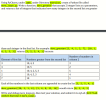 Using PyCharm, under lab8, under Directory exercise, create a Python file called more_loops.py. Write a function, nbrs_greater that accepts 2 integer lists as a parameters, and returns a list of integers that indicates how many integers in the second list are greater than each integer in the first list. For example: nbrs_greater([3, 4, 1, 2, 7], [10, 1, 4, 2, 5, 3]) returns [3, 2, 5, 4, 1] because: Number of numbers in Element of first list Numbers greater from...
1. the commands you used to create the directories and files in Linux and Windows; 2....
1. the commands you used to create the directories and files in Linux and Windows; 2. the commands you used to determine default permissions in Linux and Windows; 3. the commands you used to change permissions on your files in Linux and Windows; 4. a paragraph about how directories and file permissions work and what was the same or different between Windows and Linux.
4. (5 points each) For function f(1) = 2-*+1+3, (a) Write down the steps of graph...
 4. (5 points each) For function f(1) = 2-*+1+3, (a) Write down the steps of graph transformation from y=2 to f(1). (b) What is the domain and range for f(x)? (c) What is the horizontal asymtote for f(x)? (d) Create a table and evaluate at least three points and sketch the graph of f(x).
 Answer the following questions: (a) Create a m-file for this fix) and save it as f.m. Write the contents of the (b)Use Matlab to graph f(x) and the difquo of f(x), using linspace (0, 50) on two different graphs. You may take h ,001 to create the difquo function. (i)Conmands to sketch f(x) (i) Commands to sketch its difquo function (ii) Show two labeled graphs: one of fix) and one of its difquo function: Mark the axes. (iv)What is the...
 Write MATLAB code
g(x)=x+a*f(x)
f(x)=(e^x)+(x^2)-x-4
function f(x) is stored in fogp1.m
(c) (1) Create a file gopgi.m to calculate the function glir, a) (see Preparation, ex. 7c) function [y] =gopg1(x,a) % input: x, a % output: y y= .....; (2) Create a file sucsub1.m and write a program that calculates the solution using the method of successive substitution. Calculate the values of g(x, a) by making multiple calls to the function gopg1(x, a). Take xo = 1.3 as starting value...
Write MATLAB code
g(x)=x+a*f(x)
f(x)=(e^x)+(x^2)-x-4
function f(x) is stored in fogp1.m
(c) (1) Create a file gopgi.m to calculate the function glir, a) (see Preparation, ex. 7c) function [y] =gopg1(x,a) % input: x, a % output: y y= .....; (2) Create a file sucsub1.m and write a program that calculates the solution using the method of successive substitution. Calculate the values of g(x, a) by making multiple calls to the function gopg1(x, a). Take xo = 1.3 as starting value...
 matlab only
Question 5: a.) Write an m-file using conditional statements to evaluate the following function, assuming that the scalar variable x has a value. The function is for x <-1 - 3e y=2+cos(m) for-1 x<5 y 10-5)+1 for r 2 5 Use your file to evaluate y for x5, x-3, and x-15, and Use keyboard entry for values of x. b.) Use a for loop in the above file to plot the above function over the interval -2x <10....
matlab only
Question 5: a.) Write an m-file using conditional statements to evaluate the following function, assuming that the scalar variable x has a value. The function is for x <-1 - 3e y=2+cos(m) for-1 x<5 y 10-5)+1 for r 2 5 Use your file to evaluate y for x5, x-3, and x-15, and Use keyboard entry for values of x. b.) Use a for loop in the above file to plot the above function over the interval -2x <10....
 Given the function f, evaluate f(-1), f), f(2), and f(4). Sx²-3 if x < 2 f(x) 6 + [x - 5] if x 2 2 f(-1) = f(0) f(2) f(4) = A car travels at a constant speed of 50 miles per hour. The distance, d, the car travels in miles is a function of time, t, in hours given by d(t) = 50t. Find the inverse function by expressing the time of travel in terms of the distance traveled....
 (1 point) Consider the function f(x) = x2/5(x – 9). This function has two critical numbers A< B Then A = and B For each of the following intervals, tell whether f(x) is increasing or decreasing. (-0, A]: ? [A, B]: ? [B, 0) ? The critical number A is ? and the critical number B is ? There are two numbers C < D where either F"(x) = 0 or f'(x) is undefined. Then C= and D= Finally for...
 Using PyCharm, under lab8, under Directory exercise, create a Python file called more_loops.py. Write a function, nbrs_greater that accepts 2 integer lists as a parameters, and returns a list of integers that indicates how many integers in the second list are greater than each integer in the first list. For example: nbrs_greater([3, 4, 1, 2, 7], [10, 1, 4, 2, 5, 3]) returns [3, 2, 5, 4, 1] because: Number of numbers in Element of first list Numbers greater from...
 4. (5 points each) For function f(1) = 2-*+1+3, (a) Write down the steps of graph transformation from y=2 to f(1). (b) What is the domain and range for f(x)? (c) What is the horizontal asymtote for f(x)? (d) Create a table and evaluate at least three points and sketch the graph of f(x).
Most questions answered within 3 hours.
-
Where is the error in this code sequence?
String s1 = "Hello";
String s2 = "ello";...
asked 10 months ago -
Financial data for Joel de Paris, Inc., for last year
follow:
Joel de Paris, Inc.
Balance...
asked 10 months ago -
Consider this reaction:
Al2(SO4)3 (aq)+ BaCl3
(aq) Al2Cl6 (aq)- +
3BaSO4(s) . What is the...
asked 10 months ago -
Suppose that Savneet is considering increasing her
recent random sample from 20 car rentals to 40...
asked 10 months ago -
Trucks arrive at an unloading terminal at an average rate of 120
per hour.
Trucks arrive...
asked 10 months ago -
Why are methanol and ethanol completely soluble in water while
octanol is not very little soluble....
asked 10 months ago -
A facilities manager at a university reads in a research report
that the mean amount of...
asked 10 months ago -
When the CuSO4 is rehydrated by adding water to the anhydrous
compound, is this an endothermic...
asked 10 months ago -
A ray of sunlight is passing from diamond into crown glass; the
angle of incidence is...
asked 10 months ago -
A block of mass 0.249 kg is placed on top of a light, vertical
spring of...
asked 10 months ago -
how do the kidneys compensate in the presences of acidosis
a) trigger hyperventilate
b) reserve acid...
asked 10 months ago -
Question 501 pts
The rental rate of capital to the firm increases. Which of the
following...
asked 10 months ago