
Homework Answers
given
r(t) = 5 m
theta(t) = 2*t
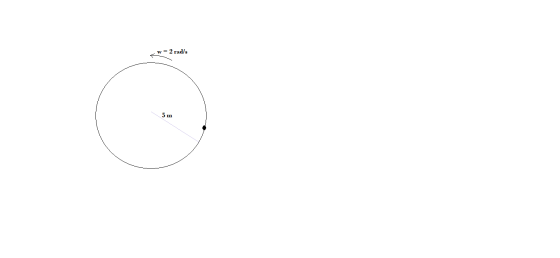
The motion can be called uniform circular motion
angular velocity, w = d(theta)/dt
= d*(2*t)/dt
= 2 rad/s
The magnitude of net force = m*a
= m*r*w^2
= 2*5*2^2
= 40 N <<<<<<-----------Answer
magnitude of acceleration = r*w^2
= 5*2^2
= 20 m/s^2 <<<<<<-----------Answer
Add Answer to:
Prob. 3 If a 2-kg particle moves along a path given by: r(t) = 5 m...
A particle moves along the path r-8tH + (t3 + 5)j) m, where t s in...
 A particle moves along the path r-8tH + (t3 + 5)j) m, where t s in seconds. Determine the magnitudes of the particle's velocity and acceleration whent-3 s.
A 0.25 kg particle moves in an xy plane according to x(t) = -15 + 2t...
A 0.25 kg particle moves in an xy plane according to x(t) = -15 + 2t - 4t3 and y(t) = 25 + 7t - 9t2, with x and y in meters and t in seconds. Find formulas at time t<35 sec for the (a) the magnitude and (b) the angle (relative to the positive direction of the x axis) of the net force on the particle (in radians), as well as (c) the angle of the particle's direction of...
2. A particle moves in the x-y plane. Its coordinates are given as functions of time...
 2. A particle moves in the x-y plane. Its coordinates are given as functions of time t(2 0) b x(t)-R(at-sina)t), )Sketch the trajectory of the particle. This is the trajectory of a point on the rim of a wheel y(t)-R(1-cosω t), where R and ω are constants. (a) (3 that is rolling at a constant speed on a horizontal surface. The curve traced out by such a point as it moves through space is called a cycloid. (b) (5 Find...
The displacement of a particle which moves along the s-axis is given by s = (t-3)exp(-0.6t)‚...
The displacement of a particle which moves along the s-axis is given by s = (t-3)exp(-0.6t)‚ where s is in meters and t is in seconds. Plot the displacement, velocity, and acceleration versus time for the first 20 seconds of motion. Determine the time at which the acceleration is zero?
L. PA AC 0 Particle A moves along a circular path (of radius R) with constant...
 L. PA AC 0 Particle A moves along a circular path (of radius R) with constant speed 4. Particle B moves along a straight-line path with constant speed vs. Circle the appropriate answer below relative to the position shown. • The velocity of Particle A with respect to Particle B is: vh UB) (UB-u) (U+08) • The acceleration of Particle A with respect to Particle B is: (uB-) R R
A 5.60-kg particle moves along the x axis. Its position varies with time according to x...
A 5.60-kg particle moves along the x axis. Its position varies with time according to x = t + 4.0t3, where x is in meters and t is in seconds. (a) Find the kinetic energy of the particle at any time t. (Use the following as necessary: t.) K = (b) Find the magnitude of the acceleration of the particle and the force acting on it at time t. (Use the following as necessary: t.) a = F = (c)...
Determine the magnitude of the resultant force acting on a 9- kg particle at the instant t = 2s
Determine the magnitude of the resultant force acting on a 9- kg particle at the instant t = 2s, if the particle is moving along a horizontal path defined by the equationsr=(2t+10) m and θ=(1.5t2-6 t) rad, where t is in seconds.F= _______
A particle moves along a circular path of radius 10 ft. If its position is 8...
 A particle moves along a circular path of radius 10 ft. If its position is 8 = 0.74 - 1 rad, where t, is in seconds, determine the magnitude of the particle's acceleration when 8 = 0.53 radians. Note that the magnitude is a scalar, if you were asked for acceleration you would need to give a vector Give answer to at least 3 decimal places jäl =
F12-18. A particle travels along a straight-line path y 0.5x. If the x component of the...
 F12-18. A particle travels along a straight-line path y 0.5x. If the x component of the particle's velocity is vr= (2) m/s, where t is in seconds, determine the magnitude of the particle's velocity and acceleration when = 4 s. y =0.5x Prob. F12-18 F12-19. A particle is traveling along the parabolic path y 0.25x. If x 8 m. , 8 m/s, and a, 4 m/s2 when 2 s. determine the magnitude of the particle's velocity and acceleration at this...
A particle moves along the x-axis so that its velocity at any time t/geq0 is given...
 A particle moves along the x-axis so that its velocity at any time t/geq0 is given by v(t) = 1 - sin(2t). (a) Determine the expression for acceleration at any time t. (b) Find all values t, 0 <t<2, for which the particle is at rest. (c) Determine the expression for the position Jf the particle at any timet if x(0) = 0.
 A particle moves along the path r-8tH + (t3 + 5)j) m, where t s in seconds. Determine the magnitudes of the particle's velocity and acceleration whent-3 s.
 2. A particle moves in the x-y plane. Its coordinates are given as functions of time t(2 0) b x(t)-R(at-sina)t), )Sketch the trajectory of the particle. This is the trajectory of a point on the rim of a wheel y(t)-R(1-cosω t), where R and ω are constants. (a) (3 that is rolling at a constant speed on a horizontal surface. The curve traced out by such a point as it moves through space is called a cycloid. (b) (5 Find...
 L. PA AC 0 Particle A moves along a circular path (of radius R) with constant speed 4. Particle B moves along a straight-line path with constant speed vs. Circle the appropriate answer below relative to the position shown. • The velocity of Particle A with respect to Particle B is: vh UB) (UB-u) (U+08) • The acceleration of Particle A with respect to Particle B is: (uB-) R R
 A particle moves along a circular path of radius 10 ft. If its position is 8 = 0.74 - 1 rad, where t, is in seconds, determine the magnitude of the particle's acceleration when 8 = 0.53 radians. Note that the magnitude is a scalar, if you were asked for acceleration you would need to give a vector Give answer to at least 3 decimal places jäl =
 F12-18. A particle travels along a straight-line path y 0.5x. If the x component of the particle's velocity is vr= (2) m/s, where t is in seconds, determine the magnitude of the particle's velocity and acceleration when = 4 s. y =0.5x Prob. F12-18 F12-19. A particle is traveling along the parabolic path y 0.25x. If x 8 m. , 8 m/s, and a, 4 m/s2 when 2 s. determine the magnitude of the particle's velocity and acceleration at this...
 A particle moves along the x-axis so that its velocity at any time t/geq0 is given by v(t) = 1 - sin(2t). (a) Determine the expression for acceleration at any time t. (b) Find all values t, 0 <t<2, for which the particle is at rest. (c) Determine the expression for the position Jf the particle at any timet if x(0) = 0.
Most questions answered within 3 hours.
-
Where is the error in this code sequence?
String s1 = "Hello";
String s2 = "ello";...
asked 10 months ago -
Financial data for Joel de Paris, Inc., for last year
follow:
Joel de Paris, Inc.
Balance...
asked 10 months ago -
Consider this reaction:
Al2(SO4)3 (aq)+ BaCl3
(aq) Al2Cl6 (aq)- +
3BaSO4(s) . What is the...
asked 10 months ago -
Suppose that Savneet is considering increasing her
recent random sample from 20 car rentals to 40...
asked 10 months ago -
Trucks arrive at an unloading terminal at an average rate of 120
per hour.
Trucks arrive...
asked 10 months ago -
Why are methanol and ethanol completely soluble in water while
octanol is not very little soluble....
asked 10 months ago -
A facilities manager at a university reads in a research report
that the mean amount of...
asked 10 months ago -
When the CuSO4 is rehydrated by adding water to the anhydrous
compound, is this an endothermic...
asked 10 months ago -
A ray of sunlight is passing from diamond into crown glass; the
angle of incidence is...
asked 10 months ago -
A block of mass 0.249 kg is placed on top of a light, vertical
spring of...
asked 10 months ago -
how do the kidneys compensate in the presences of acidosis
a) trigger hyperventilate
b) reserve acid...
asked 10 months ago -
Question 501 pts
The rental rate of capital to the firm increases. Which of the
following...
asked 10 months ago