


Homework Answers

Add Answer to:
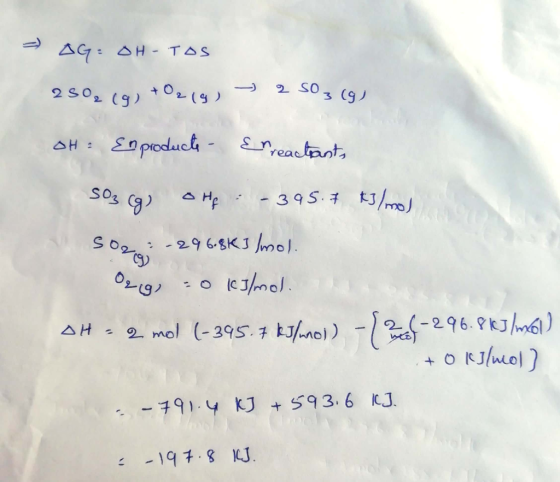
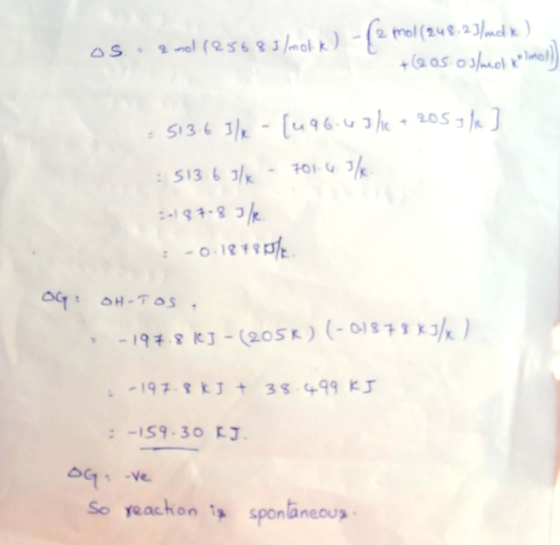
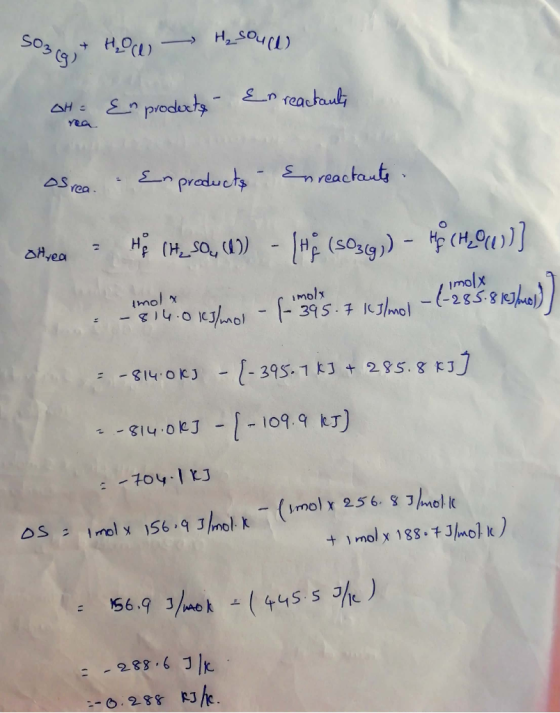
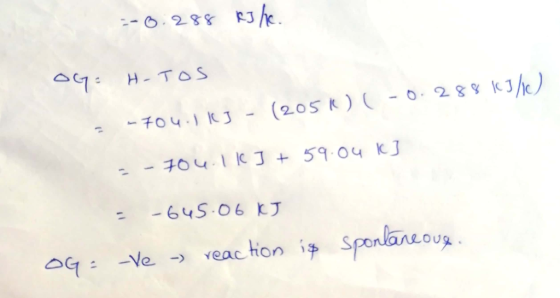
For each part below, use the data below to calculate AG at 205 K for each...
*** ** -305.01 -183.9 151.1 NH4NO3 (aq) -339.9 -190.6 259.8 AHºf (kJ/mol) AG°f (kJ/mol) Sº (/mol...
 *** ** -305.01 -183.9 151.1 NH4NO3 (aq) -339.9 -190.6 259.8 AHºf (kJ/mol) AG°f (kJ/mol) Sº (/mol K) 0 205.1 Oxygen 02 (g) O(g) 03 (g) 249.2 231.7 161.1 142.7 163.2 238.9 Phosphorus AH° (kJ/mol) AG°f(kJ/mol) sº (/mol K) Nitrogen AH°(kJ/mol) AG°f(kJ/mol) s° /mol K) N2 (8) 0 191.6 N (g) 472.7 455.6 153.3 NH3 (g) -46.1 -16.5 192.5 NH3 (aq) -80.0 -27.0 111.0 132.0 -79.0 113.0 90.3 86.6 210.8 51.7 66.1 261.8 NH4+ (aq) NO (g) NOCI (9) NO2 (g)...
2 NH3 (9)+ 3 o2(9) > 3 H20 (9) + NO2 (9) + NO (9) Use the data from this link:ThermodynamicData to calculate the following for the reaction above. (a)AG° at 298 K. kJ (b) Calculate the numerical v...
 2 NH3 (9)+ 3 o2(9) > 3 H20 (9) + NO2 (9) + NO (9) Use the data from this link:ThermodynamicData to calculate the following for the reaction above. (a)AG° at 298 K. kJ (b) Calculate the numerical value of In K at 590 K (c) The temperature at which the reaction can be at equilibrium under standard conditions, if this is possible. If it is not possible, enter 0 (d) The ΔG at 590 K if all reactants in...
#6-9 6. Calculate the enthalpy change for the reaction given below, using thermodynamic tables in your...
 #6-9
6. Calculate the enthalpy change for the reaction given below, using thermodynamic tables in your book (Appendix 2): CH(g)+02(B) HO(g) + CO,(g) (not balanced) 7. Calcium carbonate decomposes at high temperature to form carbon dioxide and calcium oxide: CaCO3 CO2+ CaO Using data from the textbook (Apendix 2), determine the heat of reaction. 8. When potassium chloride reacts with oxygen under the right conditions, potassium chlorate is formed: 2 KCI+3 02 2KCIO3 Using data from the textbook (Appendix 2),...
#6-9
6. Calculate the enthalpy change for the reaction given below, using thermodynamic tables in your book (Appendix 2): CH(g)+02(B) HO(g) + CO,(g) (not balanced) 7. Calcium carbonate decomposes at high temperature to form carbon dioxide and calcium oxide: CaCO3 CO2+ CaO Using data from the textbook (Apendix 2), determine the heat of reaction. 8. When potassium chloride reacts with oxygen under the right conditions, potassium chlorate is formed: 2 KCI+3 02 2KCIO3 Using data from the textbook (Appendix 2),...
 *** ** -305.01 -183.9 151.1 NH4NO3 (aq) -339.9 -190.6 259.8 AHºf (kJ/mol) AG°f (kJ/mol) Sº (/mol K) 0 205.1 Oxygen 02 (g) O(g) 03 (g) 249.2 231.7 161.1 142.7 163.2 238.9 Phosphorus AH° (kJ/mol) AG°f(kJ/mol) sº (/mol K) Nitrogen AH°(kJ/mol) AG°f(kJ/mol) s° /mol K) N2 (8) 0 191.6 N (g) 472.7 455.6 153.3 NH3 (g) -46.1 -16.5 192.5 NH3 (aq) -80.0 -27.0 111.0 132.0 -79.0 113.0 90.3 86.6 210.8 51.7 66.1 261.8 NH4+ (aq) NO (g) NOCI (9) NO2 (g)...
 2 NH3 (9)+ 3 o2(9) > 3 H20 (9) + NO2 (9) + NO (9) Use the data from this link:ThermodynamicData to calculate the following for the reaction above. (a)AG° at 298 K. kJ (b) Calculate the numerical value of In K at 590 K (c) The temperature at which the reaction can be at equilibrium under standard conditions, if this is possible. If it is not possible, enter 0 (d) The ΔG at 590 K if all reactants in...
 #6-9
6. Calculate the enthalpy change for the reaction given below, using thermodynamic tables in your book (Appendix 2): CH(g)+02(B) HO(g) + CO,(g) (not balanced) 7. Calcium carbonate decomposes at high temperature to form carbon dioxide and calcium oxide: CaCO3 CO2+ CaO Using data from the textbook (Apendix 2), determine the heat of reaction. 8. When potassium chloride reacts with oxygen under the right conditions, potassium chlorate is formed: 2 KCI+3 02 2KCIO3 Using data from the textbook (Appendix 2),...
#6-9
6. Calculate the enthalpy change for the reaction given below, using thermodynamic tables in your book (Appendix 2): CH(g)+02(B) HO(g) + CO,(g) (not balanced) 7. Calcium carbonate decomposes at high temperature to form carbon dioxide and calcium oxide: CaCO3 CO2+ CaO Using data from the textbook (Apendix 2), determine the heat of reaction. 8. When potassium chloride reacts with oxygen under the right conditions, potassium chlorate is formed: 2 KCI+3 02 2KCIO3 Using data from the textbook (Appendix 2),...
Most questions answered within 3 hours.
-
Where is the error in this code sequence?
String s1 = "Hello";
String s2 = "ello";...
asked 11 months ago -
Financial data for Joel de Paris, Inc., for last year
follow:
Joel de Paris, Inc.
Balance...
asked 11 months ago -
Consider this reaction:
Al2(SO4)3 (aq)+ BaCl3
(aq) Al2Cl6 (aq)- +
3BaSO4(s) . What is the...
asked 11 months ago -
Suppose that Savneet is considering increasing her
recent random sample from 20 car rentals to 40...
asked 11 months ago -
Trucks arrive at an unloading terminal at an average rate of 120
per hour.
Trucks arrive...
asked 11 months ago -
Why are methanol and ethanol completely soluble in water while
octanol is not very little soluble....
asked 11 months ago -
A facilities manager at a university reads in a research report
that the mean amount of...
asked 11 months ago -
When the CuSO4 is rehydrated by adding water to the anhydrous
compound, is this an endothermic...
asked 11 months ago -
A ray of sunlight is passing from diamond into crown glass; the
angle of incidence is...
asked 11 months ago -
A block of mass 0.249 kg is placed on top of a light, vertical
spring of...
asked 11 months ago -
how do the kidneys compensate in the presences of acidosis
a) trigger hyperventilate
b) reserve acid...
asked 11 months ago -
Question 501 pts
The rental rate of capital to the firm increases. Which of the
following...
asked 11 months ago