
Homework Answers
Add Answer to:
Only A and B please :)
The equation mgy for gravitational potential energy is valid only...
4. The equation mgy for gravitational potential energy is valid only for objects near the surface...
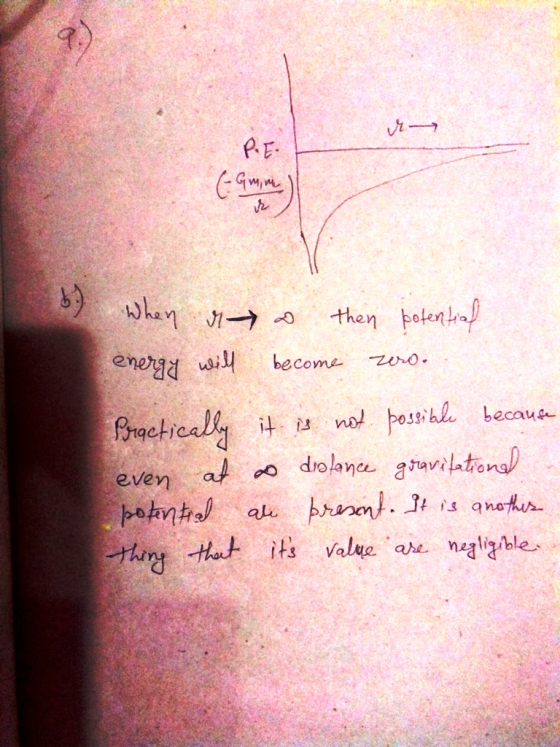
4. The equation mgy for gravitational potential energy is valid only for objects near the surface of a planet. Consider two very large objects of mass m1 and m2, such as stars or planets, whose centers are separated by the large distance r. These two large objects exert gravitational forces on each other.The gravitational potential energy is U = − Gm1m2 r where G = 6.67 × 10⁻¹¹Nm2/kg2 is the gravitational constant. (a) Sketch a graph of U versus r....
1) Use the gravitational potential energy and energy conservation arguments to write an expression for the...
 1) Use the gravitational potential energy and energy
conservation arguments to write an expression for the
Kelvin-Helmholtz time, t_KH, for stars. Calculate t_KH (in years)
for stars of mass 10 Mo, 1 Mo, and 0.1 Mo. Assume they have
luminosities and radii like main sequence stars with these masses
1) Use the gravitational potential energy and energy conservation arguments to write an expression for the Kelvin-Helmholtz time, th, for stars. Calculate tkh (in years) for stars of mass 10 M.,...
1) Use the gravitational potential energy and energy
conservation arguments to write an expression for the
Kelvin-Helmholtz time, t_KH, for stars. Calculate t_KH (in years)
for stars of mass 10 Mo, 1 Mo, and 0.1 Mo. Assume they have
luminosities and radii like main sequence stars with these masses
1) Use the gravitational potential energy and energy conservation arguments to write an expression for the Kelvin-Helmholtz time, th, for stars. Calculate tkh (in years) for stars of mass 10 M.,...
The gravitational potential energy of a small satellite with mass m orbiting the Earth, mass M,...
The gravitational potential energy of a small satellite with mass m orbiting the Earth, mass M, is U(r) = −(GMm)/r, where r is the radial distance from the center of Earth to the satellite. Derive the gravitational force F(r) acting on the satellite by evaluating the gradient of the potential energy.
A spacecraft of mass m = 1900 kg is moving on a circular orbit about the...
 A spacecraft of mass m = 1900 kg is moving on a circular orbit about the earth at a constant speed v = 5.12 km/s. [Given: Mass of the earth M = 5.98 times 10^24 kg, radius of the earth R = 6.37 times10^6 m, gravitational constant G = 6.67 times 10^-11 N.m^2/kg^2.] a. Determine the radius r of the circular orbit. b. What is the period T of the orbit? c. The satellite, by firing its engines, moves to...
?I need 7,8,9 and 10. Please show work, thank you :) For a circular merry-go-round, if...
 ?I need 7,8,9 and 10. Please show work, thank you :)
For a circular merry-go-round, if the moment if inertia is 600 kgm^2, what angular acceleration does the 150 N force generate applied perpendicular to a radius of 2.0 meters? 6 rad/s^2 1.5 rad/s^2 0.5 rad/s^2 3 rad/s^2 2 rad/s^2 Two bowling balls (m_1 = 8 kg and m_2 = 6 kg) are separated by 0.5 meters, what is the gravitational force that bowling ball# 1 exerts on bowling ball...
?I need 7,8,9 and 10. Please show work, thank you :)
For a circular merry-go-round, if the moment if inertia is 600 kgm^2, what angular acceleration does the 150 N force generate applied perpendicular to a radius of 2.0 meters? 6 rad/s^2 1.5 rad/s^2 0.5 rad/s^2 3 rad/s^2 2 rad/s^2 Two bowling balls (m_1 = 8 kg and m_2 = 6 kg) are separated by 0.5 meters, what is the gravitational force that bowling ball# 1 exerts on bowling ball...
answer all please Problem 1. A block of mass m = 735 g is located on...
 answer all please
Problem 1. A block of mass m = 735 g is located on an incline which makes an angle of 40 with the horizontal The friction coefficient between the block and the incline is K = 0.21. The block is released and it is let slide down the incline. (a) Draw a free body diagram and identify all forces acting on the block. Find the acceleration of the block (b) If the block moves d = 0.42...
answer all please
Problem 1. A block of mass m = 735 g is located on an incline which makes an angle of 40 with the horizontal The friction coefficient between the block and the incline is K = 0.21. The block is released and it is let slide down the incline. (a) Draw a free body diagram and identify all forces acting on the block. Find the acceleration of the block (b) If the block moves d = 0.42...
3. A simple model of a Neutron star is an ideal gas of neutrons (each with spin 1/2 in units of h...
 3. A simple model of a Neutron star is an ideal gas of neutrons (each with spin 1/2 in units of h). Aside from the kinetic energy of the neutrons, one must consider the gravitational energy, which for a homogeneous star of mass M and radius R, is 3GM2 5R where G 6.67 x 10⁻¹¹m3kg-'s-2 is the universal gravitational constant (i) We suppose in this problem that the Fermi temperature is large enough for T0 What general condition determines the...
Problem 1. The form of the gravitational potential energy of objects of mass mi and m2...
 Problem 1. The form of the gravitational potential energy of objects of mass mi and m2 located at positions r,-z1x + yı у + zł z and r,-z2z + угу + z2z can be written as G mim2 G mim2 A) Find the gravitational force that particle 2 exerts on particle 1. Use Fon-VU B) Find the gravitational force that particle 1 exerts on particle 2. Use Fon2=-▽2U C) Do the forces found above satisfy Newton's third law of motion?
3 GM2 (5) The gravitational potential of a uniform-density sphere of mass M and radius R is E,-- Consider a white dwarf...
 3 GM2 (5) The gravitational potential of a uniform-density sphere of mass M and radius R is E,-- Consider a white dwarf star which contains N electrons whose Fermi energy is Es. Since kaT <<Ef, the average electron energy is 3/5Er (derived in assignment 1) and the total electron energy is Ed-3/5NEs. The energies of the nuclei can be neglected. OE (a) Derive an expression for the gravitational pressure: P- OE (b) Derive an expression for the degeneracy pressure: Pa-...
3. Potential energy of rings. You know that the gravitational potential energy of two interacting spherical...
 3. Potential energy of rings. You know that the gravitational potential energy of two interacting spherical masses (e g. Earth and Sun) s u--GMm, where r distance between their centers. If the masses are not spherical, this expression is not valid. However, we can still find the total potential energy by dividing the non-spherical mass into bits, treating each tiny bit as a point mass (which gravitates like a sphere), and adding their effects. That is, U-J -GMdm. This integral...
 1) Use the gravitational potential energy and energy
conservation arguments to write an expression for the
Kelvin-Helmholtz time, t_KH, for stars. Calculate t_KH (in years)
for stars of mass 10 Mo, 1 Mo, and 0.1 Mo. Assume they have
luminosities and radii like main sequence stars with these masses
1) Use the gravitational potential energy and energy conservation arguments to write an expression for the Kelvin-Helmholtz time, th, for stars. Calculate tkh (in years) for stars of mass 10 M.,...
1) Use the gravitational potential energy and energy
conservation arguments to write an expression for the
Kelvin-Helmholtz time, t_KH, for stars. Calculate t_KH (in years)
for stars of mass 10 Mo, 1 Mo, and 0.1 Mo. Assume they have
luminosities and radii like main sequence stars with these masses
1) Use the gravitational potential energy and energy conservation arguments to write an expression for the Kelvin-Helmholtz time, th, for stars. Calculate tkh (in years) for stars of mass 10 M.,...
 A spacecraft of mass m = 1900 kg is moving on a circular orbit about the earth at a constant speed v = 5.12 km/s. [Given: Mass of the earth M = 5.98 times 10^24 kg, radius of the earth R = 6.37 times10^6 m, gravitational constant G = 6.67 times 10^-11 N.m^2/kg^2.] a. Determine the radius r of the circular orbit. b. What is the period T of the orbit? c. The satellite, by firing its engines, moves to...
 ?I need 7,8,9 and 10. Please show work, thank you :)
For a circular merry-go-round, if the moment if inertia is 600 kgm^2, what angular acceleration does the 150 N force generate applied perpendicular to a radius of 2.0 meters? 6 rad/s^2 1.5 rad/s^2 0.5 rad/s^2 3 rad/s^2 2 rad/s^2 Two bowling balls (m_1 = 8 kg and m_2 = 6 kg) are separated by 0.5 meters, what is the gravitational force that bowling ball# 1 exerts on bowling ball...
?I need 7,8,9 and 10. Please show work, thank you :)
For a circular merry-go-round, if the moment if inertia is 600 kgm^2, what angular acceleration does the 150 N force generate applied perpendicular to a radius of 2.0 meters? 6 rad/s^2 1.5 rad/s^2 0.5 rad/s^2 3 rad/s^2 2 rad/s^2 Two bowling balls (m_1 = 8 kg and m_2 = 6 kg) are separated by 0.5 meters, what is the gravitational force that bowling ball# 1 exerts on bowling ball...
 answer all please
Problem 1. A block of mass m = 735 g is located on an incline which makes an angle of 40 with the horizontal The friction coefficient between the block and the incline is K = 0.21. The block is released and it is let slide down the incline. (a) Draw a free body diagram and identify all forces acting on the block. Find the acceleration of the block (b) If the block moves d = 0.42...
answer all please
Problem 1. A block of mass m = 735 g is located on an incline which makes an angle of 40 with the horizontal The friction coefficient between the block and the incline is K = 0.21. The block is released and it is let slide down the incline. (a) Draw a free body diagram and identify all forces acting on the block. Find the acceleration of the block (b) If the block moves d = 0.42...
 3. A simple model of a Neutron star is an ideal gas of neutrons (each with spin 1/2 in units of h). Aside from the kinetic energy of the neutrons, one must consider the gravitational energy, which for a homogeneous star of mass M and radius R, is 3GM2 5R where G 6.67 x 10⁻¹¹m3kg-'s-2 is the universal gravitational constant (i) We suppose in this problem that the Fermi temperature is large enough for T0 What general condition determines the...
 Problem 1. The form of the gravitational potential energy of objects of mass mi and m2 located at positions r,-z1x + yı у + zł z and r,-z2z + угу + z2z can be written as G mim2 G mim2 A) Find the gravitational force that particle 2 exerts on particle 1. Use Fon-VU B) Find the gravitational force that particle 1 exerts on particle 2. Use Fon2=-▽2U C) Do the forces found above satisfy Newton's third law of motion?
 3 GM2 (5) The gravitational potential of a uniform-density sphere of mass M and radius R is E,-- Consider a white dwarf star which contains N electrons whose Fermi energy is Es. Since kaT <<Ef, the average electron energy is 3/5Er (derived in assignment 1) and the total electron energy is Ed-3/5NEs. The energies of the nuclei can be neglected. OE (a) Derive an expression for the gravitational pressure: P- OE (b) Derive an expression for the degeneracy pressure: Pa-...
 3. Potential energy of rings. You know that the gravitational potential energy of two interacting spherical masses (e g. Earth and Sun) s u--GMm, where r distance between their centers. If the masses are not spherical, this expression is not valid. However, we can still find the total potential energy by dividing the non-spherical mass into bits, treating each tiny bit as a point mass (which gravitates like a sphere), and adding their effects. That is, U-J -GMdm. This integral...
Most questions answered within 3 hours.
-
Where is the error in this code sequence?
String s1 = "Hello";
String s2 = "ello";...
asked 10 months ago -
Financial data for Joel de Paris, Inc., for last year
follow:
Joel de Paris, Inc.
Balance...
asked 10 months ago -
Consider this reaction:
Al2(SO4)3 (aq)+ BaCl3
(aq) Al2Cl6 (aq)- +
3BaSO4(s) . What is the...
asked 10 months ago -
Suppose that Savneet is considering increasing her
recent random sample from 20 car rentals to 40...
asked 10 months ago -
Trucks arrive at an unloading terminal at an average rate of 120
per hour.
Trucks arrive...
asked 10 months ago -
Why are methanol and ethanol completely soluble in water while
octanol is not very little soluble....
asked 10 months ago -
A facilities manager at a university reads in a research report
that the mean amount of...
asked 10 months ago -
When the CuSO4 is rehydrated by adding water to the anhydrous
compound, is this an endothermic...
asked 10 months ago -
A ray of sunlight is passing from diamond into crown glass; the
angle of incidence is...
asked 10 months ago -
A block of mass 0.249 kg is placed on top of a light, vertical
spring of...
asked 10 months ago -
how do the kidneys compensate in the presences of acidosis
a) trigger hyperventilate
b) reserve acid...
asked 10 months ago -
Question 501 pts
The rental rate of capital to the firm increases. Which of the
following...
asked 10 months ago