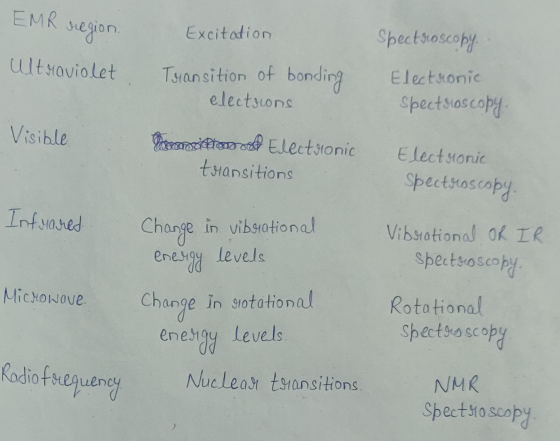
List quantum changes (or excitations) in a chemical species due to absorption each of the Following...
List quantum changes (or excitations) in a chemical species due to absorption each of the
Following regions of EMR. What is the related spectroscopic method for each type of
quantum change?
(i) ultraviolet (ii) visible (iii) infrared (iv) microwave (v) radio frequency
Homework Answers
Add Answer to:
List quantum changes (or excitations) in a chemical
species due to absorption each of the
Following...
1) Choose true (T) or false (F) to the following statements: a) Light is a...
1) Choose true (T) or false (F) to the following statements: a) Light is a shower of protons b) Light is a type of energy embodied in electric and magnetic fields c) The speed of light in vacuum is 3.00 x 10⁸ m/s d) The speed of light in vacuum is 3.00 x 10⁸ km/s 2) Choose the correct statement a) We can characterize a wave only by its amplitude b) Electric and magnetic...
From the following list of metal ions and ligands, construct metal complexes with properties which match...
 From the following list of metal ions and ligands, construct metal complexes with properties which match that described in each part of the question and provide a brief explanation. (Only one example is required for each part of the question, e.g. [Fe(H20)6]21). Metal ions Ligands (in order of increasing ligand field strength) [ < Br< <C1° <NO3 <OH <ox?- <H2O< Ti(IV), V(III), V(IV), Cr(II), Cr(III), Mn(II), NH3 <en <bpy < PPh3< CN=CO Mn(III), Mn(IV), Fe(II), Fe(III), Co(II), Co(III), en =...
1. Answer all parts to this question. From the following list of metal ions and ligands,...
 1. Answer all parts to this question. From the following list of metal ions and ligands, construct metal complexes with properties which match that described in each part of the question and provide a brief explanation (Only one example is required for each part of the question, eg [Fe(H:01) Metal ions Ligands in order of increasing ligand field strength) I <Br <C<NO, <OHOXH.0 Ti(IV), V(III), V(IV), CHIT), CHIIT), Min(II). NH<em<bry<PPh<N =CÓ Mn(III). Mn(IV), Fe(II) Fe(III). CoII), COIIT) en = ethylenediamine...
Many of the water properties lead to some crucial physical, chemical and biochemical processes that are...
Many of the water properties lead to some crucial physical, chemical and biochemical processes that are closely related to environmental and health problems. Some people state: (I) A relatively high dissolution of O2 in water is due largely to the dipolar property of water molecules. (II) Although the density of water changes only slightly with temperature, its change can cause lake water turnover or stratification. (III) Since water dissociation is so small (H2O ó H+ + OH-, Ka = 1.0...
NATS 1580 A Assignment 1 Due date: Feb 11. 2020 Each question is worth 10 marks...
 NATS 1580 A Assignment 1 Due date: Feb 11. 2020 Each question is worth 10 marks and assignment is worth 10% of your final grade. Please show all your calculation with proper units. (a) What color is typically associated with 600 nm? What is its frequency (b) What color is typically associated with 532 nm? What is its frequency? (c) What color is typically associated with 589 nm? What is its frequency? (d) In what part of the EM spectrum...
thank you for help in advance! In the following table, record the conductivity measured for each...
 thank you for help in advance!
In the following table, record the conductivity measured for each solution. The electrolyte type I should be strong, weak or non-electrolyte according to the table given previously. The species in solution should be a listing (in order of decreasing concentration) of the components of the solution. Ask your instructor if you need to list water as a species in solution. Species in Solution (In order of decreasing concentration) Electrolyte Type (SE, WE, NE) Conductivity...
thank you for help in advance!
In the following table, record the conductivity measured for each solution. The electrolyte type I should be strong, weak or non-electrolyte according to the table given previously. The species in solution should be a listing (in order of decreasing concentration) of the components of the solution. Ask your instructor if you need to list water as a species in solution. Species in Solution (In order of decreasing concentration) Electrolyte Type (SE, WE, NE) Conductivity...
Answer all parts. (a) Consider the following molecules C10H22 H.C_04 CH,CHCHCHCH.CH AICI CH206 CH For each...
 Answer all parts. (a) Consider the following molecules C10H22 H.C_04 CH,CHCHCHCH.CH AICI CH206 CH For each of the descriptors below, identify one chemical species from the above list. (1) A hydrocarbon. [1 mark] (ii) An organic acid. [1 mark] (iii) A Lewis acid. [1 mark] (iv) A molecule with sp hybridised atoms. [1 mark] (v) A sugar molecule. [1 mark] (vi) A solid waxy compound. [1 mark] (b) Consider the following reaction H CH,OH + CH3CH2COOH (1) Complete the reaction...
please answer as much as you can, i will rate. 2. Circle the designator in front of the correct answer() from the list following each question or statenent. (o) A radioactive sample with Ti 10 hou...
 please answer as much as you can, i will rate.
2. Circle the designator in front of the correct answer() from the list following each question or statenent. (o) A radioactive sample with Ti 10 hours earlier? (10 pointa 2h has an activity of I mCl sow. What wns ite activity i. 32.0 mCi ii. 10.0 mCI ii. 6.0 mCi iv. 2.0 mC v. 0.2 mC (b) The water in the primary loop of a typical PWR is used as...
please answer as much as you can, i will rate.
2. Circle the designator in front of the correct answer() from the list following each question or statenent. (o) A radioactive sample with Ti 10 hours earlier? (10 pointa 2h has an activity of I mCl sow. What wns ite activity i. 32.0 mCi ii. 10.0 mCI ii. 6.0 mCi iv. 2.0 mC v. 0.2 mC (b) The water in the primary loop of a typical PWR is used as...
help!!! Problem Statement: How can concentration changes affect a chemical reaction? I, Data Collection: EXPERIMENT #...
 help!!!
Problem Statement: How can concentration changes affect a chemical reaction? I, Data Collection: EXPERIMENT # 1 : R BG RG B + + Initial Concentration-I 0.6 0.7 0.8 0.9 - 0.13 Concentration Change-C -0.17 - 0,17 0.17 Ending Concentration-E 0.43 0.53 0.97 1.07 Calculate the change in concentration of each of the substances in the reaction. In the space below, draw a plot of the concentration v. time and label the axes. Identify the chemical substance that corresponds to...
help!!!
Problem Statement: How can concentration changes affect a chemical reaction? I, Data Collection: EXPERIMENT # 1 : R BG RG B + + Initial Concentration-I 0.6 0.7 0.8 0.9 - 0.13 Concentration Change-C -0.17 - 0,17 0.17 Ending Concentration-E 0.43 0.53 0.97 1.07 Calculate the change in concentration of each of the substances in the reaction. In the space below, draw a plot of the concentration v. time and label the axes. Identify the chemical substance that corresponds to...
I was wondering if someone could help me with problems on my test my teacher allows me to correct the wrong ones t...
 I was wondering if someone could help me with problems on my
test my teacher allows me to correct the wrong ones then give them
back for half credit. Along with the correct answer for each I’d
like to know why the answer I chose is wrong what is the correct
answer and why it is the correct answer. The marked red problems
are the incorrect problems.
17. Which of the following generally indicates the possibility of a chemical change?...
I was wondering if someone could help me with problems on my
test my teacher allows me to correct the wrong ones then give them
back for half credit. Along with the correct answer for each I’d
like to know why the answer I chose is wrong what is the correct
answer and why it is the correct answer. The marked red problems
are the incorrect problems.
17. Which of the following generally indicates the possibility of a chemical change?...
 From the following list of metal ions and ligands, construct metal complexes with properties which match that described in each part of the question and provide a brief explanation. (Only one example is required for each part of the question, e.g. [Fe(H20)6]21). Metal ions Ligands (in order of increasing ligand field strength) [ < Br< <C1° <NO3 <OH <ox?- <H2O< Ti(IV), V(III), V(IV), Cr(II), Cr(III), Mn(II), NH3 <en <bpy < PPh3< CN=CO Mn(III), Mn(IV), Fe(II), Fe(III), Co(II), Co(III), en =...
 1. Answer all parts to this question. From the following list of metal ions and ligands, construct metal complexes with properties which match that described in each part of the question and provide a brief explanation (Only one example is required for each part of the question, eg [Fe(H:01) Metal ions Ligands in order of increasing ligand field strength) I <Br <C<NO, <OHOXH.0 Ti(IV), V(III), V(IV), CHIT), CHIIT), Min(II). NH<em<bry<PPh<N =CÓ Mn(III). Mn(IV), Fe(II) Fe(III). CoII), COIIT) en = ethylenediamine...
 NATS 1580 A Assignment 1 Due date: Feb 11. 2020 Each question is worth 10 marks and assignment is worth 10% of your final grade. Please show all your calculation with proper units. (a) What color is typically associated with 600 nm? What is its frequency (b) What color is typically associated with 532 nm? What is its frequency? (c) What color is typically associated with 589 nm? What is its frequency? (d) In what part of the EM spectrum...
 thank you for help in advance!
In the following table, record the conductivity measured for each solution. The electrolyte type I should be strong, weak or non-electrolyte according to the table given previously. The species in solution should be a listing (in order of decreasing concentration) of the components of the solution. Ask your instructor if you need to list water as a species in solution. Species in Solution (In order of decreasing concentration) Electrolyte Type (SE, WE, NE) Conductivity...
thank you for help in advance!
In the following table, record the conductivity measured for each solution. The electrolyte type I should be strong, weak or non-electrolyte according to the table given previously. The species in solution should be a listing (in order of decreasing concentration) of the components of the solution. Ask your instructor if you need to list water as a species in solution. Species in Solution (In order of decreasing concentration) Electrolyte Type (SE, WE, NE) Conductivity...
 Answer all parts. (a) Consider the following molecules C10H22 H.C_04 CH,CHCHCHCH.CH AICI CH206 CH For each of the descriptors below, identify one chemical species from the above list. (1) A hydrocarbon. [1 mark] (ii) An organic acid. [1 mark] (iii) A Lewis acid. [1 mark] (iv) A molecule with sp hybridised atoms. [1 mark] (v) A sugar molecule. [1 mark] (vi) A solid waxy compound. [1 mark] (b) Consider the following reaction H CH,OH + CH3CH2COOH (1) Complete the reaction...
 please answer as much as you can, i will rate.
2. Circle the designator in front of the correct answer() from the list following each question or statenent. (o) A radioactive sample with Ti 10 hours earlier? (10 pointa 2h has an activity of I mCl sow. What wns ite activity i. 32.0 mCi ii. 10.0 mCI ii. 6.0 mCi iv. 2.0 mC v. 0.2 mC (b) The water in the primary loop of a typical PWR is used as...
please answer as much as you can, i will rate.
2. Circle the designator in front of the correct answer() from the list following each question or statenent. (o) A radioactive sample with Ti 10 hours earlier? (10 pointa 2h has an activity of I mCl sow. What wns ite activity i. 32.0 mCi ii. 10.0 mCI ii. 6.0 mCi iv. 2.0 mC v. 0.2 mC (b) The water in the primary loop of a typical PWR is used as...
 help!!!
Problem Statement: How can concentration changes affect a chemical reaction? I, Data Collection: EXPERIMENT # 1 : R BG RG B + + Initial Concentration-I 0.6 0.7 0.8 0.9 - 0.13 Concentration Change-C -0.17 - 0,17 0.17 Ending Concentration-E 0.43 0.53 0.97 1.07 Calculate the change in concentration of each of the substances in the reaction. In the space below, draw a plot of the concentration v. time and label the axes. Identify the chemical substance that corresponds to...
help!!!
Problem Statement: How can concentration changes affect a chemical reaction? I, Data Collection: EXPERIMENT # 1 : R BG RG B + + Initial Concentration-I 0.6 0.7 0.8 0.9 - 0.13 Concentration Change-C -0.17 - 0,17 0.17 Ending Concentration-E 0.43 0.53 0.97 1.07 Calculate the change in concentration of each of the substances in the reaction. In the space below, draw a plot of the concentration v. time and label the axes. Identify the chemical substance that corresponds to...
 I was wondering if someone could help me with problems on my
test my teacher allows me to correct the wrong ones then give them
back for half credit. Along with the correct answer for each I’d
like to know why the answer I chose is wrong what is the correct
answer and why it is the correct answer. The marked red problems
are the incorrect problems.
17. Which of the following generally indicates the possibility of a chemical change?...
I was wondering if someone could help me with problems on my
test my teacher allows me to correct the wrong ones then give them
back for half credit. Along with the correct answer for each I’d
like to know why the answer I chose is wrong what is the correct
answer and why it is the correct answer. The marked red problems
are the incorrect problems.
17. Which of the following generally indicates the possibility of a chemical change?...
Most questions answered within 3 hours.
-
Where is the error in this code sequence?
String s1 = "Hello";
String s2 = "ello";...
asked 10 months ago -
Financial data for Joel de Paris, Inc., for last year
follow:
Joel de Paris, Inc.
Balance...
asked 10 months ago -
Consider this reaction:
Al2(SO4)3 (aq)+ BaCl3
(aq) Al2Cl6 (aq)- +
3BaSO4(s) . What is the...
asked 10 months ago -
Suppose that Savneet is considering increasing her
recent random sample from 20 car rentals to 40...
asked 10 months ago -
Trucks arrive at an unloading terminal at an average rate of 120
per hour.
Trucks arrive...
asked 10 months ago -
Why are methanol and ethanol completely soluble in water while
octanol is not very little soluble....
asked 10 months ago -
A facilities manager at a university reads in a research report
that the mean amount of...
asked 10 months ago -
When the CuSO4 is rehydrated by adding water to the anhydrous
compound, is this an endothermic...
asked 10 months ago -
A ray of sunlight is passing from diamond into crown glass; the
angle of incidence is...
asked 10 months ago -
A block of mass 0.249 kg is placed on top of a light, vertical
spring of...
asked 10 months ago -
how do the kidneys compensate in the presences of acidosis
a) trigger hyperventilate
b) reserve acid...
asked 10 months ago -
Question 501 pts
The rental rate of capital to the firm increases. Which of the
following...
asked 10 months ago