I'm pretty confused on this whole question, and where it even begins
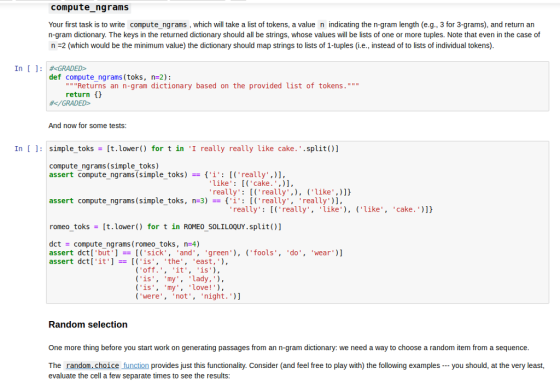
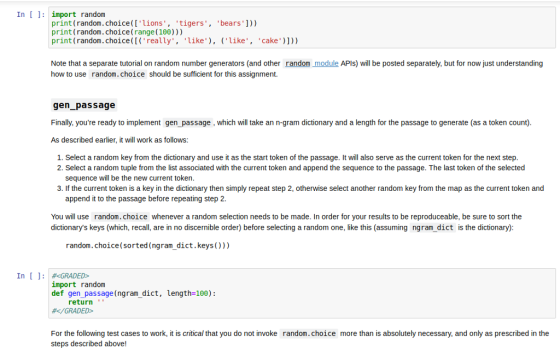
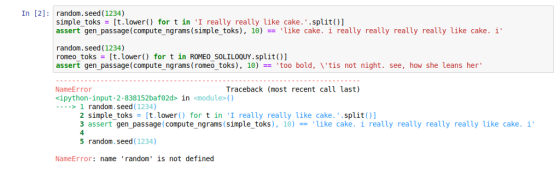
![Implementation Details Before you start working on the aforementioned functions, its important to consider how well be parsing passages for tokens. Heres the body of Romeos balcony soliloquy In [1]: #-GRADED- ROMEO SOLILOQUY = But, soft! what light through yonder window breaks? It is the east, and Juliet is the sun Arise, fair sun, and kill the envious moon, who is already sick and pale with grief, Thatthou her maid art far more fair than she: be not her maid, since she is envious; her vestal livery is but sick and green and none but fools do wear it; cast it off. It is my lady, 0, it is my love! 0, that she knew she were! She speaks yet she says nothing: what of that? Her eye discourses; I will answer it. I am too bold, tis not to me she speaks: two of the fairest stars in all the heaven, having some business, do entreat her eyes to twinkle in their spheres till they return What if her eyes were there, they in her head? The brightness of her cheek would shame those stars, as daylight doth a lamp; her eyes in heaven would through the airy region stream so bright that birds would sing and think it were not night See, how she leans her cheek upon her hand! 0, that I were a glove upon that hand, that I might touch that cheek! #</GRADED> Using the strings built-in split methodpreviously mentioned in class - along with lower, we can derive from the passage a list of tokens toks = [t, lower() for t in ROMEOSOLILOQUY, split()] toks[:8] We could do more interesting things (such as separating out punctuation), but well keep our parser simple. For the sake of consistency, well rely on this In [ ] : - fairly straighttforward approach to parsing. Onwards!](http://img.homeworklib.com/questions/9eda70c0-123b-11ec-8183-e533e693f4ef.png?x-oss-process=image/resize,w_560)
Homework Answers
import random
def compute_ngrams(toks,n=2):
"""
This problem pertains to Natural language processing
Returns an n-gram dictionary based on the provided list of
tokens.
Basic Idea is to iterate over each element and manually combine it
with the one directly following it.
This can be acheived by using loop to iterate or use zip (more
pythonic)
Here is the implementation
"""
return zip(*[toks[i:] for i in range(n)]))
"""
Function is designed as per specification provied in the
question
random module is used
"""
def gen_passage(dict, token=10):
list = []
random_key = random.choice(dict.keys())
for i in range(token):
random_tuple = random.choice(dict[random_key].pop())
list.append(random_tuple);
if random_tuple[-1] not in dict.keys():
random_key = random_tuple[-1]
Add Answer to:
I'm pretty confused on this whole question, and where it even
begins
Implementation Details Before you...
Most questions answered within 3 hours.
-
Where is the error in this code sequence?
String s1 = "Hello";
String s2 = "ello";...
asked 10 months ago -
Financial data for Joel de Paris, Inc., for last year
follow:
Joel de Paris, Inc.
Balance...
asked 10 months ago -
Consider this reaction:
Al2(SO4)3 (aq)+ BaCl3
(aq) Al2Cl6 (aq)- +
3BaSO4(s) . What is the...
asked 10 months ago -
Suppose that Savneet is considering increasing her
recent random sample from 20 car rentals to 40...
asked 10 months ago -
Trucks arrive at an unloading terminal at an average rate of 120
per hour.
Trucks arrive...
asked 10 months ago -
Why are methanol and ethanol completely soluble in water while
octanol is not very little soluble....
asked 10 months ago -
A facilities manager at a university reads in a research report
that the mean amount of...
asked 10 months ago -
When the CuSO4 is rehydrated by adding water to the anhydrous
compound, is this an endothermic...
asked 10 months ago -
A ray of sunlight is passing from diamond into crown glass; the
angle of incidence is...
asked 10 months ago -
A block of mass 0.249 kg is placed on top of a light, vertical
spring of...
asked 10 months ago -
how do the kidneys compensate in the presences of acidosis
a) trigger hyperventilate
b) reserve acid...
asked 10 months ago -
Question 501 pts
The rental rate of capital to the firm increases. Which of the
following...
asked 10 months ago