
Homework Answers
Add Answer to:
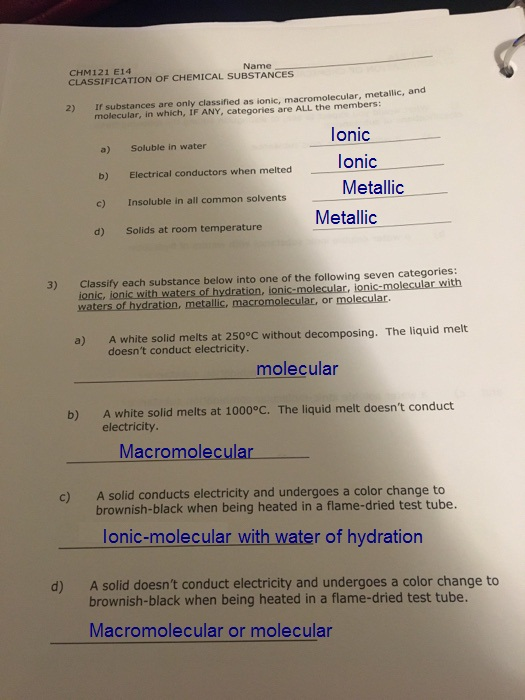
Name CHM121 E14 CLASSIFICATION OF CHEMICAL SUBSTANCES If substances are only classified as ionic, macromolecular, metallic,...
Experiment 8 Conservation of Mass kussion: action: 170 Mole wt. g/mol Aqual the combined masses of...
 Experiment 8 Conservation of Mass kussion: action: 170 Mole wt. g/mol Aqual the combined masses of all the reactants that were initially present. Furthermore, we fter any chemical reaction, the total mass of new products and any left over reactants) will a predict the mass of each product that will be formed if we know the molecular weight or the formula (from which we can predict the molecular weight). As an example, consider the dissolve the two substances in water,...
d. Suppose you mistakenly acidify the filtrate with HCl instead of with HNO3. What would you...
 d. Suppose you mistakenly acidify the filtrate with HCl instead of with HNO3. What would you obser after completing the halide test, and what would that observation lead you to conclude? Organic Laboratory Technique Primer Sodium Fusions and lon Testing Background: The elements that commonly occur in organic compounds along with carbon, hydrogen, and oxygen, are: nitrogen sulfur, and the halogens. The detection of these latter three elements depends on converting them into water soluble lons (CNS , and X...
Pre-Laboratory Exercise: Plastics Identification I. List four properties that you will use in lab...
 can
someone help me find this information?
Pre-Laboratory Exercise: Plastics Identification I. List four properties that you will use in lab to determine the identity of the polymer samples 2. Describe the density test. What observation will help you determine the density of each polymer? What precautions should be taken in placing the sample in the solutions? 3. Write the name and abbreviation for the six recyclable polymers 2 huetn deisity polyetayene.HDpz poulene: PP 4. Given the list of wavenumber...
can
someone help me find this information?
Pre-Laboratory Exercise: Plastics Identification I. List four properties that you will use in lab to determine the identity of the polymer samples 2. Describe the density test. What observation will help you determine the density of each polymer? What precautions should be taken in placing the sample in the solutions? 3. Write the name and abbreviation for the six recyclable polymers 2 huetn deisity polyetayene.HDpz poulene: PP 4. Given the list of wavenumber...
 Experiment 8 Conservation of Mass kussion: action: 170 Mole wt. g/mol Aqual the combined masses of all the reactants that were initially present. Furthermore, we fter any chemical reaction, the total mass of new products and any left over reactants) will a predict the mass of each product that will be formed if we know the molecular weight or the formula (from which we can predict the molecular weight). As an example, consider the dissolve the two substances in water,...
 d. Suppose you mistakenly acidify the filtrate with HCl instead of with HNO3. What would you obser after completing the halide test, and what would that observation lead you to conclude? Organic Laboratory Technique Primer Sodium Fusions and lon Testing Background: The elements that commonly occur in organic compounds along with carbon, hydrogen, and oxygen, are: nitrogen sulfur, and the halogens. The detection of these latter three elements depends on converting them into water soluble lons (CNS , and X...
 can
someone help me find this information?
Pre-Laboratory Exercise: Plastics Identification I. List four properties that you will use in lab to determine the identity of the polymer samples 2. Describe the density test. What observation will help you determine the density of each polymer? What precautions should be taken in placing the sample in the solutions? 3. Write the name and abbreviation for the six recyclable polymers 2 huetn deisity polyetayene.HDpz poulene: PP 4. Given the list of wavenumber...
can
someone help me find this information?
Pre-Laboratory Exercise: Plastics Identification I. List four properties that you will use in lab to determine the identity of the polymer samples 2. Describe the density test. What observation will help you determine the density of each polymer? What precautions should be taken in placing the sample in the solutions? 3. Write the name and abbreviation for the six recyclable polymers 2 huetn deisity polyetayene.HDpz poulene: PP 4. Given the list of wavenumber...
Most questions answered within 3 hours.
-
Where is the error in this code sequence?
String s1 = "Hello";
String s2 = "ello";...
asked 10 months ago -
Financial data for Joel de Paris, Inc., for last year
follow:
Joel de Paris, Inc.
Balance...
asked 10 months ago -
Consider this reaction:
Al2(SO4)3 (aq)+ BaCl3
(aq) Al2Cl6 (aq)- +
3BaSO4(s) . What is the...
asked 10 months ago -
Suppose that Savneet is considering increasing her
recent random sample from 20 car rentals to 40...
asked 10 months ago -
Trucks arrive at an unloading terminal at an average rate of 120
per hour.
Trucks arrive...
asked 10 months ago -
Why are methanol and ethanol completely soluble in water while
octanol is not very little soluble....
asked 10 months ago -
A facilities manager at a university reads in a research report
that the mean amount of...
asked 10 months ago -
When the CuSO4 is rehydrated by adding water to the anhydrous
compound, is this an endothermic...
asked 10 months ago -
A ray of sunlight is passing from diamond into crown glass; the
angle of incidence is...
asked 10 months ago -
A block of mass 0.249 kg is placed on top of a light, vertical
spring of...
asked 10 months ago -
how do the kidneys compensate in the presences of acidosis
a) trigger hyperventilate
b) reserve acid...
asked 10 months ago -
Question 501 pts
The rental rate of capital to the firm increases. Which of the
following...
asked 10 months ago