Consider the following relation R, where {A, B} is its PK. Assume that R is in...
Consider the following relation R, where {A, B} is its PK. Assume that R is in the first normal form (INF).
R (A, B, C, D, E, F)
Functional dependencies:
FD1: BàC
FD2: AàDE
FD3: ABàF
Why is this table not in 2NF? Specify which FDs make R violate 2NF.
Normalize the data shown in this table to second normal form (2NF). Specify the primary and foreign key (if any) in each table of your 3NF relations.
Normalize the data shown in this table to third normal form (3NF). Specify the primary and foreign key (if any) in each table of your 3NF relations.
Homework Answers


Add Answer to:
Consider the following relation R, where {A, B} is its PK.
Assume that R is in...
1) Consider the relation R, with key and functional dependencies shown below. What Normal form is...
1) Consider the relation R, with key and functional dependencies shown below. What Normal form is R in right now? Why is this the case? What actions would you take to normalize R to the next higher normal form? (Describe the steps) Follow the steps you described in the prior question to normalize R to the next higher form. Be sure to show all of the steps. Once you have normalized R, what normal forms are each the two new...
2. Consider an 1NF- relation StudentDB2 (sID, sFName, sLName, cID, cName, cCr, sectID, iID, iTitle, iLName,...
2. Consider an 1NF- relation StudentDB2 (sID, sFName, sLName, cID, cName, cCr, sectID, iID, iTitle, iLName, grade) that satisfies the following five functional dependencies: FD1 {sID}->{sFName, sLName} FD2 {cID}->{cName, cCr} FD3 {cID, sectID}->{iID} FD4 {iID}->{iTitle, iLName} FD5 {sID, cID, sectID}->{grade} a. What is/are candidate key(s) for relation StudentDB2? b. Normalize the relation StudentDB2 into a collection of 2NF-relations. c. Normalize the relation StudentDB2 into a collection of 3NF-relations. d. Normalize the relation StudentDB2 into a...
7. A relation schema is given as SalesRecord(sID, sName, cID, CID, PNo, pName, quantity). The functional...
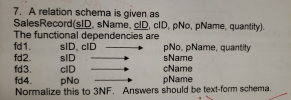 7. A relation schema is given as SalesRecord(sID, sName, cID, CID, PNo, pName, quantity). The functional dependencies are fd1. SID, CID - pNo, pName, quantity fd2. SID - SName fd3. CID cName fd4. pName Normalize this to 3NF. Answers should be text-form schema. pNo
Consider relation R = (A,B,C,D,E) for the following: 2. Is R in 2NF with the following...
 Consider relation R = (A,B,C,D,E) for the following:
2. Is R in 2NF with the following functional dependencies? If not, normalize it. [5 points] A→BC -AD → E в с 3. Are the relations from the answer of question 2 in 3NF? If not normalize it. 5 points]
Consider relation R = (A,B,C,D,E) for the following:
2. Is R in 2NF with the following functional dependencies? If not, normalize it. [5 points] A→BC -AD → E в с 3. Are the relations from the answer of question 2 in 3NF? If not normalize it. 5 points]
For each relation: a) List Functional Dependencies. b) Based on the given primary key, is the...
For each relation: a) List Functional Dependencies. b) Based on the given primary key, is the relation in 1NF, 2NF, or 3NF? Why or why not? c) Normalize the relation successively into 3NF, if it is not already in 3NF. FACULTY(FacNo, FacName, DeptNo, DeptName, DeptLoc, InsurPlanNo, InsurPlanDesc) ORDER(OrdNo, OrdDate, CustNo, PartNo, Qty, UnitPrice)
Normalize EVERY relation to 3NF step by step Q1: Given the following table, identify the functional...
 Normalize EVERY relation to 3NF step by step Q1: Given the following table, identify the functional dependencies VisitID InvoiceDate Invoice Amt Invoiceltem 1002 11/09/2016 $65.00 Updated shots 1002 11/09/2016 $45.00 Flea & tick medications 1006 11/14/2016 $35.00 Heartworm medication 1006 11/14/2016 $65.00 Updated shots 1006 11/14/2016 $75.00 Lab work 1009 11/16/2016 $50.00 Grooming 1009 11/16/2016 $15.00 Nail trim 1012 11/21/2016 $65.00 Updated shots 1012 11/21/2016 $75.00 Lab work 1013 11/21/2016 $65.00 Updated shots 1013 11/21/2016 $75.00 Lab work 1014 11/21/2016...
Language: SQL - Normalization and Functional Dependencies Part 4 Normalization and Functional Dependencies Consider the following relation R(A, B, C, D)and functional dependencies F that hold o...
 Language: SQL - Normalization and Functional
Dependencies
Part 4 Normalization and Functional Dependencies Consider the following relation R(A, B, C, D)and functional dependencies F that hold over this relation. F=D → C, A B,A-C Question 4.1 (3 Points) Determine all candidate keys of R Question 4.2 (4 Points) Compute the attribute cover of X-(C, B) according to F Question 43 (5 Points) Compute the canonical cover of F.Show each step of the generation according to the algorithm shown in class....
Language: SQL - Normalization and Functional
Dependencies
Part 4 Normalization and Functional Dependencies Consider the following relation R(A, B, C, D)and functional dependencies F that hold over this relation. F=D → C, A B,A-C Question 4.1 (3 Points) Determine all candidate keys of R Question 4.2 (4 Points) Compute the attribute cover of X-(C, B) according to F Question 43 (5 Points) Compute the canonical cover of F.Show each step of the generation according to the algorithm shown in class....
a: Give an example of a deletion anomaly and one example for the insertion anomaly ..... b: Give the all partial depe...
 a: Give an example of a deletion anomaly and one example
for the insertion anomaly
.....
b: Give the all partial dependencies and transitive
dependencies
>>>
c: Normalize this relation into 2NF. Please draw the
table(s) with data, and use underline to indicate the primary key
and squiggly line to indicate foreign keys if a table has for each
table
<<<<<
d: Normalize the 2NF into 3NF. Please draw the table(s)
with data, and use underline to indicate the primary...
a: Give an example of a deletion anomaly and one example
for the insertion anomaly
.....
b: Give the all partial dependencies and transitive
dependencies
>>>
c: Normalize this relation into 2NF. Please draw the
table(s) with data, and use underline to indicate the primary key
and squiggly line to indicate foreign keys if a table has for each
table
<<<<<
d: Normalize the 2NF into 3NF. Please draw the table(s)
with data, and use underline to indicate the primary...
Suppose we have the following relation (R) that keeps track of car sales: R(car date_sold, salesperson#,...
 Suppose we have the following relation (R) that keeps track of car sales: R(car date_sold, salesperson#, comission_rate, discount) In addition to the functional dependency implied by the primary key (car#), assume the following functional dependencies: date_sold discount salesperson commission_rate Explain why this relation is not in Boyce-Codd Normal Form (BCNF). a. b. Show how you would normalize this relation to achieve Boyce-Codd Normal Form by drawing a new relational schema. Highlight all primary keys by underlining them and use arrows...
Consider the following schema and functional dependencies: SHIPPING (ShipName, ShipType, VoyageID, Cargo, Port, ArrivalDate) Key: ShipName,...
Consider the following schema and functional dependencies: SHIPPING (ShipName, ShipType, VoyageID, Cargo, Port, ArrivalDate) Key: ShipName, ArrivalDate FD1: ShipName > ShipType FD2: VoyageID > ShipName, Cargo FD3: ShipName, ArrivalDate > VoyageId, Port 1.Please list the final set of 3NF schema including all its keys. 2.Do any of the finalized 3NF schema have determinates that are not candidate keys? If yes, explain - which schema(s)? Why?
 7. A relation schema is given as SalesRecord(sID, sName, cID, CID, PNo, pName, quantity). The functional dependencies are fd1. SID, CID - pNo, pName, quantity fd2. SID - SName fd3. CID cName fd4. pName Normalize this to 3NF. Answers should be text-form schema. pNo
 Consider relation R = (A,B,C,D,E) for the following:
2. Is R in 2NF with the following functional dependencies? If not, normalize it. [5 points] A→BC -AD → E в с 3. Are the relations from the answer of question 2 in 3NF? If not normalize it. 5 points]
Consider relation R = (A,B,C,D,E) for the following:
2. Is R in 2NF with the following functional dependencies? If not, normalize it. [5 points] A→BC -AD → E в с 3. Are the relations from the answer of question 2 in 3NF? If not normalize it. 5 points]
 Normalize EVERY relation to 3NF step by step Q1: Given the following table, identify the functional dependencies VisitID InvoiceDate Invoice Amt Invoiceltem 1002 11/09/2016 $65.00 Updated shots 1002 11/09/2016 $45.00 Flea & tick medications 1006 11/14/2016 $35.00 Heartworm medication 1006 11/14/2016 $65.00 Updated shots 1006 11/14/2016 $75.00 Lab work 1009 11/16/2016 $50.00 Grooming 1009 11/16/2016 $15.00 Nail trim 1012 11/21/2016 $65.00 Updated shots 1012 11/21/2016 $75.00 Lab work 1013 11/21/2016 $65.00 Updated shots 1013 11/21/2016 $75.00 Lab work 1014 11/21/2016...
 Language: SQL - Normalization and Functional
Dependencies
Part 4 Normalization and Functional Dependencies Consider the following relation R(A, B, C, D)and functional dependencies F that hold over this relation. F=D → C, A B,A-C Question 4.1 (3 Points) Determine all candidate keys of R Question 4.2 (4 Points) Compute the attribute cover of X-(C, B) according to F Question 43 (5 Points) Compute the canonical cover of F.Show each step of the generation according to the algorithm shown in class....
Language: SQL - Normalization and Functional
Dependencies
Part 4 Normalization and Functional Dependencies Consider the following relation R(A, B, C, D)and functional dependencies F that hold over this relation. F=D → C, A B,A-C Question 4.1 (3 Points) Determine all candidate keys of R Question 4.2 (4 Points) Compute the attribute cover of X-(C, B) according to F Question 43 (5 Points) Compute the canonical cover of F.Show each step of the generation according to the algorithm shown in class....
 a: Give an example of a deletion anomaly and one example
for the insertion anomaly
.....
b: Give the all partial dependencies and transitive
dependencies
>>>
c: Normalize this relation into 2NF. Please draw the
table(s) with data, and use underline to indicate the primary key
and squiggly line to indicate foreign keys if a table has for each
table
<<<<<
d: Normalize the 2NF into 3NF. Please draw the table(s)
with data, and use underline to indicate the primary...
a: Give an example of a deletion anomaly and one example
for the insertion anomaly
.....
b: Give the all partial dependencies and transitive
dependencies
>>>
c: Normalize this relation into 2NF. Please draw the
table(s) with data, and use underline to indicate the primary key
and squiggly line to indicate foreign keys if a table has for each
table
<<<<<
d: Normalize the 2NF into 3NF. Please draw the table(s)
with data, and use underline to indicate the primary...
 Suppose we have the following relation (R) that keeps track of car sales: R(car date_sold, salesperson#, comission_rate, discount) In addition to the functional dependency implied by the primary key (car#), assume the following functional dependencies: date_sold discount salesperson commission_rate Explain why this relation is not in Boyce-Codd Normal Form (BCNF). a. b. Show how you would normalize this relation to achieve Boyce-Codd Normal Form by drawing a new relational schema. Highlight all primary keys by underlining them and use arrows...
Most questions answered within 3 hours.
-
Where is the error in this code sequence?
String s1 = "Hello";
String s2 = "ello";...
asked 10 months ago -
Financial data for Joel de Paris, Inc., for last year
follow:
Joel de Paris, Inc.
Balance...
asked 10 months ago -
Consider this reaction:
Al2(SO4)3 (aq)+ BaCl3
(aq) Al2Cl6 (aq)- +
3BaSO4(s) . What is the...
asked 10 months ago -
Suppose that Savneet is considering increasing her
recent random sample from 20 car rentals to 40...
asked 10 months ago -
Trucks arrive at an unloading terminal at an average rate of 120
per hour.
Trucks arrive...
asked 10 months ago -
Why are methanol and ethanol completely soluble in water while
octanol is not very little soluble....
asked 10 months ago -
A facilities manager at a university reads in a research report
that the mean amount of...
asked 10 months ago -
When the CuSO4 is rehydrated by adding water to the anhydrous
compound, is this an endothermic...
asked 10 months ago -
A ray of sunlight is passing from diamond into crown glass; the
angle of incidence is...
asked 10 months ago -
A block of mass 0.249 kg is placed on top of a light, vertical
spring of...
asked 10 months ago -
how do the kidneys compensate in the presences of acidosis
a) trigger hyperventilate
b) reserve acid...
asked 10 months ago -
Question 501 pts
The rental rate of capital to the firm increases. Which of the
following...
asked 10 months ago