
Homework Answers
Add Answer to:
Please show all work
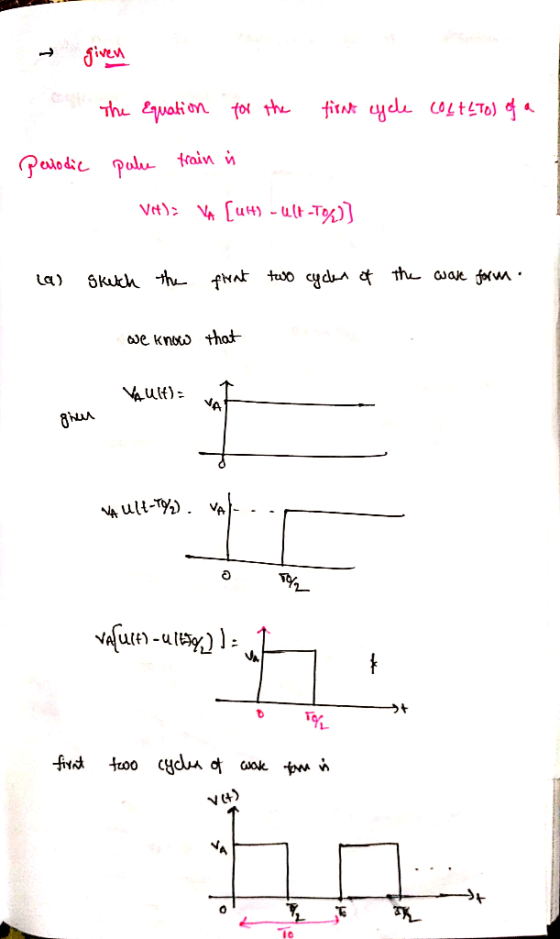
13-2 The equation for the fist cycle (0s rs T,) of a...
Please show all work and demonstrate how to find the expressions for the voltage v(t) 40...
 Please show all work and demonstrate how to find the
expressions for the voltage
v(t) 40 V 60 ms 140 ms 200 ms 240 uF Given: The figure above shows a 240 uF capacitor with a time-varying voltage across it. The graph above the figure shows the waveform of that voltage. Required: Determine the capacitor current at ta = 30 ms, at tp = 100 ms and at te = 170 ms.
Please show all work and demonstrate how to find the
expressions for the voltage
v(t) 40 V 60 ms 140 ms 200 ms 240 uF Given: The figure above shows a 240 uF capacitor with a time-varying voltage across it. The graph above the figure shows the waveform of that voltage. Required: Determine the capacitor current at ta = 30 ms, at tp = 100 ms and at te = 170 ms.
Please show all steps and show neat work. thanks 4) For the periodic signal below, find...
 Please show all steps and show neat work.
thanks
4) For the periodic signal below, find the compact trigonometric Fourier series and sketch the amplitude and phase spec ra. If either sine or cosine terms are absent in the Fourier series, explain why -T π /4
Please show all steps and show neat work.
thanks
4) For the periodic signal below, find the compact trigonometric Fourier series and sketch the amplitude and phase spec ra. If either sine or cosine terms are absent in the Fourier series, explain why -T π /4
1. A LTI system has the frequency response function 0, all other o Compute the output y(t) resulting from the in put x(t) given by (a) x(t) -2-5cos(3t)+10sin(6t-jx/3)+4cos(12t-x/4) (b) x(t) = 1 + Σ-...
 1. A LTI system has the frequency response function 0, all other o Compute the output y(t) resulting from the in put x(t) given by (a) x(t) -2-5cos(3t)+10sin(6t-jx/3)+4cos(12t-x/4) (b) x(t) = 1 + Σ- cos(2kt ) k-l (c) x(t) is the periodic pulse train signal shown below (repeats beyond the graph) 0.5 0.5 5 t (second) Hint: Refer to lecture 10 note. For (c), find the Fourier series coefficients of x(t) first.
1. A LTI system has the frequency response...
1. A LTI system has the frequency response function 0, all other o Compute the output y(t) resulting from the in put x(t) given by (a) x(t) -2-5cos(3t)+10sin(6t-jx/3)+4cos(12t-x/4) (b) x(t) = 1 + Σ- cos(2kt ) k-l (c) x(t) is the periodic pulse train signal shown below (repeats beyond the graph) 0.5 0.5 5 t (second) Hint: Refer to lecture 10 note. For (c), find the Fourier series coefficients of x(t) first.
1. A LTI system has the frequency response...
Pleaase answer all parts with neat and precise work. show all steps. Please 24. The following...
 Pleaase answer all parts with neat and precise work. show all
steps. Please
24. The following Fourier pair for the Lorentzian/Cauchy pulse was discussed in class: f(t)-_a (21) where a > 0 is a measure of the width of the time signal. The domains of f (t) and F(w) are -oo < t < oo and-oo <ω<00, respectively. (a) Showing all work, determine the time signal g (t) that has the following Fourier transform, where to is a given constant:...
Pleaase answer all parts with neat and precise work. show all
steps. Please
24. The following Fourier pair for the Lorentzian/Cauchy pulse was discussed in class: f(t)-_a (21) where a > 0 is a measure of the width of the time signal. The domains of f (t) and F(w) are -oo < t < oo and-oo <ω<00, respectively. (a) Showing all work, determine the time signal g (t) that has the following Fourier transform, where to is a given constant:...
Please show all work and graph #13 Define an equation of path, position of particle M...
 Please show all work and graph #13
Define an equation of path, position of particle M on path at t = ti (sec), velocity, normal, tangent and full accelerations of the particle M, radius of curvature at t = tį. The defined parameters show on the graph. ti, sec Equations of motion of particle M r=x(t), cm y=y(t), cm - 21² + 3 -5t 4t +4 t +1 2 sin cos 1 t + 4 - 3 -4t 313 +...
Please show all work and graph #13
Define an equation of path, position of particle M on path at t = ti (sec), velocity, normal, tangent and full accelerations of the particle M, radius of curvature at t = tį. The defined parameters show on the graph. ti, sec Equations of motion of particle M r=x(t), cm y=y(t), cm - 21² + 3 -5t 4t +4 t +1 2 sin cos 1 t + 4 - 3 -4t 313 +...
1. Using the Fourier series analysis Equation 3 for the periodic function r(t) shown in Figure 2....
 1. Using the Fourier series analysis Equation 3 for the periodic function r(t) shown in Figure 2.1, determine both the DC coefficient ao and a general expression for the other Fourier series coefficients ak. Do this by hand, not in Matlab. Show all your work in your lab report. You can add these pages as hand-written pages, rather than typing them in to your lab report, if you prefer Hint 1: It will be easiest to integrate this function from...
Problem 2 Periodic Force First Cycle The graph at the right depicts the first period of a non-harmonic periodic force (measured in Newtons). This first cycle is described by the piecewise functio...
 Problem 2 Periodic Force First Cycle The graph at the right depicts the first period of a non-harmonic periodic force (measured in Newtons). This first cycle is described by the piecewise function F(t) below the graph. Per the definition of a periodic function, the function repeats every T seconds. Note that T = 1 s. 1.8 a. What is the angular frequency wT of the periodic function?2 Include units. b. What is the Fourier Series representation of this function? c....
Please show work Consider the following linear transformation T: RS → R3 where T(X1, X2, X3,...
 Please show work
Consider the following linear transformation T: RS → R3 where T(X1, X2, X3, X4, Xs) = (x1-X3+X4, 2x1+x2-X3+2x4, -2x1+3x3-3x4+xs) (a) Determine the standard matrix representation A of T(x). (b) Find a basis for the kernel of T(x). (c) Find a basis for the range of T(x). (d) Is T(x) one-to-one? Is T(x) onto? Explain. (e) Is T(x) invertible? Explain
Please show work
Consider the following linear transformation T: RS → R3 where T(X1, X2, X3, X4, Xs) = (x1-X3+X4, 2x1+x2-X3+2x4, -2x1+3x3-3x4+xs) (a) Determine the standard matrix representation A of T(x). (b) Find a basis for the kernel of T(x). (c) Find a basis for the range of T(x). (d) Is T(x) one-to-one? Is T(x) onto? Explain. (e) Is T(x) invertible? Explain
please answer all questions and show all steps Vout Figure 2: RC Circuit 2. (15pts) Derive...
 please answer all questions and show all steps
Vout Figure 2: RC Circuit 2. (15pts) Derive the equation for the frequency response H(ju) of the RC circuit in Figure 2. Take the inverse transform of H (ju) to compute the impulse response h(t). Compute the magnitude response, H(jw). Is this a low-pass or high pass filter? Explain your answer. 3. (10pts) Let h(t)2u(t) and (t)(t). Use the Fourier transform to compute the output of the system
please answer all questions and show all steps
Vout Figure 2: RC Circuit 2. (15pts) Derive the equation for the frequency response H(ju) of the RC circuit in Figure 2. Take the inverse transform of H (ju) to compute the impulse response h(t). Compute the magnitude response, H(jw). Is this a low-pass or high pass filter? Explain your answer. 3. (10pts) Let h(t)2u(t) and (t)(t). Use the Fourier transform to compute the output of the system
This is a question about Partial differential equation - Heat equation. Please help solving part (a)...
 This is a question about
Partial differential equation - Heat equation. Please help solving
part (a) and show clear explanations. Thanks!
=K х 7. The temperature T(2,t) in an insulated rod of length L and diffusivity k is given by the heat equation ОТ 22T 0 < x < L. at Əx2' Initially this rod is at constant temperature To, and immediately after t=0 the temperature at x = L is suddenly increased to T1. The temperature at x =...
This is a question about
Partial differential equation - Heat equation. Please help solving
part (a) and show clear explanations. Thanks!
=K х 7. The temperature T(2,t) in an insulated rod of length L and diffusivity k is given by the heat equation ОТ 22T 0 < x < L. at Əx2' Initially this rod is at constant temperature To, and immediately after t=0 the temperature at x = L is suddenly increased to T1. The temperature at x =...
 Please show all work and demonstrate how to find the
expressions for the voltage
v(t) 40 V 60 ms 140 ms 200 ms 240 uF Given: The figure above shows a 240 uF capacitor with a time-varying voltage across it. The graph above the figure shows the waveform of that voltage. Required: Determine the capacitor current at ta = 30 ms, at tp = 100 ms and at te = 170 ms.
Please show all work and demonstrate how to find the
expressions for the voltage
v(t) 40 V 60 ms 140 ms 200 ms 240 uF Given: The figure above shows a 240 uF capacitor with a time-varying voltage across it. The graph above the figure shows the waveform of that voltage. Required: Determine the capacitor current at ta = 30 ms, at tp = 100 ms and at te = 170 ms.
 Please show all steps and show neat work.
thanks
4) For the periodic signal below, find the compact trigonometric Fourier series and sketch the amplitude and phase spec ra. If either sine or cosine terms are absent in the Fourier series, explain why -T π /4
Please show all steps and show neat work.
thanks
4) For the periodic signal below, find the compact trigonometric Fourier series and sketch the amplitude and phase spec ra. If either sine or cosine terms are absent in the Fourier series, explain why -T π /4
 1. A LTI system has the frequency response function 0, all other o Compute the output y(t) resulting from the in put x(t) given by (a) x(t) -2-5cos(3t)+10sin(6t-jx/3)+4cos(12t-x/4) (b) x(t) = 1 + Σ- cos(2kt ) k-l (c) x(t) is the periodic pulse train signal shown below (repeats beyond the graph) 0.5 0.5 5 t (second) Hint: Refer to lecture 10 note. For (c), find the Fourier series coefficients of x(t) first.
1. A LTI system has the frequency response...
1. A LTI system has the frequency response function 0, all other o Compute the output y(t) resulting from the in put x(t) given by (a) x(t) -2-5cos(3t)+10sin(6t-jx/3)+4cos(12t-x/4) (b) x(t) = 1 + Σ- cos(2kt ) k-l (c) x(t) is the periodic pulse train signal shown below (repeats beyond the graph) 0.5 0.5 5 t (second) Hint: Refer to lecture 10 note. For (c), find the Fourier series coefficients of x(t) first.
1. A LTI system has the frequency response...
 Pleaase answer all parts with neat and precise work. show all
steps. Please
24. The following Fourier pair for the Lorentzian/Cauchy pulse was discussed in class: f(t)-_a (21) where a > 0 is a measure of the width of the time signal. The domains of f (t) and F(w) are -oo < t < oo and-oo <ω<00, respectively. (a) Showing all work, determine the time signal g (t) that has the following Fourier transform, where to is a given constant:...
Pleaase answer all parts with neat and precise work. show all
steps. Please
24. The following Fourier pair for the Lorentzian/Cauchy pulse was discussed in class: f(t)-_a (21) where a > 0 is a measure of the width of the time signal. The domains of f (t) and F(w) are -oo < t < oo and-oo <ω<00, respectively. (a) Showing all work, determine the time signal g (t) that has the following Fourier transform, where to is a given constant:...
 Please show all work and graph #13
Define an equation of path, position of particle M on path at t = ti (sec), velocity, normal, tangent and full accelerations of the particle M, radius of curvature at t = tį. The defined parameters show on the graph. ti, sec Equations of motion of particle M r=x(t), cm y=y(t), cm - 21² + 3 -5t 4t +4 t +1 2 sin cos 1 t + 4 - 3 -4t 313 +...
Please show all work and graph #13
Define an equation of path, position of particle M on path at t = ti (sec), velocity, normal, tangent and full accelerations of the particle M, radius of curvature at t = tį. The defined parameters show on the graph. ti, sec Equations of motion of particle M r=x(t), cm y=y(t), cm - 21² + 3 -5t 4t +4 t +1 2 sin cos 1 t + 4 - 3 -4t 313 +...
 1. Using the Fourier series analysis Equation 3 for the periodic function r(t) shown in Figure 2.1, determine both the DC coefficient ao and a general expression for the other Fourier series coefficients ak. Do this by hand, not in Matlab. Show all your work in your lab report. You can add these pages as hand-written pages, rather than typing them in to your lab report, if you prefer Hint 1: It will be easiest to integrate this function from...
 Problem 2 Periodic Force First Cycle The graph at the right depicts the first period of a non-harmonic periodic force (measured in Newtons). This first cycle is described by the piecewise function F(t) below the graph. Per the definition of a periodic function, the function repeats every T seconds. Note that T = 1 s. 1.8 a. What is the angular frequency wT of the periodic function?2 Include units. b. What is the Fourier Series representation of this function? c....
 Please show work
Consider the following linear transformation T: RS → R3 where T(X1, X2, X3, X4, Xs) = (x1-X3+X4, 2x1+x2-X3+2x4, -2x1+3x3-3x4+xs) (a) Determine the standard matrix representation A of T(x). (b) Find a basis for the kernel of T(x). (c) Find a basis for the range of T(x). (d) Is T(x) one-to-one? Is T(x) onto? Explain. (e) Is T(x) invertible? Explain
Please show work
Consider the following linear transformation T: RS → R3 where T(X1, X2, X3, X4, Xs) = (x1-X3+X4, 2x1+x2-X3+2x4, -2x1+3x3-3x4+xs) (a) Determine the standard matrix representation A of T(x). (b) Find a basis for the kernel of T(x). (c) Find a basis for the range of T(x). (d) Is T(x) one-to-one? Is T(x) onto? Explain. (e) Is T(x) invertible? Explain
 please answer all questions and show all steps
Vout Figure 2: RC Circuit 2. (15pts) Derive the equation for the frequency response H(ju) of the RC circuit in Figure 2. Take the inverse transform of H (ju) to compute the impulse response h(t). Compute the magnitude response, H(jw). Is this a low-pass or high pass filter? Explain your answer. 3. (10pts) Let h(t)2u(t) and (t)(t). Use the Fourier transform to compute the output of the system
please answer all questions and show all steps
Vout Figure 2: RC Circuit 2. (15pts) Derive the equation for the frequency response H(ju) of the RC circuit in Figure 2. Take the inverse transform of H (ju) to compute the impulse response h(t). Compute the magnitude response, H(jw). Is this a low-pass or high pass filter? Explain your answer. 3. (10pts) Let h(t)2u(t) and (t)(t). Use the Fourier transform to compute the output of the system
 This is a question about
Partial differential equation - Heat equation. Please help solving
part (a) and show clear explanations. Thanks!
=K х 7. The temperature T(2,t) in an insulated rod of length L and diffusivity k is given by the heat equation ОТ 22T 0 < x < L. at Əx2' Initially this rod is at constant temperature To, and immediately after t=0 the temperature at x = L is suddenly increased to T1. The temperature at x =...
This is a question about
Partial differential equation - Heat equation. Please help solving
part (a) and show clear explanations. Thanks!
=K х 7. The temperature T(2,t) in an insulated rod of length L and diffusivity k is given by the heat equation ОТ 22T 0 < x < L. at Əx2' Initially this rod is at constant temperature To, and immediately after t=0 the temperature at x = L is suddenly increased to T1. The temperature at x =...
Most questions answered within 3 hours.
-
Where is the error in this code sequence?
String s1 = "Hello";
String s2 = "ello";...
asked 10 months ago -
Financial data for Joel de Paris, Inc., for last year
follow:
Joel de Paris, Inc.
Balance...
asked 10 months ago -
Consider this reaction:
Al2(SO4)3 (aq)+ BaCl3
(aq) Al2Cl6 (aq)- +
3BaSO4(s) . What is the...
asked 10 months ago -
Suppose that Savneet is considering increasing her
recent random sample from 20 car rentals to 40...
asked 10 months ago -
Trucks arrive at an unloading terminal at an average rate of 120
per hour.
Trucks arrive...
asked 10 months ago -
Why are methanol and ethanol completely soluble in water while
octanol is not very little soluble....
asked 10 months ago -
A facilities manager at a university reads in a research report
that the mean amount of...
asked 10 months ago -
When the CuSO4 is rehydrated by adding water to the anhydrous
compound, is this an endothermic...
asked 10 months ago -
A ray of sunlight is passing from diamond into crown glass; the
angle of incidence is...
asked 10 months ago -
A block of mass 0.249 kg is placed on top of a light, vertical
spring of...
asked 10 months ago -
how do the kidneys compensate in the presences of acidosis
a) trigger hyperventilate
b) reserve acid...
asked 10 months ago -
Question 501 pts
The rental rate of capital to the firm increases. Which of the
following...
asked 10 months ago