
Homework Answers


Add Answer to:
Determine the parameters A, A1, Xo, Xi making the following integral with algebraic accuracy. Please calculate...
Let Xo and Xı be independent exponentially distributed random variables with re- spective parameters Ao and...
 Let Xo and Xı be independent exponentially distributed random variables with re- spective parameters Ao and ^i, so that, P(Xi t)eAit, for t2 0, i = 0,1 Let 0 if Xo X1, N = 1 if X1X0, min{Xo, X1}, M = 1 - N, V = x{X0, X1}, and W = V -U = |X0 - X1]. and U max Verify that U XN and V XM, then find the following: (a) P(N 0, U > t), for t 2...
、 | | xo = 0 Xi = 2 x2 = 4 f(x) = 2 f(x1)...
 、
| | xo = 0 Xi = 2 x2 = 4 f(x) = 2 f(x1) = 6 f(x2) – 10 Consider the differential equation dy – Ax+ 4 where A is a constant. dx Let y = f(x) be the particular solution to the differential equation with the initial condition f(0) = 2. Euler's method, starting at x = 0) with a step size of 2, is used to approximate f(4). Steps from this approximation are shown in the...
、
| | xo = 0 Xi = 2 x2 = 4 f(x) = 2 f(x1) = 6 f(x2) – 10 Consider the differential equation dy – Ax+ 4 where A is a constant. dx Let y = f(x) be the particular solution to the differential equation with the initial condition f(0) = 2. Euler's method, starting at x = 0) with a step size of 2, is used to approximate f(4). Steps from this approximation are shown in the...
To calculate E[|X_i|], why do we multiply the integral by 2? Let X1, X2,.. ., X,...
 To calculate E[|X_i|], why do we multiply the integral by 2?
Let X1, X2,.. ., X, be a random sample from a N(0, e) distribution. Wewant to estimate the 5 standard deviation A.Find the constant c so that Y C ^-1 IXil is an unbiased estimator of A and determine its efficiency. From the information, consider X,,X,..., X, is a random sample drawn from a normal 2 distribution with mean 0 and variance 0 That is, X,O N(0,0) i= 1,2,...,n...
To calculate E[|X_i|], why do we multiply the integral by 2?
Let X1, X2,.. ., X, be a random sample from a N(0, e) distribution. Wewant to estimate the 5 standard deviation A.Find the constant c so that Y C ^-1 IXil is an unbiased estimator of A and determine its efficiency. From the information, consider X,,X,..., X, is a random sample drawn from a normal 2 distribution with mean 0 and variance 0 That is, X,O N(0,0) i= 1,2,...,n...
CALCULUS Consider the function f : R2 → R, defined by ï. Exam 2018 (a) Find the first-order Taylor approximation at the point Xo-(1, -2) and use it to find an approximate value for f(1.1, -2.1 (b) Ca...
 CALCULUS Consider the function f : R2 → R, defined by ï. Exam 2018 (a) Find the first-order Taylor approximation at the point Xo-(1, -2) and use it to find an approximate value for f(1.1, -2.1 (b) Calculate the Hessian ã (x-xo)' (H/(%)) (x-xo) at xo (1,-2) (c) Find the second-order Taylor approximation at Xo (1,-2) and use it to find an approximate value for f(1.1, -2.1) Use the calculator to compute the exact value of the function f(1.1,-2.1) 2....
xi = a + idelta x Question 3 Use the following definition to evaluate the integral....
 xi = a + idelta x
Question 3 Use the following definition to evaluate the integral. 4 Theorem Iff is integrable on [a, b], then 76) dx = lim Sra where and 11 (x2+5)dx Upload Choose a File
xi = a + idelta x
Question 3 Use the following definition to evaluate the integral. 4 Theorem Iff is integrable on [a, b], then 76) dx = lim Sra where and 11 (x2+5)dx Upload Choose a File
PLEASE PLEASE,ONLY ANSWER THIS QUESTION IF YOU COULD GIVE ME THE MATLAB CODE.THANK YOU. Consider the...
 PLEASE PLEASE,ONLY ANSWER THIS QUESTION IF YOU COULD
GIVE ME THE MATLAB CODE.THANK YOU.
Consider the following Ordinary Differential Equation (ODE): dy = 3.0*** + 1.08 * 210 – 3* y2 dat with initial condition at point xo = 0.375: Yo = 0.0044 Apply Runge-Kutta method of the second order with h = 0.25 and the set of parameters given below to approximate the solution of the ODE at the three points given in the table below. Fill in the...
PLEASE PLEASE,ONLY ANSWER THIS QUESTION IF YOU COULD
GIVE ME THE MATLAB CODE.THANK YOU.
Consider the following Ordinary Differential Equation (ODE): dy = 3.0*** + 1.08 * 210 – 3* y2 dat with initial condition at point xo = 0.375: Yo = 0.0044 Apply Runge-Kutta method of the second order with h = 0.25 and the set of parameters given below to approximate the solution of the ODE at the three points given in the table below. Fill in the...
Problem 4 Suppose X1, ..., Xn ~ f(x) independently. Let u = E(Xi) and o2 = Var(Xi). Let X Xi/n. (1) Calculate E(X) and...
 Problem 4 Suppose X1, ..., Xn ~ f(x) independently. Let u = E(Xi) and o2 = Var(Xi). Let X Xi/n. (1) Calculate E(X) and Var(X) (2) Explain that X -> u as n -> co. What is the shape of the density of X? (3) Let XiBernoulli(p), calculate u and a2 in terms of p. (4) Continue from (3), explain that X is the frequency of heads. Calculate E(X) and Var(X). Explain that X -> p. What is the shape...
Answer both problems please. Problem 5 Accurately sketch the following function and evaluate the integral 15...
 Answer both problems
please.
Problem 5 Accurately sketch the following function and evaluate the integral 15 Points - (s(6-(4) W 3W x(t) A tri 3W W A tri dt Xo= Problem 6: Accurately sketch the double-sided Amplitude and Phase Spectrum of the following signal. Consider f > f 15 Points A cos(2t ft - <p)cos(2t f,t - <p,) x(t)
Answer both problems
please.
Problem 5 Accurately sketch the following function and evaluate the integral 15 Points - (s(6-(4) W 3W x(t) A tri 3W W A tri dt Xo= Problem 6: Accurately sketch the double-sided Amplitude and Phase Spectrum of the following signal. Consider f > f 15 Points A cos(2t ft - <p)cos(2t f,t - <p,) x(t)
Fourier Integral #3 is demostrate Fourier Integral and #4 is calculate transform Integral de Fourier 4w...
 Fourier Integral
#3 is demostrate Fourier Integral and #4 is calculate
transform
Integral de Fourier 4w B(w) = T(1 + w?)? 3. Sea: f(x) = xe-HI Pruebe que: A(w) = 0 Transformada 4. Calcule la transformada de f(x) = || if 0 5x<1 0 otherwise ---
Fourier Integral
#3 is demostrate Fourier Integral and #4 is calculate
transform
Integral de Fourier 4w B(w) = T(1 + w?)? 3. Sea: f(x) = xe-HI Pruebe que: A(w) = 0 Transformada 4. Calcule la transformada de f(x) = || if 0 5x<1 0 otherwise ---
10 4) Calculate the following integral x by using three points Gauss integration. 4) Calculate the...
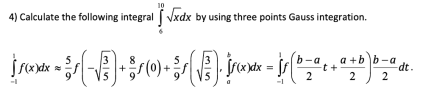 10 4) Calculate the following integral x by using three points Gauss integration. 4) Calculate the following integra | vote by using three points causintegration. frowser = f(-1)-370 ;( 1 ) brusmek =!3 (0,444 any tyto a de.
 Let Xo and Xı be independent exponentially distributed random variables with re- spective parameters Ao and ^i, so that, P(Xi t)eAit, for t2 0, i = 0,1 Let 0 if Xo X1, N = 1 if X1X0, min{Xo, X1}, M = 1 - N, V = x{X0, X1}, and W = V -U = |X0 - X1]. and U max Verify that U XN and V XM, then find the following: (a) P(N 0, U > t), for t 2...
 、
| | xo = 0 Xi = 2 x2 = 4 f(x) = 2 f(x1) = 6 f(x2) – 10 Consider the differential equation dy – Ax+ 4 where A is a constant. dx Let y = f(x) be the particular solution to the differential equation with the initial condition f(0) = 2. Euler's method, starting at x = 0) with a step size of 2, is used to approximate f(4). Steps from this approximation are shown in the...
、
| | xo = 0 Xi = 2 x2 = 4 f(x) = 2 f(x1) = 6 f(x2) – 10 Consider the differential equation dy – Ax+ 4 where A is a constant. dx Let y = f(x) be the particular solution to the differential equation with the initial condition f(0) = 2. Euler's method, starting at x = 0) with a step size of 2, is used to approximate f(4). Steps from this approximation are shown in the...
 To calculate E[|X_i|], why do we multiply the integral by 2?
Let X1, X2,.. ., X, be a random sample from a N(0, e) distribution. Wewant to estimate the 5 standard deviation A.Find the constant c so that Y C ^-1 IXil is an unbiased estimator of A and determine its efficiency. From the information, consider X,,X,..., X, is a random sample drawn from a normal 2 distribution with mean 0 and variance 0 That is, X,O N(0,0) i= 1,2,...,n...
To calculate E[|X_i|], why do we multiply the integral by 2?
Let X1, X2,.. ., X, be a random sample from a N(0, e) distribution. Wewant to estimate the 5 standard deviation A.Find the constant c so that Y C ^-1 IXil is an unbiased estimator of A and determine its efficiency. From the information, consider X,,X,..., X, is a random sample drawn from a normal 2 distribution with mean 0 and variance 0 That is, X,O N(0,0) i= 1,2,...,n...
 CALCULUS Consider the function f : R2 → R, defined by ï. Exam 2018 (a) Find the first-order Taylor approximation at the point Xo-(1, -2) and use it to find an approximate value for f(1.1, -2.1 (b) Calculate the Hessian ã (x-xo)' (H/(%)) (x-xo) at xo (1,-2) (c) Find the second-order Taylor approximation at Xo (1,-2) and use it to find an approximate value for f(1.1, -2.1) Use the calculator to compute the exact value of the function f(1.1,-2.1) 2....
 xi = a + idelta x
Question 3 Use the following definition to evaluate the integral. 4 Theorem Iff is integrable on [a, b], then 76) dx = lim Sra where and 11 (x2+5)dx Upload Choose a File
xi = a + idelta x
Question 3 Use the following definition to evaluate the integral. 4 Theorem Iff is integrable on [a, b], then 76) dx = lim Sra where and 11 (x2+5)dx Upload Choose a File
 PLEASE PLEASE,ONLY ANSWER THIS QUESTION IF YOU COULD
GIVE ME THE MATLAB CODE.THANK YOU.
Consider the following Ordinary Differential Equation (ODE): dy = 3.0*** + 1.08 * 210 – 3* y2 dat with initial condition at point xo = 0.375: Yo = 0.0044 Apply Runge-Kutta method of the second order with h = 0.25 and the set of parameters given below to approximate the solution of the ODE at the three points given in the table below. Fill in the...
PLEASE PLEASE,ONLY ANSWER THIS QUESTION IF YOU COULD
GIVE ME THE MATLAB CODE.THANK YOU.
Consider the following Ordinary Differential Equation (ODE): dy = 3.0*** + 1.08 * 210 – 3* y2 dat with initial condition at point xo = 0.375: Yo = 0.0044 Apply Runge-Kutta method of the second order with h = 0.25 and the set of parameters given below to approximate the solution of the ODE at the three points given in the table below. Fill in the...
 Problem 4 Suppose X1, ..., Xn ~ f(x) independently. Let u = E(Xi) and o2 = Var(Xi). Let X Xi/n. (1) Calculate E(X) and Var(X) (2) Explain that X -> u as n -> co. What is the shape of the density of X? (3) Let XiBernoulli(p), calculate u and a2 in terms of p. (4) Continue from (3), explain that X is the frequency of heads. Calculate E(X) and Var(X). Explain that X -> p. What is the shape...
 Answer both problems
please.
Problem 5 Accurately sketch the following function and evaluate the integral 15 Points - (s(6-(4) W 3W x(t) A tri 3W W A tri dt Xo= Problem 6: Accurately sketch the double-sided Amplitude and Phase Spectrum of the following signal. Consider f > f 15 Points A cos(2t ft - <p)cos(2t f,t - <p,) x(t)
Answer both problems
please.
Problem 5 Accurately sketch the following function and evaluate the integral 15 Points - (s(6-(4) W 3W x(t) A tri 3W W A tri dt Xo= Problem 6: Accurately sketch the double-sided Amplitude and Phase Spectrum of the following signal. Consider f > f 15 Points A cos(2t ft - <p)cos(2t f,t - <p,) x(t)
 Fourier Integral
#3 is demostrate Fourier Integral and #4 is calculate
transform
Integral de Fourier 4w B(w) = T(1 + w?)? 3. Sea: f(x) = xe-HI Pruebe que: A(w) = 0 Transformada 4. Calcule la transformada de f(x) = || if 0 5x<1 0 otherwise ---
Fourier Integral
#3 is demostrate Fourier Integral and #4 is calculate
transform
Integral de Fourier 4w B(w) = T(1 + w?)? 3. Sea: f(x) = xe-HI Pruebe que: A(w) = 0 Transformada 4. Calcule la transformada de f(x) = || if 0 5x<1 0 otherwise ---
 10 4) Calculate the following integral x by using three points Gauss integration. 4) Calculate the following integra | vote by using three points causintegration. frowser = f(-1)-370 ;( 1 ) brusmek =!3 (0,444 any tyto a de.
Most questions answered within 3 hours.
-
Where is the error in this code sequence?
String s1 = "Hello";
String s2 = "ello";...
asked 10 months ago -
Financial data for Joel de Paris, Inc., for last year
follow:
Joel de Paris, Inc.
Balance...
asked 10 months ago -
Consider this reaction:
Al2(SO4)3 (aq)+ BaCl3
(aq) Al2Cl6 (aq)- +
3BaSO4(s) . What is the...
asked 10 months ago -
Suppose that Savneet is considering increasing her
recent random sample from 20 car rentals to 40...
asked 10 months ago -
Trucks arrive at an unloading terminal at an average rate of 120
per hour.
Trucks arrive...
asked 10 months ago -
Why are methanol and ethanol completely soluble in water while
octanol is not very little soluble....
asked 10 months ago -
A facilities manager at a university reads in a research report
that the mean amount of...
asked 10 months ago -
When the CuSO4 is rehydrated by adding water to the anhydrous
compound, is this an endothermic...
asked 10 months ago -
A ray of sunlight is passing from diamond into crown glass; the
angle of incidence is...
asked 10 months ago -
A block of mass 0.249 kg is placed on top of a light, vertical
spring of...
asked 10 months ago -
how do the kidneys compensate in the presences of acidosis
a) trigger hyperventilate
b) reserve acid...
asked 10 months ago -
Question 501 pts
The rental rate of capital to the firm increases. Which of the
following...
asked 10 months ago