
Homework Answers
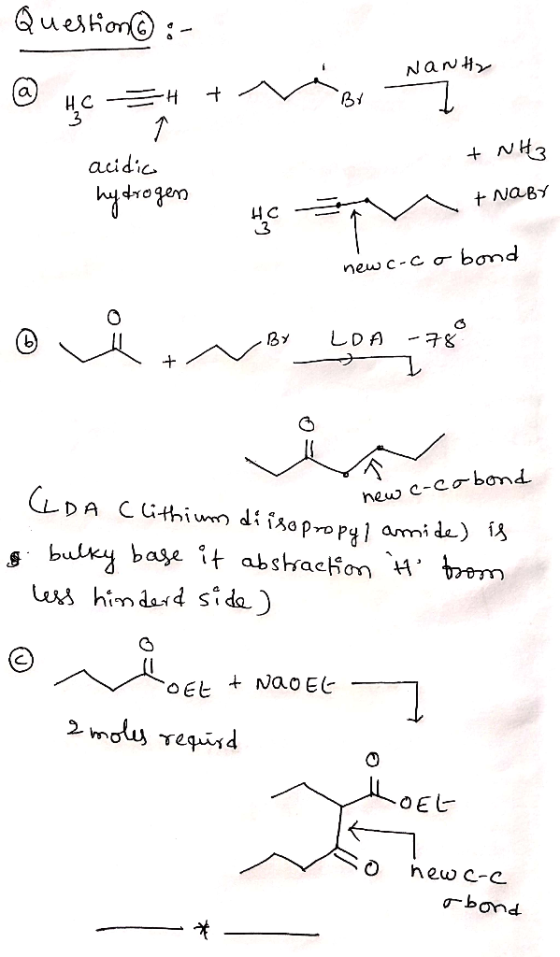
New c- c sigmabond formation.
Add Answer to:
Question 6 (9 marks) Give the products of the following reactions (do not supply mechanisms, just...
3. (3x10-30 points) Reactions. Give the product structure of following reactions, indicate stereochemistry where appropriate. A)...
 3. (3x10-30 points) Reactions. Give the product structure of following reactions, indicate stereochemistry where appropriate. A) + Ph2pt-CHCH3 i. EtMgBr (excess) B) . H3o i. NaOEt Eto C) ii. H,O i. LDA D) i. C2Hs C12, hv E) Me AlC F) NaOEt OEt Ni, H2 H) heat OEt NaOEt EtO OEt Br
4. Draw the products of the following sequences of reactions. 1) NaOET, HOE 1) NaOEt Eto...
 4. Draw the products of the following sequences of reactions. 1) NaOET, HOE 1) NaOEt Eto OEt 2) H3O+ 2) Br | 1) LDA, -78°C 2) 0 H30+ heat H 3) NaOH, heat 1) LDA (1.1 equiv), -78°C, THE 2) CH3Br 1) CH3CH2MgBr 2) H30* H2, Pd-C LU H2SO4 NaOH, H2O 1) LDA, -78°C 2) HOE 3) H30+ 1) O3 2) CH2SCH3
4) Draw the products of the following reactions. No mechanisms. (6 points each two-step process, 4...
 4) Draw the products of the following reactions. No mechanisms. (6 points each two-step process, 4 pts for one- step reaction at the end) NaOEt H2SO4 خ,H2O NaOEt H2SO4 دلم H20,۵ 1) LDA H2SO4 H2O, NaOME
Predict the products for the following reactions. Note – think about the base being used – is it catalytic? If so, can t...
 Predict the products for the following reactions. Note – think
about the base being used – is it catalytic? If so, can the product
molecule ring-close?
NaOEt OEt 1) Ph,CuLi, -78°C 2) H20 1) NaOEt EtO OEt 2) NaOH/H20 3) HСИН20 4) Heat 1) R2NH, H 2) H 3) Н,о" 1) R2NH, H* Ph 2) 3) Нзо*
NaOEt OEt 1) Ph,CuLi, -78°C 2) H20 1) NaOEt EtO OEt 2) NaOH/H20 3) HСИН20 4) Heat 1) R2NH, H 2) H 3)...
Predict the products for the following reactions. Note – think
about the base being used – is it catalytic? If so, can the product
molecule ring-close?
NaOEt OEt 1) Ph,CuLi, -78°C 2) H20 1) NaOEt EtO OEt 2) NaOH/H20 3) HСИН20 4) Heat 1) R2NH, H 2) H 3) Н,о" 1) R2NH, H* Ph 2) 3) Нзо*
NaOEt OEt 1) Ph,CuLi, -78°C 2) H20 1) NaOEt EtO OEt 2) NaOH/H20 3) HСИН20 4) Heat 1) R2NH, H 2) H 3)...
Provide the major product(s) for the following Provide the major product(s) for the following reactions. Be...
 Provide the major product(s) for the following Provide the major product(s) for the following reactions. Be sure to note stereochemistry and racemic mixtures. NaOH, H29 2 100 °Ç ? NaOH, H2O H 0°C H W H CCl3 OC (provide product of both steps) H a. Hn b. CHEM 370 W13 Homework Page 1 of 2 giorel Noot Hoi solu NOEL IN DER NaOH, H2O 100 °C Hv NaOET, H OEt EtOH 8. Eto- i. LDA, -78°C NaO Me MeOH Оме...
2. Give the products for four of the five reactions below, If you do all five,...
 2. Give the products for four of the five reactions below, If you do all five, I will grade the first four in order. (12 points) heodsoM-0arE nteimsd 3 H,0 /H20/ A NMe To oe EOH/Pyridine +3 OH 43 MeOH/H/ A OH wa 2 eq. EtLi OMe then H,O 3. Give the product for the following acetoacetic acid ester synthesis. Draw the transition state for the decarboxylation. (5 points) O 1. EtONa /PhCH Br Na OEt 2. HO/A
2. Give...
2. Give the products for four of the five reactions below, If you do all five, I will grade the first four in order. (12 points) heodsoM-0arE nteimsd 3 H,0 /H20/ A NMe To oe EOH/Pyridine +3 OH 43 MeOH/H/ A OH wa 2 eq. EtLi OMe then H,O 3. Give the product for the following acetoacetic acid ester synthesis. Draw the transition state for the decarboxylation. (5 points) O 1. EtONa /PhCH Br Na OEt 2. HO/A
2. Give...
Mechanisms (40 marks) 1 Draw the mechanism of each of the following reactions. (5 marks cach)...
 Mechanisms (40 marks) 1 Draw the mechanism of each of the following reactions. (5 marks cach) (a) HCHO + H HO H- OH OH CCI,CHO +H30 Bocco HO OH , c=NR + H2O c=0 + HN-R- 1. LDA 2. CH31 CHI 2-methyl-3-Pentanone 3-Pentanone Treat LDA as B OH но 2 HẠC-CHO H 2-Hydroxybutanal B-hydroxy carbonyl L a .B-unsaturated carbonyl
Question 2 (a) Predict the products A-F of the following reactions (no mechanisms are required): AICI:...
 Question 2 (a) Predict the products A-F of the following reactions (no mechanisms are required): AICI: Br2 Meo para os 0.0... HF H NMe,, POCI then H30Ⓡ 1. NaNO2, HCI 2. H20 NH2 [6 marks] (b) Suggest a mechanism for the following reaction: ОН ano [4 marks] [Total for question 3 = 10 marks]
Mechanisms Question 1 (22 marks) (a) Consider the radical chain reactions of the alkane shown below with Br, in the...
 Mechanisms Question 1 (22 marks) (a) Consider the radical chain reactions of the alkane shown below with Br, in the presence of light. H3C HH H C-CCHS CH3 Br2 hv 2 Different mono- bromo products 25 °C + (you will need to look up the bond dissociation energy (BDE) for the types of bonds formed and broken in this reactions) (i) Give the structures of the products from the reaction and using standard arrow conventions show the series of mechanistic...
le chatelier experimen Thursday). 1. What starting material and reagents are needed for the following multi-s...
 le
chatelier experimen
Thursday). 1. What starting material and reagents are needed for the following multi-step synthesis (HINT: aldol reactions work best when the starting material can only form one enolate)? 5 он о D. NaOH, H2O, Heat F. HO E. NaOH, H2O G. LDA Starting Material: Reagents: 2. LDA is a strong, sterically hindered base and will form the enolate. Sodium hydride is a weak base and will form the _ - enolate. Kinetic enolates are the stable and...
le
chatelier experimen
Thursday). 1. What starting material and reagents are needed for the following multi-step synthesis (HINT: aldol reactions work best when the starting material can only form one enolate)? 5 он о D. NaOH, H2O, Heat F. HO E. NaOH, H2O G. LDA Starting Material: Reagents: 2. LDA is a strong, sterically hindered base and will form the enolate. Sodium hydride is a weak base and will form the _ - enolate. Kinetic enolates are the stable and...
 3. (3x10-30 points) Reactions. Give the product structure of following reactions, indicate stereochemistry where appropriate. A) + Ph2pt-CHCH3 i. EtMgBr (excess) B) . H3o i. NaOEt Eto C) ii. H,O i. LDA D) i. C2Hs C12, hv E) Me AlC F) NaOEt OEt Ni, H2 H) heat OEt NaOEt EtO OEt Br
 4. Draw the products of the following sequences of reactions. 1) NaOET, HOE 1) NaOEt Eto OEt 2) H3O+ 2) Br | 1) LDA, -78°C 2) 0 H30+ heat H 3) NaOH, heat 1) LDA (1.1 equiv), -78°C, THE 2) CH3Br 1) CH3CH2MgBr 2) H30* H2, Pd-C LU H2SO4 NaOH, H2O 1) LDA, -78°C 2) HOE 3) H30+ 1) O3 2) CH2SCH3
 4) Draw the products of the following reactions. No mechanisms. (6 points each two-step process, 4 pts for one- step reaction at the end) NaOEt H2SO4 خ,H2O NaOEt H2SO4 دلم H20,۵ 1) LDA H2SO4 H2O, NaOME
 Predict the products for the following reactions. Note – think
about the base being used – is it catalytic? If so, can the product
molecule ring-close?
NaOEt OEt 1) Ph,CuLi, -78°C 2) H20 1) NaOEt EtO OEt 2) NaOH/H20 3) HСИН20 4) Heat 1) R2NH, H 2) H 3) Н,о" 1) R2NH, H* Ph 2) 3) Нзо*
NaOEt OEt 1) Ph,CuLi, -78°C 2) H20 1) NaOEt EtO OEt 2) NaOH/H20 3) HСИН20 4) Heat 1) R2NH, H 2) H 3)...
Predict the products for the following reactions. Note – think
about the base being used – is it catalytic? If so, can the product
molecule ring-close?
NaOEt OEt 1) Ph,CuLi, -78°C 2) H20 1) NaOEt EtO OEt 2) NaOH/H20 3) HСИН20 4) Heat 1) R2NH, H 2) H 3) Н,о" 1) R2NH, H* Ph 2) 3) Нзо*
NaOEt OEt 1) Ph,CuLi, -78°C 2) H20 1) NaOEt EtO OEt 2) NaOH/H20 3) HСИН20 4) Heat 1) R2NH, H 2) H 3)...
 Provide the major product(s) for the following Provide the major product(s) for the following reactions. Be sure to note stereochemistry and racemic mixtures. NaOH, H29 2 100 °Ç ? NaOH, H2O H 0°C H W H CCl3 OC (provide product of both steps) H a. Hn b. CHEM 370 W13 Homework Page 1 of 2 giorel Noot Hoi solu NOEL IN DER NaOH, H2O 100 °C Hv NaOET, H OEt EtOH 8. Eto- i. LDA, -78°C NaO Me MeOH Оме...
 2. Give the products for four of the five reactions below, If you do all five, I will grade the first four in order. (12 points) heodsoM-0arE nteimsd 3 H,0 /H20/ A NMe To oe EOH/Pyridine +3 OH 43 MeOH/H/ A OH wa 2 eq. EtLi OMe then H,O 3. Give the product for the following acetoacetic acid ester synthesis. Draw the transition state for the decarboxylation. (5 points) O 1. EtONa /PhCH Br Na OEt 2. HO/A
2. Give...
2. Give the products for four of the five reactions below, If you do all five, I will grade the first four in order. (12 points) heodsoM-0arE nteimsd 3 H,0 /H20/ A NMe To oe EOH/Pyridine +3 OH 43 MeOH/H/ A OH wa 2 eq. EtLi OMe then H,O 3. Give the product for the following acetoacetic acid ester synthesis. Draw the transition state for the decarboxylation. (5 points) O 1. EtONa /PhCH Br Na OEt 2. HO/A
2. Give...
 Mechanisms (40 marks) 1 Draw the mechanism of each of the following reactions. (5 marks cach) (a) HCHO + H HO H- OH OH CCI,CHO +H30 Bocco HO OH , c=NR + H2O c=0 + HN-R- 1. LDA 2. CH31 CHI 2-methyl-3-Pentanone 3-Pentanone Treat LDA as B OH но 2 HẠC-CHO H 2-Hydroxybutanal B-hydroxy carbonyl L a .B-unsaturated carbonyl
 Question 2 (a) Predict the products A-F of the following reactions (no mechanisms are required): AICI: Br2 Meo para os 0.0... HF H NMe,, POCI then H30Ⓡ 1. NaNO2, HCI 2. H20 NH2 [6 marks] (b) Suggest a mechanism for the following reaction: ОН ano [4 marks] [Total for question 3 = 10 marks]
 Mechanisms Question 1 (22 marks) (a) Consider the radical chain reactions of the alkane shown below with Br, in the presence of light. H3C HH H C-CCHS CH3 Br2 hv 2 Different mono- bromo products 25 °C + (you will need to look up the bond dissociation energy (BDE) for the types of bonds formed and broken in this reactions) (i) Give the structures of the products from the reaction and using standard arrow conventions show the series of mechanistic...
 le
chatelier experimen
Thursday). 1. What starting material and reagents are needed for the following multi-step synthesis (HINT: aldol reactions work best when the starting material can only form one enolate)? 5 он о D. NaOH, H2O, Heat F. HO E. NaOH, H2O G. LDA Starting Material: Reagents: 2. LDA is a strong, sterically hindered base and will form the enolate. Sodium hydride is a weak base and will form the _ - enolate. Kinetic enolates are the stable and...
le
chatelier experimen
Thursday). 1. What starting material and reagents are needed for the following multi-step synthesis (HINT: aldol reactions work best when the starting material can only form one enolate)? 5 он о D. NaOH, H2O, Heat F. HO E. NaOH, H2O G. LDA Starting Material: Reagents: 2. LDA is a strong, sterically hindered base and will form the enolate. Sodium hydride is a weak base and will form the _ - enolate. Kinetic enolates are the stable and...
Most questions answered within 3 hours.
-
Where is the error in this code sequence?
String s1 = "Hello";
String s2 = "ello";...
asked 11 months ago -
Financial data for Joel de Paris, Inc., for last year
follow:
Joel de Paris, Inc.
Balance...
asked 11 months ago -
Consider this reaction:
Al2(SO4)3 (aq)+ BaCl3
(aq) Al2Cl6 (aq)- +
3BaSO4(s) . What is the...
asked 11 months ago -
Suppose that Savneet is considering increasing her
recent random sample from 20 car rentals to 40...
asked 11 months ago -
Trucks arrive at an unloading terminal at an average rate of 120
per hour.
Trucks arrive...
asked 11 months ago -
Why are methanol and ethanol completely soluble in water while
octanol is not very little soluble....
asked 11 months ago -
A facilities manager at a university reads in a research report
that the mean amount of...
asked 11 months ago -
When the CuSO4 is rehydrated by adding water to the anhydrous
compound, is this an endothermic...
asked 11 months ago -
A ray of sunlight is passing from diamond into crown glass; the
angle of incidence is...
asked 11 months ago -
A block of mass 0.249 kg is placed on top of a light, vertical
spring of...
asked 11 months ago -
how do the kidneys compensate in the presences of acidosis
a) trigger hyperventilate
b) reserve acid...
asked 11 months ago -
Question 501 pts
The rental rate of capital to the firm increases. Which of the
following...
asked 11 months ago