1. Assume a private, closed economy where Y = C + I, and C = 10...
1. Assume a private, closed economy where Y = C + I, and C = 10 + 0.9Y and I = 15. (Values in $ billions.)
- Solve algebraically for the equilibrium level of national income.
- Calculate the value of the multiplier.
- Solve graphically for the equilibrium income by constructing an accurate
i) The 45 degree graph
ii) savings/investment graph
- Now add the government sector to the model so that Y = C + I + G where C = 10 + 0.9[Y – T] , I = 15, G = 25, T = Ta + tY = 5 + 0.10Y.
a) Solve for the new equilibrium level of national income.
b) Calculate the size of the
i) new multiplier
ii) budget balance
- Now add the foreign sector to the model so that Y = C + I + G + [ X - M ] where the new variables are: X = Xa = 40, and M = Ma + mY = 5 + 0.11Y. The other variables remain the same as in question 2.
- Solve for the new equilibrium level of national income.
- Calculate the size of the
i) New multiplier
ii) Trade balance
iii) Budget balance
- Assume the full employment level of national income (YF ) is at $280 billion. In order to reach YF from the existing equilibrium income level in ( 3 ) above, calculate the required changes, ceteris paribus, in
a) Government spending ( G )
b) Autonomous taxes ( Ta )
c) The tax rate (t)
Homework Answers
(I) Private closed economy
(Part a)
Y = C + I
Y = 10 + 0.9Y + 15
0.1Y = 25
Y = $250 billion
(Part b)
Multiplier = 1 / (1 - MPC) = 1 / (1 - 0.9) = 1/0.1 = 10
(Part c)
(i)
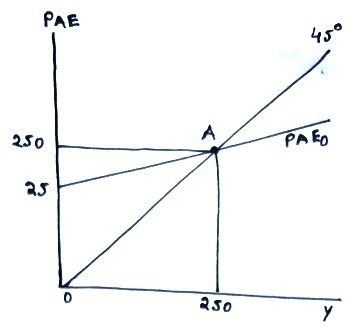
PAE = C + I
PAE = 10 + 0.9Y + 15
PAE = 25 + 0.9Y
When Y = 0, PAE = 25 (Vertical intercept)
In following graph, planned aggregate expenditure (PAE) and real GDP (Y) are measured vertically and horizontally respectively. Initial Equilibrium is at point A where 450 line intersects initial aggregate expenditure curve PAE0 (with vertical intercept of 25), with equilibrium GDP Y0 (= 250) and planned aggregate expenditure E0 (= 250).
(ii)
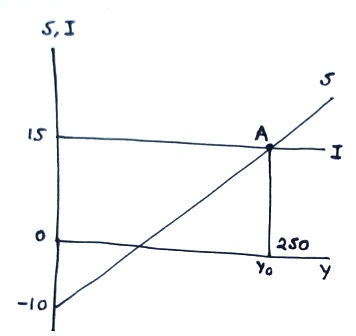
S = Y - C
S = Y - 10 - 0.9Y
S = 0.1Y - 10
When Y = 0, S = - 10 (Vertical intercept)
In following graph, Saving (S0) and Investment (I0) are shown, where investment is horizontal straight line (being autonomous). Initial Equilibrium is at point A where S0 intersects investment curve I0, with equilibrium GDP Y0 (= 250) and equilibrium saving/investment I0 (= 15).
(II) Private economy with government
(Part a)
Y = C + I + G
Y = 10 + 0.9(Y - 5 - 0.1Y) + 15 + 25
Y = 50 + 0.9(0.9Y - 5)
Y = 50 + 0.81Y - 4.5
0.19Y = 45.5
Y = $239.47 billion
NOTE: As per Chegg's Policy, I've answered 1st 4 parts only. You need to post rest of the parts separately, 4 at a time.
1. In a three-sector economy: C = 200 + 0.75Yd T = 0.2Y I = 800...
1. In a three-sector economy: C = 200 + 0.75Yd T = 0.2Y I = 800 G = 1000 Calculate national income when the economy is at equilibrium. Graph your results. (b) Full employment is achieved when income is 5500. What is the multiplier? (ii) How much should taxes be cut to achieve full employment? What is the budget at full employment? 2.In an open economy: C = 400 + 0.75Yd T = 0.2Y I = 600 G = 1000...
1. In an economy which has a national income identity as the following; Y= C+ I + G + NX where C ...
 I need help with this.
1. In an economy which has a national income identity as the following; Y= C+ I + G + NX where C = 400 + 0.6 Yd,; 1 = 1000-4600 r, G-1240 T-200 +0.25 Y; NX-400-0.05Y-8 00 e ( ofcourse, Yd=Y-T) Where e- foreign currency/ domestic currency, and initially set at e 1.25+2.5R The money demand function is Md- 0.75 Y-7500 r, and money supply is set by the Central Bank at 450. All calculation...
I need help with this.
1. In an economy which has a national income identity as the following; Y= C+ I + G + NX where C = 400 + 0.6 Yd,; 1 = 1000-4600 r, G-1240 T-200 +0.25 Y; NX-400-0.05Y-8 00 e ( ofcourse, Yd=Y-T) Where e- foreign currency/ domestic currency, and initially set at e 1.25+2.5R The money demand function is Md- 0.75 Y-7500 r, and money supply is set by the Central Bank at 450. All calculation...
Question 3: Multiplier Model (20 Points] Suppose the components of a closed economy can be described...
 Question 3: Multiplier Model (20 Points] Suppose the components of a closed economy can be described by the following set of equations: Y=C+I+G C= 1200 +0.8 (Y-T) I = 750 G = 900 T=950 (a) Is the government currently running a balanced budget, a budget deficit or a budget surplus? Explain. [3 Points (b) Calculate the equilibrium income. [6 Points) (c) Graphically illustrate, using the Keynesian Cross Diagram, the effect of a decrease in government spending on equilibrium output. [5...
A5-10. Suppose the following aggregate expenditure model describes an economy: C = 100 + (5/6)Yd T...
 A5-10. Suppose the following aggregate expenditure model describes an economy: C = 100 + (5/6)Yd T = (1/5)Y 1 = 200 G = 400 X = 300 IM = (1/3)Y where C is consumption, Yd is disposable income, T is taxes, Y is national income, I is investment, G is government spending, X is exports, and IM is imports. (a) Derive a numerical expression for aggregate expenditure (AE) as a function of Y. Calculate the equilibrium level of national income....
1. Consider an economy where aggregate expenditures can be characterized by the following information: household consumption...
 1. Consider an economy where aggregate expenditures can be characterized by the following information: household consumption C = 100+ 0.8Yd, investment expenditure 1 = 100, government expenditure G = 300, exports X = 300 and imports IM = 0.14Y. Suppose that the income tax rate is 20%, and that the government has no initial debt, so that D = 0. (a) Solve for the AE function and the equilibrium level of national output Y. (b) Solve for the government's budget...
s. (2 PTS) Assume the following closed economy model: C-350+0,7 (Y 1 300 + 0,04%-30i G=330...
 s. (2 PTS) Assume the following closed economy model: C-350+0,7 (Y 1 300 + 0,04%-30i G=330 ; T . 400 + 0.1Y (MP)"-1,4%. 60i M-4.610;P-2 Where C consumption, I- investment, Y- income, i-interest rate (in percentage ponts, 6, 7, 8 . .), О . government spending; (MP), demand for real balances, Me money supply a) Compute the equilbrium levels for income, the interest rate, consumption investment and the budget balance b) Suppose the goal of the govermnment is to increase...
Consider an economy in the short-run described by the following equations: AD = C + I...
Consider an economy in the short-run described by the following equations: AD = C + I + G G = 500 TA = 700, TR = 200 C = 400 + 0.6(Y – TA + TR) I = 600 What is the equilibrium condition that allows us to solve for Y. Find Y. Compute private saving, public saving and total/national saving at this level of Y. What is the value of the marginal propensity to consume? What is the value of...
19. Consider a closed economy where the consumption function is C = 100+ 0.8(Y – T),...
 19. Consider a closed economy where the consumption function is C = 100+ 0.8(Y – T), where T represents lump sum taxes. Investment is fixed at 100, and government spending is also 100. a. Assuming that the budget is balanced, calculate the equilibrium income for this economy. b. Suppose the government is committed to a balanced budget, but it sees that the economy is overheating (growing too fast). It decides to lower both government spending and taxes by 50 each....
6) Consider a closed economy described by the following equations: (1) Y=C+I+G (2) Y = 5(K)S(L)05...
 6) Consider a closed economy described by the following equations: (1) Y=C+I+G (2) Y = 5(K)S(L)05 (3) K = 1600 (4) L = 1600 (5) G = 2500 (6) T = 2000 (7) C = 1000 + 2/3 (Y-T) (8) I= 1200 - 100r, where r is the real interest rate. a) What is the equilibrium level of income? Show your work. b) Solve for the equilibrium interest rate (r) and the level of investment (I). The interest rate will...
An open economy is described by the following system of macroeconomic equations, in which all macroeconomic...
An open economy is described by the following system of macroeconomic equations, in which all macroeconomic aggregate are measured in billions of Namibian dollars, N$: Y = C + I + G + X – M C = 10 + 0.8 Yd T = 10+ 0.2Y X = 80 I = 35 G = 15 TR = 10 – 0.05Y M = 22 + 0.1Y Where: Y is domestic income Yd is private disposable income C is...
 I need help with this.
1. In an economy which has a national income identity as the following; Y= C+ I + G + NX where C = 400 + 0.6 Yd,; 1 = 1000-4600 r, G-1240 T-200 +0.25 Y; NX-400-0.05Y-8 00 e ( ofcourse, Yd=Y-T) Where e- foreign currency/ domestic currency, and initially set at e 1.25+2.5R The money demand function is Md- 0.75 Y-7500 r, and money supply is set by the Central Bank at 450. All calculation...
I need help with this.
1. In an economy which has a national income identity as the following; Y= C+ I + G + NX where C = 400 + 0.6 Yd,; 1 = 1000-4600 r, G-1240 T-200 +0.25 Y; NX-400-0.05Y-8 00 e ( ofcourse, Yd=Y-T) Where e- foreign currency/ domestic currency, and initially set at e 1.25+2.5R The money demand function is Md- 0.75 Y-7500 r, and money supply is set by the Central Bank at 450. All calculation...
 Question 3: Multiplier Model (20 Points] Suppose the components of a closed economy can be described by the following set of equations: Y=C+I+G C= 1200 +0.8 (Y-T) I = 750 G = 900 T=950 (a) Is the government currently running a balanced budget, a budget deficit or a budget surplus? Explain. [3 Points (b) Calculate the equilibrium income. [6 Points) (c) Graphically illustrate, using the Keynesian Cross Diagram, the effect of a decrease in government spending on equilibrium output. [5...
 A5-10. Suppose the following aggregate expenditure model describes an economy: C = 100 + (5/6)Yd T = (1/5)Y 1 = 200 G = 400 X = 300 IM = (1/3)Y where C is consumption, Yd is disposable income, T is taxes, Y is national income, I is investment, G is government spending, X is exports, and IM is imports. (a) Derive a numerical expression for aggregate expenditure (AE) as a function of Y. Calculate the equilibrium level of national income....
 1. Consider an economy where aggregate expenditures can be characterized by the following information: household consumption C = 100+ 0.8Yd, investment expenditure 1 = 100, government expenditure G = 300, exports X = 300 and imports IM = 0.14Y. Suppose that the income tax rate is 20%, and that the government has no initial debt, so that D = 0. (a) Solve for the AE function and the equilibrium level of national output Y. (b) Solve for the government's budget...
 s. (2 PTS) Assume the following closed economy model: C-350+0,7 (Y 1 300 + 0,04%-30i G=330 ; T . 400 + 0.1Y (MP)"-1,4%. 60i M-4.610;P-2 Where C consumption, I- investment, Y- income, i-interest rate (in percentage ponts, 6, 7, 8 . .), О . government spending; (MP), demand for real balances, Me money supply a) Compute the equilbrium levels for income, the interest rate, consumption investment and the budget balance b) Suppose the goal of the govermnment is to increase...
 19. Consider a closed economy where the consumption function is C = 100+ 0.8(Y – T), where T represents lump sum taxes. Investment is fixed at 100, and government spending is also 100. a. Assuming that the budget is balanced, calculate the equilibrium income for this economy. b. Suppose the government is committed to a balanced budget, but it sees that the economy is overheating (growing too fast). It decides to lower both government spending and taxes by 50 each....
 6) Consider a closed economy described by the following equations: (1) Y=C+I+G (2) Y = 5(K)S(L)05 (3) K = 1600 (4) L = 1600 (5) G = 2500 (6) T = 2000 (7) C = 1000 + 2/3 (Y-T) (8) I= 1200 - 100r, where r is the real interest rate. a) What is the equilibrium level of income? Show your work. b) Solve for the equilibrium interest rate (r) and the level of investment (I). The interest rate will...
Most questions answered within 3 hours.
-
Where is the error in this code sequence?
String s1 = "Hello";
String s2 = "ello";...
asked 11 months ago -
Financial data for Joel de Paris, Inc., for last year
follow:
Joel de Paris, Inc.
Balance...
asked 11 months ago -
Consider this reaction:
Al2(SO4)3 (aq)+ BaCl3
(aq) Al2Cl6 (aq)- +
3BaSO4(s) . What is the...
asked 11 months ago -
Suppose that Savneet is considering increasing her
recent random sample from 20 car rentals to 40...
asked 11 months ago -
Trucks arrive at an unloading terminal at an average rate of 120
per hour.
Trucks arrive...
asked 11 months ago -
Why are methanol and ethanol completely soluble in water while
octanol is not very little soluble....
asked 11 months ago -
A facilities manager at a university reads in a research report
that the mean amount of...
asked 11 months ago -
When the CuSO4 is rehydrated by adding water to the anhydrous
compound, is this an endothermic...
asked 11 months ago -
A ray of sunlight is passing from diamond into crown glass; the
angle of incidence is...
asked 11 months ago -
A block of mass 0.249 kg is placed on top of a light, vertical
spring of...
asked 11 months ago -
how do the kidneys compensate in the presences of acidosis
a) trigger hyperventilate
b) reserve acid...
asked 11 months ago -
Question 501 pts
The rental rate of capital to the firm increases. Which of the
following...
asked 11 months ago