
Homework Answers
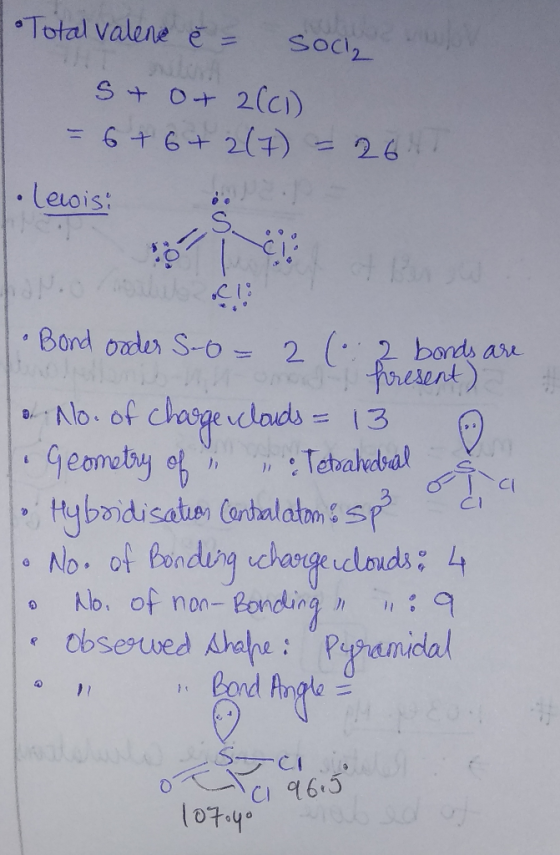
For writing letter, reference sheet is required.
bond angles are less than tetrahedral Bond bond angle, that is 109.5 degree due to presence of The Lone pair ,there is a lone pair - bond pair repulsion, which decreases the bond angle.
Add Answer to:
Total number of anceste trends Lewis Structure ISO Cla What is the bond order of the...
THE STRUCTURE OF CHEMICAL COMPOUNDS Partner Name: In each of the following molecular formulas, the central...
 THE STRUCTURE OF CHEMICAL COMPOUNDS Partner Name: In each of the following molecular formulas, the central atom is in italic. CH4 Number of charge clouds: Geometry of the charge clouds: Bonding charge clouds Non-bonding charge clouds: Observed Shape: LEDS 3D Shape NH3 bola obe Number of charge clouds: Geometry of the charge clouds: Bonding charge clouds: Non-bonding charge clouds: Observed Shape: LEDS 3D Shape
Species Lewis Structure Electronic Geometry Molecular Geometry Bond hybridization Polar or Nonpolar Bond angle on central...
 Species Lewis Structure Electronic Geometry Molecular Geometry Bond hybridization Polar or Nonpolar Bond angle on central atom List 2 types equatorial and axial CIFs Eci. - T-shaped I triagonal Bypyramidal 90 120° polar 1593 octehradrel octahedral 900 F Isps non SF polar IFs MOLECULAR BONDING AND STRUCTURE ns: For each chemical species, draw the most stable Lewis structure and predict its molecular and electronic geometry about the underlined central atom using VSEPR and Orbital Hybridization theory, Predict the bond angle...
Lewis Dot structure Electronic geometry Molecular shape Ideal Bond angles Hybridization of central atom Does it...
 Lewis Dot structure Electronic geometry Molecular shape Ideal Bond angles Hybridization of central atom Does it contain polar bonds? is the molecule polar? Seci, Lewis Dot structure Electronic geometry Molecular shape Ideal Bond angles Hybridization of central atom Does it contain polar bonds? Is the molecule polar? 124 Chemical Bonding Laboratory 12
thanks! 1. Determine the following for (a) PF3 and (b) BrF4 Complete Lewis Dot Structure (all...
 thanks!
1. Determine the following for (a) PF3 and (b) BrF4 Complete Lewis Dot Structure (all bonding and non-bonding electrons) (a) :F: PEF (b) Number of electron groups around the central atom (a) (b) → Electron Group Geometry (the shape corresponding to the arrangement of th electron groups) (b) Number of bonding/non-bonding groups around the central atom (a) (b) → Molecular Geometry (Molecular Shape) (a) (b) Is the molecule polar? Explain your choice (use the arrangement of the dipoles, i...
thanks!
1. Determine the following for (a) PF3 and (b) BrF4 Complete Lewis Dot Structure (all bonding and non-bonding electrons) (a) :F: PEF (b) Number of electron groups around the central atom (a) (b) → Electron Group Geometry (the shape corresponding to the arrangement of th electron groups) (b) Number of bonding/non-bonding groups around the central atom (a) (b) → Molecular Geometry (Molecular Shape) (a) (b) Is the molecule polar? Explain your choice (use the arrangement of the dipoles, i...
thanks! 1. Determine the following for (a) PF3 and (b) BrF4 Complete Lewis Dot Structure (all...
 thanks!
1. Determine the following for (a) PF3 and (b) BrF4 Complete Lewis Dot Structure (all bonding and non-bonding electrons) (a) :F: PEF (b) Number of electron groups around the central atom (a) (b) → Electron Group Geometry (the shape corresponding to the arrangement of th electron groups) (b) Number of bonding/non-bonding groups around the central atom (a) (b) → Molecular Geometry (Molecular Shape) (a) (b) Is the molecule polar? Explain your choice (use the arrangement of the dipoles, i...
thanks!
1. Determine the following for (a) PF3 and (b) BrF4 Complete Lewis Dot Structure (all bonding and non-bonding electrons) (a) :F: PEF (b) Number of electron groups around the central atom (a) (b) → Electron Group Geometry (the shape corresponding to the arrangement of th electron groups) (b) Number of bonding/non-bonding groups around the central atom (a) (b) → Molecular Geometry (Molecular Shape) (a) (b) Is the molecule polar? Explain your choice (use the arrangement of the dipoles, i...
NAME: INSTRUCTOR: SECTION/GROUP: Lewis Dot structure Electronic geometry Molecular shape Ideal Bond angles Hybridization of central...
 NAME: INSTRUCTOR: SECTION/GROUP: Lewis Dot structure Electronic geometry Molecular shape Ideal Bond angles Hybridization of central atom Does it contain polar bonds? is the molecule polar? Lewis Dot structure Electronic geometry Molecular shape Ideal Bond angles Hybridization of central atom Does it contain polar bonds? Is the molecule polar? Laboratory 12 Chemical Bonding 125
MOLECULAR BONDING AND STRUCTURE s: For each chemical species, draw the most stable Lewis structure and...
 MOLECULAR BONDING AND STRUCTURE s: For each chemical species, draw the most stable Lewis structure and predict its molecular and electronic geometry abc the underlined central atom using VSEPR and Orbital Hybridization theory. Predict the bond angle about the underlinec central atom and finally indicate whether the substance is polar or nonpofar Font Bond angle on central atom Electronic Geometry Molecular Geometry Bond Polar or hybridization Nonpolar Lewis Structure Species CO2 SF BCB
MOLECULAR BONDING AND STRUCTURE ons: For each chemical species, draw the most stable Lewis structure and...
 MOLECULAR BONDING AND STRUCTURE ons: For each chemical species, draw the most stable Lewis structure and predict its molecular and electronic geometry about the underlined central atom using VSEPR and Orbital Hybridization theory. Predict the bond angle about the underlined central atom and finally indicate whether the substance is polar or nonpolar. Dard Bond angle on central atom Bond hybridization Polar or Nonpolar Species Lewis Structure Electronic Geometry Molecular Geometry SO H:02 SO,
MOLECULAR BONDING AND STRUCTURE Directions: For each chemical species, draw the most stable Lewis structure and...
 MOLECULAR BONDING AND STRUCTURE Directions: For each chemical species, draw the most stable Lewis structure and predict its molecular and electronic geometry about the underlined central atom using VSEPR and Orbital Hybridization theory. Predict the bond angle about the underlined central atom and finally indicate whether the substance is polar or nonpolar. Species Lewis Structure Bond angle on Bond Polar or Electronic Geometry Molecular Geometry central atom hybridization Nonpolar CO2 SF2 BCI List 2 types: equatorial and axial CIF:
MOLECULAR BONDING AND STRUCTURE mns For each chemical species, draw the most stable Lewis structure and...
 MOLECULAR BONDING AND STRUCTURE mns For each chemical species, draw the most stable Lewis structure and predict its molecular and electronic geometry abou the underlined central atom using VSEPR and Orbital Hybridization theory. Predict the bond angle about the underlined central atom and finally indicate whether the substance is polar or nonpolar. Font Paragraph Electronic Geometry Molecular Geometry Bond Polar or hybridization Nonpolar Species Lewis Structure Bond angle on central atom List 2 types equatorial and axial CIFs SF
 THE STRUCTURE OF CHEMICAL COMPOUNDS Partner Name: In each of the following molecular formulas, the central atom is in italic. CH4 Number of charge clouds: Geometry of the charge clouds: Bonding charge clouds Non-bonding charge clouds: Observed Shape: LEDS 3D Shape NH3 bola obe Number of charge clouds: Geometry of the charge clouds: Bonding charge clouds: Non-bonding charge clouds: Observed Shape: LEDS 3D Shape
 Species Lewis Structure Electronic Geometry Molecular Geometry Bond hybridization Polar or Nonpolar Bond angle on central atom List 2 types equatorial and axial CIFs Eci. - T-shaped I triagonal Bypyramidal 90 120° polar 1593 octehradrel octahedral 900 F Isps non SF polar IFs MOLECULAR BONDING AND STRUCTURE ns: For each chemical species, draw the most stable Lewis structure and predict its molecular and electronic geometry about the underlined central atom using VSEPR and Orbital Hybridization theory, Predict the bond angle...
 Lewis Dot structure Electronic geometry Molecular shape Ideal Bond angles Hybridization of central atom Does it contain polar bonds? is the molecule polar? Seci, Lewis Dot structure Electronic geometry Molecular shape Ideal Bond angles Hybridization of central atom Does it contain polar bonds? Is the molecule polar? 124 Chemical Bonding Laboratory 12
 thanks!
1. Determine the following for (a) PF3 and (b) BrF4 Complete Lewis Dot Structure (all bonding and non-bonding electrons) (a) :F: PEF (b) Number of electron groups around the central atom (a) (b) → Electron Group Geometry (the shape corresponding to the arrangement of th electron groups) (b) Number of bonding/non-bonding groups around the central atom (a) (b) → Molecular Geometry (Molecular Shape) (a) (b) Is the molecule polar? Explain your choice (use the arrangement of the dipoles, i...
thanks!
1. Determine the following for (a) PF3 and (b) BrF4 Complete Lewis Dot Structure (all bonding and non-bonding electrons) (a) :F: PEF (b) Number of electron groups around the central atom (a) (b) → Electron Group Geometry (the shape corresponding to the arrangement of th electron groups) (b) Number of bonding/non-bonding groups around the central atom (a) (b) → Molecular Geometry (Molecular Shape) (a) (b) Is the molecule polar? Explain your choice (use the arrangement of the dipoles, i...
 thanks!
1. Determine the following for (a) PF3 and (b) BrF4 Complete Lewis Dot Structure (all bonding and non-bonding electrons) (a) :F: PEF (b) Number of electron groups around the central atom (a) (b) → Electron Group Geometry (the shape corresponding to the arrangement of th electron groups) (b) Number of bonding/non-bonding groups around the central atom (a) (b) → Molecular Geometry (Molecular Shape) (a) (b) Is the molecule polar? Explain your choice (use the arrangement of the dipoles, i...
thanks!
1. Determine the following for (a) PF3 and (b) BrF4 Complete Lewis Dot Structure (all bonding and non-bonding electrons) (a) :F: PEF (b) Number of electron groups around the central atom (a) (b) → Electron Group Geometry (the shape corresponding to the arrangement of th electron groups) (b) Number of bonding/non-bonding groups around the central atom (a) (b) → Molecular Geometry (Molecular Shape) (a) (b) Is the molecule polar? Explain your choice (use the arrangement of the dipoles, i...
 NAME: INSTRUCTOR: SECTION/GROUP: Lewis Dot structure Electronic geometry Molecular shape Ideal Bond angles Hybridization of central atom Does it contain polar bonds? is the molecule polar? Lewis Dot structure Electronic geometry Molecular shape Ideal Bond angles Hybridization of central atom Does it contain polar bonds? Is the molecule polar? Laboratory 12 Chemical Bonding 125
 MOLECULAR BONDING AND STRUCTURE s: For each chemical species, draw the most stable Lewis structure and predict its molecular and electronic geometry abc the underlined central atom using VSEPR and Orbital Hybridization theory. Predict the bond angle about the underlinec central atom and finally indicate whether the substance is polar or nonpofar Font Bond angle on central atom Electronic Geometry Molecular Geometry Bond Polar or hybridization Nonpolar Lewis Structure Species CO2 SF BCB
 MOLECULAR BONDING AND STRUCTURE ons: For each chemical species, draw the most stable Lewis structure and predict its molecular and electronic geometry about the underlined central atom using VSEPR and Orbital Hybridization theory. Predict the bond angle about the underlined central atom and finally indicate whether the substance is polar or nonpolar. Dard Bond angle on central atom Bond hybridization Polar or Nonpolar Species Lewis Structure Electronic Geometry Molecular Geometry SO H:02 SO,
 MOLECULAR BONDING AND STRUCTURE Directions: For each chemical species, draw the most stable Lewis structure and predict its molecular and electronic geometry about the underlined central atom using VSEPR and Orbital Hybridization theory. Predict the bond angle about the underlined central atom and finally indicate whether the substance is polar or nonpolar. Species Lewis Structure Bond angle on Bond Polar or Electronic Geometry Molecular Geometry central atom hybridization Nonpolar CO2 SF2 BCI List 2 types: equatorial and axial CIF:
 MOLECULAR BONDING AND STRUCTURE mns For each chemical species, draw the most stable Lewis structure and predict its molecular and electronic geometry abou the underlined central atom using VSEPR and Orbital Hybridization theory. Predict the bond angle about the underlined central atom and finally indicate whether the substance is polar or nonpolar. Font Paragraph Electronic Geometry Molecular Geometry Bond Polar or hybridization Nonpolar Species Lewis Structure Bond angle on central atom List 2 types equatorial and axial CIFs SF
Most questions answered within 3 hours.
-
Where is the error in this code sequence?
String s1 = "Hello";
String s2 = "ello";...
asked 10 months ago -
Financial data for Joel de Paris, Inc., for last year
follow:
Joel de Paris, Inc.
Balance...
asked 10 months ago -
Consider this reaction:
Al2(SO4)3 (aq)+ BaCl3
(aq) Al2Cl6 (aq)- +
3BaSO4(s) . What is the...
asked 10 months ago -
Suppose that Savneet is considering increasing her
recent random sample from 20 car rentals to 40...
asked 10 months ago -
Trucks arrive at an unloading terminal at an average rate of 120
per hour.
Trucks arrive...
asked 10 months ago -
Why are methanol and ethanol completely soluble in water while
octanol is not very little soluble....
asked 10 months ago -
A facilities manager at a university reads in a research report
that the mean amount of...
asked 10 months ago -
When the CuSO4 is rehydrated by adding water to the anhydrous
compound, is this an endothermic...
asked 10 months ago -
A ray of sunlight is passing from diamond into crown glass; the
angle of incidence is...
asked 10 months ago -
A block of mass 0.249 kg is placed on top of a light, vertical
spring of...
asked 10 months ago -
how do the kidneys compensate in the presences of acidosis
a) trigger hyperventilate
b) reserve acid...
asked 10 months ago -
Question 501 pts
The rental rate of capital to the firm increases. Which of the
following...
asked 10 months ago