
Homework Answers
(1).
False.
Input Output relation:
x(t) => x(nt)
where n is integer
If we add delay in the input
x(t-k) => Y=x(n(t-k)) = x(nt-nk)
If we add delay at the output
Y'=x(nt-k)
So, Y != Y'
Time variance violates.
So, an LTI system can not provide output with the frequency of integer multiple of the input frequency.
(2).
True.
The frequency spectrum of an odd symmetry can be written as:

 represents the 90 degree phase difference.
(3).
True.
Response of an LTI system can be calculated as the convolution sum of input to the impulse response.

(4).
True.
Discrete-time accumulator is a linear system. the impulse response is finite and absolutely summable.
(5).
True.
For time invariance:
if y(t) is the response to an input signal x(t), then y(t+T) will be the output to the shifted input x(t+T). If the input signal x(t) is periodic with a period of T, this suggests that x(t)=x(t+T), and, consequently, y(t)=y(t+T), i.e. the output is also periodic with a same time period as the input signal.
(6).
False.
For the signal to be periodic, the ratio  must be rational.
(8).
True.
To apply frequency response the system response must be absolutely integrable, and for that the system must be BIBO stabel.
(9).
True.
Energy of a signal:

From the expression above we can clearly conclude, for the energy to be finite it must be integrable over the period - infinity to + infinity.
Add Answer to:
1. (15 points) Review Carefully read each statement below and identify it as True or False...
Problem 1: (15 points) Determine if the following statements are True or False and briefly describe...
 Problem 1: (15 points) Determine if the following statements are True or False and briefly describe the reasons for your answers. (2 points for the correct answer of True or False, and 3 points for the correct reasoning.) (a) The Laplace transform of an LTI system's zero-input response is always equal to the system's transfer function, H(s). (b) The transfer function of an LTI system is H(s) = e. Then, it can be concluded that the system is BIBO stable....
5. (12 points) Consider a continuous-time LTI system whose frequency response is sin(w) H(ju) 4w If...
 5. (12 points) Consider a continuous-time LTI system whose frequency response is sin(w) H(ju) 4w If the input to this system is a periodic signal 0, -4<t<-1 x(t)=1, -1st<1 0, 1st<4 with period T= 8 (a) (2 points) sketch r(t) for -4ts4 (b) (5 points) determine the Fourier series coefficients at of x(t), (c) (5 points) determine the Fourier series coefficients be of the corresponding system output y(t)
5. (12 points) Consider a continuous-time LTI system whose frequency response is...
5. (12 points) Consider a continuous-time LTI system whose frequency response is sin(w) H(ju) 4w If the input to this system is a periodic signal 0, -4<t<-1 x(t)=1, -1st<1 0, 1st<4 with period T= 8 (a) (2 points) sketch r(t) for -4ts4 (b) (5 points) determine the Fourier series coefficients at of x(t), (c) (5 points) determine the Fourier series coefficients be of the corresponding system output y(t)
5. (12 points) Consider a continuous-time LTI system whose frequency response is...
6- A contiuous-time periodic signal x(t) is given graphically below. (a) Determine the exponential Fourier coefficients...
 6- A contiuous-time periodic signal x(t) is given graphically below. (a) Determine the exponential Fourier coefficients for k+oo a ()-ΣGeko, k-oo where c is given by T/2 1 (t)ek dt J-T/2 Ck= T (b) r(t) is applied as an input to an LTI system whose frequency response is H(ju)=2 sin(w Determine the corresponding output y(t) (e) Sketch y(t). Be sure to mark the axes properly -JT
6- A contiuous-time periodic signal x(t) is given graphically below. (a) Determine the exponential...
6- A contiuous-time periodic signal x(t) is given graphically below. (a) Determine the exponential Fourier coefficients for k+oo a ()-ΣGeko, k-oo where c is given by T/2 1 (t)ek dt J-T/2 Ck= T (b) r(t) is applied as an input to an LTI system whose frequency response is H(ju)=2 sin(w Determine the corresponding output y(t) (e) Sketch y(t). Be sure to mark the axes properly -JT
6- A contiuous-time periodic signal x(t) is given graphically below. (a) Determine the exponential...
This is about signals and systems. I want to know anwser and solution. Please write down your han...
 This is about signals and systems.
I want to know anwser and solution.
Please write down your handwriting correctly and take
a good picture.
(1)[30 Points]Answer the following questions with 'T' for a true sentence or 'F' for a false sentence. (1-1) If the system is described as y(t) x(t) + 1, where the input signal and output signals are denoted by x(t) and y(t), respectively, the system is a linear system. (1-2) ( When a discrete time signal is...
This is about signals and systems.
I want to know anwser and solution.
Please write down your handwriting correctly and take
a good picture.
(1)[30 Points]Answer the following questions with 'T' for a true sentence or 'F' for a false sentence. (1-1) If the system is described as y(t) x(t) + 1, where the input signal and output signals are denoted by x(t) and y(t), respectively, the system is a linear system. (1-2) ( When a discrete time signal is...
1. Consider the system shown in the figure below. The system is an integrator, in which...
 1. Consider the system shown in the figure below. The system is an integrator, in which the output is the integral: y(t)x()dr -00 Integrator x(t) y(t) (a) We may determine the impulse response h(t) by applying an impulse signal to the integrator, i.e. x(t) -5(t). What is the impulse response? Answer: (10 points) (b) The output of the integrator may be found by apply convolution method to determine the output. The convolution of the two signals is expressed a)ht -...
6- A continuous-time periodic signal r(t) is given graphically below (a) Determine the exponential Fourier coefficients...
 6- A continuous-time periodic signal r(t) is given graphically below (a) Determine the exponential Fourier coefficients c for k+oo r(t) Cet k=-oo where ck is given by T/2 x(t)ejkwotdt -T/2 Ск T (b) (t) is applied as an input to an LTI system whose frequency response is H(jw)2 sin(w) = Determine the corresponding output y(t) (c) Sketch y(t). Be re to mark the ces properly su x(t)t 0 -T
6- A continuous-time periodic signal r(t) is given graphically below (a)...
6- A continuous-time periodic signal r(t) is given graphically below (a) Determine the exponential Fourier coefficients c for k+oo r(t) Cet k=-oo where ck is given by T/2 x(t)ejkwotdt -T/2 Ск T (b) (t) is applied as an input to an LTI system whose frequency response is H(jw)2 sin(w) = Determine the corresponding output y(t) (c) Sketch y(t). Be re to mark the ces properly su x(t)t 0 -T
6- A continuous-time periodic signal r(t) is given graphically below (a)...
Please answer in as much detail as possible. Thank you. Question 1 Check each FIR frequency...
 Please answer in as much detail as possible. Thank you.
Question 1 Check each FIR frequency response property statement below that is true and leave blank each false statement. H (eJ is periodic with period TT. If the FIR coefficients are all real-valued, then the frequency response is conjugate symmetric or The first difference FIR filter defined by: removes any DC component in the input signal because the frequency response is zero at A cascade of two linear time-invariant (LTI)...
Please answer in as much detail as possible. Thank you.
Question 1 Check each FIR frequency response property statement below that is true and leave blank each false statement. H (eJ is periodic with period TT. If the FIR coefficients are all real-valued, then the frequency response is conjugate symmetric or The first difference FIR filter defined by: removes any DC component in the input signal because the frequency response is zero at A cascade of two linear time-invariant (LTI)...
Problem 1 (20 pts) Suppose that x(t) = e 2 for 0 st <3 and is...
 Problem 1 (20 pts) Suppose that x(t) = e 2 for 0 st <3 and is periodic with period 3. a) Determine the fundamental frequency of this signal. (2 pts) b) Determine the Fourier series representation for this signal. (7 pts) c) Suppose that this signal is the input to an LTI system with impulse response h(t) = 5sinc(0.5t). Determine the Fourier series representation for the output signal y(t). Be sure to specify the fundamental period and all Fourier series...
2. (12 points) Apply the result from part 1 to determine the response of a lowpass...
 2. (12 points) Apply the result from part 1 to determine the response of a lowpass filter. a) (4 points) Determine the fundamental frequency and non-zero complex exponential Fourier series coeffi- cients of the periodic signal 2π f(t) =-2-5 sin(2nt) + 10 cos(Grt + "") and sketch the Fourier magnitude spectum D versus w and the Fourier phase spectrum LD versus w (b) (2 points) Use Parseval's theorem for the exponential Fourier series to find the power of the signal...
5. As you know from class and the homework to this point, the following simple statement...
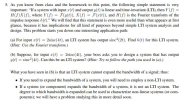 5. As you know from class and the homework to this point, the following simple statement is very important:"If a system with input 2(t) and output y(t) is linear and time-invariant (LTI), then Y (f)- H(/)x(f), where Y(f) = F(y(t), X(f)-F(x(t)), and H(/) is the Fourier transform of the impulse response h(t)." We wll find that this statement is even more useful than what appears at first glance, because it has implications for all kind of design. This problem starts...
 Problem 1: (15 points) Determine if the following statements are True or False and briefly describe the reasons for your answers. (2 points for the correct answer of True or False, and 3 points for the correct reasoning.) (a) The Laplace transform of an LTI system's zero-input response is always equal to the system's transfer function, H(s). (b) The transfer function of an LTI system is H(s) = e. Then, it can be concluded that the system is BIBO stable....
 5. (12 points) Consider a continuous-time LTI system whose frequency response is sin(w) H(ju) 4w If the input to this system is a periodic signal 0, -4<t<-1 x(t)=1, -1st<1 0, 1st<4 with period T= 8 (a) (2 points) sketch r(t) for -4ts4 (b) (5 points) determine the Fourier series coefficients at of x(t), (c) (5 points) determine the Fourier series coefficients be of the corresponding system output y(t)
5. (12 points) Consider a continuous-time LTI system whose frequency response is...
5. (12 points) Consider a continuous-time LTI system whose frequency response is sin(w) H(ju) 4w If the input to this system is a periodic signal 0, -4<t<-1 x(t)=1, -1st<1 0, 1st<4 with period T= 8 (a) (2 points) sketch r(t) for -4ts4 (b) (5 points) determine the Fourier series coefficients at of x(t), (c) (5 points) determine the Fourier series coefficients be of the corresponding system output y(t)
5. (12 points) Consider a continuous-time LTI system whose frequency response is...
 6- A contiuous-time periodic signal x(t) is given graphically below. (a) Determine the exponential Fourier coefficients for k+oo a ()-ΣGeko, k-oo where c is given by T/2 1 (t)ek dt J-T/2 Ck= T (b) r(t) is applied as an input to an LTI system whose frequency response is H(ju)=2 sin(w Determine the corresponding output y(t) (e) Sketch y(t). Be sure to mark the axes properly -JT
6- A contiuous-time periodic signal x(t) is given graphically below. (a) Determine the exponential...
6- A contiuous-time periodic signal x(t) is given graphically below. (a) Determine the exponential Fourier coefficients for k+oo a ()-ΣGeko, k-oo where c is given by T/2 1 (t)ek dt J-T/2 Ck= T (b) r(t) is applied as an input to an LTI system whose frequency response is H(ju)=2 sin(w Determine the corresponding output y(t) (e) Sketch y(t). Be sure to mark the axes properly -JT
6- A contiuous-time periodic signal x(t) is given graphically below. (a) Determine the exponential...
 This is about signals and systems.
I want to know anwser and solution.
Please write down your handwriting correctly and take
a good picture.
(1)[30 Points]Answer the following questions with 'T' for a true sentence or 'F' for a false sentence. (1-1) If the system is described as y(t) x(t) + 1, where the input signal and output signals are denoted by x(t) and y(t), respectively, the system is a linear system. (1-2) ( When a discrete time signal is...
This is about signals and systems.
I want to know anwser and solution.
Please write down your handwriting correctly and take
a good picture.
(1)[30 Points]Answer the following questions with 'T' for a true sentence or 'F' for a false sentence. (1-1) If the system is described as y(t) x(t) + 1, where the input signal and output signals are denoted by x(t) and y(t), respectively, the system is a linear system. (1-2) ( When a discrete time signal is...
 1. Consider the system shown in the figure below. The system is an integrator, in which the output is the integral: y(t)x()dr -00 Integrator x(t) y(t) (a) We may determine the impulse response h(t) by applying an impulse signal to the integrator, i.e. x(t) -5(t). What is the impulse response? Answer: (10 points) (b) The output of the integrator may be found by apply convolution method to determine the output. The convolution of the two signals is expressed a)ht -...
 6- A continuous-time periodic signal r(t) is given graphically below (a) Determine the exponential Fourier coefficients c for k+oo r(t) Cet k=-oo where ck is given by T/2 x(t)ejkwotdt -T/2 Ск T (b) (t) is applied as an input to an LTI system whose frequency response is H(jw)2 sin(w) = Determine the corresponding output y(t) (c) Sketch y(t). Be re to mark the ces properly su x(t)t 0 -T
6- A continuous-time periodic signal r(t) is given graphically below (a)...
6- A continuous-time periodic signal r(t) is given graphically below (a) Determine the exponential Fourier coefficients c for k+oo r(t) Cet k=-oo where ck is given by T/2 x(t)ejkwotdt -T/2 Ск T (b) (t) is applied as an input to an LTI system whose frequency response is H(jw)2 sin(w) = Determine the corresponding output y(t) (c) Sketch y(t). Be re to mark the ces properly su x(t)t 0 -T
6- A continuous-time periodic signal r(t) is given graphically below (a)...
 Please answer in as much detail as possible. Thank you.
Question 1 Check each FIR frequency response property statement below that is true and leave blank each false statement. H (eJ is periodic with period TT. If the FIR coefficients are all real-valued, then the frequency response is conjugate symmetric or The first difference FIR filter defined by: removes any DC component in the input signal because the frequency response is zero at A cascade of two linear time-invariant (LTI)...
Please answer in as much detail as possible. Thank you.
Question 1 Check each FIR frequency response property statement below that is true and leave blank each false statement. H (eJ is periodic with period TT. If the FIR coefficients are all real-valued, then the frequency response is conjugate symmetric or The first difference FIR filter defined by: removes any DC component in the input signal because the frequency response is zero at A cascade of two linear time-invariant (LTI)...
 Problem 1 (20 pts) Suppose that x(t) = e 2 for 0 st <3 and is periodic with period 3. a) Determine the fundamental frequency of this signal. (2 pts) b) Determine the Fourier series representation for this signal. (7 pts) c) Suppose that this signal is the input to an LTI system with impulse response h(t) = 5sinc(0.5t). Determine the Fourier series representation for the output signal y(t). Be sure to specify the fundamental period and all Fourier series...
 2. (12 points) Apply the result from part 1 to determine the response of a lowpass filter. a) (4 points) Determine the fundamental frequency and non-zero complex exponential Fourier series coeffi- cients of the periodic signal 2π f(t) =-2-5 sin(2nt) + 10 cos(Grt + "") and sketch the Fourier magnitude spectum D versus w and the Fourier phase spectrum LD versus w (b) (2 points) Use Parseval's theorem for the exponential Fourier series to find the power of the signal...
 5. As you know from class and the homework to this point, the following simple statement is very important:"If a system with input 2(t) and output y(t) is linear and time-invariant (LTI), then Y (f)- H(/)x(f), where Y(f) = F(y(t), X(f)-F(x(t)), and H(/) is the Fourier transform of the impulse response h(t)." We wll find that this statement is even more useful than what appears at first glance, because it has implications for all kind of design. This problem starts...
Most questions answered within 3 hours.
-
Where is the error in this code sequence?
String s1 = "Hello";
String s2 = "ello";...
asked 11 months ago -
Financial data for Joel de Paris, Inc., for last year
follow:
Joel de Paris, Inc.
Balance...
asked 11 months ago -
Consider this reaction:
Al2(SO4)3 (aq)+ BaCl3
(aq) Al2Cl6 (aq)- +
3BaSO4(s) . What is the...
asked 11 months ago -
Suppose that Savneet is considering increasing her
recent random sample from 20 car rentals to 40...
asked 11 months ago -
Trucks arrive at an unloading terminal at an average rate of 120
per hour.
Trucks arrive...
asked 11 months ago -
Why are methanol and ethanol completely soluble in water while
octanol is not very little soluble....
asked 11 months ago -
A facilities manager at a university reads in a research report
that the mean amount of...
asked 11 months ago -
When the CuSO4 is rehydrated by adding water to the anhydrous
compound, is this an endothermic...
asked 11 months ago -
A ray of sunlight is passing from diamond into crown glass; the
angle of incidence is...
asked 11 months ago -
A block of mass 0.249 kg is placed on top of a light, vertical
spring of...
asked 11 months ago -
how do the kidneys compensate in the presences of acidosis
a) trigger hyperventilate
b) reserve acid...
asked 11 months ago -
Question 501 pts
The rental rate of capital to the firm increases. Which of the
following...
asked 11 months ago