
Homework Answers

Add Answer to:
Most of the motion generated by joints in the human body are examples of levers. An...
Most of the motion generated by joints in the human body are examples of levers. An...
Most of the motion generated by joints in the human body are examples of levers. An example of a third class lever is the forearm; the force which generates the motion is located in between the pivot point and the resistance force. The elbow acts as the pivot point, the biceps muscle pulls up on the forearm to move the mass which is held in the hand. Imagine you are holding an object in your hand with your forearm horizontal...
Most of the motion generated by joints in the human body are examples of levers. An...
Most of the motion generated by joints in the human body are examples of levers. An example of a third class lever is the forearm; the force which generates the motion is located in‑between the pivot point and the resistance force. The elbow acts as the pivot point, the biceps muscle pulls up on the forearm to move the mass which is held in the hand. Imagine someone is holding an object in her hand with her forearm horizontal and...
3) Weightlifting Weightlifting can exert extremely large forces on the human body, especially on joints and...
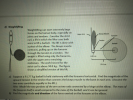 3) Weightlifting Weightlifting can exert extremely large forces on the human body, especially on joints and tendons. Consider the strict curl, a lift in which the lifter uses both arms to lift a barbell. The lift is done with a pivot of the elbow. The biceps muscle contracts, pulling up on the forearm through the tension in a tendon. The weight is lifted using only the forearms, with the upper arms remaining stationary. The world record for the strict curl...
Give an example of each class of lever in the human body. (i.e. class I, II,...
 Give an example of each class of lever in the human body. (i.e. class I, II, and III) Fully describe the action of the muscle-bone-joint system. A tendon attached to the radius in your arm provides a greater force upward than the weight of an object in your hand when you are lifting an object by just your forearm (like doing curls in weight-lifting, using only your elbow as a pivot point). Please explain why.
Constants A 71.0 kg weight lifter is doing arm raises using a 7.50 kg weight in...
 Constants A 71.0 kg weight lifter is doing arm raises using a 7.50 kg weight in her hand. Her arm pivots around the elbow joint, starting 40.0 below the horizontal. (See the figure(Figure 1).) Biometric measurements have shown that both forearms and the hands together account for 6.40 % of a person's weight. Since the upper arm is held vertically, the biceps muscle always acts vertically and is attached to the bones of the forearm 5.50 cm from the elbow...
Dan's biceps muscle has a moment arm about the elbow joint of 0.011 m when the...
Dan's biceps muscle has a moment arm about the elbow joint of 0.011 m when the joint is held at a joint angle of 90 degrees and can produce a force of 526 N. His forearm is 0.24 m from the elbow joint center to the center of his hand where he grips a handle. His forearm has a mass of 1.2 kg and the center of mass is located directly above the elbow joint. How much force can he...
Part A A 75.0 kg weight lifter is doing arm raises using a 7.50 kg weight...
 Part A A 75.0 kg weight lifter is doing arm raises using a 7.50 kg weight in her hand. Her arm pivots around the elbow joint, starting 40.0° below the horizontal (See the figure(Figure 1).) Biometric measurements have shown that both forearms and the hands together account for 5.75 % of a person's weight. Since the upper arm is held vertically, the biceps muscle always acts vertically and is attached to the bones of the forearm 5.50 cm from the...
A 75.0 kg weight lifter is doing arm raises using a 7.50 kg weight in her...
 A 75.0 kg weight lifter is doing arm raises using a 7.50 kg weight in her hand. Her arm pivots around the elbow joint, starting 40.0 below the horizontal. (See the figure (Figure 1).) Biometric measurements have shown that both forearms and the hands together account for 5.75% of a person's weight. Since the upper arm is held vertically, the biceps muscle always acts vertically and is attached to the bones of the forearm 5.50 cm from the elbow Part...
A 60 newton hand and forearm are held at 90 degrees, the center of gravity of...
A 60 newton hand and forearm are held at 90 degrees, the center of gravity of the forearm is 20 cm from the elbow joint center. Assume the tendon of the biceps muscle attaches at a 90 degree angle to the forearm at a point 4 cm from the elbow joint center. How much force must the biceps muscle produce to maintain this position?
The figure below shows an arm that is balancing a carton of milk in the hand....
 The figure below shows an arm that is balancing a carton of milk in the hand. The mass of the carton of milk is 1.08 kg, and in the figure is the gravitational force on the carton The biceps muscle applies a force F, to the forearm directed up and to the right at an angle of 75.0" from vertical. The point where is applied to the forearm is 8.00 cm to the left of the elbow joint and 25.0...
 3) Weightlifting Weightlifting can exert extremely large forces on the human body, especially on joints and tendons. Consider the strict curl, a lift in which the lifter uses both arms to lift a barbell. The lift is done with a pivot of the elbow. The biceps muscle contracts, pulling up on the forearm through the tension in a tendon. The weight is lifted using only the forearms, with the upper arms remaining stationary. The world record for the strict curl...
 Give an example of each class of lever in the human body. (i.e. class I, II, and III) Fully describe the action of the muscle-bone-joint system. A tendon attached to the radius in your arm provides a greater force upward than the weight of an object in your hand when you are lifting an object by just your forearm (like doing curls in weight-lifting, using only your elbow as a pivot point). Please explain why.
 Constants A 71.0 kg weight lifter is doing arm raises using a 7.50 kg weight in her hand. Her arm pivots around the elbow joint, starting 40.0 below the horizontal. (See the figure(Figure 1).) Biometric measurements have shown that both forearms and the hands together account for 6.40 % of a person's weight. Since the upper arm is held vertically, the biceps muscle always acts vertically and is attached to the bones of the forearm 5.50 cm from the elbow...
 Part A A 75.0 kg weight lifter is doing arm raises using a 7.50 kg weight in her hand. Her arm pivots around the elbow joint, starting 40.0° below the horizontal (See the figure(Figure 1).) Biometric measurements have shown that both forearms and the hands together account for 5.75 % of a person's weight. Since the upper arm is held vertically, the biceps muscle always acts vertically and is attached to the bones of the forearm 5.50 cm from the...
 A 75.0 kg weight lifter is doing arm raises using a 7.50 kg weight in her hand. Her arm pivots around the elbow joint, starting 40.0 below the horizontal. (See the figure (Figure 1).) Biometric measurements have shown that both forearms and the hands together account for 5.75% of a person's weight. Since the upper arm is held vertically, the biceps muscle always acts vertically and is attached to the bones of the forearm 5.50 cm from the elbow Part...
 The figure below shows an arm that is balancing a carton of milk in the hand. The mass of the carton of milk is 1.08 kg, and in the figure is the gravitational force on the carton The biceps muscle applies a force F, to the forearm directed up and to the right at an angle of 75.0" from vertical. The point where is applied to the forearm is 8.00 cm to the left of the elbow joint and 25.0...
Most questions answered within 3 hours.
-
Where is the error in this code sequence?
String s1 = "Hello";
String s2 = "ello";...
asked 10 months ago -
Financial data for Joel de Paris, Inc., for last year
follow:
Joel de Paris, Inc.
Balance...
asked 10 months ago -
Consider this reaction:
Al2(SO4)3 (aq)+ BaCl3
(aq) Al2Cl6 (aq)- +
3BaSO4(s) . What is the...
asked 10 months ago -
Suppose that Savneet is considering increasing her
recent random sample from 20 car rentals to 40...
asked 10 months ago -
Trucks arrive at an unloading terminal at an average rate of 120
per hour.
Trucks arrive...
asked 10 months ago -
Why are methanol and ethanol completely soluble in water while
octanol is not very little soluble....
asked 10 months ago -
A facilities manager at a university reads in a research report
that the mean amount of...
asked 10 months ago -
When the CuSO4 is rehydrated by adding water to the anhydrous
compound, is this an endothermic...
asked 10 months ago -
A ray of sunlight is passing from diamond into crown glass; the
angle of incidence is...
asked 10 months ago -
A block of mass 0.249 kg is placed on top of a light, vertical
spring of...
asked 10 months ago -
how do the kidneys compensate in the presences of acidosis
a) trigger hyperventilate
b) reserve acid...
asked 10 months ago -
Question 501 pts
The rental rate of capital to the firm increases. Which of the
following...
asked 10 months ago