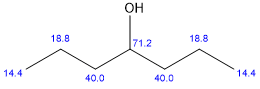
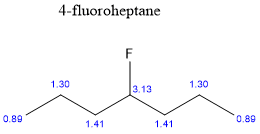
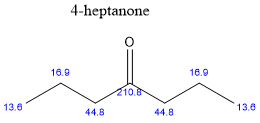
Calculate the C-NMR chemical shifts for the first 4 carbons on each compound: heptane, 4-heptanol, 4-fluoroheptane,...
Calculate the C-NMR chemical shifts for the first 4 carbons on each compound: heptane, 4-heptanol, 4-fluoroheptane, and 4-heptanone.
Homework Answers
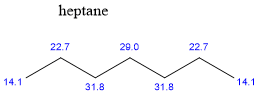
4-heptanol:
Add Answer to:
Calculate the C-NMR chemical shifts for the first 4 carbons on
each compound: heptane, 4-heptanol, 4-fluoroheptane,...
What is responsible for the differences in chemical shift observed in carbon 4 in 4-fluoroheptane and...
 What is responsible for the differences in chemical shift observed in carbon 4 in 4-fluoroheptane and carbon 4 in heptane? 2 Check all that apply View Available Hint(s) The electronegative fluorine atom generates a partial positive charge on carbon 4, which results in a downfield shift of the carbon signal. There is no difference in the chemical environment between the carbon 4 in heptane and 4-fluoroheptane, so there is no difference in chemical shift. The hybridization of carbon 4 has...
1H-NMR: interpret the spectrum detailing chemical shifts and splittings. draw the structure of the compound and label t...
 1H-NMR: interpret the spectrum detailing chemical shifts and
splittings. draw the structure of the compound and label the
hydrogens for the signals.
13C-NMR: draw the structure of the compound and label the
carbons for the signals.
IR: draw the structure of the compound and label functional
groups that are responsible for the stretches.
100 7 90 80 70 60 20 10 0 -10 2500 Wavenumbers (cm-1) 1000 4000 3500 3000 1500 2000 %Transmittance 3075.91 2937.08 2805.05 2736.70 1593.81 1575.40 1508.95...
1H-NMR: interpret the spectrum detailing chemical shifts and
splittings. draw the structure of the compound and label the
hydrogens for the signals.
13C-NMR: draw the structure of the compound and label the
carbons for the signals.
IR: draw the structure of the compound and label functional
groups that are responsible for the stretches.
100 7 90 80 70 60 20 10 0 -10 2500 Wavenumbers (cm-1) 1000 4000 3500 3000 1500 2000 %Transmittance 3075.91 2937.08 2805.05 2736.70 1593.81 1575.40 1508.95...
Using a correlation table for 13C chemical shifts, calculate the o for the carbons for the...
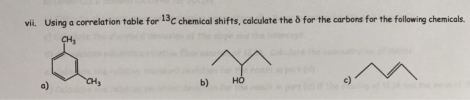 Using a correlation table for 13C chemical shifts, calculate the o for the carbons for the following chemicals. vii. CH3 CH3 но b) a)
4. The following 'H NMR spectrum is for a compound with the chemical formula C3HBr. Propose...
 4. The following 'H NMR spectrum is for a compound with the chemical formula C3HBr. Propose a structure for the compound based on the chemical shifts and multiplicity seen in the given spectrum, along with a brief explanation triplet sextet triplet 11 109876 4320 5 chemical shift (ppm)
at the top to access full instructions), complele the labile below By the ACDLabs NMR simulator...
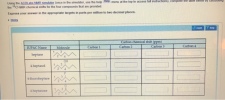 at the top to access full instructions), complele the labile below By the ACDLabs NMR simulator (once in the simulator use the help Hep menu the 13C-NMR chemical shifts for the four compounds that are provided. Express your answer in the appropriate targets in parts per million to two decimal places Hints eset? help Carbon chemical shift (ppm) UPAC Name Molecule Carbon 1 Carbon 4 heptane OH ?heptanone ?3
Propose structures for the following isomeric alcohols that give the 13C NMR spectra below. Assign the carbons to their respective peaks. A table of chemical shifts is located on page 43.
 Propose structures for the following isomeric alcohols that give the 13C NMR spectra below. Assign the carbons to their respective peaks. A table of chemical shifts is located on page 43.09 13C shift chart 304.pdf
Show the chemical shifts and splittings of 13C NMR for dibenzalacetone (or dibenzyl acetone) with the...
Show the chemical shifts and splittings of 13C NMR for dibenzalacetone (or dibenzyl acetone) with the drawing of the compound attached
How many carbons and hydrogen NMR signals would you expect to see for compounds A, B,...
 How many carbons and hydrogen NMR signals would you expect to
see for compounds A, B, and C if all non-equivalent atoms gave
different shifts? Match one compound to the hydrogen NMR.
# carbons: #carbons: # hydrogens: #hydrogens: PPM #carbons: #hydrogens:
How many carbons and hydrogen NMR signals would you expect to
see for compounds A, B, and C if all non-equivalent atoms gave
different shifts? Match one compound to the hydrogen NMR.
# carbons: #carbons: # hydrogens: #hydrogens: PPM #carbons: #hydrogens:
The compound given is 3,3-dimethyl-2-butanone. Interpret the 1H-NMR spectrum, detailing chemical shifts and splittings, draw the...
 The compound given is 3,3-dimethyl-2-butanone.
Interpret the 1H-NMR spectrum, detailing chemical shifts and
splittings, draw the structure of the compound and label hydrogens
(a,b,c,d,e) for the signals.
Interpret the 13C-NMR spectrum and draw the structure of the
compound and label carbons (a,b,c,d,e) for the signals.
Interpret the IR spectrum and draw the structure of the
compound, and label functional groups that are responsible for the
stretches.
amk UIT IKLUUENCY PPM INTENSITY 1071.875 575.350 572.946 2.1432 1.1505 1.1475 IHNMR 6.882 16.205...
The compound given is 3,3-dimethyl-2-butanone.
Interpret the 1H-NMR spectrum, detailing chemical shifts and
splittings, draw the structure of the compound and label hydrogens
(a,b,c,d,e) for the signals.
Interpret the 13C-NMR spectrum and draw the structure of the
compound and label carbons (a,b,c,d,e) for the signals.
Interpret the IR spectrum and draw the structure of the
compound, and label functional groups that are responsible for the
stretches.
amk UIT IKLUUENCY PPM INTENSITY 1071.875 575.350 572.946 2.1432 1.1505 1.1475 IHNMR 6.882 16.205...
please explain 74. Determine the multiplicity and predict the chemical shifts of each signal in the...
 please explain
74. Determine the multiplicity and predict the chemical shifts of each signal in the expected 'H NMR spectrum of the following compound.
please explain
74. Determine the multiplicity and predict the chemical shifts of each signal in the expected 'H NMR spectrum of the following compound.
 What is responsible for the differences in chemical shift observed in carbon 4 in 4-fluoroheptane and carbon 4 in heptane? 2 Check all that apply View Available Hint(s) The electronegative fluorine atom generates a partial positive charge on carbon 4, which results in a downfield shift of the carbon signal. There is no difference in the chemical environment between the carbon 4 in heptane and 4-fluoroheptane, so there is no difference in chemical shift. The hybridization of carbon 4 has...
 1H-NMR: interpret the spectrum detailing chemical shifts and
splittings. draw the structure of the compound and label the
hydrogens for the signals.
13C-NMR: draw the structure of the compound and label the
carbons for the signals.
IR: draw the structure of the compound and label functional
groups that are responsible for the stretches.
100 7 90 80 70 60 20 10 0 -10 2500 Wavenumbers (cm-1) 1000 4000 3500 3000 1500 2000 %Transmittance 3075.91 2937.08 2805.05 2736.70 1593.81 1575.40 1508.95...
1H-NMR: interpret the spectrum detailing chemical shifts and
splittings. draw the structure of the compound and label the
hydrogens for the signals.
13C-NMR: draw the structure of the compound and label the
carbons for the signals.
IR: draw the structure of the compound and label functional
groups that are responsible for the stretches.
100 7 90 80 70 60 20 10 0 -10 2500 Wavenumbers (cm-1) 1000 4000 3500 3000 1500 2000 %Transmittance 3075.91 2937.08 2805.05 2736.70 1593.81 1575.40 1508.95...
 Using a correlation table for 13C chemical shifts, calculate the o for the carbons for the following chemicals. vii. CH3 CH3 но b) a)
 4. The following 'H NMR spectrum is for a compound with the chemical formula C3HBr. Propose a structure for the compound based on the chemical shifts and multiplicity seen in the given spectrum, along with a brief explanation triplet sextet triplet 11 109876 4320 5 chemical shift (ppm)
 at the top to access full instructions), complele the labile below By the ACDLabs NMR simulator (once in the simulator use the help Hep menu the 13C-NMR chemical shifts for the four compounds that are provided. Express your answer in the appropriate targets in parts per million to two decimal places Hints eset? help Carbon chemical shift (ppm) UPAC Name Molecule Carbon 1 Carbon 4 heptane OH ?heptanone ?3
 How many carbons and hydrogen NMR signals would you expect to
see for compounds A, B, and C if all non-equivalent atoms gave
different shifts? Match one compound to the hydrogen NMR.
# carbons: #carbons: # hydrogens: #hydrogens: PPM #carbons: #hydrogens:
How many carbons and hydrogen NMR signals would you expect to
see for compounds A, B, and C if all non-equivalent atoms gave
different shifts? Match one compound to the hydrogen NMR.
# carbons: #carbons: # hydrogens: #hydrogens: PPM #carbons: #hydrogens:
 The compound given is 3,3-dimethyl-2-butanone.
Interpret the 1H-NMR spectrum, detailing chemical shifts and
splittings, draw the structure of the compound and label hydrogens
(a,b,c,d,e) for the signals.
Interpret the 13C-NMR spectrum and draw the structure of the
compound and label carbons (a,b,c,d,e) for the signals.
Interpret the IR spectrum and draw the structure of the
compound, and label functional groups that are responsible for the
stretches.
amk UIT IKLUUENCY PPM INTENSITY 1071.875 575.350 572.946 2.1432 1.1505 1.1475 IHNMR 6.882 16.205...
The compound given is 3,3-dimethyl-2-butanone.
Interpret the 1H-NMR spectrum, detailing chemical shifts and
splittings, draw the structure of the compound and label hydrogens
(a,b,c,d,e) for the signals.
Interpret the 13C-NMR spectrum and draw the structure of the
compound and label carbons (a,b,c,d,e) for the signals.
Interpret the IR spectrum and draw the structure of the
compound, and label functional groups that are responsible for the
stretches.
amk UIT IKLUUENCY PPM INTENSITY 1071.875 575.350 572.946 2.1432 1.1505 1.1475 IHNMR 6.882 16.205...
 please explain
74. Determine the multiplicity and predict the chemical shifts of each signal in the expected 'H NMR spectrum of the following compound.
please explain
74. Determine the multiplicity and predict the chemical shifts of each signal in the expected 'H NMR spectrum of the following compound.
Most questions answered within 3 hours.
-
Where is the error in this code sequence?
String s1 = "Hello";
String s2 = "ello";...
asked 11 months ago -
Financial data for Joel de Paris, Inc., for last year
follow:
Joel de Paris, Inc.
Balance...
asked 11 months ago -
Consider this reaction:
Al2(SO4)3 (aq)+ BaCl3
(aq) Al2Cl6 (aq)- +
3BaSO4(s) . What is the...
asked 11 months ago -
Suppose that Savneet is considering increasing her
recent random sample from 20 car rentals to 40...
asked 11 months ago -
Trucks arrive at an unloading terminal at an average rate of 120
per hour.
Trucks arrive...
asked 11 months ago -
Why are methanol and ethanol completely soluble in water while
octanol is not very little soluble....
asked 11 months ago -
A facilities manager at a university reads in a research report
that the mean amount of...
asked 11 months ago -
When the CuSO4 is rehydrated by adding water to the anhydrous
compound, is this an endothermic...
asked 11 months ago -
A ray of sunlight is passing from diamond into crown glass; the
angle of incidence is...
asked 11 months ago -
A block of mass 0.249 kg is placed on top of a light, vertical
spring of...
asked 11 months ago -
how do the kidneys compensate in the presences of acidosis
a) trigger hyperventilate
b) reserve acid...
asked 11 months ago -
Question 501 pts
The rental rate of capital to the firm increases. Which of the
following...
asked 11 months ago