
Homework Answers

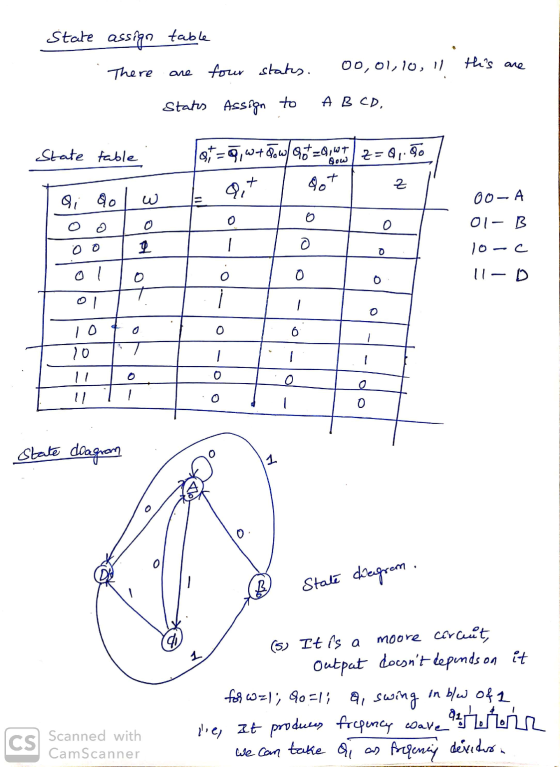
Add Answer to:
2. (25 pts) Refer to the sequential circuit given below. Think about how you design a...
2. (8 marks] Design a sequential circuit specified by the state diagram in the figure below,...
 2. (8 marks] Design a sequential circuit specified by the state diagram in the figure below, using D flip-flops. A. (4 marks] Construct the state table. B. [3 marks] Write the necessary equations using k-map. C. [1 mark] Implement the circuit. 01/0 ooo 0011 s, lovo 1010 10/0 oo! 10/ S2 01/o
ercise 5 Part One: Sequential Logic ask 5.1,1: Design a 4-bit up/down counter that does not...
 ercise 5 Part One: Sequential Logic ask 5.1,1: Design a 4-bit up/down counter that does not overflow or underflow. That is, counting up is disabled when it reaches its maximum value and counting down is disabled when it reaches its minimum value. Use circuit simulation to verify your design. Task 5.1.2: Design a logic implementation of the Finite State Machine in Fiqure 2.3 using JK flip flops. It can be assumed that unused state combinations may be considered as don't...
Used 2. (10 points) Design a sequential circuit, which has the potential of being combinational l...
 please answer the following?
used 2. (10 points) Design a sequential circuit, which has the potential of being combinational lock" if the number of inputs is expanded. The circuit has four inputs, labelet as reset, codeo, codel, and code2, and one output, labeled as match. Binary bits are coming to the four inputs sequentially, one bit at a time for each clock cycle. After reset - 1 for one clock cycle, the circuit searches for the first occurrence of the...
please answer the following?
used 2. (10 points) Design a sequential circuit, which has the potential of being combinational lock" if the number of inputs is expanded. The circuit has four inputs, labelet as reset, codeo, codel, and code2, and one output, labeled as match. Binary bits are coming to the four inputs sequentially, one bit at a time for each clock cycle. After reset - 1 for one clock cycle, the circuit searches for the first occurrence of the...
Problem 3 (10 points: Refer to the sequential circuit shown below. The circuit has four D...
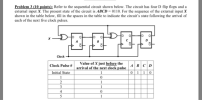 Problem 3 (10 points: Refer to the sequential circuit shown below. The circuit has four D flip flops and a external input X. The present state of the circuit is ABCD = 01 10, For the sequence of the external input X shown in the table below, fill in the spaces in the table to indicate the circuit's state following the arrival of each of the next five clock pulses. Clock Clock Pulse # | Value of X just arrival...
Design a synchronous sequential circuit that generates the repeating sequence of numbers O, 2, 1, 3,...
Design a synchronous sequential circuit that generates the repeating sequence of numbers O, 2, 1, 3, O, 2, 1, 3, O, Indicate all the inputs and outputs that are required to realise such a circuit. Make a suitable state assignment to guide your design. Write a state transition table to assist in your design. Write a state excitation table to design the sequential circuit using D-type flipflops. Draw the final logic circuit that results from your design.
Its logic design my sequence is 127605 i need help with all this pages please and thank you
 Its logic design
my sequence is 127605
i need help with all this pages please and thank you
27 60 Experiment 4 Six-State Up-Down Counter 1 Objective To become familiar with the design procedures of a counter, which are applicable to the design of other synchronous sequential circuits. 2 Problem description A six-state up-down counter is to be designed. Three flip-flops with outputs Q2,Qi and Qo are required in the design. As shown in Figure 1, the counter is initialized...
Its logic design
my sequence is 127605
i need help with all this pages please and thank you
27 60 Experiment 4 Six-State Up-Down Counter 1 Objective To become familiar with the design procedures of a counter, which are applicable to the design of other synchronous sequential circuits. 2 Problem description A six-state up-down counter is to be designed. Three flip-flops with outputs Q2,Qi and Qo are required in the design. As shown in Figure 1, the counter is initialized...
A combination circuit is specified by the following Boolean functions listed below. h(a, b, c) = b,c' + a'c Implement the circuit with a 3x8 decoder. Provide truth table and drawing the l...
 A combination circuit is specified by the following Boolean functions listed below. h(a, b, c) = b,c' + a'c Implement the circuit with a 3x8 decoder. Provide truth table and drawing the logic/circuit diagram. Use the block diagram for the decoder provided in Figure A4 in supplements. Please label the inputs and outputs clearly. Note: use single 3x8 decoder Question 2 (15 points] A priority encoder is an encoder circuit that includes the Truth Table of a priority function. The...
8.9,8.14 and 8.18 please 5 Hlnd the state table for the sequential circuit in Fig. P8.8. 8.9 Consider a sequential circuit consisting of two cascaded circuits illustrated in Fig. P8.9. If...
 8.9,8.14 and 8.18 please
5 Hlnd the state table for the sequential circuit in Fig. P8.8. 8.9 Consider a sequential circuit consisting of two cascaded circuits illustrated in Fig. P8.9. If the starting state is yi =y2 =0, what is the output sequence generated by the input sequence x = 01 1011 1010 8.14 Derive the minimum state diagram of a clocked sequential circuit that recognizes the input sequence 1010. Sequences may overlap. For example, 00101001010101110 00000100001010000 8.18 For the...
8.9,8.14 and 8.18 please
5 Hlnd the state table for the sequential circuit in Fig. P8.8. 8.9 Consider a sequential circuit consisting of two cascaded circuits illustrated in Fig. P8.9. If the starting state is yi =y2 =0, what is the output sequence generated by the input sequence x = 01 1011 1010 8.14 Derive the minimum state diagram of a clocked sequential circuit that recognizes the input sequence 1010. Sequences may overlap. For example, 00101001010101110 00000100001010000 8.18 For the...
A sequential circuit is to be designed with two input lines A - "Pres> 800" and...
 A sequential circuit is to be designed with two input lines A - "Pres> 800" and B Temp> 100" and a single outputX-"ALARM". If a clock pulse arrives when AB 00 the circuit is to assume a reset state which may be labeled SO. Suppose the next "3" clock pulses following a resetting pulse coincide with thoe following sequence of input conditions 01- 11 - 01 The output"ALARM" is to be"1" coinciding with the third of such a string of...
4. (30 pts.) Construct an asynchronous sequential dual edge trigger circuit which at each change (0 1 or 10) of the inp...
 4. (30 pts.) Construct an asynchronous sequential dual edge trigger circuit which at each change (0 1 or 10) of the input signal w generates a short pulse at the output z. When the input signal is unchanged, the output should be z 0. Output pulse length is given by the time for the transition state in the asynchronous sequential circuit. See timing diagram for clarification. Your answer must include a state diagram, if necessary minimized, a flow table, and...
 2. (8 marks] Design a sequential circuit specified by the state diagram in the figure below, using D flip-flops. A. (4 marks] Construct the state table. B. [3 marks] Write the necessary equations using k-map. C. [1 mark] Implement the circuit. 01/0 ooo 0011 s, lovo 1010 10/0 oo! 10/ S2 01/o
 ercise 5 Part One: Sequential Logic ask 5.1,1: Design a 4-bit up/down counter that does not overflow or underflow. That is, counting up is disabled when it reaches its maximum value and counting down is disabled when it reaches its minimum value. Use circuit simulation to verify your design. Task 5.1.2: Design a logic implementation of the Finite State Machine in Fiqure 2.3 using JK flip flops. It can be assumed that unused state combinations may be considered as don't...
 please answer the following?
used 2. (10 points) Design a sequential circuit, which has the potential of being combinational lock" if the number of inputs is expanded. The circuit has four inputs, labelet as reset, codeo, codel, and code2, and one output, labeled as match. Binary bits are coming to the four inputs sequentially, one bit at a time for each clock cycle. After reset - 1 for one clock cycle, the circuit searches for the first occurrence of the...
please answer the following?
used 2. (10 points) Design a sequential circuit, which has the potential of being combinational lock" if the number of inputs is expanded. The circuit has four inputs, labelet as reset, codeo, codel, and code2, and one output, labeled as match. Binary bits are coming to the four inputs sequentially, one bit at a time for each clock cycle. After reset - 1 for one clock cycle, the circuit searches for the first occurrence of the...
 Problem 3 (10 points: Refer to the sequential circuit shown below. The circuit has four D flip flops and a external input X. The present state of the circuit is ABCD = 01 10, For the sequence of the external input X shown in the table below, fill in the spaces in the table to indicate the circuit's state following the arrival of each of the next five clock pulses. Clock Clock Pulse # | Value of X just arrival...
 Its logic design
my sequence is 127605
i need help with all this pages please and thank you
27 60 Experiment 4 Six-State Up-Down Counter 1 Objective To become familiar with the design procedures of a counter, which are applicable to the design of other synchronous sequential circuits. 2 Problem description A six-state up-down counter is to be designed. Three flip-flops with outputs Q2,Qi and Qo are required in the design. As shown in Figure 1, the counter is initialized...
Its logic design
my sequence is 127605
i need help with all this pages please and thank you
27 60 Experiment 4 Six-State Up-Down Counter 1 Objective To become familiar with the design procedures of a counter, which are applicable to the design of other synchronous sequential circuits. 2 Problem description A six-state up-down counter is to be designed. Three flip-flops with outputs Q2,Qi and Qo are required in the design. As shown in Figure 1, the counter is initialized...
 A combination circuit is specified by the following Boolean functions listed below. h(a, b, c) = b,c' + a'c Implement the circuit with a 3x8 decoder. Provide truth table and drawing the logic/circuit diagram. Use the block diagram for the decoder provided in Figure A4 in supplements. Please label the inputs and outputs clearly. Note: use single 3x8 decoder Question 2 (15 points] A priority encoder is an encoder circuit that includes the Truth Table of a priority function. The...
 8.9,8.14 and 8.18 please
5 Hlnd the state table for the sequential circuit in Fig. P8.8. 8.9 Consider a sequential circuit consisting of two cascaded circuits illustrated in Fig. P8.9. If the starting state is yi =y2 =0, what is the output sequence generated by the input sequence x = 01 1011 1010 8.14 Derive the minimum state diagram of a clocked sequential circuit that recognizes the input sequence 1010. Sequences may overlap. For example, 00101001010101110 00000100001010000 8.18 For the...
8.9,8.14 and 8.18 please
5 Hlnd the state table for the sequential circuit in Fig. P8.8. 8.9 Consider a sequential circuit consisting of two cascaded circuits illustrated in Fig. P8.9. If the starting state is yi =y2 =0, what is the output sequence generated by the input sequence x = 01 1011 1010 8.14 Derive the minimum state diagram of a clocked sequential circuit that recognizes the input sequence 1010. Sequences may overlap. For example, 00101001010101110 00000100001010000 8.18 For the...
 A sequential circuit is to be designed with two input lines A - "Pres> 800" and B Temp> 100" and a single outputX-"ALARM". If a clock pulse arrives when AB 00 the circuit is to assume a reset state which may be labeled SO. Suppose the next "3" clock pulses following a resetting pulse coincide with thoe following sequence of input conditions 01- 11 - 01 The output"ALARM" is to be"1" coinciding with the third of such a string of...
 4. (30 pts.) Construct an asynchronous sequential dual edge trigger circuit which at each change (0 1 or 10) of the input signal w generates a short pulse at the output z. When the input signal is unchanged, the output should be z 0. Output pulse length is given by the time for the transition state in the asynchronous sequential circuit. See timing diagram for clarification. Your answer must include a state diagram, if necessary minimized, a flow table, and...
Most questions answered within 3 hours.
-
Where is the error in this code sequence?
String s1 = "Hello";
String s2 = "ello";...
asked 10 months ago -
Financial data for Joel de Paris, Inc., for last year
follow:
Joel de Paris, Inc.
Balance...
asked 10 months ago -
Consider this reaction:
Al2(SO4)3 (aq)+ BaCl3
(aq) Al2Cl6 (aq)- +
3BaSO4(s) . What is the...
asked 10 months ago -
Suppose that Savneet is considering increasing her
recent random sample from 20 car rentals to 40...
asked 10 months ago -
Trucks arrive at an unloading terminal at an average rate of 120
per hour.
Trucks arrive...
asked 10 months ago -
Why are methanol and ethanol completely soluble in water while
octanol is not very little soluble....
asked 10 months ago -
A facilities manager at a university reads in a research report
that the mean amount of...
asked 10 months ago -
When the CuSO4 is rehydrated by adding water to the anhydrous
compound, is this an endothermic...
asked 10 months ago -
A ray of sunlight is passing from diamond into crown glass; the
angle of incidence is...
asked 10 months ago -
A block of mass 0.249 kg is placed on top of a light, vertical
spring of...
asked 10 months ago -
how do the kidneys compensate in the presences of acidosis
a) trigger hyperventilate
b) reserve acid...
asked 10 months ago -
Question 501 pts
The rental rate of capital to the firm increases. Which of the
following...
asked 10 months ago