
Homework Answers
Add Answer to:
10. Consider two long, parallel, and oppositely charged wires of radius R with their centers separated...
Consider two long, parallel and oppositely charged wires of radius Y with their centers separated by...
 Consider two long, parallel and oppositely charged wires of radius Y with their centers separated by a distance D (D>>r). The charges are uniformly distributed strictly on the surface of each wire, with a line charge density A. Using Gauss's Law, derive an expression for the total electric field in the space between the two wires. ((1) consider each wire individually and then add the individual contributions; (2): the wires'length extends to infinity, and thus the two wires can be...
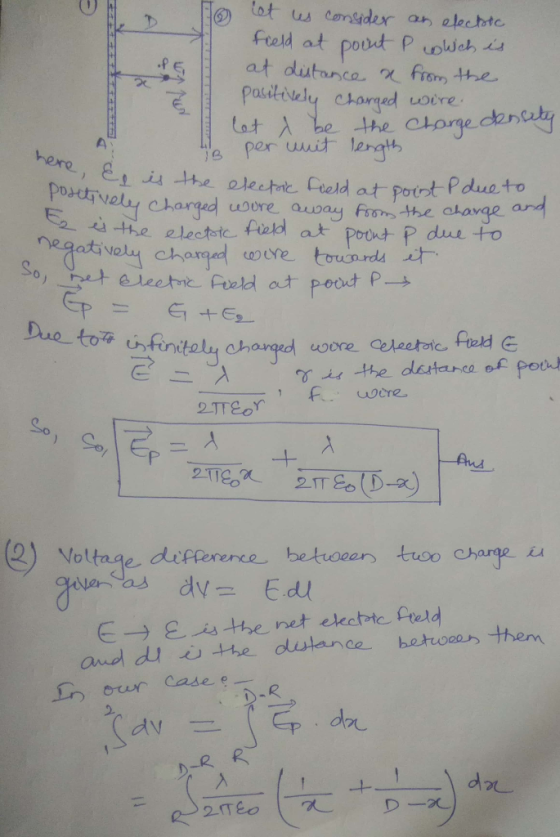
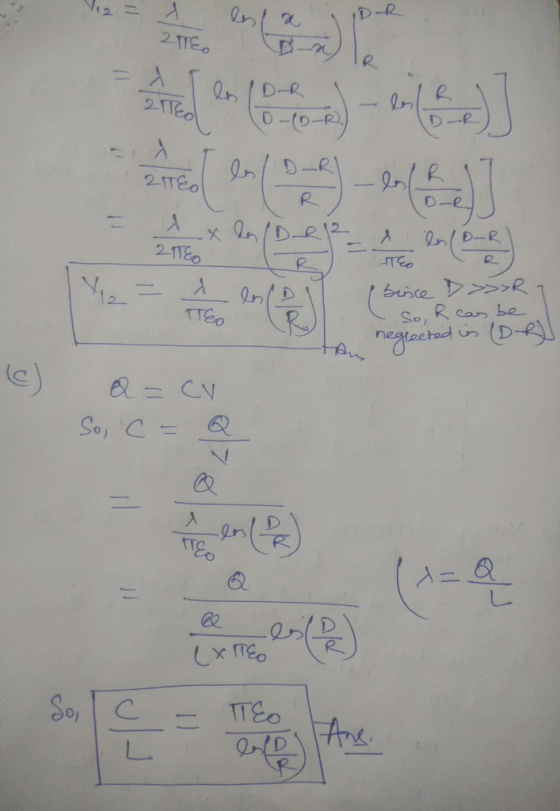
5) Find the capacitance per unit length of two parallel wires, each of radius R, separated...
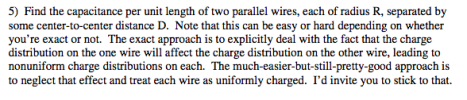 5) Find the capacitance per unit length of two parallel wires, each of radius R, separated by some center-to-center distance D. Note that this can be easy or hard depending on whether you're exact or not. The exact approach is to explicitly deal with the fact that the charge distribution on the one wire will affect the charge distribution on the other wire, leading to nonuniform charge distributions on each. The much-easier-but-still-pretty-good approach is to neglect that effect and treat...
I need the answer step by step please Consider two infinitely long wires with radius R....
 I need the answer step by step please
Consider two infinitely long wires with radius R. The wires are parallel and separated by a distance d and have a length L. One of the wires is charged with + Q while the other is charged with -Q Derive the capacitance of a capacitor made out of these wire* (detail your reasoning for partial credit).
I need the answer step by step please
Consider two infinitely long wires with radius R. The wires are parallel and separated by a distance d and have a length L. One of the wires is charged with + Q while the other is charged with -Q Derive the capacitance of a capacitor made out of these wire* (detail your reasoning for partial credit).
If two infinite, parallel, z-directed wires of radius “a” lie at x = b/2, y =...
If two infinite, parallel, z-directed wires of radius “a” lie at x = b/2, y = 0 for one wire and x = -b/2, y = 0 for the other wire. The wires are separated by a center-to center distance “b” where b >> a and the entire system is in a vacuum. Find: (10) The magnetic field at a distance “d” where d >> b for a current of I in one wire and -I in the other wire....
Two long straight wires are parallel to each other and are separated by 78 mm. The...
Two long straight wires are parallel to each other and are separated by 78 mm. The current in wire 1 is 3.55 A and the current in wire 2 is 2.75 A. What is the force per unit length between the two wires?
1. Parallel plates. You have two equal but oppositely charged parallel conducting plates, separated by 10...
 1. Parallel plates. You have two equal but oppositely charged parallel conducting plates, separated by 10 cm. A voltmeter shows that the potential difference between the plates is 500 V. (a) Which is at a higher potential, the positive or negative plate? (b) How big is the electric field between the plates? (c) You let go of an electron next to the negative plate. How much work does the electric field do in moving the electron to the positive plate?...
(7%) Problem 11: Two parallel wires are separated by a distance R as shown in the...
 (7%) Problem 11: Two parallel wires are separated by a distance R as shown in the diagram. As compared to their separation, the wires are very long, extending well beyond the boundaries of the image. Wire 1 carries current / Wire 2 carries current l in the opposite direction as the first current. Coordinate axes have been included for convenience. L A Grade Summary Deductions 0% Potential 100% 7% Part (a) What is the direction of the magnetic field due...
Consider two long, straight parallel wires separated by 1.00 m. In the figure below, the current...
 Consider two long, straight parallel wires separated by 1.00 m.
In the figure below, the current through wire one is 1.00 A and is
directed out of the page. The direction and magnitude of the
current through wire two is unknown. Wire two is observed to be
attracted toward wire one with a force per unit length of
2.00×10^-7 N/m.
what is the current through wire two?
A) 1.00 A
B) 1.50 A
C) 2.00 A
D) 2.50 A
E)...
Consider two long, straight parallel wires separated by 1.00 m.
In the figure below, the current through wire one is 1.00 A and is
directed out of the page. The direction and magnitude of the
current through wire two is unknown. Wire two is observed to be
attracted toward wire one with a force per unit length of
2.00×10^-7 N/m.
what is the current through wire two?
A) 1.00 A
B) 1.50 A
C) 2.00 A
D) 2.50 A
E)...
Two long, parallel wires are separated by a distance of 3.40 cm. The force per unit...
 Two long, parallel wires are separated by a distance of 3.40 cm. The force per unit length that each wire exerts on the other is 4.20x10⁻⁵ N/m and the wires repel each other. The current in one wire is 0.520 A. Part A What is the current in the second wire? 10 AP R O ? Submit Request Answer Part B Are the two currents in the same direction or in opposite directions? In the same direction In opposite direction...
8. As shown in the figure, two long, parallel wires are separated by 0.50 meters. The...
 8. As shown in the figure, two long, parallel wires are separated by 0.50 meters. The current in wire B is 7.0 A upwards and 5.0 A downward in wire A. A 15-turn coil is centered between the two wires and spans from wire B to wire A. What must be the magnitude and direction of the current in the coils for the magnetic field to be zero at the center of the coil? (8 points) +4 7.0 som -...
 Consider two long, parallel and oppositely charged wires of radius Y with their centers separated by a distance D (D>>r). The charges are uniformly distributed strictly on the surface of each wire, with a line charge density A. Using Gauss's Law, derive an expression for the total electric field in the space between the two wires. ((1) consider each wire individually and then add the individual contributions; (2): the wires'length extends to infinity, and thus the two wires can be...
 5) Find the capacitance per unit length of two parallel wires, each of radius R, separated by some center-to-center distance D. Note that this can be easy or hard depending on whether you're exact or not. The exact approach is to explicitly deal with the fact that the charge distribution on the one wire will affect the charge distribution on the other wire, leading to nonuniform charge distributions on each. The much-easier-but-still-pretty-good approach is to neglect that effect and treat...
 I need the answer step by step please
Consider two infinitely long wires with radius R. The wires are parallel and separated by a distance d and have a length L. One of the wires is charged with + Q while the other is charged with -Q Derive the capacitance of a capacitor made out of these wire* (detail your reasoning for partial credit).
I need the answer step by step please
Consider two infinitely long wires with radius R. The wires are parallel and separated by a distance d and have a length L. One of the wires is charged with + Q while the other is charged with -Q Derive the capacitance of a capacitor made out of these wire* (detail your reasoning for partial credit).
 1. Parallel plates. You have two equal but oppositely charged parallel conducting plates, separated by 10 cm. A voltmeter shows that the potential difference between the plates is 500 V. (a) Which is at a higher potential, the positive or negative plate? (b) How big is the electric field between the plates? (c) You let go of an electron next to the negative plate. How much work does the electric field do in moving the electron to the positive plate?...
 (7%) Problem 11: Two parallel wires are separated by a distance R as shown in the diagram. As compared to their separation, the wires are very long, extending well beyond the boundaries of the image. Wire 1 carries current / Wire 2 carries current l in the opposite direction as the first current. Coordinate axes have been included for convenience. L A Grade Summary Deductions 0% Potential 100% 7% Part (a) What is the direction of the magnetic field due...
 Consider two long, straight parallel wires separated by 1.00 m.
In the figure below, the current through wire one is 1.00 A and is
directed out of the page. The direction and magnitude of the
current through wire two is unknown. Wire two is observed to be
attracted toward wire one with a force per unit length of
2.00×10^-7 N/m.
what is the current through wire two?
A) 1.00 A
B) 1.50 A
C) 2.00 A
D) 2.50 A
E)...
Consider two long, straight parallel wires separated by 1.00 m.
In the figure below, the current through wire one is 1.00 A and is
directed out of the page. The direction and magnitude of the
current through wire two is unknown. Wire two is observed to be
attracted toward wire one with a force per unit length of
2.00×10^-7 N/m.
what is the current through wire two?
A) 1.00 A
B) 1.50 A
C) 2.00 A
D) 2.50 A
E)...
 Two long, parallel wires are separated by a distance of 3.40 cm. The force per unit length that each wire exerts on the other is 4.20x10⁻⁵ N/m and the wires repel each other. The current in one wire is 0.520 A. Part A What is the current in the second wire? 10 AP R O ? Submit Request Answer Part B Are the two currents in the same direction or in opposite directions? In the same direction In opposite direction...
 8. As shown in the figure, two long, parallel wires are separated by 0.50 meters. The current in wire B is 7.0 A upwards and 5.0 A downward in wire A. A 15-turn coil is centered between the two wires and spans from wire B to wire A. What must be the magnitude and direction of the current in the coils for the magnetic field to be zero at the center of the coil? (8 points) +4 7.0 som -...
Most questions answered within 3 hours.
-
Where is the error in this code sequence?
String s1 = "Hello";
String s2 = "ello";...
asked 11 months ago -
Financial data for Joel de Paris, Inc., for last year
follow:
Joel de Paris, Inc.
Balance...
asked 11 months ago -
Consider this reaction:
Al2(SO4)3 (aq)+ BaCl3
(aq) Al2Cl6 (aq)- +
3BaSO4(s) . What is the...
asked 11 months ago -
Suppose that Savneet is considering increasing her
recent random sample from 20 car rentals to 40...
asked 11 months ago -
Trucks arrive at an unloading terminal at an average rate of 120
per hour.
Trucks arrive...
asked 11 months ago -
Why are methanol and ethanol completely soluble in water while
octanol is not very little soluble....
asked 11 months ago -
A facilities manager at a university reads in a research report
that the mean amount of...
asked 11 months ago -
When the CuSO4 is rehydrated by adding water to the anhydrous
compound, is this an endothermic...
asked 11 months ago -
A ray of sunlight is passing from diamond into crown glass; the
angle of incidence is...
asked 11 months ago -
A block of mass 0.249 kg is placed on top of a light, vertical
spring of...
asked 11 months ago -
how do the kidneys compensate in the presences of acidosis
a) trigger hyperventilate
b) reserve acid...
asked 11 months ago -
Question 501 pts
The rental rate of capital to the firm increases. Which of the
following...
asked 11 months ago