
Homework Answers
Question (a)

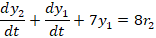
From the second equation, we get
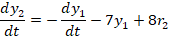
Substituting this equation in the first one, we get


Let us take the state variables as


Let the inputs be


From the above definition, we get one state space equation as

So

Now substituting the state variables in the differential equation we get



Substituting the state variables in
 , we
get
, we
get

So the state equations are



The output equations are


Question (b)
The state space representation in matrix form is

![[ ៩ 31 -[:] : 1= []](http://img.homeworklib.com/questions/c9a466c0-1577-11ec-8c2e-4b728f5ca231.png?x-oss-process=image/resize,w_560)
So the matrices are
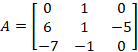
![B = O 01 10 -8 lo 8]](http://img.homeworklib.com/questions/ca641450-1577-11ec-a742-c1354d9bc2b0.png?x-oss-process=image/resize,w_560)
![1 0 9=3 Lo 0 ]](http://img.homeworklib.com/questions/cabbdeb0-1577-11ec-9884-c17834e26ec3.png?x-oss-process=image/resize,w_560)

Question (c)
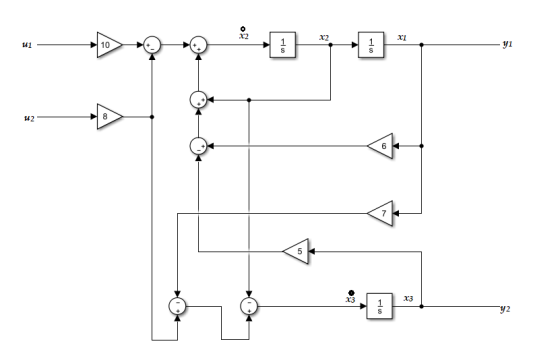
The state space diagram is as shown below
Transfer function is given by
![Y(s) UC =C(SI - A]-1B+D](http://img.homeworklib.com/questions/cbd76410-1577-11ec-825c-45e19d52de17.png?x-oss-process=image/resize,w_560)
![[1 0 [s1 – A] = SO 1 Lo 0 0 0 1] - 0 6 -7 1 1 -1 0 1 -5 0]](http://img.homeworklib.com/questions/cc2e39c0-1577-11ec-ab64-c561b72c8988.png?x-oss-process=image/resize,w_560)
![Is [sl - A] = -6 17 -1 5-1 1 01 5 s](http://img.homeworklib.com/questions/cc944b40-1577-11ec-86b7-a1050045a425.png?x-oss-process=image/resize,w_560)



![Co factor Matrix of [sl - A] = s(S-1) -(-s) -5 -(-65 – 35) s2 (5) -6-7(5-1)] -(s + 7) s(s -1)-6]](http://img.homeworklib.com/questions/cddd4cf0-1577-11ec-9ad4-d3a270354372.png?x-oss-process=image/resize,w_560)
![[s- s 6s +351 - 7s Co factor Matrix of [s1 – A] = s 52 -s-7 1-5 -55 52 - 5 - 61](http://img.homeworklib.com/questions/ce373050-1577-11ec-9566-cf8d422ffc94.png?x-oss-process=image/resize,w_560)
![s2-5 Adjoint Matrix of [sl – A] = 6s +35 11-7s S 52 -S-7 -5 -5 -5s 52-5-61](http://img.homeworklib.com/questions/ce930880-1577-11ec-aec1-21a965fa2ca2.png?x-oss-process=image/resize,w_560)
So the inverse
![[sl – A]-? = a 2 Adjoint Matrix of [sl – A]](http://img.homeworklib.com/questions/ceee7830-1577-11ec-9c7f-19c2861a3c2d.png?x-oss-process=image/resize,w_560)

So the transfer function will be
![Y(s) UC =C(SI - A]-1B+D](http://img.homeworklib.com/questions/cf981020-1577-11ec-a894-295f89f4c005.png?x-oss-process=image/resize,w_560)
![Y(S) 1 s2-5 1153 – 52 - 115 - 35 265 + 35 P11-7s s -5 10 01 52 -5s 10 -8 -S-7 SP - $-61108 ] U(S) Lo](http://img.homeworklib.com/questions/cff18110-1577-11ec-8804-6d3d64290ab1.png?x-oss-process=image/resize,w_560)
![Y(S) PO ==-5 -115– 356 91 (S) 0 10s -8s – 40 -8s2 - 40s L-10s - 70 8s +56 +8s2 - 85 - 48] 1052 U(s) 53 – 52 - 1](http://img.homeworklib.com/questions/d04890c0-1577-11ec-b557-9152dde79d8d.png?x-oss-process=image/resize,w_560)

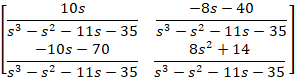
![Y(s) 10s US = 53 – 52 - 115 -351-10s - 70 -8s - 407 852 +8]](http://img.homeworklib.com/questions/d0f8a2a0-1577-11ec-b4ec-3bd36e3e3dee.png?x-oss-process=image/resize,w_560)
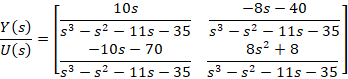
So the transfer function matrix is
Add Answer to:
Question 5 Following differential equations defines input-output relationships of a system with y as output and...
Problem 2 - System Representation: Input/Output (20pts) (2 For the following set of coupled differential equations: or...
 Problem 2 - System Representation: Input/Output (20pts) (2 For the following set of coupled differential equations: or the following set dx dt + F(t dt Find the input/output equation describing x, given the input force F(t).
Problem 2 - System Representation: Input/Output (20pts) (2 For the following set of coupled differential equations: or the following set dx dt + F(t dt Find the input/output equation describing x, given the input force F(t).
Problem 2 - System Representation: Input/Output (20pts) (2 For the following set of coupled differential equations: or the following set dx dt + F(t dt Find the input/output equation describing x, given the input force F(t).
5. A two-input, two-output dynamic system is defined by the following differential equations syst...
 5. A two-input, two-output dynamic system is defined by the following differential equations system 2x, (t) ) +3x1(t) -2x2 () fi(t) x2 t) -2x,(t) +2x2(t) f2(t) Determine its transfer function matrix considering that the input is (fi (t) f2(t) and the output is x, (t) x2 (t)J.
5. A two-input, two-output dynamic system is defined by the following differential equations system 2x, (t) ) +3x1(t) -2x2 () fi(t) x2 t) -2x,(t) +2x2(t) f2(t) Determine its transfer function matrix considering that...
5. A two-input, two-output dynamic system is defined by the following differential equations system 2x, (t) ) +3x1(t) -2x2 () fi(t) x2 t) -2x,(t) +2x2(t) f2(t) Determine its transfer function matrix considering that the input is (fi (t) f2(t) and the output is x, (t) x2 (t)J.
5. A two-input, two-output dynamic system is defined by the following differential equations system 2x, (t) ) +3x1(t) -2x2 () fi(t) x2 t) -2x,(t) +2x2(t) f2(t) Determine its transfer function matrix considering that...
Question 3 Consider the following linear system of differential equations dx: = 2x-3y dt dy dt (a) Write this system of...
 Question 3 Consider the following linear system of differential equations dx: = 2x-3y dt dy dt (a) Write this system of differential equations in matrix form (b) Find the general solution of the system (c) Solve the initial value problem given (0) 3 and y(0)-4 (d) Verify the calculations with MATLAB
Question 3 Consider the following linear system of differential equations dx: = 2x-3y dt dy dt (a) Write this system of differential equations in matrix form (b) Find the...
Question 3 Consider the following linear system of differential equations dx: = 2x-3y dt dy dt (a) Write this system of differential equations in matrix form (b) Find the general solution of the system (c) Solve the initial value problem given (0) 3 and y(0)-4 (d) Verify the calculations with MATLAB
Question 3 Consider the following linear system of differential equations dx: = 2x-3y dt dy dt (a) Write this system of differential equations in matrix form (b) Find the...
Determine a set of state equations and an output equation for the system that is described...
Determine a set of state equations and an output equation for the system that is described by the following differential equation. Put the results in matrix form y''(t)+7Y'(t)+3y(t)=4u'(t)+5u(t)
Consider three systems with the following input-output relationships 6. Consider three systems with the following input-output...
 Consider three systems with the following input-output
relationships
6. Consider three systems with the following input-output relationships: { 4 0, odd System 1: y[n n even r[n] 10ar(n 2]3r[n - 1 System 2: yn + + System 3: yn x[3n] The interconnection diagram is at follows: System 1 System 2 System 3 Find the input-output relationship of the interconnected system. State the properties of the system (linear, stable, time invariant, memoryless, and causal).
6. Consider three systems with the following...
Consider three systems with the following input-output
relationships
6. Consider three systems with the following input-output relationships: { 4 0, odd System 1: y[n n even r[n] 10ar(n 2]3r[n - 1 System 2: yn + + System 3: yn x[3n] The interconnection diagram is at follows: System 1 System 2 System 3 Find the input-output relationship of the interconnected system. State the properties of the system (linear, stable, time invariant, memoryless, and causal).
6. Consider three systems with the following...
Consider the following linear system of differential equations:
Consider the following linear system of differential equations: dx/dt = 2x-3y dy/dt = -x +4y (a) Write this system of differential equations in matrix form (b) Find the general solution of the system (c) Solve the initial value problem given x(0) = 3 and y(0) = 4 (d) Verify the calculations with MATLAB
3. (l’+2° +1²=4') Topic: Laplace transform, CT system described by differential equations, LTI system properties. Consider...
 3. (l’+2° +1²=4') Topic: Laplace transform, CT system described by differential equations, LTI system properties. Consider a differential equation system for which the input x(t) and output y(t) are related by the differential equation d’y(t) dy(t) -6y(t) = 5x(t). dt dt Assume that the system is initially at rest. a) Determine the transfer function. b) Specify the ROC of H(s) and justify it. c) Determine the system impulse response h(t).
Given the system of differential equations o y (7tcos(tut) Write the first order matrix different...
 Given the system of differential equations o y (7tcos(tut) Write the first order matrix differential equation that is the basis for using Euler's method to compute the numerical solution. It is assumed you will use two auxiliary functions, xi and t2 Define the functions i and 2 in terms of v and y. E2 dri (t) dt 1(t) dr2(t) dt a2(t)
Given the system of differential equations o y (7tcos(tut) Write the first order matrix differential equation that is the...
Given the system of differential equations o y (7tcos(tut) Write the first order matrix differential equation that is the basis for using Euler's method to compute the numerical solution. It is assumed you will use two auxiliary functions, xi and t2 Define the functions i and 2 in terms of v and y. E2 dri (t) dt 1(t) dr2(t) dt a2(t)
Given the system of differential equations o y (7tcos(tut) Write the first order matrix differential equation that is the...
For the given RC circuit shown below, ys the output, and ut) is the input. Values of the components are marked on schematic i) Derive the system differential equation and transfer function Y(s)/U(s)...
 For the given RC circuit shown below, ys the output, and ut) is the input. Values of the components are marked on schematic i) Derive the system differential equation and transfer function Y(s)/U(s) ii) Choose voltage across capacitors as states and derive the state equations and state matrices (A, B, C,and D). iii) Validate the states by deriving the transfer function from state matrices. iv) Choose a different set of states and derive a different state equation and state Matrix...
DONGGUK UNIVERSITY Division of Electronics and Electrical Engineering ENE4067-01 Modern control system Homework #2 Student ID:...
 DONGGUK UNIVERSITY Division of Electronics and Electrical Engineering ENE4067-01 Modern control system Homework #2 Student ID: 1st Semester, 2020 Name: Note that you have to represent all the derivation process in detail. Problem 1. A spring-mass-friction system is described by the following differential equation. d?y(t) dy(t) dt2 + y(t) = r(t) dt (a) Define the state variables as xi(t) = y(t), x2(t) = y(t) + dy(t)/dt. Write the state equations in vector-matrix form. Find the state transition matrix of A....
 Problem 2 - System Representation: Input/Output (20pts) (2 For the following set of coupled differential equations: or the following set dx dt + F(t dt Find the input/output equation describing x, given the input force F(t).
Problem 2 - System Representation: Input/Output (20pts) (2 For the following set of coupled differential equations: or the following set dx dt + F(t dt Find the input/output equation describing x, given the input force F(t).
Problem 2 - System Representation: Input/Output (20pts) (2 For the following set of coupled differential equations: or the following set dx dt + F(t dt Find the input/output equation describing x, given the input force F(t).
 5. A two-input, two-output dynamic system is defined by the following differential equations system 2x, (t) ) +3x1(t) -2x2 () fi(t) x2 t) -2x,(t) +2x2(t) f2(t) Determine its transfer function matrix considering that the input is (fi (t) f2(t) and the output is x, (t) x2 (t)J.
5. A two-input, two-output dynamic system is defined by the following differential equations system 2x, (t) ) +3x1(t) -2x2 () fi(t) x2 t) -2x,(t) +2x2(t) f2(t) Determine its transfer function matrix considering that...
5. A two-input, two-output dynamic system is defined by the following differential equations system 2x, (t) ) +3x1(t) -2x2 () fi(t) x2 t) -2x,(t) +2x2(t) f2(t) Determine its transfer function matrix considering that the input is (fi (t) f2(t) and the output is x, (t) x2 (t)J.
5. A two-input, two-output dynamic system is defined by the following differential equations system 2x, (t) ) +3x1(t) -2x2 () fi(t) x2 t) -2x,(t) +2x2(t) f2(t) Determine its transfer function matrix considering that...
 Question 3 Consider the following linear system of differential equations dx: = 2x-3y dt dy dt (a) Write this system of differential equations in matrix form (b) Find the general solution of the system (c) Solve the initial value problem given (0) 3 and y(0)-4 (d) Verify the calculations with MATLAB
Question 3 Consider the following linear system of differential equations dx: = 2x-3y dt dy dt (a) Write this system of differential equations in matrix form (b) Find the...
Question 3 Consider the following linear system of differential equations dx: = 2x-3y dt dy dt (a) Write this system of differential equations in matrix form (b) Find the general solution of the system (c) Solve the initial value problem given (0) 3 and y(0)-4 (d) Verify the calculations with MATLAB
Question 3 Consider the following linear system of differential equations dx: = 2x-3y dt dy dt (a) Write this system of differential equations in matrix form (b) Find the...
 Consider three systems with the following input-output
relationships
6. Consider three systems with the following input-output relationships: { 4 0, odd System 1: y[n n even r[n] 10ar(n 2]3r[n - 1 System 2: yn + + System 3: yn x[3n] The interconnection diagram is at follows: System 1 System 2 System 3 Find the input-output relationship of the interconnected system. State the properties of the system (linear, stable, time invariant, memoryless, and causal).
6. Consider three systems with the following...
Consider three systems with the following input-output
relationships
6. Consider three systems with the following input-output relationships: { 4 0, odd System 1: y[n n even r[n] 10ar(n 2]3r[n - 1 System 2: yn + + System 3: yn x[3n] The interconnection diagram is at follows: System 1 System 2 System 3 Find the input-output relationship of the interconnected system. State the properties of the system (linear, stable, time invariant, memoryless, and causal).
6. Consider three systems with the following...
 3. (l’+2° +1²=4') Topic: Laplace transform, CT system described by differential equations, LTI system properties. Consider a differential equation system for which the input x(t) and output y(t) are related by the differential equation d’y(t) dy(t) -6y(t) = 5x(t). dt dt Assume that the system is initially at rest. a) Determine the transfer function. b) Specify the ROC of H(s) and justify it. c) Determine the system impulse response h(t).
 Given the system of differential equations o y (7tcos(tut) Write the first order matrix differential equation that is the basis for using Euler's method to compute the numerical solution. It is assumed you will use two auxiliary functions, xi and t2 Define the functions i and 2 in terms of v and y. E2 dri (t) dt 1(t) dr2(t) dt a2(t)
Given the system of differential equations o y (7tcos(tut) Write the first order matrix differential equation that is the...
Given the system of differential equations o y (7tcos(tut) Write the first order matrix differential equation that is the basis for using Euler's method to compute the numerical solution. It is assumed you will use two auxiliary functions, xi and t2 Define the functions i and 2 in terms of v and y. E2 dri (t) dt 1(t) dr2(t) dt a2(t)
Given the system of differential equations o y (7tcos(tut) Write the first order matrix differential equation that is the...
 For the given RC circuit shown below, ys the output, and ut) is the input. Values of the components are marked on schematic i) Derive the system differential equation and transfer function Y(s)/U(s) ii) Choose voltage across capacitors as states and derive the state equations and state matrices (A, B, C,and D). iii) Validate the states by deriving the transfer function from state matrices. iv) Choose a different set of states and derive a different state equation and state Matrix...
 DONGGUK UNIVERSITY Division of Electronics and Electrical Engineering ENE4067-01 Modern control system Homework #2 Student ID: 1st Semester, 2020 Name: Note that you have to represent all the derivation process in detail. Problem 1. A spring-mass-friction system is described by the following differential equation. d?y(t) dy(t) dt2 + y(t) = r(t) dt (a) Define the state variables as xi(t) = y(t), x2(t) = y(t) + dy(t)/dt. Write the state equations in vector-matrix form. Find the state transition matrix of A....
Most questions answered within 3 hours.
-
Where is the error in this code sequence?
String s1 = "Hello";
String s2 = "ello";...
asked 11 months ago -
Financial data for Joel de Paris, Inc., for last year
follow:
Joel de Paris, Inc.
Balance...
asked 11 months ago -
Consider this reaction:
Al2(SO4)3 (aq)+ BaCl3
(aq) Al2Cl6 (aq)- +
3BaSO4(s) . What is the...
asked 11 months ago -
Suppose that Savneet is considering increasing her
recent random sample from 20 car rentals to 40...
asked 11 months ago -
Trucks arrive at an unloading terminal at an average rate of 120
per hour.
Trucks arrive...
asked 11 months ago -
Why are methanol and ethanol completely soluble in water while
octanol is not very little soluble....
asked 11 months ago -
A facilities manager at a university reads in a research report
that the mean amount of...
asked 11 months ago -
When the CuSO4 is rehydrated by adding water to the anhydrous
compound, is this an endothermic...
asked 11 months ago -
A ray of sunlight is passing from diamond into crown glass; the
angle of incidence is...
asked 11 months ago -
A block of mass 0.249 kg is placed on top of a light, vertical
spring of...
asked 11 months ago -
how do the kidneys compensate in the presences of acidosis
a) trigger hyperventilate
b) reserve acid...
asked 11 months ago -
Question 501 pts
The rental rate of capital to the firm increases. Which of the
following...
asked 11 months ago