


Homework Answers
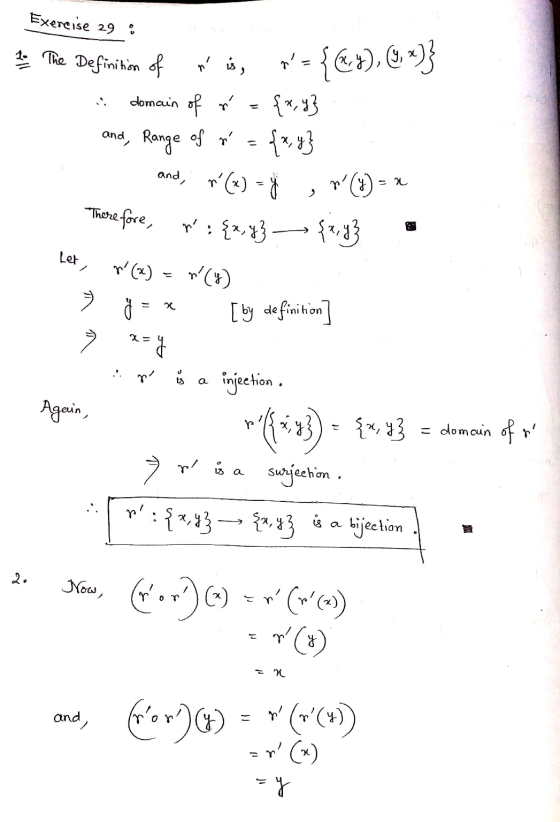

 Feel
free to ask any doubts in comment section. Thank you sir/ma'am.
??
Feel
free to ask any doubts in comment section. Thank you sir/ma'am.
??
Add Answer to:
Please do exercise 129:
Exercise 128: Define r:N + N by r(n) = next(next(n)). Let f:N...
4. Define a function f:N → Z by tof n/2 if n is even 1-(n +...
 4. Define a function f:N → Z by tof n/2 if n is even 1-(n + 1)/2 if n is odd. f(n) = Show that f is a bijection. 11 ] 7. Let X = R XR and let R be a relation on X defined as follows ((x,y),(w,z)) ER 4 IC ER\ {0} (w = cx and z = cy.) Is R reflexive? Symmetric? Transitive? An equivalence relation? Explain each of your answers. Describe the equivalence classes [(0,0)]R and...
5. Let A = P(R). Define f : R → A by the formula f(x) =...
 5. Let A = P(R). Define f : R → A by the formula f(x) = {y E RIy2 < x). (a) Find f(2). (b) Is f injective, surjective, both (bijective), or neither? Z given by f(u)n+l, ifn is even n - 3, if n is odd 6. Consider the function f : Z → Z given by f(n) = (a) Is f injective? Prove your answer. (b) Is f surjective? Prove your answer
Real analysis 10 11 12 13 please (r 2 4.1 Limit of Function 129 se f: E → R, p is a limit point of E, and li...
 Real analysis
10 11 12 13 please
(r 2 4.1 Limit of Function 129 se f: E → R, p is a limit point of E, and limf(x)-L. Prove that lim)ILI. h If, in addition, )o for all x E E, prove that lim b. Prove that lim (f(x))"-L" for each n E N. ethe limit theorems, examples, and previous exercises to find each of the following limits. State which theo- rems, examples, or exercises are used in each case....
Real analysis
10 11 12 13 please
(r 2 4.1 Limit of Function 129 se f: E → R, p is a limit point of E, and limf(x)-L. Prove that lim)ILI. h If, in addition, )o for all x E E, prove that lim b. Prove that lim (f(x))"-L" for each n E N. ethe limit theorems, examples, and previous exercises to find each of the following limits. State which theo- rems, examples, or exercises are used in each case....
Suppose f:N → N satisfies the recurrence f(n+1) = f(n) 7. Note that this is not...
 Suppose f:N → N satisfies the recurrence f(n+1) = f(n) 7. Note that this is not enough information to define the function, since we don't have an initial condition. For each of the initial conditions below, find the value of f(7). a. f(0) = 1. $(7) = b. f(0) = 5. f(7) = c. f(0) = 19. f(7) = d. f(0) = 249. f(7) =
Theorem 3.14 Let (neN aand EneN be sequences in R. Let be in R# and suppose that x" → x, y, → oo,...
 Finish the proof of Theorem 3.14.
Theorem 3.14 Let (neN aand EneN be sequences in R. Let be in R# and suppose that x" → x, y, → oo, and z" →-oo. . If -oo <x o, then +yn 2. If-oo x < 00, then x" + Zn →-00 4. If-oo x < 0, then xoY" →-00 and xnZn → oo. 5. If x is in R. then-→0and-" →0 Proof Note that the conditions in the different parts of the...
Finish the proof of Theorem 3.14.
Theorem 3.14 Let (neN aand EneN be sequences in R. Let be in R# and suppose that x" → x, y, → oo, and z" →-oo. . If -oo <x o, then +yn 2. If-oo x < 00, then x" + Zn →-00 4. If-oo x < 0, then xoY" →-00 and xnZn → oo. 5. If x is in R. then-→0and-" →0 Proof Note that the conditions in the different parts of the...
Implicit Function Theorem in Two Variables: Let g: R2 → R be a smooth function. Set {(z, y) E R2 ...
 Implicit Function Theorem in Two Variables: Let g: R2 → R be a smooth function. Set {(z, y) E R2 | g(z, y) = 0} S Suppose g(a, b)-0 so that (a, b) E S and dg(a, b)メO. Then there exists an open neighborhood of (a, b) say V such that SnV is the image of a smooth parameterized curve. (1) Verify the implicit function theorem using the two examples above. 2) Since dg(a,b) 0, argue that it suffices to...
Please Answer 135 Below Completely: Definition Let E-R and f : E-+ R be a function....
 Please Answer 135 Below Completely:
Definition Let E-R and f : E-+ R be a function. For some p E E' we say that f is continuous at p if for any ε > 0, there exists a δ > 0 (which depends on ε) such that for any x E E with |x-Pl < δ we have If(x) -f(p)le KE. This is often called the rigorous δ-ε definition of continuity. A couple of things to note about this definition....
Please Answer 135 Below Completely:
Definition Let E-R and f : E-+ R be a function. For some p E E' we say that f is continuous at p if for any ε > 0, there exists a δ > 0 (which depends on ε) such that for any x E E with |x-Pl < δ we have If(x) -f(p)le KE. This is often called the rigorous δ-ε definition of continuity. A couple of things to note about this definition....
8 marks] Number representations. We define the predicate BT(n,): "r has a balanced ternary repres...
 8 marks] Number representations. We define the predicate BT(n,): "r has a balanced ternary represen tation that contains n digits," where n eZ+ and z e Z. Equivalently BT(n,z) : 34, di, ,dn-le(-1,0,1), Σdi.gi=z Prove the following statement using induction on n 3a-1
8 marks] Number representations. We define the predicate BT(n,): "r has a balanced ternary represen tation that contains n digits," where n eZ+ and z e Z. Equivalently BT(n,z) : 34, di, ,dn-le(-1,0,1), Σdi.gi=z Prove the following...
8 marks] Number representations. We define the predicate BT(n,): "r has a balanced ternary represen tation that contains n digits," where n eZ+ and z e Z. Equivalently BT(n,z) : 34, di, ,dn-le(-1,0,1), Σdi.gi=z Prove the following statement using induction on n 3a-1
8 marks] Number representations. We define the predicate BT(n,): "r has a balanced ternary represen tation that contains n digits," where n eZ+ and z e Z. Equivalently BT(n,z) : 34, di, ,dn-le(-1,0,1), Σdi.gi=z Prove the following...
Define a relation < on Z by m <n iff |m| < |n| or (\m| =...
 Define a relation < on Z by m <n iff |m| < |n| or (\m| = |n| 1 m <n) (a) Prove that < is a partial order on Z. (b) A partial order R on a set S is called a total order (or linear order) iff (Vx, Y ES)(x + y + ((x, y) E R V (y,x) E R)) Prove that is a total order on Z. (c) List the following elements in <-increasing order. –5, 2,...
Number Theory 13 and 14 please! 13)) Let n E N, and let ā, x, y E Zn. Prove that if ā + x = ā + y, then x-y. 14. In this exercise, you will prove that the additive inverse of any element of Z, is uni...
 Number Theory
13 and 14 please!
13)) Let n E N, and let ā, x, y E Zn. Prove that if ā + x = ā + y, then x-y. 14. In this exercise, you will prove that the additive inverse of any element of Z, is unique. (In fact, this is true not only in Z, but in any ring, as we prove in the Appendix on the Student Companion Website.) Let n E N, and let aE Z...
Number Theory
13 and 14 please!
13)) Let n E N, and let ā, x, y E Zn. Prove that if ā + x = ā + y, then x-y. 14. In this exercise, you will prove that the additive inverse of any element of Z, is unique. (In fact, this is true not only in Z, but in any ring, as we prove in the Appendix on the Student Companion Website.) Let n E N, and let aE Z...
 4. Define a function f:N → Z by tof n/2 if n is even 1-(n + 1)/2 if n is odd. f(n) = Show that f is a bijection. 11 ] 7. Let X = R XR and let R be a relation on X defined as follows ((x,y),(w,z)) ER 4 IC ER\ {0} (w = cx and z = cy.) Is R reflexive? Symmetric? Transitive? An equivalence relation? Explain each of your answers. Describe the equivalence classes [(0,0)]R and...
 5. Let A = P(R). Define f : R → A by the formula f(x) = {y E RIy2 < x). (a) Find f(2). (b) Is f injective, surjective, both (bijective), or neither? Z given by f(u)n+l, ifn is even n - 3, if n is odd 6. Consider the function f : Z → Z given by f(n) = (a) Is f injective? Prove your answer. (b) Is f surjective? Prove your answer
 Real analysis
10 11 12 13 please
(r 2 4.1 Limit of Function 129 se f: E → R, p is a limit point of E, and limf(x)-L. Prove that lim)ILI. h If, in addition, )o for all x E E, prove that lim b. Prove that lim (f(x))"-L" for each n E N. ethe limit theorems, examples, and previous exercises to find each of the following limits. State which theo- rems, examples, or exercises are used in each case....
Real analysis
10 11 12 13 please
(r 2 4.1 Limit of Function 129 se f: E → R, p is a limit point of E, and limf(x)-L. Prove that lim)ILI. h If, in addition, )o for all x E E, prove that lim b. Prove that lim (f(x))"-L" for each n E N. ethe limit theorems, examples, and previous exercises to find each of the following limits. State which theo- rems, examples, or exercises are used in each case....
 Suppose f:N → N satisfies the recurrence f(n+1) = f(n) 7. Note that this is not enough information to define the function, since we don't have an initial condition. For each of the initial conditions below, find the value of f(7). a. f(0) = 1. $(7) = b. f(0) = 5. f(7) = c. f(0) = 19. f(7) = d. f(0) = 249. f(7) =
 Finish the proof of Theorem 3.14.
Theorem 3.14 Let (neN aand EneN be sequences in R. Let be in R# and suppose that x" → x, y, → oo, and z" →-oo. . If -oo <x o, then +yn 2. If-oo x < 00, then x" + Zn →-00 4. If-oo x < 0, then xoY" →-00 and xnZn → oo. 5. If x is in R. then-→0and-" →0 Proof Note that the conditions in the different parts of the...
Finish the proof of Theorem 3.14.
Theorem 3.14 Let (neN aand EneN be sequences in R. Let be in R# and suppose that x" → x, y, → oo, and z" →-oo. . If -oo <x o, then +yn 2. If-oo x < 00, then x" + Zn →-00 4. If-oo x < 0, then xoY" →-00 and xnZn → oo. 5. If x is in R. then-→0and-" →0 Proof Note that the conditions in the different parts of the...
 Implicit Function Theorem in Two Variables: Let g: R2 → R be a smooth function. Set {(z, y) E R2 | g(z, y) = 0} S Suppose g(a, b)-0 so that (a, b) E S and dg(a, b)メO. Then there exists an open neighborhood of (a, b) say V such that SnV is the image of a smooth parameterized curve. (1) Verify the implicit function theorem using the two examples above. 2) Since dg(a,b) 0, argue that it suffices to...
 Please Answer 135 Below Completely:
Definition Let E-R and f : E-+ R be a function. For some p E E' we say that f is continuous at p if for any ε > 0, there exists a δ > 0 (which depends on ε) such that for any x E E with |x-Pl < δ we have If(x) -f(p)le KE. This is often called the rigorous δ-ε definition of continuity. A couple of things to note about this definition....
Please Answer 135 Below Completely:
Definition Let E-R and f : E-+ R be a function. For some p E E' we say that f is continuous at p if for any ε > 0, there exists a δ > 0 (which depends on ε) such that for any x E E with |x-Pl < δ we have If(x) -f(p)le KE. This is often called the rigorous δ-ε definition of continuity. A couple of things to note about this definition....
 8 marks] Number representations. We define the predicate BT(n,): "r has a balanced ternary represen tation that contains n digits," where n eZ+ and z e Z. Equivalently BT(n,z) : 34, di, ,dn-le(-1,0,1), Σdi.gi=z Prove the following statement using induction on n 3a-1
8 marks] Number representations. We define the predicate BT(n,): "r has a balanced ternary represen tation that contains n digits," where n eZ+ and z e Z. Equivalently BT(n,z) : 34, di, ,dn-le(-1,0,1), Σdi.gi=z Prove the following...
8 marks] Number representations. We define the predicate BT(n,): "r has a balanced ternary represen tation that contains n digits," where n eZ+ and z e Z. Equivalently BT(n,z) : 34, di, ,dn-le(-1,0,1), Σdi.gi=z Prove the following statement using induction on n 3a-1
8 marks] Number representations. We define the predicate BT(n,): "r has a balanced ternary represen tation that contains n digits," where n eZ+ and z e Z. Equivalently BT(n,z) : 34, di, ,dn-le(-1,0,1), Σdi.gi=z Prove the following...
 Define a relation < on Z by m <n iff |m| < |n| or (\m| = |n| 1 m <n) (a) Prove that < is a partial order on Z. (b) A partial order R on a set S is called a total order (or linear order) iff (Vx, Y ES)(x + y + ((x, y) E R V (y,x) E R)) Prove that is a total order on Z. (c) List the following elements in <-increasing order. –5, 2,...
 Number Theory
13 and 14 please!
13)) Let n E N, and let ā, x, y E Zn. Prove that if ā + x = ā + y, then x-y. 14. In this exercise, you will prove that the additive inverse of any element of Z, is unique. (In fact, this is true not only in Z, but in any ring, as we prove in the Appendix on the Student Companion Website.) Let n E N, and let aE Z...
Number Theory
13 and 14 please!
13)) Let n E N, and let ā, x, y E Zn. Prove that if ā + x = ā + y, then x-y. 14. In this exercise, you will prove that the additive inverse of any element of Z, is unique. (In fact, this is true not only in Z, but in any ring, as we prove in the Appendix on the Student Companion Website.) Let n E N, and let aE Z...
Most questions answered within 3 hours.
-
Where is the error in this code sequence?
String s1 = "Hello";
String s2 = "ello";...
asked 11 months ago -
Financial data for Joel de Paris, Inc., for last year
follow:
Joel de Paris, Inc.
Balance...
asked 11 months ago -
Consider this reaction:
Al2(SO4)3 (aq)+ BaCl3
(aq) Al2Cl6 (aq)- +
3BaSO4(s) . What is the...
asked 11 months ago -
Suppose that Savneet is considering increasing her
recent random sample from 20 car rentals to 40...
asked 11 months ago -
Trucks arrive at an unloading terminal at an average rate of 120
per hour.
Trucks arrive...
asked 11 months ago -
Why are methanol and ethanol completely soluble in water while
octanol is not very little soluble....
asked 11 months ago -
A facilities manager at a university reads in a research report
that the mean amount of...
asked 11 months ago -
When the CuSO4 is rehydrated by adding water to the anhydrous
compound, is this an endothermic...
asked 11 months ago -
A ray of sunlight is passing from diamond into crown glass; the
angle of incidence is...
asked 11 months ago -
A block of mass 0.249 kg is placed on top of a light, vertical
spring of...
asked 11 months ago -
how do the kidneys compensate in the presences of acidosis
a) trigger hyperventilate
b) reserve acid...
asked 11 months ago -
Question 501 pts
The rental rate of capital to the firm increases. Which of the
following...
asked 11 months ago