![l put kinetic energy of 1 equal to kinetic energy of 2. and it didnt work any ideas? KA08: Ch 25 Problem 29.3 2 of 7 inl302]:- .5*1.67 * 10 ^-27 * 46 ??? A 2 outo2- 1.76686 x 10⁻¹⁸ ni3os)- Solve [1.76686-18 A proton is released from rest at the positive plate of a parallel-plate capacitor. It crosses the capacitor and reaches the negative plate with a speed of 4.60x10⁴ m/s Part A 59.1 10 A -31VA2, V] v1.97859 x10°), [v-»1.97059x 10°)) What will be the protons final speed if the experiment is repeated with double the amount of charge on each capacitor plate? ?? .97 106 m/s Submit Previous Answers Request Answer X Incorrect: Try Again: 3 attempts remaining](http://img.homeworklib.com/questions/f0a0aa50-15c7-11ec-9f73-3ff8802ceacd.png?x-oss-process=image/resize,w_560)
Homework Answers


Add Answer to:
l put kinetic energy of 1 equal to kinetic energy of 2. and it didnt work...
A proton is released from rest at the positive plate of a parallel-plate capacitor. It crosses...
A proton is released from rest at the positive plate of a parallel-plate capacitor. It crosses the capacitor and reaches the negative plate with a speed of 5.50×10⁴ m/s . What will be the proton's final speed if the experiment is repeated with double the amount of charge on each capacitor plate?
Will upvote on three accounts if you provide a good walkthrough for both. A proton is...
 Will upvote on three accounts if you provide a good walkthrough
for both.
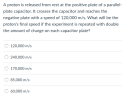
A proton is released from rest at the positive plate of a parallel- plate capacitor. It crosses the capacitor and reaches the negative plate with a speed of 120,000 m/s. What will be the proton's final speed if the experiment is repeated with double the amount of charge on each capacitor plate? 120,000 m/s 240,000 m/s 170,000 m/s 85,000 m/s O 60,000 m/s
Will upvote on three accounts if you provide a good walkthrough
for both.
A proton is released from rest at the positive plate of a parallel- plate capacitor. It crosses the capacitor and reaches the negative plate with a speed of 120,000 m/s. What will be the proton's final speed if the experiment is repeated with double the amount of charge on each capacitor plate? 120,000 m/s 240,000 m/s 170,000 m/s 85,000 m/s O 60,000 m/s
Find the speed of an electron that has a kinetic energy of 2.07 eV. 1 eV= 1.602 x 10^-19 J. Answer in units of m/s. Ca...
 Find the speed of an electron that has a kinetic energy of 2.07
eV. 1 eV= 1.602 x 10^-19 J. Answer in units of m/s.
Calculate the speed of a proton with a kinetic energy of 2.07
eV. Answer in units of m/s.
A parallel-plate capacitor has a capacitance Co. A second
parallel-plate capacitor has plates with twice the area and twice
the separation. What is the capacitance of the second
capacitor?
Calculate the energy stored in a 27.3 uF...
Find the speed of an electron that has a kinetic energy of 2.07
eV. 1 eV= 1.602 x 10^-19 J. Answer in units of m/s.
Calculate the speed of a proton with a kinetic energy of 2.07
eV. Answer in units of m/s.
A parallel-plate capacitor has a capacitance Co. A second
parallel-plate capacitor has plates with twice the area and twice
the separation. What is the capacitance of the second
capacitor?
Calculate the energy stored in a 27.3 uF...
I. A proton in a certain particle accelerator has a kinetic energy that is equal to...
 I. A proton in a certain particle accelerator has a kinetic energy that is equal to 3.421 times its rest energy. What is the momentum of the proton as measured by a physicist working with the accelerator? (c = 3.00 x 10⁸ m/s, mproton = 1.67 * 10-27 kg)
1) A 11.0-V battery is connected to a 4.40-μF capacitor. How much energy is stored in...
1) A 11.0-V battery is connected to a 4.40-μF capacitor. How much energy is stored in the capacitor? J 2) Calculate the speed (in m/s) of an electron and a proton with a kinetic energy of 1.10 electron volt (eV). (The electron and proton masses are me = 9.11 ✕ 10−31 kg and mp = 1.67 ✕ 10−27 kg. Boltzmann's constant is kB = 1.38 ✕ 10−23 J/K.) hint: Use the conversion 1 eV = 1.60 ✕ 10−19 J. (a) an electron? m/s...
Calculate the speed (in m/s) of an electron and a proton with a kinetic energy of...
Calculate the speed (in m/s) of an electron and a proton with a kinetic energy of 1.90 electron volt (eV). (The electron and proton masses are me = 9.11 ✕ 10−31 kg and mp = 1.67 ✕ 10−27 kg. Boltzmann's constant is kB = 1.38 ✕ 10−23 J/K.) (a) an electron m/s (b) a proton m/s (c) Calculate the average translational kinetic energy in eV of a 3.19 ✕ 102 K ideal gas particle. (Recall from Topic 10 that 1...
A proton ( m=1.67 × 10 -27 kg) is accelerated to a kinetic energy of 200...
A proton ( m=1.67 × 10 -27 kg) is accelerated to a kinetic energy of 200 MeV. What is its speed at this energy? A-1.70 × 10⁸ m/s B-9.79 × 10⁷ m/s C-2.47 × 10⁸ m/s D-6.25 × 10⁸ m/s
1. A uniform electric field of magnitude 364 N/C pointing in the positive x-direction acts on...
1. A uniform electric field of magnitude 364 N/C pointing in the positive x-direction acts on an electron, which is initially at rest. The electron has moved 2.80 cm. (a) What is the work done by the field on the electron? J (b) What is the change in potential energy associated with the electron? J (c) What is the velocity of the electron? magnitude m/s direction 2. Calculate the speed (in m/s) of an electron and a proton with a...
1) A uniform electric field of magnitude 411 N/C pointing in the positive x-direction acts on...
1) A uniform electric field of magnitude 411 N/C pointing in the positive x-direction acts on an electron, which is initially at rest. The electron has moved 2.70 cm. (a) What is the work done by the field on the electron? (b) What is the change in potential energy associated with the electron? (c) What is the velocity of the electron? magnitude ms? direction ? (+x, -x, +y, -y) 2) A 11.0-V battery is connected to a 4.40-μF...
030 (part 1 of 2) 10.0 points A proton in a cyclotron is moving with a...
 030 (part 1 of 2) 10.0 points A proton in a cyclotron is moving with a speed of 3.27 x 10 m/s in a circle of radius 0.704 m. 1.67 x 10⁻²⁷ kg is the mass of the pro- ton, and 1.60218 x 10⁻¹⁹ C is its fundamental charge. What is the magnitude of the force exerted on the proton by the magnetic field of the cyclotron? Answer in units of N. 031 (part 2 of 2) 10.0 points What...
 Will upvote on three accounts if you provide a good walkthrough
for both.
A proton is released from rest at the positive plate of a parallel- plate capacitor. It crosses the capacitor and reaches the negative plate with a speed of 120,000 m/s. What will be the proton's final speed if the experiment is repeated with double the amount of charge on each capacitor plate? 120,000 m/s 240,000 m/s 170,000 m/s 85,000 m/s O 60,000 m/s
Will upvote on three accounts if you provide a good walkthrough
for both.
A proton is released from rest at the positive plate of a parallel- plate capacitor. It crosses the capacitor and reaches the negative plate with a speed of 120,000 m/s. What will be the proton's final speed if the experiment is repeated with double the amount of charge on each capacitor plate? 120,000 m/s 240,000 m/s 170,000 m/s 85,000 m/s O 60,000 m/s
 Find the speed of an electron that has a kinetic energy of 2.07
eV. 1 eV= 1.602 x 10^-19 J. Answer in units of m/s.
Calculate the speed of a proton with a kinetic energy of 2.07
eV. Answer in units of m/s.
A parallel-plate capacitor has a capacitance Co. A second
parallel-plate capacitor has plates with twice the area and twice
the separation. What is the capacitance of the second
capacitor?
Calculate the energy stored in a 27.3 uF...
Find the speed of an electron that has a kinetic energy of 2.07
eV. 1 eV= 1.602 x 10^-19 J. Answer in units of m/s.
Calculate the speed of a proton with a kinetic energy of 2.07
eV. Answer in units of m/s.
A parallel-plate capacitor has a capacitance Co. A second
parallel-plate capacitor has plates with twice the area and twice
the separation. What is the capacitance of the second
capacitor?
Calculate the energy stored in a 27.3 uF...
 I. A proton in a certain particle accelerator has a kinetic energy that is equal to 3.421 times its rest energy. What is the momentum of the proton as measured by a physicist working with the accelerator? (c = 3.00 x 10⁸ m/s, mproton = 1.67 * 10-27 kg)
 030 (part 1 of 2) 10.0 points A proton in a cyclotron is moving with a speed of 3.27 x 10 m/s in a circle of radius 0.704 m. 1.67 x 10⁻²⁷ kg is the mass of the pro- ton, and 1.60218 x 10⁻¹⁹ C is its fundamental charge. What is the magnitude of the force exerted on the proton by the magnetic field of the cyclotron? Answer in units of N. 031 (part 2 of 2) 10.0 points What...
Most questions answered within 3 hours.
-
Where is the error in this code sequence?
String s1 = "Hello";
String s2 = "ello";...
asked 11 months ago -
Financial data for Joel de Paris, Inc., for last year
follow:
Joel de Paris, Inc.
Balance...
asked 11 months ago -
Consider this reaction:
Al2(SO4)3 (aq)+ BaCl3
(aq) Al2Cl6 (aq)- +
3BaSO4(s) . What is the...
asked 11 months ago -
Suppose that Savneet is considering increasing her
recent random sample from 20 car rentals to 40...
asked 11 months ago -
Trucks arrive at an unloading terminal at an average rate of 120
per hour.
Trucks arrive...
asked 11 months ago -
Why are methanol and ethanol completely soluble in water while
octanol is not very little soluble....
asked 11 months ago -
A facilities manager at a university reads in a research report
that the mean amount of...
asked 11 months ago -
When the CuSO4 is rehydrated by adding water to the anhydrous
compound, is this an endothermic...
asked 11 months ago -
A ray of sunlight is passing from diamond into crown glass; the
angle of incidence is...
asked 11 months ago -
A block of mass 0.249 kg is placed on top of a light, vertical
spring of...
asked 11 months ago -
how do the kidneys compensate in the presences of acidosis
a) trigger hyperventilate
b) reserve acid...
asked 11 months ago -
Question 501 pts
The rental rate of capital to the firm increases. Which of the
following...
asked 11 months ago