
Homework Answers
Stack is based on Last-In-First-Out(LIFO) Principle.
So 25 is inserted then 15 on top of it then 45 and at last 35. When we remove from the stack it gets removed from the top.So35 is removed first then 45 is removed and at last 15 is removed
25 remains at last.
Add Answer to:
Suppose you insert 25. 15, 45, and 35 in this order into a stack. Then you...
Be able to give traversals of the entire tree: Pre-Order: 45, 25, 15, 10, 20, 35,...
 Be able to give traversals of the entire tree: Pre-Order: 45, 25, 15, 10, 20, 35, 30, 40, 65, 55, 50, 60, 75, 70, 80 (extra 45 removed). In-Order: 10, 15, 20, 25, 30, 35, 40, 45, 50, 55, 60, 65, 70, 75, 80 Post-Order: 10, 20, 15, 30, 40, 35, 25, 50, 60, 55, 70, 80, 75, 65, 45
What is the principle difference in behavior between a stack and a queue? a stack preserves...
 What is the principle difference in behavior between a stack and a queue? a stack preserves the order in which items are added whereas a queue reverses order there is no difference a stack reverses the order in which items are added whereas a queue preserves order xa stack does nothing whereas a queue can preserve and reverse the order that items are added to it Fill in the blank in the following sentence with one of the answers listed....
#include <iostream> #include <stack> #include <queue> using namespace std; void printFromStack(string expr){ stack<char> myStack; for(int i=0;...
#include <iostream> #include <stack> #include <queue> using namespace std; void printFromStack(string expr){ stack<char> myStack; for(int i=0; i<expr.length(); i++){ //Insert code here to push each character onto the stack } cout << "My stack is popped in this order" << endl; while(!myStack.empty()){ //Insert code here to cout the top of the stack one by one //Pop each one after it’s printed out } cout << endl; } void printFromQueue(string expr){ queue<char> myQueue; //Insert code here to push each character onto the...
9. The tree below is a RBT. 14 12 20 16 15 25 (a) (4 points) Insert 27. (b) (4 points) Insert 29 ...
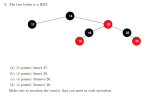 9. The tree below is a RBT. 14 12 20 16 15 25 (a) (4 points) Insert 27. (b) (4 points) Insert 29 (c) (4 points) Remove 20. (d) (4 points) Remove 16. Make sure to mention the case(s) that you meet in each operation
9. The tree below is a RBT. 14 12 20 16 15 25 (a) (4 points) Insert 27. (b) (4 points) Insert 29 (c) (4 points) Remove 20. (d) (4 points) Remove 16. Make sure...
9. The tree below is a RBT. 14 12 20 16 15 25 (a) (4 points) Insert 27. (b) (4 points) Insert 29 (c) (4 points) Remove 20. (d) (4 points) Remove 16. Make sure to mention the case(s) that you meet in each operation
9. The tree below is a RBT. 14 12 20 16 15 25 (a) (4 points) Insert 27. (b) (4 points) Insert 29 (c) (4 points) Remove 20. (d) (4 points) Remove 16. Make sure...
Using C 2.A Stack data structure with at least following functions pushO - Insert an element...
 Using C
2.A Stack data structure with at least following functions pushO - Insert an element at one end of the stack called top. )-Remove and return the element at the top of the stack, if it is not empty. "peek0- Return the element at the top of the stack without removing it, if the stack is not empty. size0 -Return the number of elements in the stack. isEmpty0-Return true if the stack is empty, otherwise return false isFullO-Return true...
Using C
2.A Stack data structure with at least following functions pushO - Insert an element at one end of the stack called top. )-Remove and return the element at the top of the stack, if it is not empty. "peek0- Return the element at the top of the stack without removing it, if the stack is not empty. size0 -Return the number of elements in the stack. isEmpty0-Return true if the stack is empty, otherwise return false isFullO-Return true...
help finish Queue, don't think I have the right thing. # 1. After studying the Stack...
 help finish Queue, don't think
I have the right thing.
# 1. After studying the Stack class and testStack() functions in stack.py # complete the Queue class below (and test it with the testQueue function) # # 2. Afer studying and testing the Circle class in circle.py, # complete the Rectangle class below (and test it with the testRectangle function) # # # 3. SUBMIT THIS ONE FILE, with your updates, TO ICON. # # # NOTE: you may certainly...
help finish Queue, don't think
I have the right thing.
# 1. After studying the Stack class and testStack() functions in stack.py # complete the Queue class below (and test it with the testQueue function) # # 2. Afer studying and testing the Circle class in circle.py, # complete the Rectangle class below (and test it with the testRectangle function) # # # 3. SUBMIT THIS ONE FILE, with your updates, TO ICON. # # # NOTE: you may certainly...
Lab 3 – Array-Based Stack and Queue Overview In this assignment, you will be implementing your...
Lab 3 – Array-Based Stack and Queue Overview In this assignment, you will be implementing your own Array-Based Stack (ABS) and Array-Based Queue (ABQ). A stack is a linear data structure which follows the Last-In, First-Out (LIFO) property. LIFO means that the data most recently added is the first data to be removed. (Imagine a stack of books, or a stack of papers on a desk—the first one to be removed is the last one placed on top.) A queue...
Stacks There are two main operations associated with stacks; 1) putting things on the stack which...
Stacks There are two main operations associated with stacks; 1) putting things on the stack which is referred to as push, 2) taking things from the stack which is referred to as pop. We can create a stack using linked lists if we force ourselves to insert and remove nodes only at the top of the list. One use of a stack is when you want to write a word backward. In that case, you will read the letters of...
In C++ Task 3: Use the stack and queue to simulate receiving and transforming data We are creating a system that will co...
 In C++
Task 3: Use the stack and queue to simulate receiving and transforming data We are creating a system that will convert strings sent over a serial bus one character at a time. The conversion will be from big to little endian or from little to big endian. To simplify this, each character will be considered a word. Little endian will have the lowest address first. Big endian will have the biggest address first. For example (for this lab),...
In C++
Task 3: Use the stack and queue to simulate receiving and transforming data We are creating a system that will convert strings sent over a serial bus one character at a time. The conversion will be from big to little endian or from little to big endian. To simplify this, each character will be considered a word. Little endian will have the lowest address first. Big endian will have the biggest address first. For example (for this lab),...
(java) Write an algorithm that displays all the characters in a stack in the order in...
(java) Write an algorithm that displays all the characters in a stack in the order in which they were pushed onto the stack. After all the characters are displayed, the stack should have the same contents as when you started. In your method, you can only use the stack’s operation, and NO explicit index can be declared to locate the items in the stack. Also, write the main() function to test your algorithm.
 Be able to give traversals of the entire tree: Pre-Order: 45, 25, 15, 10, 20, 35, 30, 40, 65, 55, 50, 60, 75, 70, 80 (extra 45 removed). In-Order: 10, 15, 20, 25, 30, 35, 40, 45, 50, 55, 60, 65, 70, 75, 80 Post-Order: 10, 20, 15, 30, 40, 35, 25, 50, 60, 55, 70, 80, 75, 65, 45
 What is the principle difference in behavior between a stack and a queue? a stack preserves the order in which items are added whereas a queue reverses order there is no difference a stack reverses the order in which items are added whereas a queue preserves order xa stack does nothing whereas a queue can preserve and reverse the order that items are added to it Fill in the blank in the following sentence with one of the answers listed....
 9. The tree below is a RBT. 14 12 20 16 15 25 (a) (4 points) Insert 27. (b) (4 points) Insert 29 (c) (4 points) Remove 20. (d) (4 points) Remove 16. Make sure to mention the case(s) that you meet in each operation
9. The tree below is a RBT. 14 12 20 16 15 25 (a) (4 points) Insert 27. (b) (4 points) Insert 29 (c) (4 points) Remove 20. (d) (4 points) Remove 16. Make sure...
9. The tree below is a RBT. 14 12 20 16 15 25 (a) (4 points) Insert 27. (b) (4 points) Insert 29 (c) (4 points) Remove 20. (d) (4 points) Remove 16. Make sure to mention the case(s) that you meet in each operation
9. The tree below is a RBT. 14 12 20 16 15 25 (a) (4 points) Insert 27. (b) (4 points) Insert 29 (c) (4 points) Remove 20. (d) (4 points) Remove 16. Make sure...
 Using C
2.A Stack data structure with at least following functions pushO - Insert an element at one end of the stack called top. )-Remove and return the element at the top of the stack, if it is not empty. "peek0- Return the element at the top of the stack without removing it, if the stack is not empty. size0 -Return the number of elements in the stack. isEmpty0-Return true if the stack is empty, otherwise return false isFullO-Return true...
Using C
2.A Stack data structure with at least following functions pushO - Insert an element at one end of the stack called top. )-Remove and return the element at the top of the stack, if it is not empty. "peek0- Return the element at the top of the stack without removing it, if the stack is not empty. size0 -Return the number of elements in the stack. isEmpty0-Return true if the stack is empty, otherwise return false isFullO-Return true...
 help finish Queue, don't think
I have the right thing.
# 1. After studying the Stack class and testStack() functions in stack.py # complete the Queue class below (and test it with the testQueue function) # # 2. Afer studying and testing the Circle class in circle.py, # complete the Rectangle class below (and test it with the testRectangle function) # # # 3. SUBMIT THIS ONE FILE, with your updates, TO ICON. # # # NOTE: you may certainly...
help finish Queue, don't think
I have the right thing.
# 1. After studying the Stack class and testStack() functions in stack.py # complete the Queue class below (and test it with the testQueue function) # # 2. Afer studying and testing the Circle class in circle.py, # complete the Rectangle class below (and test it with the testRectangle function) # # # 3. SUBMIT THIS ONE FILE, with your updates, TO ICON. # # # NOTE: you may certainly...
 In C++
Task 3: Use the stack and queue to simulate receiving and transforming data We are creating a system that will convert strings sent over a serial bus one character at a time. The conversion will be from big to little endian or from little to big endian. To simplify this, each character will be considered a word. Little endian will have the lowest address first. Big endian will have the biggest address first. For example (for this lab),...
In C++
Task 3: Use the stack and queue to simulate receiving and transforming data We are creating a system that will convert strings sent over a serial bus one character at a time. The conversion will be from big to little endian or from little to big endian. To simplify this, each character will be considered a word. Little endian will have the lowest address first. Big endian will have the biggest address first. For example (for this lab),...
Most questions answered within 3 hours.
-
Where is the error in this code sequence?
String s1 = "Hello";
String s2 = "ello";...
asked 10 months ago -
Financial data for Joel de Paris, Inc., for last year
follow:
Joel de Paris, Inc.
Balance...
asked 10 months ago -
Consider this reaction:
Al2(SO4)3 (aq)+ BaCl3
(aq) Al2Cl6 (aq)- +
3BaSO4(s) . What is the...
asked 10 months ago -
Suppose that Savneet is considering increasing her
recent random sample from 20 car rentals to 40...
asked 10 months ago -
Trucks arrive at an unloading terminal at an average rate of 120
per hour.
Trucks arrive...
asked 10 months ago -
Why are methanol and ethanol completely soluble in water while
octanol is not very little soluble....
asked 10 months ago -
A facilities manager at a university reads in a research report
that the mean amount of...
asked 10 months ago -
When the CuSO4 is rehydrated by adding water to the anhydrous
compound, is this an endothermic...
asked 10 months ago -
A ray of sunlight is passing from diamond into crown glass; the
angle of incidence is...
asked 10 months ago -
A block of mass 0.249 kg is placed on top of a light, vertical
spring of...
asked 10 months ago -
how do the kidneys compensate in the presences of acidosis
a) trigger hyperventilate
b) reserve acid...
asked 10 months ago -
Question 501 pts
The rental rate of capital to the firm increases. Which of the
following...
asked 10 months ago