
Homework Answers
Add Answer to:
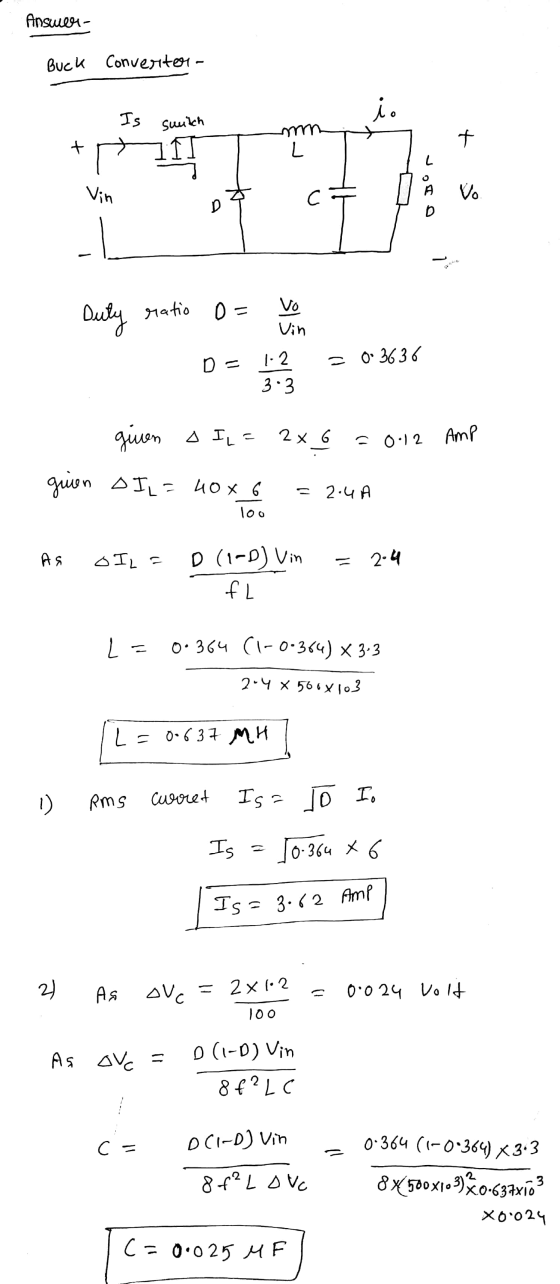
Power electronics Homework 3 Buck converter design Example : design a buck converter, Input voltage 3.3V,...
Design a buck converter which has an output of 12V from an input of 18V. The...
 Design a buck converter which has an output of 12V from an input of 18V. The output power is 10W. The output voltage ripple must be no more than 100mV peak to peak. Specify the duty ratio, switching frequency is 500kHz, ton, and inductor and capacitor values. Design for continuous inductor current. Assume ideal conditions, and assume the output current is symmetric
design buck convertor
Design a buck converter to produce an output voltage of 24 V across a 10 ohm load resistor. The output voltage ripple must not exceed 0.4 percent. The dc supply is 50 V. Design for continuous inductor current. Specify the duty ratio. Find the values of the inductor and capacitor, the peak voltage rating of each device, and the rms current in the inductor and capacitor. Assume ideal components.
Buck Converter Design Design a buck converter to produce an output voltage of 18 V across a 10-Ω load resistor. The output voltage ripple must not exceed 0.5 percent. The de supply is 48 V. Design fo...
 Buck Converter Design Design a buck converter to produce an output voltage of 18 V across a 10-Ω load resistor. The output voltage ripple must not exceed 0.5 percent. The de supply is 48 V. Design for continuous inductor current. a. What is the limitation on the load resistance for continuous-current operation? b. What would be the range of output voltage for a load resistance range of 5 to 20 ohm? c. Redesign the converter so inductor current remains continuous...
A buck-boost converter has input voltage of 12V and operates with a duty cycle of 0.6...
A buck-boost converter has input voltage of 12V and operates with a duty cycle of 0.6 at a frequency of 50kHz and a load current of 5A average. Assuming sufficiently large L, and C = 500uF, calculate the peak-peak output voltage ripple and the rms current rating for the capacitor and inductor.
Design a buck converter to produce an output voltage of 18 V across a 10-Ω load resistor.
Buck Converter Design Design a buck converter to produce an output voltage of 18 V across a 10-Ω load resistor. The output voltage ripple must not exceed 0.5 percent. The de supply is 48 V. Design for continuous inductor current. a. What is the limitation on the load resistance for continuous-current operation? b. What would be the range of output voltage for a load resistance range of 5 to 20 ohm? c. Redesign the converter so inductor current remains continuous for a load resistance...
1) (6 points) It is desired to design a 50 W buck-boost converter to regulate its...
 1) (6 points) It is desired to design a 50 W buck-boost converter to regulate its output voltage at 26V from a solar panel whose output voltage varies between 20 and 40 V. The desired switching frequency is 20 kHz. The ripple current in the inductor should remain within +/-0.1 A, and the output voltage ripple should not exceed +/- 2%. a. Determine the duty cycle range for operating this converter. b. Design this buck-boost converter by finding lower limits...
A buck converter is used to have low output voltage from the high input source to...
 A buck converter is used to have low output voltage from the high input source to low output voltage. The estimated power output is at 25 kW with the switching frequency of 25 kHz. Design the buck converter as by finding and following specifications consider the ripple of the output is set at 1% (i) Calculate the duty ratio of the buck converter (1 mark) (ii) Determine the minimum requirement for the inductor and the capacitor (5 marks) (iii) Determine...
Design a buck converter with the following specifications: Input voltage = 311 V Output voltage =...
Design a buck converter with the following specifications: Input voltage = 311 V Output voltage = 48 V Output voltage ripple = +/- 0.1% Maximum output current = 10 A Inductor current ripple = 5% Switching frequency = 100 kHz a) Select the inductor and the output capacitor and show a capture of the behaviour b) Calculate power losses assuming a rising time of 100 ns, a falling time of 100 ns, and Rdson = 10 mΩ. c) Calculate output...
Buck Converter: Theory, schematic, operation, advantages, application, duty cycle, efficiency Design calculation Example: Input voltage:
Buck Converter: Theory, schematic, operation, advantages, application, duty cycle, efficiency Design calculation Example: Input voltage: min 12V max 17V Output voltage: nominal (regulated) 15V Nominal load current: 3 A Max Switching frequency: 20 kHz Output voltage ripple: 25 mV Draw the schematic, find L, C, Diode current, max drain voltage, max and min duty cycle
Problem 3: (20 points) Design a suitable power converter (only the power stage) for the following...
 Problem 3: (20 points) Design a suitable power converter (only the power stage) for the following specifications Input voltage: 36 V to 72 V; required output voltage: 48 V regulated; load current: 2 A to 10 A Maximum allowable pk-pk output ripple voltage: 0.5 V; maximum allowable pk-pk ripple in any inductor current: 2 A. Assume a switching frequency of 200 kHz. Show a complete schematic and the following details in your answer. L: Minimum L value C: Minimum C...
 Design a buck converter which has an output of 12V from an input of 18V. The output power is 10W. The output voltage ripple must be no more than 100mV peak to peak. Specify the duty ratio, switching frequency is 500kHz, ton, and inductor and capacitor values. Design for continuous inductor current. Assume ideal conditions, and assume the output current is symmetric
 Buck Converter Design Design a buck converter to produce an output voltage of 18 V across a 10-Ω load resistor. The output voltage ripple must not exceed 0.5 percent. The de supply is 48 V. Design for continuous inductor current. a. What is the limitation on the load resistance for continuous-current operation? b. What would be the range of output voltage for a load resistance range of 5 to 20 ohm? c. Redesign the converter so inductor current remains continuous...
 1) (6 points) It is desired to design a 50 W buck-boost converter to regulate its output voltage at 26V from a solar panel whose output voltage varies between 20 and 40 V. The desired switching frequency is 20 kHz. The ripple current in the inductor should remain within +/-0.1 A, and the output voltage ripple should not exceed +/- 2%. a. Determine the duty cycle range for operating this converter. b. Design this buck-boost converter by finding lower limits...
 A buck converter is used to have low output voltage from the high input source to low output voltage. The estimated power output is at 25 kW with the switching frequency of 25 kHz. Design the buck converter as by finding and following specifications consider the ripple of the output is set at 1% (i) Calculate the duty ratio of the buck converter (1 mark) (ii) Determine the minimum requirement for the inductor and the capacitor (5 marks) (iii) Determine...
 Problem 3: (20 points) Design a suitable power converter (only the power stage) for the following specifications Input voltage: 36 V to 72 V; required output voltage: 48 V regulated; load current: 2 A to 10 A Maximum allowable pk-pk output ripple voltage: 0.5 V; maximum allowable pk-pk ripple in any inductor current: 2 A. Assume a switching frequency of 200 kHz. Show a complete schematic and the following details in your answer. L: Minimum L value C: Minimum C...
Most questions answered within 3 hours.
-
Where is the error in this code sequence?
String s1 = "Hello";
String s2 = "ello";...
asked 11 months ago -
Financial data for Joel de Paris, Inc., for last year
follow:
Joel de Paris, Inc.
Balance...
asked 11 months ago -
Consider this reaction:
Al2(SO4)3 (aq)+ BaCl3
(aq) Al2Cl6 (aq)- +
3BaSO4(s) . What is the...
asked 11 months ago -
Suppose that Savneet is considering increasing her
recent random sample from 20 car rentals to 40...
asked 11 months ago -
Trucks arrive at an unloading terminal at an average rate of 120
per hour.
Trucks arrive...
asked 11 months ago -
Why are methanol and ethanol completely soluble in water while
octanol is not very little soluble....
asked 11 months ago -
A facilities manager at a university reads in a research report
that the mean amount of...
asked 11 months ago -
When the CuSO4 is rehydrated by adding water to the anhydrous
compound, is this an endothermic...
asked 11 months ago -
A ray of sunlight is passing from diamond into crown glass; the
angle of incidence is...
asked 11 months ago -
A block of mass 0.249 kg is placed on top of a light, vertical
spring of...
asked 11 months ago -
how do the kidneys compensate in the presences of acidosis
a) trigger hyperventilate
b) reserve acid...
asked 11 months ago -
Question 501 pts
The rental rate of capital to the firm increases. Which of the
following...
asked 11 months ago