
Homework Answers
Please rate the solution if you find it satisfactory.
The detailed soution is given below.
Add Answer to:
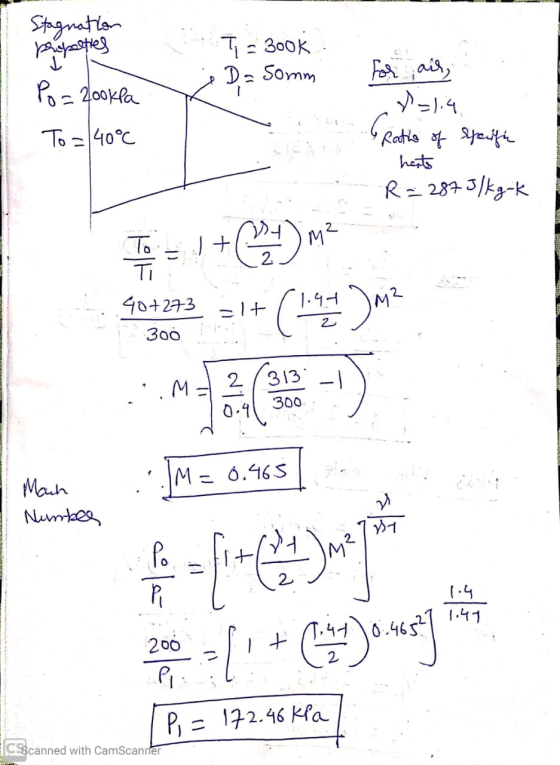
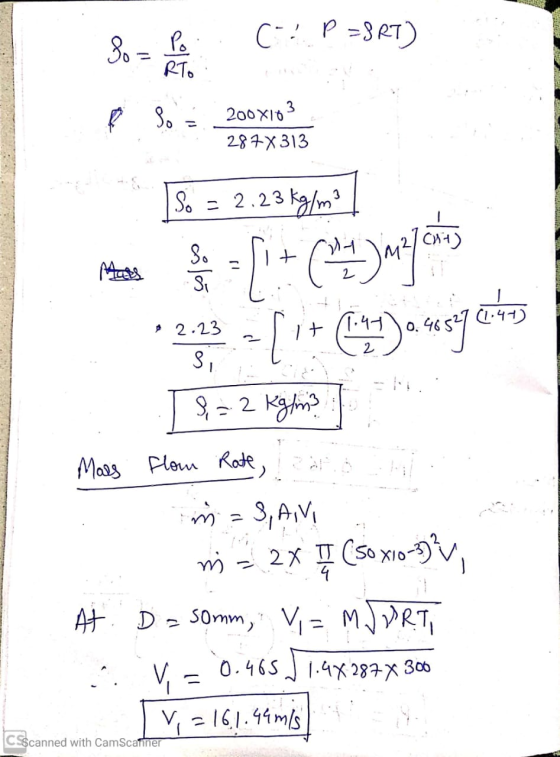
4. Air enters a converging pipe where the temperature reaches 300 K at a 50 mm...
Air at stagnation pressure of 700 kPa and temperature of 530 K enters a isentropic converging-diverging...
Air at stagnation pressure of 700 kPa and temperature of 530 K enters a isentropic converging-diverging nozzle. The throat area of the nozzle is 5 cm2, the exit area is 12.5 cm2. The back pressure is 350 kPa and a normal shock occurs within a diverging section. Determine (a) exit Mach number, (b) change in stagnation pressure, (c) upstream and downstream Mach number of shock (d) cross sectional area where shock occurs (e) back pressure if the flow were isentropic...
Air flow is induced in an insulated tube of 7.16 mm diameter by a vacuum pump....
 Air flow is induced in an insulated tube of 7.16 mm diameter by a vacuum pump. Air is drawn from a room where stagnation pressure is 101 kPa (abs) and stagnation temperature 23 °C, through a smoothly contoured converging nozzle. At station (1), where the converging nozzle joins the constant area tube, the static pressure is 98.5 kPa (abs). At section (2), located some distance downstream in the constant area tube, the air temperature is 14 °C. Determine a) the...
Argon gas enters a converging-diverging nozzle at 60 m/s, 310 °C, and 300 kPa, and it...
 Argon gas enters a converging-diverging nozzle at 60 m/s, 310 °C, and 300 kPa, and it leaves the nozzle at a supersonic velocity. The throat diameter is 3 cm. For Argon R= 208.1 Pa.m3/kg.K; k= 1.667. Determine (a) the stagnation temperature and pressure (8 points) (b) the critical temperature and pressure at the throat (7 points) (c) the velocity at the throat (4 points) (d) the mass flow rate. (6 points)
find mach 1 as a function of stagnation pressure for air, sulfur hexafluoride (sf6) and helium...
 find mach 1 as a function of stagnation pressure for air,
sulfur hexafluoride (sf6) and helium
find mass flow rate as a function of stagnation pressure for
air, sulfur hexafluoride (sf6) and helium
1 Flow enters the above nozzle isentropically. At section 1, where d = 50 cm, a pitot-static tube measures the local flow properties as shown in the table below. The stagnation temperature is 450 K throughout P. (kPa) 75 100 Instance 1 2 3 4 5 P....
find mach 1 as a function of stagnation pressure for air,
sulfur hexafluoride (sf6) and helium
find mass flow rate as a function of stagnation pressure for
air, sulfur hexafluoride (sf6) and helium
1 Flow enters the above nozzle isentropically. At section 1, where d = 50 cm, a pitot-static tube measures the local flow properties as shown in the table below. The stagnation temperature is 450 K throughout P. (kPa) 75 100 Instance 1 2 3 4 5 P....
solve all parts please Argon gas enters a converging-diverging nozzle at 60 m/s, 310 °C, and...
 solve all parts please
Argon gas enters a converging-diverging nozzle at 60 m/s, 310 °C, and 300 kPa, and it leaves the nozzle at a supersonic velocity. The throat diameter is 3 cm. For Argon R= 208.1 Pa.mº/kg.K; k= 1.667. Determine (a) the stagnation temperature and pressure (8 points) (b) the critical temperature and pressure at the throat (7 points) (c) the velocity at the throat (4 points) (d) the mass flow rate. (6 points)
solve all parts please
Argon gas enters a converging-diverging nozzle at 60 m/s, 310 °C, and 300 kPa, and it leaves the nozzle at a supersonic velocity. The throat diameter is 3 cm. For Argon R= 208.1 Pa.mº/kg.K; k= 1.667. Determine (a) the stagnation temperature and pressure (8 points) (b) the critical temperature and pressure at the throat (7 points) (c) the velocity at the throat (4 points) (d) the mass flow rate. (6 points)
Air enters the compressor of a cold air-standard Brayton cycle at 100 kpa, 300 k, with...
 Air enters the compressor of a cold air-standard Brayton cycle at 100 kpa, 300 k, with a mass flow rate of 6 kg/s. the compressor pressure ratio is 10, and the turbine inlet temperature is 1400 K. For k = 1.4, calculate a. The thermal efficiency of the cycle b. The back work ratio c. The net power developed, in kW d. Reconsider the above with an ideal regenerator.
1. Airflow enters a duct at a total pressure of 250 kPa and a total temperature...
 1. Airflow enters a duct at a total pressure of 250 kPa and a total temperature of 350 K. The inlet static pressure, P, is 239.35 kPa. The flow exits a converging section at 2 where the area is 0.01 m2. Treat air as an ideal gas where k 14. Pback- 120kpa (a) Determine the Mach number at A2 (b) Determine the exit static pressure and temperature at 2. (c) Determine the mass flow rate. (d) Determine the inlet area...
Q6 (a) Explain briefly the different between incompressible and compressible fluid flow (5 marks) (6) Air...
 Q6 (a) Explain briefly the different between incompressible and compressible fluid flow (5 marks) (6) Air at pressure and temperature of 200 kPa, 373.2 K flows through a duct at Mach Number of 0.8. The gas constant and specific heat ratio of air are 0.287 kJ/kg k, 1.4 respectively. Determine, (1) air velocity: (11) stagnation pressure: (111) stagnation temperature and (iv) stagnation density (8 marks) Nitrogen enters a converging diverging nozzle from a reservoir at a pressure of 700 kPa...
5-30 Air enters an adiabatic nozzle steadily at 300 kPa, 200°C, and 30 m/s and leaves...
 5-30 Air enters an adiabatic nozzle steadily at 300 kPa, 200°C, and 30 m/s and leaves at 100 kPa and 180 m/s. The inlet area of the nozzle is 80 cm². Determine (a) the mass flow rate through the nozzle, (b) the exit temperature of the air, and (c) the exit area of the nozzle. Answers: (a) 0.5304 kg/s, (b) 184.6°C, (c) 38.7 cm P = 300 kPa T, = 200°C Vi = 30 m/s A = 80 cm AIR...
Problem No. 4 (20 Points) Carbon dioxide flows through a converging nozzle with exit diameter of...
 Problem No. 4 (20 Points) Carbon dioxide flows through a converging nozzle with exit diameter of 2.5 cm from a reservoir at stagnation pressure of 500 kPa and exits to back pressure of 100 kPa at temperature of 300 K. a) Find the exit plane Mach number and exit plane velocity. b) Calculate the mass flow rate through this nozzle?
 Air flow is induced in an insulated tube of 7.16 mm diameter by a vacuum pump. Air is drawn from a room where stagnation pressure is 101 kPa (abs) and stagnation temperature 23 °C, through a smoothly contoured converging nozzle. At station (1), where the converging nozzle joins the constant area tube, the static pressure is 98.5 kPa (abs). At section (2), located some distance downstream in the constant area tube, the air temperature is 14 °C. Determine a) the...
 Argon gas enters a converging-diverging nozzle at 60 m/s, 310 °C, and 300 kPa, and it leaves the nozzle at a supersonic velocity. The throat diameter is 3 cm. For Argon R= 208.1 Pa.m3/kg.K; k= 1.667. Determine (a) the stagnation temperature and pressure (8 points) (b) the critical temperature and pressure at the throat (7 points) (c) the velocity at the throat (4 points) (d) the mass flow rate. (6 points)
 find mach 1 as a function of stagnation pressure for air,
sulfur hexafluoride (sf6) and helium
find mass flow rate as a function of stagnation pressure for
air, sulfur hexafluoride (sf6) and helium
1 Flow enters the above nozzle isentropically. At section 1, where d = 50 cm, a pitot-static tube measures the local flow properties as shown in the table below. The stagnation temperature is 450 K throughout P. (kPa) 75 100 Instance 1 2 3 4 5 P....
find mach 1 as a function of stagnation pressure for air,
sulfur hexafluoride (sf6) and helium
find mass flow rate as a function of stagnation pressure for
air, sulfur hexafluoride (sf6) and helium
1 Flow enters the above nozzle isentropically. At section 1, where d = 50 cm, a pitot-static tube measures the local flow properties as shown in the table below. The stagnation temperature is 450 K throughout P. (kPa) 75 100 Instance 1 2 3 4 5 P....
 solve all parts please
Argon gas enters a converging-diverging nozzle at 60 m/s, 310 °C, and 300 kPa, and it leaves the nozzle at a supersonic velocity. The throat diameter is 3 cm. For Argon R= 208.1 Pa.mº/kg.K; k= 1.667. Determine (a) the stagnation temperature and pressure (8 points) (b) the critical temperature and pressure at the throat (7 points) (c) the velocity at the throat (4 points) (d) the mass flow rate. (6 points)
solve all parts please
Argon gas enters a converging-diverging nozzle at 60 m/s, 310 °C, and 300 kPa, and it leaves the nozzle at a supersonic velocity. The throat diameter is 3 cm. For Argon R= 208.1 Pa.mº/kg.K; k= 1.667. Determine (a) the stagnation temperature and pressure (8 points) (b) the critical temperature and pressure at the throat (7 points) (c) the velocity at the throat (4 points) (d) the mass flow rate. (6 points)
 Air enters the compressor of a cold air-standard Brayton cycle at 100 kpa, 300 k, with a mass flow rate of 6 kg/s. the compressor pressure ratio is 10, and the turbine inlet temperature is 1400 K. For k = 1.4, calculate a. The thermal efficiency of the cycle b. The back work ratio c. The net power developed, in kW d. Reconsider the above with an ideal regenerator.
 1. Airflow enters a duct at a total pressure of 250 kPa and a total temperature of 350 K. The inlet static pressure, P, is 239.35 kPa. The flow exits a converging section at 2 where the area is 0.01 m2. Treat air as an ideal gas where k 14. Pback- 120kpa (a) Determine the Mach number at A2 (b) Determine the exit static pressure and temperature at 2. (c) Determine the mass flow rate. (d) Determine the inlet area...
 Q6 (a) Explain briefly the different between incompressible and compressible fluid flow (5 marks) (6) Air at pressure and temperature of 200 kPa, 373.2 K flows through a duct at Mach Number of 0.8. The gas constant and specific heat ratio of air are 0.287 kJ/kg k, 1.4 respectively. Determine, (1) air velocity: (11) stagnation pressure: (111) stagnation temperature and (iv) stagnation density (8 marks) Nitrogen enters a converging diverging nozzle from a reservoir at a pressure of 700 kPa...
 5-30 Air enters an adiabatic nozzle steadily at 300 kPa, 200°C, and 30 m/s and leaves at 100 kPa and 180 m/s. The inlet area of the nozzle is 80 cm². Determine (a) the mass flow rate through the nozzle, (b) the exit temperature of the air, and (c) the exit area of the nozzle. Answers: (a) 0.5304 kg/s, (b) 184.6°C, (c) 38.7 cm P = 300 kPa T, = 200°C Vi = 30 m/s A = 80 cm AIR...
 Problem No. 4 (20 Points) Carbon dioxide flows through a converging nozzle with exit diameter of 2.5 cm from a reservoir at stagnation pressure of 500 kPa and exits to back pressure of 100 kPa at temperature of 300 K. a) Find the exit plane Mach number and exit plane velocity. b) Calculate the mass flow rate through this nozzle?
Most questions answered within 3 hours.
-
Where is the error in this code sequence?
String s1 = "Hello";
String s2 = "ello";...
asked 10 months ago -
Financial data for Joel de Paris, Inc., for last year
follow:
Joel de Paris, Inc.
Balance...
asked 10 months ago -
Consider this reaction:
Al2(SO4)3 (aq)+ BaCl3
(aq) Al2Cl6 (aq)- +
3BaSO4(s) . What is the...
asked 10 months ago -
Suppose that Savneet is considering increasing her
recent random sample from 20 car rentals to 40...
asked 10 months ago -
Trucks arrive at an unloading terminal at an average rate of 120
per hour.
Trucks arrive...
asked 10 months ago -
Why are methanol and ethanol completely soluble in water while
octanol is not very little soluble....
asked 10 months ago -
A facilities manager at a university reads in a research report
that the mean amount of...
asked 10 months ago -
When the CuSO4 is rehydrated by adding water to the anhydrous
compound, is this an endothermic...
asked 10 months ago -
A ray of sunlight is passing from diamond into crown glass; the
angle of incidence is...
asked 10 months ago -
A block of mass 0.249 kg is placed on top of a light, vertical
spring of...
asked 10 months ago -
how do the kidneys compensate in the presences of acidosis
a) trigger hyperventilate
b) reserve acid...
asked 10 months ago -
Question 501 pts
The rental rate of capital to the firm increases. Which of the
following...
asked 10 months ago