
Homework Answers
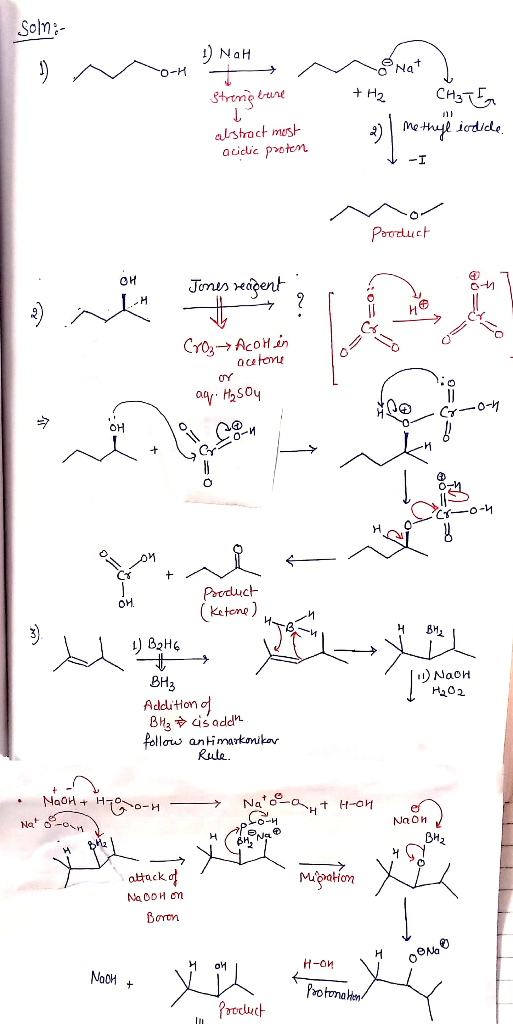
1. NaH is strong base, abstract most acidic proton and generate an anion which can act as a nucleophile with methyl iodide.
2. Jones reagent ( CrO3, AcOH in acetone or aq. H2SO4)- used to oxidize alcohols using chromic trioxide and acid in water. It oxidize secondary alcohol to ketone.
3. B2H6 - Hydroboration of alkene via Cis manner or syn addition follow antimarkonikov rule. H and BH2 add from the same side of double bond.
NaOH and H2O2-The mixture of sodium hydroxide and hydrogen
peroxide produces an even stronger oxidizer called sodium peroxide.
Add Answer to:
Help please.
For questions 1-3, draw the product(e) of given reactions. In multiple step sequences, provide...
Organic Chemistry Help (2) Provide products for each of the reactions below. Show all enantiomers and/or...
 Organic Chemistry Help
(2) Provide products for each of the reactions below. Show all enantiomers and/or diastereomers. Circle any meso compounds that are produced. (1) BDs, THF (2) NaOH, H202, THF- H20 (1) BD3, THF (2) NaOH, H202 THF- H20 OsO4, NMO, THF-H20 HCI ether
Organic Chemistry Help
(2) Provide products for each of the reactions below. Show all enantiomers and/or diastereomers. Circle any meso compounds that are produced. (1) BDs, THF (2) NaOH, H202, THF- H20 (1) BD3, THF (2) NaOH, H202 THF- H20 OsO4, NMO, THF-H20 HCI ether
Give the major organic product(s) of the following reactions or sequences of reactions. Show the stereochemistry...
 Give the major organic product(s) of the following reactions or
sequences of reactions. Show the stereochemistry and/or isotope
position clearly where it is relevant. If you think that the
reaction would not occur, write as "NR" or "No Reaction."
A) 1) NaOH ОН ? 2) CH3CH Br B) 1) NH3, excess 2) SOC12, Pyridine, heat CI
Give the major organic product(s) of the following reactions or
sequences of reactions. Show the stereochemistry and/or isotope
position clearly where it is relevant. If you think that the
reaction would not occur, write as "NR" or "No Reaction."
A) 1) NaOH ОН ? 2) CH3CH Br B) 1) NH3, excess 2) SOC12, Pyridine, heat CI
Provide all organic products for the reactions below. Indicate the relationship between any stereoisomers (label as...
 Provide all organic products for the reactions below. Indicate
the relationship between any stereoisomers (label as diastereomers
or enantiomers).
e. 1. Cl2, H20 2. KOtBu 1. NaOH, H20 2. PCC HO 1. cat. OsO4, H202 2. Br2, hv, CCl4 g. 1. ICH2Znl, Et20 2. MsCI, руг 3. LDA он h. CHCl3 KOtBu 1. HBr, 'BuoOH, hv 2. NaCN, DMF
Provide all organic products for the reactions below. Indicate
the relationship between any stereoisomers (label as diastereomers
or enantiomers).
e. 1. Cl2, H20 2. KOtBu 1. NaOH, H20 2. PCC HO 1. cat. OsO4, H202 2. Br2, hv, CCl4 g. 1. ICH2Znl, Et20 2. MsCI, руг 3. LDA он h. CHCl3 KOtBu 1. HBr, 'BuoOH, hv 2. NaCN, DMF
Draw the final product for the following reactions 6. Draw the final product for the following...
 Draw the final product for the following reactions
6. Draw the final product for the following reactions 19 AICI 2) Zn, HCI 3) Brz, light (1 eq.) 4) NaOH, heat 1) KMnO4, hot 2) HNO3, H2SO4 3) LiAIHA 4) Hot 1) AICI3, tai 2) mCPBA 3) Jones Reagent
Draw the final product for the following reactions
6. Draw the final product for the following reactions 19 AICI 2) Zn, HCI 3) Brz, light (1 eq.) 4) NaOH, heat 1) KMnO4, hot 2) HNO3, H2SO4 3) LiAIHA 4) Hot 1) AICI3, tai 2) mCPBA 3) Jones Reagent
Provide the major organic product (including stereochemistry if appropriate) for each of the following reactions: 3....
 Provide the major organic product (including stereochemistry if appropriate) for each of the following reactions: 3. 1) NaH а) (CH)-СHCH,ОН 2) (CH),СНОСH-CH,Br b) excess HI 1) Hg(OAc),/H,O 2) NaBHĄ/HO¯ 1) NaOH 2) PҺOH d) CH,CH,Br 1) BH3/THF 2) H-0,/Но" НCIZnClz он g) MCPBA h) 1) mCPBA 2) CH3O¯ 1) mCPBA 2) CH,ОН/Н"
Question 4) Draw the major organic product(s) for the following reactions or sequences of reactions. Show...
 Question 4) Draw the major organic product(s) for the following reactions or sequences of reactions. Show all relevant stereochemistry if applicable No reaction is a possible answer (24 points) 1) PPh3 2) Buli
Question 4) Draw the major organic product(s) for the following reactions or sequences of reactions Show...
 Question 4) Draw the major organic product(s) for the following reactions or sequences of reactions Show all relevant stereochemistry if applicable No reaction is a possible answer (24 points) 1) LIAID Do 2) H30*
please help 3. Draw the major product of the final step of the following scheme in...
 please help
3. Draw the major product of the final step of the following scheme in the box provided. 1. NBS, ROOR or NBS, cat AIBN, CCls, heat 2. DBN 3. Hydroboration-oxidation 4. PBr3 5. Mg, Et2o 6. PhCHO, then workup 7. Jones reagent 8. PhLi, Et O, then H30 9. TsOH, heat 10. NBS, HOH 11. NaOH (intramolecular SN2) 12. MeMgBr (excess), then workup 13. E2 14. HBr 15. Mg, ether 16. dry ice, then workup 17. LiAlH4, ether,...
please help
3. Draw the major product of the final step of the following scheme in the box provided. 1. NBS, ROOR or NBS, cat AIBN, CCls, heat 2. DBN 3. Hydroboration-oxidation 4. PBr3 5. Mg, Et2o 6. PhCHO, then workup 7. Jones reagent 8. PhLi, Et O, then H30 9. TsOH, heat 10. NBS, HOH 11. NaOH (intramolecular SN2) 12. MeMgBr (excess), then workup 13. E2 14. HBr 15. Mg, ether 16. dry ice, then workup 17. LiAlH4, ether,...
1. The chiral compound in the center of the diagram below can undergo three different reactions. Fill in product struct...
 1. The chiral compound in the center of the diagram below can undergo three different reactions. Fill in product structures in each box and give their stereochemistry. For the Sul reaction the two products are enantiomers of each other. For the E1 reaction products, two are diastereomers of each other and the third is a constitutional isomer of the other two. H30 NaOH H20 E1 E2 Sn1 NaOH SN2 2. Draw the structure of the major product of the reaction...
3. Reactions: (21 pts) Draw the structure of the expected organic product(s) formed in the following...
 3. Reactions: (21 pts) Draw the structure of the expected organic product(s) formed in the following reactions including correct stereochemistry, if the product is racemic indicate this by either drawing both enantiomers or drawing one and writing racemic. Assume all reagents listed are present in excess unless otherwise noted. If no reaction occurs, state ‘No Reaction'. HI H) 1) CHELI 2) H30 CrOg, H2SO4 H20 (xs) 1) mCPBA J) (CH3),COK (CH3)3COH CH,CI2 K) H2SO4 180°C OH L NaH, DMSO Br...
 Organic Chemistry Help
(2) Provide products for each of the reactions below. Show all enantiomers and/or diastereomers. Circle any meso compounds that are produced. (1) BDs, THF (2) NaOH, H202, THF- H20 (1) BD3, THF (2) NaOH, H202 THF- H20 OsO4, NMO, THF-H20 HCI ether
Organic Chemistry Help
(2) Provide products for each of the reactions below. Show all enantiomers and/or diastereomers. Circle any meso compounds that are produced. (1) BDs, THF (2) NaOH, H202, THF- H20 (1) BD3, THF (2) NaOH, H202 THF- H20 OsO4, NMO, THF-H20 HCI ether
 Give the major organic product(s) of the following reactions or
sequences of reactions. Show the stereochemistry and/or isotope
position clearly where it is relevant. If you think that the
reaction would not occur, write as "NR" or "No Reaction."
A) 1) NaOH ОН ? 2) CH3CH Br B) 1) NH3, excess 2) SOC12, Pyridine, heat CI
Give the major organic product(s) of the following reactions or
sequences of reactions. Show the stereochemistry and/or isotope
position clearly where it is relevant. If you think that the
reaction would not occur, write as "NR" or "No Reaction."
A) 1) NaOH ОН ? 2) CH3CH Br B) 1) NH3, excess 2) SOC12, Pyridine, heat CI
 Provide all organic products for the reactions below. Indicate
the relationship between any stereoisomers (label as diastereomers
or enantiomers).
e. 1. Cl2, H20 2. KOtBu 1. NaOH, H20 2. PCC HO 1. cat. OsO4, H202 2. Br2, hv, CCl4 g. 1. ICH2Znl, Et20 2. MsCI, руг 3. LDA он h. CHCl3 KOtBu 1. HBr, 'BuoOH, hv 2. NaCN, DMF
Provide all organic products for the reactions below. Indicate
the relationship between any stereoisomers (label as diastereomers
or enantiomers).
e. 1. Cl2, H20 2. KOtBu 1. NaOH, H20 2. PCC HO 1. cat. OsO4, H202 2. Br2, hv, CCl4 g. 1. ICH2Znl, Et20 2. MsCI, руг 3. LDA он h. CHCl3 KOtBu 1. HBr, 'BuoOH, hv 2. NaCN, DMF
 Draw the final product for the following reactions
6. Draw the final product for the following reactions 19 AICI 2) Zn, HCI 3) Brz, light (1 eq.) 4) NaOH, heat 1) KMnO4, hot 2) HNO3, H2SO4 3) LiAIHA 4) Hot 1) AICI3, tai 2) mCPBA 3) Jones Reagent
Draw the final product for the following reactions
6. Draw the final product for the following reactions 19 AICI 2) Zn, HCI 3) Brz, light (1 eq.) 4) NaOH, heat 1) KMnO4, hot 2) HNO3, H2SO4 3) LiAIHA 4) Hot 1) AICI3, tai 2) mCPBA 3) Jones Reagent
 Provide the major organic product (including stereochemistry if appropriate) for each of the following reactions: 3. 1) NaH а) (CH)-СHCH,ОН 2) (CH),СНОСH-CH,Br b) excess HI 1) Hg(OAc),/H,O 2) NaBHĄ/HO¯ 1) NaOH 2) PҺOH d) CH,CH,Br 1) BH3/THF 2) H-0,/Но" НCIZnClz он g) MCPBA h) 1) mCPBA 2) CH3O¯ 1) mCPBA 2) CH,ОН/Н"
 Question 4) Draw the major organic product(s) for the following reactions or sequences of reactions. Show all relevant stereochemistry if applicable No reaction is a possible answer (24 points) 1) PPh3 2) Buli
 Question 4) Draw the major organic product(s) for the following reactions or sequences of reactions Show all relevant stereochemistry if applicable No reaction is a possible answer (24 points) 1) LIAID Do 2) H30*
 please help
3. Draw the major product of the final step of the following scheme in the box provided. 1. NBS, ROOR or NBS, cat AIBN, CCls, heat 2. DBN 3. Hydroboration-oxidation 4. PBr3 5. Mg, Et2o 6. PhCHO, then workup 7. Jones reagent 8. PhLi, Et O, then H30 9. TsOH, heat 10. NBS, HOH 11. NaOH (intramolecular SN2) 12. MeMgBr (excess), then workup 13. E2 14. HBr 15. Mg, ether 16. dry ice, then workup 17. LiAlH4, ether,...
please help
3. Draw the major product of the final step of the following scheme in the box provided. 1. NBS, ROOR or NBS, cat AIBN, CCls, heat 2. DBN 3. Hydroboration-oxidation 4. PBr3 5. Mg, Et2o 6. PhCHO, then workup 7. Jones reagent 8. PhLi, Et O, then H30 9. TsOH, heat 10. NBS, HOH 11. NaOH (intramolecular SN2) 12. MeMgBr (excess), then workup 13. E2 14. HBr 15. Mg, ether 16. dry ice, then workup 17. LiAlH4, ether,...
 1. The chiral compound in the center of the diagram below can undergo three different reactions. Fill in product structures in each box and give their stereochemistry. For the Sul reaction the two products are enantiomers of each other. For the E1 reaction products, two are diastereomers of each other and the third is a constitutional isomer of the other two. H30 NaOH H20 E1 E2 Sn1 NaOH SN2 2. Draw the structure of the major product of the reaction...
 3. Reactions: (21 pts) Draw the structure of the expected organic product(s) formed in the following reactions including correct stereochemistry, if the product is racemic indicate this by either drawing both enantiomers or drawing one and writing racemic. Assume all reagents listed are present in excess unless otherwise noted. If no reaction occurs, state ‘No Reaction'. HI H) 1) CHELI 2) H30 CrOg, H2SO4 H20 (xs) 1) mCPBA J) (CH3),COK (CH3)3COH CH,CI2 K) H2SO4 180°C OH L NaH, DMSO Br...
Most questions answered within 3 hours.
-
Where is the error in this code sequence?
String s1 = "Hello";
String s2 = "ello";...
asked 10 months ago -
Financial data for Joel de Paris, Inc., for last year
follow:
Joel de Paris, Inc.
Balance...
asked 10 months ago -
Consider this reaction:
Al2(SO4)3 (aq)+ BaCl3
(aq) Al2Cl6 (aq)- +
3BaSO4(s) . What is the...
asked 10 months ago -
Suppose that Savneet is considering increasing her
recent random sample from 20 car rentals to 40...
asked 10 months ago -
Trucks arrive at an unloading terminal at an average rate of 120
per hour.
Trucks arrive...
asked 10 months ago -
Why are methanol and ethanol completely soluble in water while
octanol is not very little soluble....
asked 10 months ago -
A facilities manager at a university reads in a research report
that the mean amount of...
asked 10 months ago -
When the CuSO4 is rehydrated by adding water to the anhydrous
compound, is this an endothermic...
asked 10 months ago -
A ray of sunlight is passing from diamond into crown glass; the
angle of incidence is...
asked 10 months ago -
A block of mass 0.249 kg is placed on top of a light, vertical
spring of...
asked 10 months ago -
how do the kidneys compensate in the presences of acidosis
a) trigger hyperventilate
b) reserve acid...
asked 10 months ago -
Question 501 pts
The rental rate of capital to the firm increases. Which of the
following...
asked 10 months ago