1.) A student enters the lab and performs Experiment 14 as written. In the procedure for...
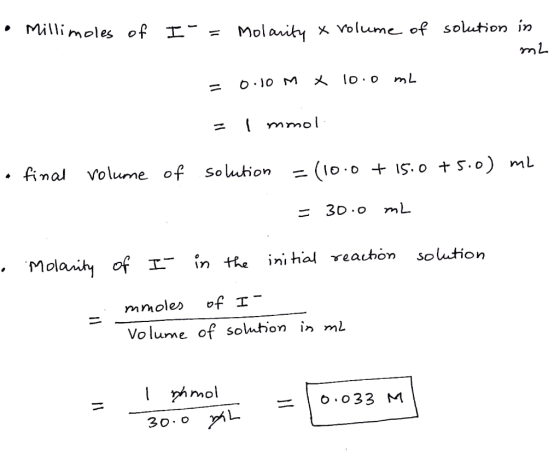
1.) A student enters the lab and performs Experiment 14 as written. In the procedure for "Experiment 1" on p. 230 of the lab manual, the student records the concentration of the stock solution of H2O2 to be 0.965 M. The student proceeds to prepare the reaction solution as stated in the lab manual: They add 10.0 mL of 0.10 M potassium iodide and 15.0 mL of distilled water to their flask. They then add 5.0 mL of the stock H2O2 solution and mix the solution to initiate the reaction.
Calculate the molarity of I- in the initial reaction solution. Do not include the units with your answer.
2.) Given the equation: rate =
k[H2O2]m[I-]n
Which of the following statements is (are) true about the orders,
m and n?
| A. |
m and n must be determined by experiment |
|
| B. |
m and n are equal to each other in all cases. |
|
| C. |
m and n are independent from the molar coefficients of the reactants in the balanced chemical equation. |
|
| D. |
m and n are equal to the molar coefficients of H2O2 and I- in the balanced chemical reaction, respectively. |
Homework Answers
2) The correct statements are (A) and (C).
Explanation: The order of a reaction is an experimental quantity. It is determined by the mechanism of a reaction. It may or may not be equal to the respective stoichiometric coefficients of the reactants in a balanced chemical equation.
Add Answer to:
1.) A student enters the lab and performs Experiment 14 as
written. In the procedure for...
LAB PARTNER Pre-Lab Questions Answer questions 1-6 after you have read the lab experiment and studied...
 LAB PARTNER Pre-Lab Questions Answer questions 1-6 after you have read the lab experiment and studied titration in your textbook (section 7.5) and/or in the lab manual (pages xxi-xxiv). Show your work fully and clearly. Calculate the molar mass of NaOH and the molar concentration of a solution containing 3.978 g of NaOH in 750.0 mL 1. Calculate the number of moles of HCl in 50.00 mL of 0.1444 M HCl. 2. Continued on the next page. 3. Calculate the...
Jill, an undergraduate student, carried out the following experiment. Read the procedure she followed and answer...
 Jill, an undergraduate student, carried out the following experiment. Read the procedure she followed and answer the questions below to help her understand and complete analysis of the results Place 2.0g of powdered maleic anhydride in a 50-ml Erlenmeyer flask. Add 5 mL of dry ethyl acetate to partially dissolve the anhydride. Warm The flask using a sand bath until all the solid has dissolved. Add 5 ml of dry hexanes to the solution and cool the solution in an...
5. A student performs the following reaction using the procedure outlined in Part A of this...
 5. A student performs the following reaction using the procedure outlined in Part A of this experiment. Ba(NO3)2 (aq) + K2SO4 (aq) - BaSO4(s) + 2 KNO3(aq) The student adds 55.0 mL of 0.050 M K SO. solution to 50.0 ml of 0.050 M Ba(NO3)2 solution. The precipitate of Baso. is collected by gravity filtration and dried to a constant mass. The BaSO.is determined to have a mass of 0.49 g. (See section 3.9 in the textbook for a review...
2. A student performs a titration on a 5.00 mL sample of an HBr solution. She...
 2. A student performs a titration on a 5.00 mL sample of an HBr solution. She uses 24.32 mL of a 0.459 M KOH solution to reach a phenolphthalein endpoint. (See Example 2, if necessary.) a. Write the balanced equation for the reaction. Remember to include the correct physical states for each reactant and product in your balanced equation. b. How many moles of KOH were used? C. How many moles of HBr were present? d. What is the molarity...
Lab Day and Section: Na Chemistry 112 Pre-lab Exercise Experiment 5 Exercise Number 145 A buffer...
 Lab Day and Section: Na Chemistry 112 Pre-lab Exercise Experiment 5 Exercise Number 145 A buffer solution is prepared as described in (a) below. To a sample of this buffer solution is added a solution of a strong base as described in (b). (a) 100 mL of 0.18 M benzoic acid are mixed with 0.018 moles of sodium benzoate plus 100 mL of water. (b) 1.0 mL of 0.53 M KOH is added to 50 mL of the solution described...
Chemistry 102 Lab Practical, Spring 2019 RedOx Titration of an Unknown Iron Compound This experiment is worth half of the final exam score for this semester. It contains a laboratory procedure tha...
 Chemistry 102 Lab Practical, Spring 2019 RedOx Titration of an Unknown Iron Compound This experiment is worth half of the final exam score for this semester. It contains a laboratory procedure that is similar to the ones we've been working with all semester Part of the score for this lab practical is based on the preparations you make for the lab in advance of the experiment. When you walk into lab on Thursday night, you should have written out the...
Section: Date: lodine Pre-Lab Questions 1. A student followed the procedure of this experiment to...
 Section: Date: lodine Pre-Lab Questions 1. A student followed the procedure of this experiment to determine the K of zinc(I) iodate, Zn(IO). Solutions of Zn(NO), of known concentrations were titrated with 0.200 M KIO, solutions to the first appearance of a white precipitate. The following data were collected: Zn(NO)atlM KIose M nof Zn(NO), mL V of KIO, added, mL At endpoint M0.226 0.200 100.0 12.9 0.101 0.200 100.0 12.4 0.0452 0.200 100.0 13.0 0.0118 0.200 100.0 18.3 112. 112.4 113...
Question 3 1 pts A student performs part C of the substitution lab. The student is...
 Question 3 1 pts A student performs part C of the substitution lab. The student is using 0.50 Mbutyl bromine in ethanol, 0.50 M potassium hydroxide in ethanol and 0.15 M HCl for the reactions. If the student took a 20 mL sample of the solution and titrated it with HCI, what would be the [OH-] from Data Set C of the student data (shown below? Report answers with 4 places past the decimal...for example 0.000158, would be 0.0002 Data...
1. A student following the procedure of this experiment obtained the following data for solutions of...
 1. A student following the procedure of this experiment obtained the following data for solutions of Cr(III) ion at 580 nm: Standard Solution Number Volume, in mL 0.1000 M Cr(III) Ion Solution Volume, in ml Distilled Water Molarity of Standard Solution Absorbance of Standard Solution blank 0 10.0 0.000 1.0 9.0 0.0921 0.180 8.0 7.0 6.0 0.278 4.0 0.375 5.0 5.0 0.460 (a) Calculate the molarity of each of the standard solutions.
CHE 101 EXPERIMENT 10 PRE-LAB; OXIDATION - REDUCTION TITRATION Name Gisselle. Caballo Lab Day Timetaday op...
 CHE 101 EXPERIMENT 10 PRE-LAB; OXIDATION - REDUCTION TITRATION Name Gisselle. Caballo Lab Day Timetaday op Date II2929 5 Points (3 Points not completed before lab begins) Consider the following molecular equation for the reaction wolved in today's experiment: (Place a and b at the end of the Procedure for Part 2) KMnO4 + Na2C204 + H2504 - MnSO4 + CO2 + Na2SO4 + H2O a. Write a balanced, unmultiplied ionic half-reaction for the oxidation: b. Write a balanced, unmultiplied...
 LAB PARTNER Pre-Lab Questions Answer questions 1-6 after you have read the lab experiment and studied titration in your textbook (section 7.5) and/or in the lab manual (pages xxi-xxiv). Show your work fully and clearly. Calculate the molar mass of NaOH and the molar concentration of a solution containing 3.978 g of NaOH in 750.0 mL 1. Calculate the number of moles of HCl in 50.00 mL of 0.1444 M HCl. 2. Continued on the next page. 3. Calculate the...
 Jill, an undergraduate student, carried out the following experiment. Read the procedure she followed and answer the questions below to help her understand and complete analysis of the results Place 2.0g of powdered maleic anhydride in a 50-ml Erlenmeyer flask. Add 5 mL of dry ethyl acetate to partially dissolve the anhydride. Warm The flask using a sand bath until all the solid has dissolved. Add 5 ml of dry hexanes to the solution and cool the solution in an...
 5. A student performs the following reaction using the procedure outlined in Part A of this experiment. Ba(NO3)2 (aq) + K2SO4 (aq) - BaSO4(s) + 2 KNO3(aq) The student adds 55.0 mL of 0.050 M K SO. solution to 50.0 ml of 0.050 M Ba(NO3)2 solution. The precipitate of Baso. is collected by gravity filtration and dried to a constant mass. The BaSO.is determined to have a mass of 0.49 g. (See section 3.9 in the textbook for a review...
 2. A student performs a titration on a 5.00 mL sample of an HBr solution. She uses 24.32 mL of a 0.459 M KOH solution to reach a phenolphthalein endpoint. (See Example 2, if necessary.) a. Write the balanced equation for the reaction. Remember to include the correct physical states for each reactant and product in your balanced equation. b. How many moles of KOH were used? C. How many moles of HBr were present? d. What is the molarity...
 Lab Day and Section: Na Chemistry 112 Pre-lab Exercise Experiment 5 Exercise Number 145 A buffer solution is prepared as described in (a) below. To a sample of this buffer solution is added a solution of a strong base as described in (b). (a) 100 mL of 0.18 M benzoic acid are mixed with 0.018 moles of sodium benzoate plus 100 mL of water. (b) 1.0 mL of 0.53 M KOH is added to 50 mL of the solution described...
 Chemistry 102 Lab Practical, Spring 2019 RedOx Titration of an Unknown Iron Compound This experiment is worth half of the final exam score for this semester. It contains a laboratory procedure that is similar to the ones we've been working with all semester Part of the score for this lab practical is based on the preparations you make for the lab in advance of the experiment. When you walk into lab on Thursday night, you should have written out the...
 Section: Date: lodine Pre-Lab Questions 1. A student followed the procedure of this experiment to determine the K of zinc(I) iodate, Zn(IO). Solutions of Zn(NO), of known concentrations were titrated with 0.200 M KIO, solutions to the first appearance of a white precipitate. The following data were collected: Zn(NO)atlM KIose M nof Zn(NO), mL V of KIO, added, mL At endpoint M0.226 0.200 100.0 12.9 0.101 0.200 100.0 12.4 0.0452 0.200 100.0 13.0 0.0118 0.200 100.0 18.3 112. 112.4 113...
 Question 3 1 pts A student performs part C of the substitution lab. The student is using 0.50 Mbutyl bromine in ethanol, 0.50 M potassium hydroxide in ethanol and 0.15 M HCl for the reactions. If the student took a 20 mL sample of the solution and titrated it with HCI, what would be the [OH-] from Data Set C of the student data (shown below? Report answers with 4 places past the decimal...for example 0.000158, would be 0.0002 Data...
 1. A student following the procedure of this experiment obtained the following data for solutions of Cr(III) ion at 580 nm: Standard Solution Number Volume, in mL 0.1000 M Cr(III) Ion Solution Volume, in ml Distilled Water Molarity of Standard Solution Absorbance of Standard Solution blank 0 10.0 0.000 1.0 9.0 0.0921 0.180 8.0 7.0 6.0 0.278 4.0 0.375 5.0 5.0 0.460 (a) Calculate the molarity of each of the standard solutions.
 CHE 101 EXPERIMENT 10 PRE-LAB; OXIDATION - REDUCTION TITRATION Name Gisselle. Caballo Lab Day Timetaday op Date II2929 5 Points (3 Points not completed before lab begins) Consider the following molecular equation for the reaction wolved in today's experiment: (Place a and b at the end of the Procedure for Part 2) KMnO4 + Na2C204 + H2504 - MnSO4 + CO2 + Na2SO4 + H2O a. Write a balanced, unmultiplied ionic half-reaction for the oxidation: b. Write a balanced, unmultiplied...
Most questions answered within 3 hours.
-
Where is the error in this code sequence?
String s1 = "Hello";
String s2 = "ello";...
asked 10 months ago -
Financial data for Joel de Paris, Inc., for last year
follow:
Joel de Paris, Inc.
Balance...
asked 10 months ago -
Consider this reaction:
Al2(SO4)3 (aq)+ BaCl3
(aq) Al2Cl6 (aq)- +
3BaSO4(s) . What is the...
asked 10 months ago -
Suppose that Savneet is considering increasing her
recent random sample from 20 car rentals to 40...
asked 10 months ago -
Trucks arrive at an unloading terminal at an average rate of 120
per hour.
Trucks arrive...
asked 10 months ago -
Why are methanol and ethanol completely soluble in water while
octanol is not very little soluble....
asked 10 months ago -
A facilities manager at a university reads in a research report
that the mean amount of...
asked 10 months ago -
When the CuSO4 is rehydrated by adding water to the anhydrous
compound, is this an endothermic...
asked 10 months ago -
A ray of sunlight is passing from diamond into crown glass; the
angle of incidence is...
asked 10 months ago -
A block of mass 0.249 kg is placed on top of a light, vertical
spring of...
asked 10 months ago -
how do the kidneys compensate in the presences of acidosis
a) trigger hyperventilate
b) reserve acid...
asked 10 months ago -
Question 501 pts
The rental rate of capital to the firm increases. Which of the
following...
asked 10 months ago