
Homework Answers
Newton’s third law- for every action there is an equal and opposite reaction. It means the act of ejecting molecules pushes back on the rocket: every time a water molecule flies from the nozzle, the rocket loses a little mass and in return gains a little velocity. If the rocket burns fuel at a high rate, the reaction force on the rocket will be high, and so will the acceleration. The force is approximately proportional to the rate at which propellant is consumed.
Momentum is zero in the left panel and is conserved, the total momentum in the right panel must also be zero, which means the leftward momentum of the ejected mass must equal the rightward momentum of the rocket:

If the ejected mass dm is very small compared with the total mass m, we should be able to ignore the –dm term on the right-hand side. However, if we do this, it’s important to be careful in the bookkeeping and encode in the equation the fact that a decrease in the mass of the rocket results in an increase in its velocity. A consistent convention is that both +dm and +dv should indicate increases in the mass and velocity of the rocket, which means reversing the sign of dm in Equation 1 (so that dm is now a negative number) and writing

The rocket ejects small masses molecule by molecule, each one adding a small increment to the rocket’s velocity and subtracting a bit from the remaining mass. Each time we can shift to a moving frame of reference where the rocket is stationary, as in the left panel of Figure 1, then apply the conservation of momentum. As time goes on, the rocket’s mass will drop as it consumes propellant. We want to know the cumulative effect of all the small velocity changes (all the dvs) during the rocket burn, relative to all the small mass changes (all the dms), and calculate a relationship between velocity and mass. First, rewrite Equation 2 as
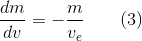
It looks a little strange to write it this way, but what it says is the change in the rocket’s mass, per change in velocity, is proportional to the mass divided by the exhaust velocity. This is a direct consequence of the conservation of momentum and is true at every moment in time, even though the rocket’s mass and velocity are changing during the burn (I’ll assume the exhaust velocity remains constant). Now, if you’re familiar with differential equations and calculus, you may already know what to do with Equation 3: integrate it. If not, I must ask you to accept a mathematical leap of faith: it’s a well-established result that if the change in some quantity is proportional to the quantity itself, then the quantity varies exponentially. This sort of behavior occurs frequently in nature, including the exponential decay of radioactive isotopes and the exponential growth of bacteria when food is plentiful. In the present case the change in mass, with respect to change in velocity, is proportional to the mass itself, and therefore the rocket’s mass, as a function of velocity, obeys an exponential relation called the rocket equation. Written in a convenient form it looks like this:
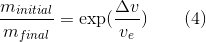
where the left-hand side is the ratio of the initial mass of the rocket (at the beginning of the burn) to the final mass (after the burn is complete), delta-v is the total change in velocity caused by the burn, and exp() is the exponential function. It’s a compact and beautiful result. In English it says the ratio of initial to final mass is the exponential of the ratio of delta-v to exhaust velocity, or, even more simply, the mass ratio is the exponential of the velocity ratio. The plot below shows Equation 4, where you can see how rapidly the mass ratio rises once the velocity ratio goes beyond 3 or 4; huge increases in mass are required for each increment of velocity. Often you’ll see the rocket equation written in an equivalent form, solved for delta-v:

where ln() is the natural logarithm function, the inverse of the exponential function.
You may have noticed that time appears nowhere in the rocket equation. That’s because the conservation of momentum “doesn’t care” how long it takes to use up propellant—the change in momentum, and therefore the final velocity, is the same. This is certainly true in the vacuum of empty space, far away from a planet. In the presence of gravity, though, it matters how fast a rocket consumes propellant. Imagine a rocket standing on the launch pad, burning its propellant so slowly that there’s not enough thrust to lift the rocket. All the propellant will be used up, and the rocket will go absolutely nowhere. This is an extreme example of an effect called gravity drag. The absolute amount of thrust is clearly important if our rocket is to leave the pad. If we divide both sides of Equation (2) by the small time interval dt during which the mass dm was ejected, and also make use of Newton’s famous second law of motion, force equals mass times acceleration, we get

where the acceleration a is the change in velocity per time, dv/dt. As before, note the minus sign: since dm/dt, the rate at which the rocket’s mass changes due to consuming propellant, is a negative number, the force is positive.
Add Answer to:
4. The rocket equation states that for a given Isp and propulsion system mass fraction, 2,...
ME 341-Fluid Mechanics I Fall 2018 Example Problem #16 Consider a rocket moving straight up in...
 ME 341-Fluid Mechanics I Fall 2018 Example Problem #16 Consider a rocket moving straight up in the gravity field, as shown in the figure below. Let the initial mass of the rocket be Mo, and assume a steady exhaust mass flow rate m and exhaust velocity (relative to the rocket). If the flow pattern within the rocket motor is steady, and aerodynamic drag is neglected, derive the differential equation of the vertical rocket motion V(t) and integrate the equation using...
Chapter overview 1. Reasons for international trade Resources reasons Economic reasons Other reasons 2. Difference between...
Chapter overview 1. Reasons for international trade Resources reasons Economic reasons Other reasons 2. Difference between international trade and domestic trade More complex context More difficult and risky Higher management skills required 3. Basic concept s relating to international trade Visible trade & invisible trade Favorable trade & unfavorable trade General trade system & special trade system Volume of international trade & quantum of international trade Commodity composition of international trade Geographical composition of international trade Degree / ratio of...
I need Summary of this Paper i dont need long summary i need What methodology they used , what is the purpose of this p...
 I need Summary of this Paper i dont need long summary i need
What methodology they used , what is the purpose of this paper and
some conclusions and contributes of this paper. I need this for my
Finishing Project so i need this ASAP please ( IN 1-2-3 HOURS
PLEASE !!!)
Budgetary Policy and Economic Growth Errol D'Souza The share of capital expenditures in government expenditures has been slipping and the tax reforms have not yet improved the income...
I need Summary of this Paper i dont need long summary i need
What methodology they used , what is the purpose of this paper and
some conclusions and contributes of this paper. I need this for my
Finishing Project so i need this ASAP please ( IN 1-2-3 HOURS
PLEASE !!!)
Budgetary Policy and Economic Growth Errol D'Souza The share of capital expenditures in government expenditures has been slipping and the tax reforms have not yet improved the income...
10. Write a one-page summary of the attached paper? INTRODUCTION Many problems can develop in activated...
10. Write a one-page summary of the attached paper? INTRODUCTION Many problems can develop in activated sludge operation that adversely affect effluent quality with origins in the engineering, hydraulic and microbiological components of the process. The real "heart" of the activated sludge system is the development and maintenance of a mixed microbial culture (activated sludge) that treats wastewater and which can be managed. One definition of a wastewater treatment plant operator is a "bug farmer", one who controls the aeration...
 ME 341-Fluid Mechanics I Fall 2018 Example Problem #16 Consider a rocket moving straight up in the gravity field, as shown in the figure below. Let the initial mass of the rocket be Mo, and assume a steady exhaust mass flow rate m and exhaust velocity (relative to the rocket). If the flow pattern within the rocket motor is steady, and aerodynamic drag is neglected, derive the differential equation of the vertical rocket motion V(t) and integrate the equation using...
 I need Summary of this Paper i dont need long summary i need
What methodology they used , what is the purpose of this paper and
some conclusions and contributes of this paper. I need this for my
Finishing Project so i need this ASAP please ( IN 1-2-3 HOURS
PLEASE !!!)
Budgetary Policy and Economic Growth Errol D'Souza The share of capital expenditures in government expenditures has been slipping and the tax reforms have not yet improved the income...
I need Summary of this Paper i dont need long summary i need
What methodology they used , what is the purpose of this paper and
some conclusions and contributes of this paper. I need this for my
Finishing Project so i need this ASAP please ( IN 1-2-3 HOURS
PLEASE !!!)
Budgetary Policy and Economic Growth Errol D'Souza The share of capital expenditures in government expenditures has been slipping and the tax reforms have not yet improved the income...
Most questions answered within 3 hours.
-
Where is the error in this code sequence?
String s1 = "Hello";
String s2 = "ello";...
asked 10 months ago -
Financial data for Joel de Paris, Inc., for last year
follow:
Joel de Paris, Inc.
Balance...
asked 10 months ago -
Consider this reaction:
Al2(SO4)3 (aq)+ BaCl3
(aq) Al2Cl6 (aq)- +
3BaSO4(s) . What is the...
asked 10 months ago -
Suppose that Savneet is considering increasing her
recent random sample from 20 car rentals to 40...
asked 10 months ago -
Trucks arrive at an unloading terminal at an average rate of 120
per hour.
Trucks arrive...
asked 10 months ago -
Why are methanol and ethanol completely soluble in water while
octanol is not very little soluble....
asked 10 months ago -
A facilities manager at a university reads in a research report
that the mean amount of...
asked 10 months ago -
When the CuSO4 is rehydrated by adding water to the anhydrous
compound, is this an endothermic...
asked 10 months ago -
A ray of sunlight is passing from diamond into crown glass; the
angle of incidence is...
asked 10 months ago -
A block of mass 0.249 kg is placed on top of a light, vertical
spring of...
asked 10 months ago -
how do the kidneys compensate in the presences of acidosis
a) trigger hyperventilate
b) reserve acid...
asked 10 months ago -
Question 501 pts
The rental rate of capital to the firm increases. Which of the
following...
asked 10 months ago