Equations of Motion: Cylindrical Coordinates Learning Goal: To set up and analyze equations of motion in...
|
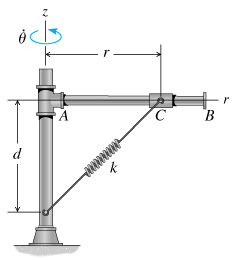
Equations of Motion: Cylindrical Coordinates Learning Goal: To set up and analyze equations of motion in a cylindrical coordinate system. The mechanism shown in the figure below rotates about the vertical axis. The collar has mass m=3.05 kg. The spring has an unstretched length of 310 mm and the spring constant is k=160 N/m. The distance d=200 mm , and the collar is required to stay a fixed distance r=480 mm from the vertical axis.(Figure 1) |
Part A - The angular velocity for a smooth shaft If there is no friction between shaft AB and the collar, what angular velocity ?? must the mechanism have to keep the collar at r=480 mm from the vertical axis? Express your answer to three significant figures.
SubmitHintsMy AnswersGive UpReview Part Correct Part B - The minimum required angular velocity when there is friction Consider the same mechanism again, with m=3.05 kg, d=200 mm, k=160 N/m, only now, instead of being smooth, the collar and shaft have a maximum coefficient of friction of ?s=0.67. What is the minimum angular velocity required to keep the collar at a constant distance r=480 mm from the axis of rotation? Express your answer to three significant figures.
SubmitHintsMy AnswersGive UpReview Part Correct Notice that this angular velocity is less than that found in Part A, as expected. Part C - The maximum allowable angular velocity when there is friction Consider the same mechanism again, with m=3.05 kg, d=200 mm, k=160 N/m, and ?s=0.67. What is the maximum angular velocity allowable if the collar is to remain at a constant distance r=480 mm from the axis of rotation? Express your answer to three significant figures.
|
| ??= |
rad/s
Homework Answers
length of spring = sqrt(d^2 + r^2)
= sqrt(200^2 + 480^2) = 520 mm
x = 520 - 310 = 210 mm = 0.210 m
angle of spring will shaft, @ = tan^-1(d/r)
@ = tan^-1 ( 200/480) = 22.62 degrees
balancing forces on collar,
kx cos@ = mw^2 r
160 x 0.210 x cos22.62 = 3.05 x w^2 x 0.480
w = 4.60 rad/s ...........Ans
B) friction = uN
and N = kxsin@ + mg
N = 160x0.210xsin22.62 + 3.05x9.81 = 42.84 N
f = 0.67 x 42.84 = 28.70 N
now, On collar
kx cos@ - f = mw^2 r
160 x0.210 x cos22.62 - 28.70 = 3.05 x w^2 x 0.480
w = 1.25 rad/s
C) for maximum,
kx cos@ + f = mw^2 r
160 x0.210 x cos22.62 + 28.70 = 3.05 x w^2 x 0.480
w = 6.39 rad/s
Add Answer to:
Equations of Motion: Cylindrical Coordinates
Learning Goal:
To set up and analyze equations of motion in...
To set up and solve the equations of motion using rectangular coordinates The 2-kg collar shown...
 To set up and solve the equations of motion using rectangular coordinates The 2-kg collar shown has a coefficient of kinetic friction uk= 0.18 with the shaft. The spring is unstretched when s=0 and the collar is given an initial velocity of vo = 17.1 m/s. The unstretched length of the spring is d=1.2 m and the spring constant is k=8.70 N/m. Part B - The acceleration of the collar after it has moved a certain distance What is the...
Equations of Motion: Rectangular Coordinates a,--150 m Learning Goal To set up and solve the equations...
 Equations of Motion: Rectangular Coordinates a,--150 m Learning Goal To set up and solve the equations of motion using rectangular coordinates The 2kg collar shown has a coeficient of kinesic friction Correct = 0.2 wit, the shut The spring is urstre ed aren s :0 and the collar is given an initial velocity of to 19.6 m/s The unstretohed length of the spring is d-1.1 m and the spring constant is 423 N/m part C . The speed of the...
Part B and C <Problem Assignment No. 2 Equations of Motion: Rectangular Coordinates Learning Goal: To...
 Part B and C
<Problem Assignment No. 2 Equations of Motion: Rectangular Coordinates Learning Goal: To set up and solve the equations of motion using rectangular coordinates. The 3.5-kg collar shown has a coefficient of kinetic friction μk 0.195 with the shaft. The spring is unstretched when s 0 and the collar is given an initial velocity of vo 10.3 m/s. The unstretched length of the spring is d- 1.3 nm and the spring constant is k- 3.13 N/m. (Figure...
Part B and C
<Problem Assignment No. 2 Equations of Motion: Rectangular Coordinates Learning Goal: To set up and solve the equations of motion using rectangular coordinates. The 3.5-kg collar shown has a coefficient of kinetic friction μk 0.195 with the shaft. The spring is unstretched when s 0 and the collar is given an initial velocity of vo 10.3 m/s. The unstretched length of the spring is d- 1.3 nm and the spring constant is k- 3.13 N/m. (Figure...
Shear and Bending Moment Diagrams Learning Goal: To determine the reactive forces and moments acting on...
 Shear and Bending Moment Diagrams
Learning Goal:
To determine the reactive forces and moments acting on a beam;
express the shear and bending moment as functions of their
positions along the beam; and construct shear and bending moment
diagrams.
The cantilever beam shown is subjected to a moment at A
and a distributed load that acts over segment BC, and is
fixed at C. Determine the reactions at the support located
at C. Then write expressions for shear and bending...
Shear and Bending Moment Diagrams
Learning Goal:
To determine the reactive forces and moments acting on a beam;
express the shear and bending moment as functions of their
positions along the beam; and construct shear and bending moment
diagrams.
The cantilever beam shown is subjected to a moment at A
and a distributed load that acts over segment BC, and is
fixed at C. Determine the reactions at the support located
at C. Then write expressions for shear and bending...
Learning Goal: To understand and apply the formula τ=Iα to rigid objects rotating about a fixed axis. To fin...
 Learning Goal:
To understand and apply the formula
τ=Iα to rigid objects rotating about a
fixed axis.
To find the acceleration a of a particle of mass
m, we use Newton's second law: F⃗
net=ma⃗ , where F⃗ net is the net force
acting on the particle.
To find the angular acceleration α of a rigid object
rotating about a fixed axis, we can use a similar formula:
τnet=Iα, where τnet=∑τ
is the net torque acting on the object and...
Learning Goal:
To understand and apply the formula
τ=Iα to rigid objects rotating about a
fixed axis.
To find the acceleration a of a particle of mass
m, we use Newton's second law: F⃗
net=ma⃗ , where F⃗ net is the net force
acting on the particle.
To find the angular acceleration α of a rigid object
rotating about a fixed axis, we can use a similar formula:
τnet=Iα, where τnet=∑τ
is the net torque acting on the object and...
Part A - Angular Acceleration of the Rod Learning Goal: To apply the equations of motion...
 Part A - Angular Acceleration of the Rod Learning Goal: To apply the equations of motion to a system that involves rotation about a fixed axis and to use this information to determine key characteristics. The slender rod AB shown has a mass of m = 71.0 kg and is being supported by a rope and pulley system stationed at C. Starting from rest in the position shown), the rope and pulley system tug on the rod causing it to...
Learning Goal: To apply the equations of motion to a system that involves rotation about a...
 Learning Goal: To apply the equations of motion to a system that involves rotation about a fixed axis and to use this information to determine key characteristics. The slender rod AB shown has a mass of m=61.0 kg and is being supported by a rope and pulley system stationed at C. Starting from rest (in the position shown), the rope and pulley system tug on the rod causing it to rotate about A. The torque applied to the pulley is...
Part A The plate gears A and B are rotating with the angular velocities WA =...
 Part A The plate gears A and B are rotating with the angular velocities WA = 9 rad/s and wb = 17 rad/s. (Figure 1) Determine the magnitude of the angular velocity of gear C about the shaft DE. Express your answer using three significant figures. V AEO11 vec ? ( @DE rad/s Figure 1 of 1 Submit Request Answer Part B 100 mm Determine the angular velocity of DE about the axis using scalar notation. Express your answer using...
Learning Goal: To apply the equations of motion to a system that involves rotation about a...
 Learning Goal: To apply the equations of motion to a system that involves rotation about a fixed axis and to use this information to determine key characteristics The slender rod AB shown has a mass of m 51.0 kg and is being supported by a rope and pulley system stationed at C. Starting from rest in the position shown), the rope and pulley system tug on the rod causing it to rotate about A The torque applied to the pulley...
Learning Goal: To determine the maximum shear force that can be applied to two shafts of...
 Learning Goal: To determine the maximum shear force that can be applied to two shafts of varying cross sections: a solid square shaft and a hollow square shaft. The two square cross sections shown below (Figure 1) are each subjected to a vertical shear force, V. The side length of each cross section is s = 6.00 in and the side length of the hollowed- out portion of the second cross section is r = 2.25 in. The maximum allowable...
 To set up and solve the equations of motion using rectangular coordinates The 2-kg collar shown has a coefficient of kinetic friction uk= 0.18 with the shaft. The spring is unstretched when s=0 and the collar is given an initial velocity of vo = 17.1 m/s. The unstretched length of the spring is d=1.2 m and the spring constant is k=8.70 N/m. Part B - The acceleration of the collar after it has moved a certain distance What is the...
 Equations of Motion: Rectangular Coordinates a,--150 m Learning Goal To set up and solve the equations of motion using rectangular coordinates The 2kg collar shown has a coeficient of kinesic friction Correct = 0.2 wit, the shut The spring is urstre ed aren s :0 and the collar is given an initial velocity of to 19.6 m/s The unstretohed length of the spring is d-1.1 m and the spring constant is 423 N/m part C . The speed of the...
 Part B and C
<Problem Assignment No. 2 Equations of Motion: Rectangular Coordinates Learning Goal: To set up and solve the equations of motion using rectangular coordinates. The 3.5-kg collar shown has a coefficient of kinetic friction μk 0.195 with the shaft. The spring is unstretched when s 0 and the collar is given an initial velocity of vo 10.3 m/s. The unstretched length of the spring is d- 1.3 nm and the spring constant is k- 3.13 N/m. (Figure...
Part B and C
<Problem Assignment No. 2 Equations of Motion: Rectangular Coordinates Learning Goal: To set up and solve the equations of motion using rectangular coordinates. The 3.5-kg collar shown has a coefficient of kinetic friction μk 0.195 with the shaft. The spring is unstretched when s 0 and the collar is given an initial velocity of vo 10.3 m/s. The unstretched length of the spring is d- 1.3 nm and the spring constant is k- 3.13 N/m. (Figure...
 Shear and Bending Moment Diagrams
Learning Goal:
To determine the reactive forces and moments acting on a beam;
express the shear and bending moment as functions of their
positions along the beam; and construct shear and bending moment
diagrams.
The cantilever beam shown is subjected to a moment at A
and a distributed load that acts over segment BC, and is
fixed at C. Determine the reactions at the support located
at C. Then write expressions for shear and bending...
Shear and Bending Moment Diagrams
Learning Goal:
To determine the reactive forces and moments acting on a beam;
express the shear and bending moment as functions of their
positions along the beam; and construct shear and bending moment
diagrams.
The cantilever beam shown is subjected to a moment at A
and a distributed load that acts over segment BC, and is
fixed at C. Determine the reactions at the support located
at C. Then write expressions for shear and bending...
 Learning Goal:
To understand and apply the formula
τ=Iα to rigid objects rotating about a
fixed axis.
To find the acceleration a of a particle of mass
m, we use Newton's second law: F⃗
net=ma⃗ , where F⃗ net is the net force
acting on the particle.
To find the angular acceleration α of a rigid object
rotating about a fixed axis, we can use a similar formula:
τnet=Iα, where τnet=∑τ
is the net torque acting on the object and...
Learning Goal:
To understand and apply the formula
τ=Iα to rigid objects rotating about a
fixed axis.
To find the acceleration a of a particle of mass
m, we use Newton's second law: F⃗
net=ma⃗ , where F⃗ net is the net force
acting on the particle.
To find the angular acceleration α of a rigid object
rotating about a fixed axis, we can use a similar formula:
τnet=Iα, where τnet=∑τ
is the net torque acting on the object and...
 Part A - Angular Acceleration of the Rod Learning Goal: To apply the equations of motion to a system that involves rotation about a fixed axis and to use this information to determine key characteristics. The slender rod AB shown has a mass of m = 71.0 kg and is being supported by a rope and pulley system stationed at C. Starting from rest in the position shown), the rope and pulley system tug on the rod causing it to...
 Learning Goal: To apply the equations of motion to a system that involves rotation about a fixed axis and to use this information to determine key characteristics. The slender rod AB shown has a mass of m=61.0 kg and is being supported by a rope and pulley system stationed at C. Starting from rest (in the position shown), the rope and pulley system tug on the rod causing it to rotate about A. The torque applied to the pulley is...
 Part A The plate gears A and B are rotating with the angular velocities WA = 9 rad/s and wb = 17 rad/s. (Figure 1) Determine the magnitude of the angular velocity of gear C about the shaft DE. Express your answer using three significant figures. V AEO11 vec ? ( @DE rad/s Figure 1 of 1 Submit Request Answer Part B 100 mm Determine the angular velocity of DE about the axis using scalar notation. Express your answer using...
 Learning Goal: To apply the equations of motion to a system that involves rotation about a fixed axis and to use this information to determine key characteristics The slender rod AB shown has a mass of m 51.0 kg and is being supported by a rope and pulley system stationed at C. Starting from rest in the position shown), the rope and pulley system tug on the rod causing it to rotate about A The torque applied to the pulley...
 Learning Goal: To determine the maximum shear force that can be applied to two shafts of varying cross sections: a solid square shaft and a hollow square shaft. The two square cross sections shown below (Figure 1) are each subjected to a vertical shear force, V. The side length of each cross section is s = 6.00 in and the side length of the hollowed- out portion of the second cross section is r = 2.25 in. The maximum allowable...
Most questions answered within 3 hours.
-
Where is the error in this code sequence?
String s1 = "Hello";
String s2 = "ello";...
asked 10 months ago -
Financial data for Joel de Paris, Inc., for last year
follow:
Joel de Paris, Inc.
Balance...
asked 10 months ago -
Consider this reaction:
Al2(SO4)3 (aq)+ BaCl3
(aq) Al2Cl6 (aq)- +
3BaSO4(s) . What is the...
asked 10 months ago -
Suppose that Savneet is considering increasing her
recent random sample from 20 car rentals to 40...
asked 10 months ago -
Trucks arrive at an unloading terminal at an average rate of 120
per hour.
Trucks arrive...
asked 10 months ago -
Why are methanol and ethanol completely soluble in water while
octanol is not very little soluble....
asked 10 months ago -
A facilities manager at a university reads in a research report
that the mean amount of...
asked 10 months ago -
When the CuSO4 is rehydrated by adding water to the anhydrous
compound, is this an endothermic...
asked 10 months ago -
A ray of sunlight is passing from diamond into crown glass; the
angle of incidence is...
asked 10 months ago -
A block of mass 0.249 kg is placed on top of a light, vertical
spring of...
asked 10 months ago -
how do the kidneys compensate in the presences of acidosis
a) trigger hyperventilate
b) reserve acid...
asked 10 months ago -
Question 501 pts
The rental rate of capital to the firm increases. Which of the
following...
asked 10 months ago