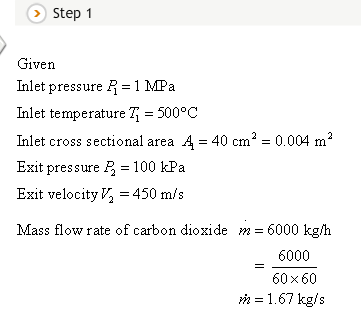
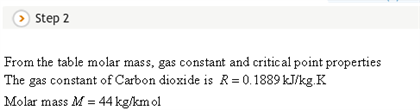
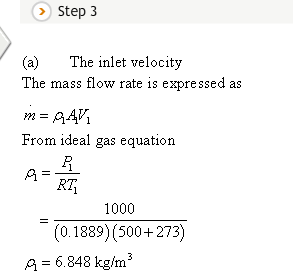
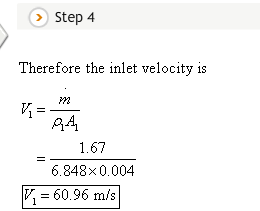
Carbon dioxide enters an adiabatic nozzle steadily at 1 MPa and 500°C with a mass flow...
Homework Answers
Add Answer to:
Carbon dioxide enters an adiabatic nozzle steadily at 1 MPa and 500°C with a mass flow...
1. Water enters the constant 130-mm inside-diameter tubes of a boiler at 7 MPa and 65°C...
 1. Water enters the constant 130-mm inside-diameter tubes of a boiler at 7 MPa and 65°C and leaves the tubes at 6 MPa and 450°C with a velocity of 80 m/s. Calculate the velocity of the water at the tube inlet and the inlet volume flow rate. [5-14] 2. Air enters a nozzle steadily at 50 psia, 140°F, and 150 ft/s and leaves at 14.7 psia and 900 ft/s. The heat loss from the nozzle is estimated to be 6.5...
QUESTION 2 Carbon dioxide enters an adiabatic nozzle steadily at 1 MP, 481 °C, and mass...
 QUESTION 2 Carbon dioxide enters an adiabatic nozzle steadily at 1 MP, 481 °C, and mass flow rate of 6,706 kg/h and exits the system at 110 kPa and 468 m/s. Considering the nozzle having an inlet area of 45 cm, calculate the inlet velocity in m/s (Give your answer with three decimals, and do NOT enter units!!!).
5-30 Air enters an adiabatic nozzle steadily at 300 kPa, 200°C, and 30 m/s and leaves...
 5-30 Air enters an adiabatic nozzle steadily at 300 kPa, 200°C, and 30 m/s and leaves at 100 kPa and 180 m/s. The inlet area of the nozzle is 80 cm². Determine (a) the mass flow rate through the nozzle, (b) the exit temperature of the air, and (c) the exit area of the nozzle. Answers: (a) 0.5304 kg/s, (b) 184.6°C, (c) 38.7 cm P = 300 kPa T, = 200°C Vi = 30 m/s A = 80 cm AIR...
Steam enters an adiabatic nozzle at 400 °C and 800 kPa with a velocity of 16...
 Steam enters an adiabatic nozzle at 400 °C and 800 kPa with a velocity of 16 m/s. It leaves the nozzle at 300 °C and 400 kPa. The inlet area of the nozzle is 800 cm2. Determine; a. The mass flow rate through the nozzle, in kg/s Ans. _kg/s b. The volume flow rate of the steam at the exit, in m3/s Ans._ _m3/s The velocity of the steam at the nozzle exit, in c. m/s Ans. m/s
2.Air enters an adiabatic nozzle in steady flow at 300 kPa, 200 C and 45 m/sec,...
 2.Air enters an adiabatic nozzle in steady flow at 300 kPa, 200 C and 45 m/sec, and leaves at 100 kPa and 180 m/sec. The inlet area of the nozzle is 110 cm 2. Determine: (a) the mass flow rate through the nozzle, and mdot = _ kg/sec (b) the exit temperature T2 = OC
thermodynamics Thermodynamics P5.31: - Steam at 3 MPa and 400°C enters an adiabatic nozle steadily with...
 thermodynamics
Thermodynamics
P5.31: - Steam at 3 MPa and 400°C enters an adiabatic nozle steadily with a velocity of 40 m/s and leaves at 2.5 MPa and 300 m/s. Determine (a) the exit temperature (b) the ratio of the inlet to exit area A1/A2. P5.64:- Refrigerant-134a at 800 kPa and 25°C is throttled to a temperature of 220°C. Determine the pressure and the internal energy of the refrigerant at the final state P1-0.8 MPa
thermodynamics
Thermodynamics
P5.31: - Steam at 3 MPa and 400°C enters an adiabatic nozle steadily with a velocity of 40 m/s and leaves at 2.5 MPa and 300 m/s. Determine (a) the exit temperature (b) the ratio of the inlet to exit area A1/A2. P5.64:- Refrigerant-134a at 800 kPa and 25°C is throttled to a temperature of 220°C. Determine the pressure and the internal energy of the refrigerant at the final state P1-0.8 MPa
Steam enters an adiabatic turbine steadily at 7 MPa, 500 °C, and 45 m/s
Steam enters an adiabatic turbine steadily at 7 MPa, 500 °C, and 45 m/s, and leaves at 100 kPa and 75 m/s. If the power output of the turbine is 5 MW and the isentropic efficiency is 77 percent, determine: A. the mass flow rate of steam through the turbine, B. the temperature at the turbine exit, and C. the rate of entropy generation during this process.
4-1-30 [WX] An adiabatic steam nozzle operates steadily under the following conditions. Inlet: superheated vapor, p1...
 4-1-30 [WX] An adiabatic steam nozzle operates steadily under the following conditions. Inlet: superheated vapor, p1 = 1 MPa, T1 = 300°C, A1 78.54 cm2; Exit: saturated vapor, p2 = 100 kPa. Determine (a) the exit velocity (V2) in m/s, (b) the rate of entropy Solution] [Discuss] generation (Šgen) in kW/K. The mass flow rate (m is 1 kg/s.
Air enters an adiabatic nozzle at 500 kPa and a temperature of 200 °C with a...
Air enters an adiabatic nozzle at 500 kPa and a temperature of 200 °C with a velocity of 100 m/s. It exits the nozzle at a pressure of 100 kPa. Assuming that the expansion through the nozzle occurs reversibly, determine (a) the exit temperature and (b) the exit velocity of the air. The specific heats of air can be assumed to be constant with Cv = 0.742 kJ/kg oC and Cp = 1.029 kJ/kg oC.
Nitrogen gas at 60 kPa and 7°C enters an adiabatic diffuser steadily with a velocity of...
Nitrogen gas at 60 kPa and 7°C enters an adiabatic diffuser steadily with a velocity of 200 m/s and leaves at 85 kPa and 22°C. Determine (a) the exit velocity of the nitrogen and (b) the ratio of the inlet to exit area A1/A2. Why in this question we ignore the value of mass flow rate ?
 1. Water enters the constant 130-mm inside-diameter tubes of a boiler at 7 MPa and 65°C and leaves the tubes at 6 MPa and 450°C with a velocity of 80 m/s. Calculate the velocity of the water at the tube inlet and the inlet volume flow rate. [5-14] 2. Air enters a nozzle steadily at 50 psia, 140°F, and 150 ft/s and leaves at 14.7 psia and 900 ft/s. The heat loss from the nozzle is estimated to be 6.5...
 QUESTION 2 Carbon dioxide enters an adiabatic nozzle steadily at 1 MP, 481 °C, and mass flow rate of 6,706 kg/h and exits the system at 110 kPa and 468 m/s. Considering the nozzle having an inlet area of 45 cm, calculate the inlet velocity in m/s (Give your answer with three decimals, and do NOT enter units!!!).
 5-30 Air enters an adiabatic nozzle steadily at 300 kPa, 200°C, and 30 m/s and leaves at 100 kPa and 180 m/s. The inlet area of the nozzle is 80 cm². Determine (a) the mass flow rate through the nozzle, (b) the exit temperature of the air, and (c) the exit area of the nozzle. Answers: (a) 0.5304 kg/s, (b) 184.6°C, (c) 38.7 cm P = 300 kPa T, = 200°C Vi = 30 m/s A = 80 cm AIR...
 Steam enters an adiabatic nozzle at 400 °C and 800 kPa with a velocity of 16 m/s. It leaves the nozzle at 300 °C and 400 kPa. The inlet area of the nozzle is 800 cm2. Determine; a. The mass flow rate through the nozzle, in kg/s Ans. _kg/s b. The volume flow rate of the steam at the exit, in m3/s Ans._ _m3/s The velocity of the steam at the nozzle exit, in c. m/s Ans. m/s
 2.Air enters an adiabatic nozzle in steady flow at 300 kPa, 200 C and 45 m/sec, and leaves at 100 kPa and 180 m/sec. The inlet area of the nozzle is 110 cm 2. Determine: (a) the mass flow rate through the nozzle, and mdot = _ kg/sec (b) the exit temperature T2 = OC
 thermodynamics
Thermodynamics
P5.31: - Steam at 3 MPa and 400°C enters an adiabatic nozle steadily with a velocity of 40 m/s and leaves at 2.5 MPa and 300 m/s. Determine (a) the exit temperature (b) the ratio of the inlet to exit area A1/A2. P5.64:- Refrigerant-134a at 800 kPa and 25°C is throttled to a temperature of 220°C. Determine the pressure and the internal energy of the refrigerant at the final state P1-0.8 MPa
thermodynamics
Thermodynamics
P5.31: - Steam at 3 MPa and 400°C enters an adiabatic nozle steadily with a velocity of 40 m/s and leaves at 2.5 MPa and 300 m/s. Determine (a) the exit temperature (b) the ratio of the inlet to exit area A1/A2. P5.64:- Refrigerant-134a at 800 kPa and 25°C is throttled to a temperature of 220°C. Determine the pressure and the internal energy of the refrigerant at the final state P1-0.8 MPa
 4-1-30 [WX] An adiabatic steam nozzle operates steadily under the following conditions. Inlet: superheated vapor, p1 = 1 MPa, T1 = 300°C, A1 78.54 cm2; Exit: saturated vapor, p2 = 100 kPa. Determine (a) the exit velocity (V2) in m/s, (b) the rate of entropy Solution] [Discuss] generation (Šgen) in kW/K. The mass flow rate (m is 1 kg/s.
Most questions answered within 3 hours.
-
Where is the error in this code sequence?
String s1 = "Hello";
String s2 = "ello";...
asked 10 months ago -
Financial data for Joel de Paris, Inc., for last year
follow:
Joel de Paris, Inc.
Balance...
asked 10 months ago -
Consider this reaction:
Al2(SO4)3 (aq)+ BaCl3
(aq) Al2Cl6 (aq)- +
3BaSO4(s) . What is the...
asked 10 months ago -
Suppose that Savneet is considering increasing her
recent random sample from 20 car rentals to 40...
asked 10 months ago -
Trucks arrive at an unloading terminal at an average rate of 120
per hour.
Trucks arrive...
asked 10 months ago -
Why are methanol and ethanol completely soluble in water while
octanol is not very little soluble....
asked 10 months ago -
A facilities manager at a university reads in a research report
that the mean amount of...
asked 10 months ago -
When the CuSO4 is rehydrated by adding water to the anhydrous
compound, is this an endothermic...
asked 10 months ago -
A ray of sunlight is passing from diamond into crown glass; the
angle of incidence is...
asked 10 months ago -
A block of mass 0.249 kg is placed on top of a light, vertical
spring of...
asked 10 months ago -
how do the kidneys compensate in the presences of acidosis
a) trigger hyperventilate
b) reserve acid...
asked 10 months ago -
Question 501 pts
The rental rate of capital to the firm increases. Which of the
following...
asked 10 months ago