Rank the following objects according to the amount of momentum they have, from least to greatest....
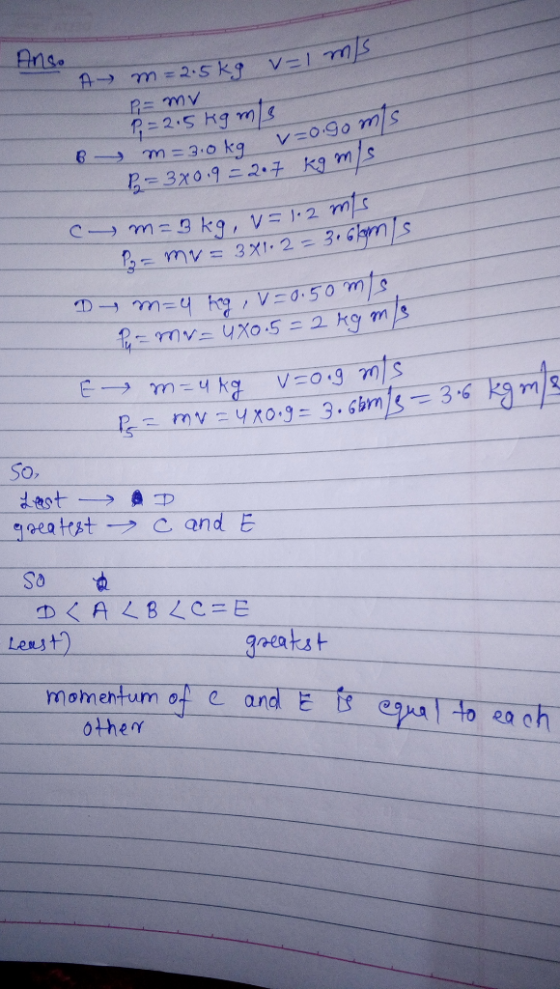
Rank the following objects according to the amount of momentum they have, from least to greatest. Specifically indicate any ties.
Object A: mass 2.5 kg, velocity 1.0 m/s east
Object B: mass 3.0 kg, velocity 0.90 m/s west
Object C: mass 3.0 kg, velocity 1.2 m/s west
Object D: mass 4.0 kg, velocity 0.50 m/s north
Object E: mass 4.0 kg, velocity 0.90 m/s east
Homework Answers
Add Answer to:
Rank the following objects according to the amount of momentum
they have, from least to greatest....
Four objects are projected from a spring gun. Their masses and velocities are given in the...
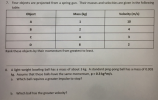 Four objects are projected from a spring gun. Their masses and velocities are given in the following table: 7. Velocity (m/s) 10 4 Object Mass (kg) 2 4 8 2 Rank these objects by their momentum from greatest to least. A light-weight bowling ball has a mass of about 3 kg. A standard ping-pong ball has a mass of 0.003 kg. Assume that these balls have the same momentum, p 0.3 kg*m/s. a. Which ball requires a greater Impulse to...
CONSERVATION OF MOMENTUM IN ONE DIMENSION Mech 49 I. Momentum as a vector The momentum. P....
 CONSERVATION OF MOMENTUM IN ONE DIMENSION Mech 49 I. Momentum as a vector The momentum. P. of an object is defined as the product of its mass and its velocity: P = mü. The momentum of a system of multiple objects is defined as the vector sum of the momenta of the objects in that system: Psystem = P. + P2 + P3 + .... ob a bilno A. Two small boats are in a lake. An observer on the...
Rank the arrangements based on their ability to detect very dim objects, from greatest to least
 Rank the arrangements based on their ability to detect
very dim objects, from greatest to least
s and totall
s and totall
Rank the arrangements based on their ability to detect
very dim objects, from greatest to least
s and totall
s and totall
(a) Rank the following particles in order of their de Broglie wavelength, from longest wavelength to...
(a) Rank the following particles in order of their de Broglie wavelength, from longest wavelength to shortest wavelength. If any two particles have the same de Broglie wavelength, state this. Explain how you made your ranking. (i) A proton (mass 1.67 ´ 10–27 kg) moving north at 1.0 ´ 103 m/s (ii) A proton (mass 1.67 ´ 10–27 kg) moving west at 2.0 ´ 103 m/s (iii) An electron (mass 9.11 ´ 10–31 kg) moving south at 1.0 ´ 103...
Let’s begin by calculating the total momentum of two moving objects. Suppose a small compact car...
 Let’s begin by calculating the total momentum of two moving
objects. Suppose a small compact car with a mass of 1000 kg is
traveling north on Morewood Avenue at a speed of 15 m/sm/s. At the
intersection of Morewood and Fifth Avenues, it collides with a
truck with a mass of 2000 kg that is traveling east on Fifth Avenue
at 10 m/sm/s. Treating each vehicle as a particle, find the total
momentum (magnitude and direction) just before the collision....
Let’s begin by calculating the total momentum of two moving
objects. Suppose a small compact car with a mass of 1000 kg is
traveling north on Morewood Avenue at a speed of 15 m/sm/s. At the
intersection of Morewood and Fifth Avenues, it collides with a
truck with a mass of 2000 kg that is traveling east on Fifth Avenue
at 10 m/sm/s. Treating each vehicle as a particle, find the total
momentum (magnitude and direction) just before the collision....
The masses of four objects and their speeds on circular paths of the indicated radii are...
The masses of four objects and their speeds on circular paths of the indicated radii are shown below. Part A Rank these objects in order of increasing centripetal force. Indicate ties where appropriate. Object A Object B Object C Object D Mass (kg) 60 5 24 2 Speed (m/s) 1 2 2 4 Radius (m) 5 2 8 1 Rank from largest to smallest. To rank items as equivalent, overlap them.
An object (A) of mass m A = 29.0 kg is moving in a direction that...
An object (A) of mass m A = 29.0 kg is moving in a direction that makes angle of 40° north of east with a speed v A = 5.10 m/s, while object (B) of mass m B = 17.5 kg is moving due north with a speed v B = 7.85 m/s. The two objects collide and stick together in a completely inelastic collision. Find the magnitude of the final velocity of the two-object system after the collision. An...
PHYSICS 30 MOMENTUM AND IMPULSE Q9 ASSIGNMENT A. MOMENTUM AND IMPULSE a. C. 1. Use the...
 PHYSICS 30 MOMENTUM AND IMPULSE Q9 ASSIGNMENT A. MOMENTUM AND IMPULSE a. C. 1. Use the concept of Impulse to describe one advantage of seatbelts. 2. A 5.00 kg mass is moving with a velocity of 3.50 m/s. A force of 4.00 N acts on the object increasing its velocity (in the same direction) to 12.5 m/s. Determine Change in momentum b. Impulse the mass experiences Time interval that the force was applied for 3. A 15.0 kg object is...
Let’s begin by calculating the total momentum of two moving objects. Suppose a small compact car...
Let’s begin by calculating the total momentum of two moving objects. Suppose a small compact car with a mass of 1000 kg is traveling north on Morewood Avenue at a speed of 15 m/s. At the intersection of Morewood and Fifth Avenues, it collides with a truck with a mass of 2000 kg that is traveling east on Fifth Avenue at 10 m/s. Treating each vehicle as a particle, find the total momentum (magnitude and direction) just before the collision....
Three objects are placed in water. Cube A (0.5 m on a side) has a mass...
 Three objects are placed in water. Cube A (0.5 m on a side) has a mass of 2.0 kg. Cube B (1.2 m on a side) has a mass of 4.0 kg. Cube C (2.0 m on a side) has a mass of 1.0 kg. Which cubes float? Which cube experiences the greatest buoyant force? Which experiences the least buoyant force? Show your work and/or explain your reasoning. (20 pts, 10 for floating, 10 for buoyant force)
 Four objects are projected from a spring gun. Their masses and velocities are given in the following table: 7. Velocity (m/s) 10 4 Object Mass (kg) 2 4 8 2 Rank these objects by their momentum from greatest to least. A light-weight bowling ball has a mass of about 3 kg. A standard ping-pong ball has a mass of 0.003 kg. Assume that these balls have the same momentum, p 0.3 kg*m/s. a. Which ball requires a greater Impulse to...
 CONSERVATION OF MOMENTUM IN ONE DIMENSION Mech 49 I. Momentum as a vector The momentum. P. of an object is defined as the product of its mass and its velocity: P = mü. The momentum of a system of multiple objects is defined as the vector sum of the momenta of the objects in that system: Psystem = P. + P2 + P3 + .... ob a bilno A. Two small boats are in a lake. An observer on the...
 Rank the arrangements based on their ability to detect
very dim objects, from greatest to least
s and totall
s and totall
Rank the arrangements based on their ability to detect
very dim objects, from greatest to least
s and totall
s and totall
 Let’s begin by calculating the total momentum of two moving
objects. Suppose a small compact car with a mass of 1000 kg is
traveling north on Morewood Avenue at a speed of 15 m/sm/s. At the
intersection of Morewood and Fifth Avenues, it collides with a
truck with a mass of 2000 kg that is traveling east on Fifth Avenue
at 10 m/sm/s. Treating each vehicle as a particle, find the total
momentum (magnitude and direction) just before the collision....
Let’s begin by calculating the total momentum of two moving
objects. Suppose a small compact car with a mass of 1000 kg is
traveling north on Morewood Avenue at a speed of 15 m/sm/s. At the
intersection of Morewood and Fifth Avenues, it collides with a
truck with a mass of 2000 kg that is traveling east on Fifth Avenue
at 10 m/sm/s. Treating each vehicle as a particle, find the total
momentum (magnitude and direction) just before the collision....
 PHYSICS 30 MOMENTUM AND IMPULSE Q9 ASSIGNMENT A. MOMENTUM AND IMPULSE a. C. 1. Use the concept of Impulse to describe one advantage of seatbelts. 2. A 5.00 kg mass is moving with a velocity of 3.50 m/s. A force of 4.00 N acts on the object increasing its velocity (in the same direction) to 12.5 m/s. Determine Change in momentum b. Impulse the mass experiences Time interval that the force was applied for 3. A 15.0 kg object is...
 Three objects are placed in water. Cube A (0.5 m on a side) has a mass of 2.0 kg. Cube B (1.2 m on a side) has a mass of 4.0 kg. Cube C (2.0 m on a side) has a mass of 1.0 kg. Which cubes float? Which cube experiences the greatest buoyant force? Which experiences the least buoyant force? Show your work and/or explain your reasoning. (20 pts, 10 for floating, 10 for buoyant force)
Most questions answered within 3 hours.
-
Where is the error in this code sequence?
String s1 = "Hello";
String s2 = "ello";...
asked 10 months ago -
Financial data for Joel de Paris, Inc., for last year
follow:
Joel de Paris, Inc.
Balance...
asked 10 months ago -
Consider this reaction:
Al2(SO4)3 (aq)+ BaCl3
(aq) Al2Cl6 (aq)- +
3BaSO4(s) . What is the...
asked 10 months ago -
Suppose that Savneet is considering increasing her
recent random sample from 20 car rentals to 40...
asked 10 months ago -
Trucks arrive at an unloading terminal at an average rate of 120
per hour.
Trucks arrive...
asked 10 months ago -
Why are methanol and ethanol completely soluble in water while
octanol is not very little soluble....
asked 10 months ago -
A facilities manager at a university reads in a research report
that the mean amount of...
asked 10 months ago -
When the CuSO4 is rehydrated by adding water to the anhydrous
compound, is this an endothermic...
asked 10 months ago -
A ray of sunlight is passing from diamond into crown glass; the
angle of incidence is...
asked 10 months ago -
A block of mass 0.249 kg is placed on top of a light, vertical
spring of...
asked 10 months ago -
how do the kidneys compensate in the presences of acidosis
a) trigger hyperventilate
b) reserve acid...
asked 10 months ago -
Question 501 pts
The rental rate of capital to the firm increases. Which of the
following...
asked 10 months ago