
Homework Answers
Add Answer to:
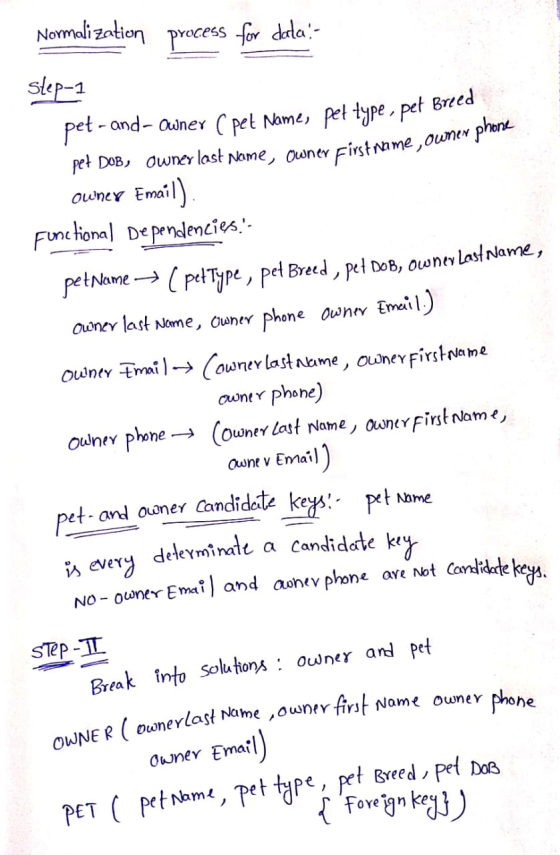
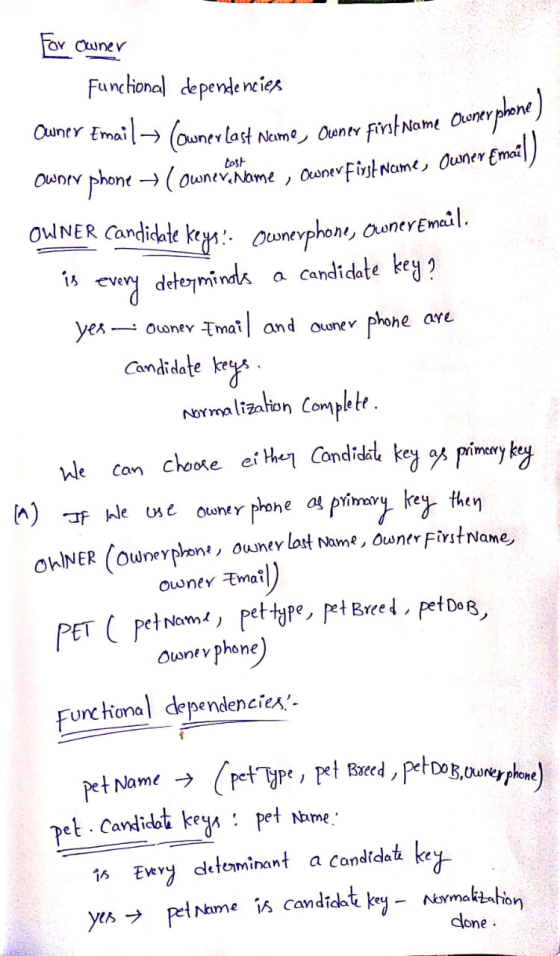
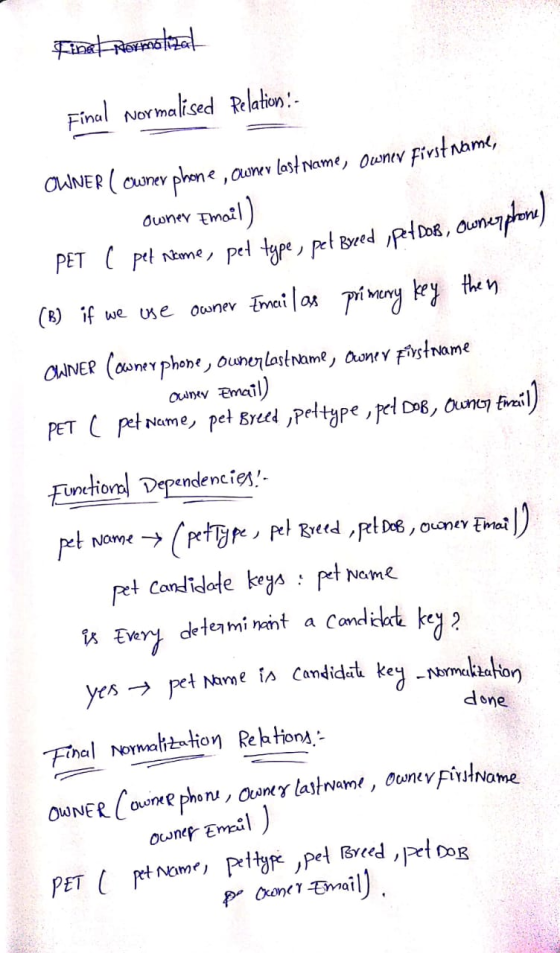
2.1 Apply the normalization process to the Veterinary Office List–Version One relation shown in Figure 1-34...
The figure below shows a list used by a veterinary office. Refer to the list and...
 The figure below shows a list used by a veterinary office. Refer to the list and answer the questions below. 1. G H OwnerEmail Marsha Dow@somewhere.com Richaed James@omewhere.com Marha Downs@somewhere.com Lic Frie@somehere.com Richard James@somewhere.com Richard James@somewhere.com Mies Trent@somewhere.com Hilay Exains@smewhere.com PerD08 27-Feb-12 Downs 1Feb-11 James 17-Jul-13 Downs 5-May-13 Frer 6Jun-10 James Ownerl astName OwnerFirstName Marsha Richard Marsha Liz Richard Richard Miles Hilary OwnerPhone 201-823-5467 201-735-9812 201-823-5467 201-823-6578 201-735-9812 201-735-9812 201-634-7065 210-634-2345 PetType PetName 2 King 3 Teddy 4 Fido 5...
Examine the determinants of the functional dependencies. If any determinant is not a candidate key, the...
 Examine the determinants of the functional dependencies. If any
determinant is not a candidate key, the relation is not well
formed. In this case: a. Place the columns of the functional
dependency in a new relation of their own. b. Make the determinant
of the functional dependency the primary key of the new relation.
c. Leave a copy of the determinant as a foreign key in the original
relation. d. Create a referential integrity constraint between the
original relation and...
Examine the determinants of the functional dependencies. If any
determinant is not a candidate key, the relation is not well
formed. In this case: a. Place the columns of the functional
dependency in a new relation of their own. b. Make the determinant
of the functional dependency the primary key of the new relation.
c. Leave a copy of the determinant as a foreign key in the original
relation. d. Create a referential integrity constraint between the
original relation and...
Sample data for these tables are shown in Figures 3-26 and 3-27. For each SQL statement...
 Sample data for these tables are shown in Figures 3-26 and 3-27. For each SQL statement you write, show the results based on these data. If possible, run the statements you write for the questions that follow in an actual DBMS, as appropriate, to obtain results. Use data types that are consistent with the DBMS you are using. If you are not using an actual DBMS, consistently represent data types by using either the MySQL, Microsoft SQL Server, or Oracle...
 The figure below shows a list used by a veterinary office. Refer to the list and answer the questions below. 1. G H OwnerEmail Marsha Dow@somewhere.com Richaed James@omewhere.com Marha Downs@somewhere.com Lic Frie@somehere.com Richard James@somewhere.com Richard James@somewhere.com Mies Trent@somewhere.com Hilay Exains@smewhere.com PerD08 27-Feb-12 Downs 1Feb-11 James 17-Jul-13 Downs 5-May-13 Frer 6Jun-10 James Ownerl astName OwnerFirstName Marsha Richard Marsha Liz Richard Richard Miles Hilary OwnerPhone 201-823-5467 201-735-9812 201-823-5467 201-823-6578 201-735-9812 201-735-9812 201-634-7065 210-634-2345 PetType PetName 2 King 3 Teddy 4 Fido 5...
 Examine the determinants of the functional dependencies. If any
determinant is not a candidate key, the relation is not well
formed. In this case: a. Place the columns of the functional
dependency in a new relation of their own. b. Make the determinant
of the functional dependency the primary key of the new relation.
c. Leave a copy of the determinant as a foreign key in the original
relation. d. Create a referential integrity constraint between the
original relation and...
Examine the determinants of the functional dependencies. If any
determinant is not a candidate key, the relation is not well
formed. In this case: a. Place the columns of the functional
dependency in a new relation of their own. b. Make the determinant
of the functional dependency the primary key of the new relation.
c. Leave a copy of the determinant as a foreign key in the original
relation. d. Create a referential integrity constraint between the
original relation and...
 Sample data for these tables are shown in Figures 3-26 and 3-27. For each SQL statement you write, show the results based on these data. If possible, run the statements you write for the questions that follow in an actual DBMS, as appropriate, to obtain results. Use data types that are consistent with the DBMS you are using. If you are not using an actual DBMS, consistently represent data types by using either the MySQL, Microsoft SQL Server, or Oracle...
Most questions answered within 3 hours.
-
Where is the error in this code sequence?
String s1 = "Hello";
String s2 = "ello";...
asked 10 months ago -
Financial data for Joel de Paris, Inc., for last year
follow:
Joel de Paris, Inc.
Balance...
asked 10 months ago -
Consider this reaction:
Al2(SO4)3 (aq)+ BaCl3
(aq) Al2Cl6 (aq)- +
3BaSO4(s) . What is the...
asked 10 months ago -
Suppose that Savneet is considering increasing her
recent random sample from 20 car rentals to 40...
asked 10 months ago -
Trucks arrive at an unloading terminal at an average rate of 120
per hour.
Trucks arrive...
asked 10 months ago -
Why are methanol and ethanol completely soluble in water while
octanol is not very little soluble....
asked 10 months ago -
A facilities manager at a university reads in a research report
that the mean amount of...
asked 10 months ago -
When the CuSO4 is rehydrated by adding water to the anhydrous
compound, is this an endothermic...
asked 10 months ago -
A ray of sunlight is passing from diamond into crown glass; the
angle of incidence is...
asked 10 months ago -
A block of mass 0.249 kg is placed on top of a light, vertical
spring of...
asked 10 months ago -
how do the kidneys compensate in the presences of acidosis
a) trigger hyperventilate
b) reserve acid...
asked 10 months ago -
Question 501 pts
The rental rate of capital to the firm increases. Which of the
following...
asked 10 months ago